A 220-unit community in Orange County, California tried to amend their CC&Rs to allow electric vehicle charging stations in parking garages. They needed 67% of all members to approve, not 67% of those who voted, but 67% of the entire 220-unit membership. That meant 148 "yes" votes.
They got 141.
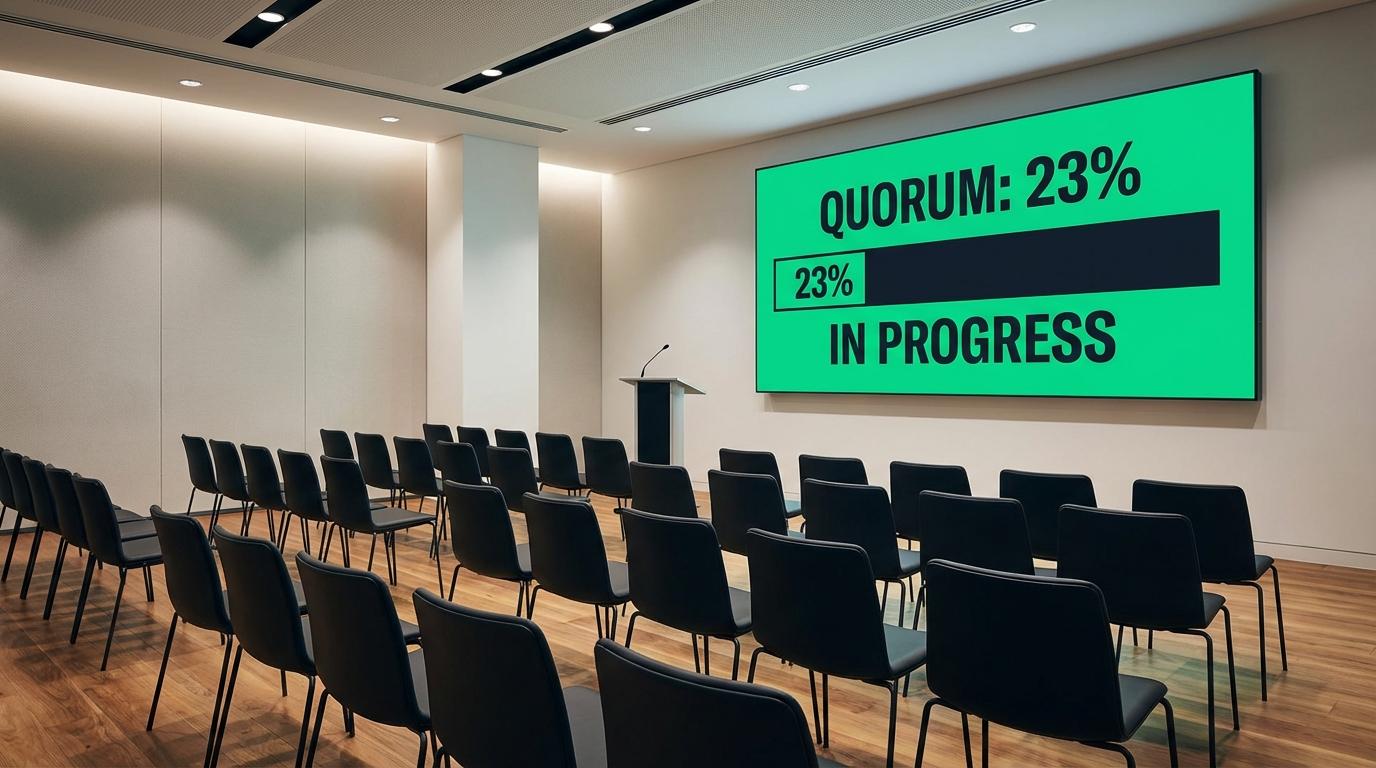
Seven votes short. After four months of planning, three town halls, hundreds of mailings, and $12,000 in legal and administrative costs, the amendment failed. Not because the community opposed it (93% of voters said yes), but because 29% of the membership simply didn't participate.
This is the supermajority problem, and it kills more HOA amendments than opposition ever does. The voting thresholds for amending governing documents are set by state law and by the documents themselves, and they are consistently higher than what most boards expect.
This guide covers every major state's amendment voting requirements, CC&Rs vs. bylaws, who can initiate changes, the thresholds that apply, and how to actually reach them.
This article is for informational purposes only and does not constitute legal advice. HOA amendment requirements vary by state, governing documents, and local regulations. Consult a qualified attorney for advice specific to your community.
CC&Rs vs. Bylaws vs. Rules: The Hierarchy
Before diving into thresholds, it's important to understand what you're actually amending. HOAs have a hierarchy of governing documents, and each type has different amendment procedures:
Declaration of CC&Rs (Covenants, Conditions & Restrictions)
The founding document of the association. Recorded with the county. Controls:
- Property use restrictions (rentals, business use, modifications)
- Assessment authority and limits
- Architectural standards
- Common area rights and responsibilities
- Amendment procedures for the CC&Rs themselves
Amendment difficulty: Highest, typically requires 50% to 75% of ALL members (not just those who vote)
Bylaws
The operational rules of the association. Controls:
- Board structure (number of directors, terms, officers)
- Meeting procedures (notice, quorum, voting)
- Election rules
- Committee authority
- Amendment procedures for the bylaws
Amendment difficulty: Moderate, typically requires a majority of a quorum or a majority of all members
Rules & Regulations (Operating Rules)
Day-to-day policies adopted by the board. Controls:
- Pool hours, guest policies, parking rules
- Architectural review guidelines
- Fine schedules
- Noise and nuisance standards
Amendment difficulty: Lowest, typically the board can adopt or modify rules by board vote, subject to notice and comment requirements. California requires a 28-day notice-and-comment period (Civil Code §4360).
Why This Matters for Voting
The higher you go in the hierarchy, the harder it is to change. Amending CC&Rs in most states requires a supermajority of the entire membership, which is why so many communities are stuck with outdated restrictions that were written decades ago and no longer reflect how people live.
State-by-State Amendment Voting Thresholds
California
Key statutes: Civil Code §4275 (CC&R amendments); Corporations Code §7150 (bylaw amendments)
California's amendment requirements depend on what you're amending and what your documents say:
CC&R Amendments:
- Default threshold: The percentage specified in the CC&Rs themselves (typically 50% to 67% of all members)
- If CC&Rs are silent: A majority of all members (Civil Code §4275)
- Court petition option: If the CC&Rs require more than 50% of all members and the association can only get a "reasonably diligent effort" to reach that threshold, the association can petition Superior Court to reduce the required percentage (Civil Code §4275(c))
- Deletion of discriminatory provisions: Can be done by board resolution without member vote (Civil Code §4225)
Bylaw Amendments:
- Default threshold: A majority of a quorum at a properly noticed member meeting (Corporations Code §7150(a))
- Board authority: The board may adopt, amend, or repeal bylaws UNLESS the articles of incorporation or a bylaw adopted by the members reserves that power exclusively to members
Important 2026 Changes:
- AB 1458 reduced quorum: For board elections only, if quorum is not met at the initial meeting, quorum drops to 20% on the second attempt (Civil Code §5115(d)). This does NOT apply to amendment votes.
- AB 2159 electronic voting: Electronic voting is now authorized for governing document amendments (not just board elections). The same requirements apply: voter authentication, ballot secrecy, permanent identity separation, receipt confirmation, record retention, and device testing.
Recording requirement: Amended CC&Rs must be recorded in the county recorder's office to be enforceable. This is a step many associations skip, and unrecorded amendments are legally unenforceable.
Source: Civil Code §§4225, 4270, 4275; Corporations Code §7150
Florida
Key statute: Florida Statutes §720.306(1)(b)
Florida has a clear statutory default for HOA amendments:
CC&R (Declaration) Amendments:
- Default threshold: Two-thirds (2/3) of all voting interests, unless the governing documents specify a different percentage (§720.306(1)(b))
- Material alterations: Amendments that materially alter or modify appurtenances to a unit require the same 2/3 vote
- Developer veto: During the developer-controlled period, the developer may have a veto right over amendments, even if the membership votes in favor
Bylaw Amendments:
- Default threshold: Per governing documents (Florida statute defers to the bylaws themselves for bylaw amendment procedures)
- If bylaws are silent: A majority of voting interests at a properly noticed meeting
Electronic Voting Updates (2026):
- HOA authorization: Florida HOAs authorize electronic voting under §720.317 via board resolution with a 14-day mailed notice to members
- Condo expansion (HB 1021): For condominiums, HB 1021 simplified electronic consent, a board resolution plus proper notice is now sufficient instead of individual written signatures
- Email ballot option (HB 913, condos only): Condos without formal electronic voting must now accept emailed ballots
- Paper fallback required: Non-consenting members must always have access to a paper ballot option
Recording requirement: All amendments to the declaration must be recorded in the official records of the county where the community is located (§720.306(1)(d)).
Source: Florida Statutes §720.306(1)(b), §720.306(1)(d), §720.317; HB 1021 (2024, condos), HB 913 (2025, condos)
Texas
Key statute: Texas Property Code Chapter 209 (limited statutory guidance)
Texas provides minimal statutory requirements for governing document amendments, leaving most procedures to the governing documents themselves.
CC&R (Dedicatory Instrument) Amendments:
- Default threshold: Per governing documents (Texas has no statutory default percentage)
- Petition right: Property owners representing at least 10% of the lots may petition the board to add new restrictions or modify existing ones (Property Code §209.0041)
- 67% cap (certain amendments): For amendments proposed by the 10% petition method, only 67% of voting interests can be required, the documents cannot impose a higher threshold for this type of amendment
Bylaw Amendments:
- Per governing documents: Texas has no statutory default
Electronic Voting:
- Electronic ballots qualify as written and signed (Property Code §209.0058)
- Absentee voting is mandatory: owners must be allowed to vote by absentee ballot, including electronic methods (§209.00592)
- No assessment-based restrictions: voting rights for amendments cannot be denied based on unpaid assessments
Recording requirement: Amended restrictions must be recorded in the real property records of each county in which any portion of the subdivision is located.
Source: Texas Property Code §209.0041, §209.0058, §209.00592
Nevada
Key statute: NRS 116.2117, NRS 116.31065
Nevada's amendment provisions reflect recent legislative modernization:
CC&R (Declaration) Amendments:
- Default threshold: Per governing documents (unless the declaration requires an unreasonably high threshold)
- Judicial relief: If the declaration requires a supermajority that has proven impossible to achieve, the association can petition the court for relief (NRS 116.2117(4))
- Prohibition on unreasonable thresholds: Nevada courts have shown willingness to reduce amendment thresholds when a community can demonstrate that the required percentage is effectively impossible
Bylaw Amendments:
- Default threshold: A majority of votes cast at a properly noticed meeting where quorum is present
- No quorum for elections: NRS 116.31034 eliminates quorum requirements when secret ballots are counted, but this applies to elections, not necessarily to amendment votes (check your governing documents)
Proxy Rules:
- Proxies PROHIBITED for amendments to governing documents if the vote is conducted by secret ballot (NRS 116.311)
- Electronic voting authorized under NRS 116's general electronic transaction provisions
Source: NRS 116.2117, NRS 116.311, NRS 116.31034, NRS 116.31065
Arizona
Key statute: ARS §33-1227 (condominiums), ARS §33-1817 (planned communities)
CC&R (Declaration) Amendments:
- Default threshold: Per governing documents
- Statutory maximum: ARS §33-1227 provides that declaration amendments require approval by a sufficiently large number of unit owners as specified in the declaration
- Restatement option: ARS §33-1817 allows planned communities to restate their entire declaration with approval of the percentage specified in the declaration (or 2/3 of votes cast if the declaration is silent)
Bylaw Amendments:
- Default threshold: Per governing documents (ARS §33-1824 for condominiums)
Proxy Rules:
- Proxies PROHIBITED after declarant control ends (ARS §33-1812 planned communities, §33-1250 condominiums)
- Electronic voting and absentee ballots serve as the alternative for members who cannot attend amendment vote meetings
Source: ARS §33-1227, §33-1250, §33-1812, §33-1817, §33-1824
Colorado
Key statute: C.R.S. §38-33.3-217 (CCIOA), C.R.S. §7-127-205 (Nonprofit Corporation Act)
CC&R (Declaration) Amendments:
- Default threshold: More than 50% of the votes in the association. A declaration may demand a larger percentage, but 67% is a ceiling, not the default — a provision requiring more is void as contrary to public policy and is read down to 67% (C.R.S. §38-33.3-217(1)(a)(I))
- Board-initiated vs. member-initiated: Both the board and members can propose amendments, but the voting threshold is the same regardless of who initiates
Bylaw Amendments:
- Default threshold: With a quorum present, action other than the election of directors passes when the votes cast in favor exceed the votes cast against — not a majority of all votes entitled to be cast — unless the articles or bylaws require more (C.R.S. §7-127-205(3))
- Board authority: The board may adopt or amend bylaws unless the declaration or bylaws reserve that power to members
Quorum:
- Default: Unless the bylaws provide otherwise, 20% of the votes that may be cast for the executive board — or 10% for an association with over 1,000 unit owners (C.R.S. §38-33.3-309(1))
Electronic Voting:
- Authorized under the Colorado Revised Nonprofit Corporation Act and the Uniform Electronic Records Act
- Opt-out right: Members must be given the opportunity to opt out of electronic voting and vote by alternative means
Recording requirement: Amended declarations must be recorded in the county clerk and recorder's office.
Source: C.R.S. §38-33.3-217(1)(a)(I), §38-33.3-309(1), §7-127-205(3), §7-127-109, §24-71.3-107
This one gets heated
Should community boards be required to use independent election administrators?
Utah (New 2025 Legislation)
Key statute: Utah Code Ann. §57-8a-218 (effective May 7, 2025)
Utah passed significant amendment reform in 2025:
- Voting threshold: Amendments require a majority vote at a properly noticed meeting attended by at least 51% of voting interests
- Cap on supermajority requirements: HOAs cannot require more than 67% of votes to approve an amendment, even if the existing governing documents specify a higher threshold
- Impact: This effectively nullifies any CC&R provision requiring 75% or higher approval, bringing Utah's threshold in line with more modernized states
Source: Utah Code Ann. §57-8a-218 (2025)
State-by-State Amendment Comparison
| Requirement | California | Florida | Texas | Nevada | Arizona | Colorado | Utah |
|---|---|---|---|---|---|---|---|
| CC&R default threshold | Per docs (typically 50-67% of all) | 2/3 of all voting interests | Per docs | Per docs | Per docs | 67% of all votes | Majority at 51% quorum |
| Bylaw default threshold | Majority of quorum | Per docs | Per docs | Majority of quorum | Per docs | Majority of votes cast | Per docs |
| Court reduction available | Yes (Civil Code §4275(c)) | No | No | Yes (NRS 116.2117(4)) | No | No | N/A (capped at 67%) |
| Theshold cap | No statutory cap | No statutory cap | 67% for petition-based | No statutory cap | No statutory cap | No statutory cap | 67% max |
| Electronic voting | Yes (AB 2159) | Yes (§720.317 for HOAs; HB 1021 for condos) | Yes (qualifies as written) | Yes | Yes (absentee) | Yes (Nonprofit Act) | Yes |
| Proxies for amendments | Yes | Yes | Yes | Prohibited (secret ballot) | Prohibited | Yes | Per docs |
| Recording required | Yes (county recorder) | Yes (county records) | Yes (county records) | Yes | Yes | Yes (county clerk) | Yes |
| Board can amend bylaws | Yes (unless reserved) | Per docs | Per docs | Per docs | Per docs | Yes (unless reserved) | Per docs |
The Supermajority Problem and How to Solve It
The single biggest obstacle to amending HOA governing documents isn't opposition. It's non-participation.
Here's the math:
| Community Size | CC&R Threshold (67% of all) | Voter Turnout | Votes Needed | Approval Rate Needed |
|---|---|---|---|---|
| 100 units | 67 yes votes | 80% (80 voters) | 67 | 84% of voters must say yes |
| 100 units | 67 yes votes | 60% (60 voters) | 67 | Impossible (need 67 but only 60 voted) |
| 200 units | 134 yes votes | 70% (140 voters) | 134 | 96% of voters must say yes |
| 500 units | 335 yes votes | 50% (250 voters) | 335 | Impossible (need 335 but only 250 voted) |
When the threshold is based on all members (not just those who vote), every non-vote is effectively a "no" vote. A 200-unit community that needs 67% approval with 70% turnout requires near-unanimous support among those who actually vote, a near-impossible bar.
Three Strategies to Beat the Supermajority Problem
1. Maximize voter turnout: by removing friction
The most effective voter turnout strategy is making voting effortless. A member who has to attend a meeting, find parking, bring their paper ballot, and wait for proceedings is far less likely to participate than one who gets a text with a link and votes in 60 seconds from their couch.
Electronic voting can reduce friction, but it does not consistently guarantee two or three times the turnout. For an amendment requiring approval from 67% of all members, calculate the exact number of yes votes needed and build a neutral outreach plan from the association’s own prior participation.
2. Extend the voting window
Many associations limit amendment votes to a single meeting, which means members who travel, work nights, or simply forget are automatically counted as "no." An extended voting window (14-30 days) with electronic balloting dramatically increases participation.
Vote.Direct's platform supports voting periods of any length. Members receive a notification, vote when convenient, and the association monitors real-time turnout to identify who hasn't voted yet (without seeing how anyone voted).
3. Use California's court petition option
If your CC&Rs require more than 50% and you've made a "reasonably diligent effort" to reach the threshold, California allows the association to petition Superior Court to reduce the required percentage (Civil Code §4275(c)). This is underutilized but powerful: a court can approve an amendment that received overwhelming support but fell just short of an unreasonable threshold.
Nevada offers similar judicial relief under NRS 116.2117(4).
Step-by-Step: How to Run an Amendment Vote
Phase 1: Preparation (60-90 Days Before Vote)
- [ ] Identify what you're amending: CC&Rs, bylaws, or rules (this determines the threshold and procedure)
- [ ] Review existing amendment provisions: your governing documents may specify exact procedures, thresholds, and notice requirements
- [ ] Research state law: confirm the statutory default and any recent legislative changes
- [ ] Engage legal counsel: have the proposed amendment language reviewed for compliance with state law and consistency with other governing documents
- [ ] Draft the amendment: include the exact existing language being modified and the exact replacement language
- [ ] Calculate your threshold: determine the exact number of "yes" votes needed based on community size and applicable threshold
Phase 2: Notice and Education (30-60 Days Before Vote)
- [ ] Send formal notice: include the full text of the proposed amendment, the date of the meeting/vote, voting procedures, and the threshold required for passage
- [ ] Hold a town hall or Q&A session: give members the opportunity to ask questions and voice concerns before voting begins
- [ ] Distribute a comparison document: show the existing language side-by-side with the proposed language so members can easily see what's changing
- [ ] Address concerns proactively: if the amendment is controversial, prepare a FAQ addressing the most common objections
Phase 3: Voting (Election Period)
- [ ] Appoint an inspector of elections (mandatory in California; strongly recommended everywhere)
- [ ] Distribute ballots: electronic and/or paper, depending on your state's requirements and member preferences
- [ ] Monitor participation: track turnout in real time to identify members who haven't voted yet
- [ ] Send reminders: follow up with non-participating members via email, text, and mail (without revealing how anyone has voted)
- [ ] Keep the voting window open long enough: for supermajority amendments, extended voting windows significantly improve turnout
Phase 4: After the Vote
- [ ] Count and certify results: by the inspector of elections or a neutral committee
- [ ] Announce results to all members: include vote totals, the threshold required, and whether the amendment passed or failed
- [ ] If passed: Record the amendment: file the amended document with the county recorder's office (this step is legally required in every major state and is the #1 most commonly skipped step)
- [ ] Retain all election records: ballots, voter rolls, notices, and results for at least 1 year (longer in some states)
- [ ] If failed: Plan next steps: consider whether to re-attempt with higher turnout, pursue court reduction (CA, NV), or adjust the amendment itself
Common Amendments in 2026
These are the most frequently proposed amendments nationwide in 2026:
Electric Vehicle Charging
Allowing or requiring EV charging infrastructure in garages and parking areas. Many CC&Rs written before 2015 either prohibit modifications to parking structures or are silent on electrical installations. Note: Several states (California, Colorado) have enacted right-to-charge legislation that overrides CC&R restrictions, but amending the CC&Rs prevents confusion and litigation.
Solar Panel Installation
Updating architectural restrictions to accommodate rooftop solar panels. Similar to EV charging, many states have enacted solar access laws, but updating CC&Rs clarifies the rules for all parties.
Short-Term Rental Restrictions
Adding or modifying restrictions on platforms like Airbnb and VRBO. This is the most contentious amendment category: communities are divided, and courts in different states have reached different conclusions about existing CC&R language.
Electronic Voting Authorization
Amending bylaws to authorize electronic voting for future elections and votes. In states like California (AB 2159), the statute authorizes electronic voting, but many associations' election rules still need to be updated to implement it. This is often the easiest amendment to pass because it directly improves participation in future votes.
Remote/Virtual Meeting Authorization
Updating bylaws to allow board meetings, member meetings, and voting to occur virtually. Many associations amended their bylaws during COVID-19 under emergency orders, but those emergency provisions have expired. Permanent bylaw changes are now needed.
Age Restriction Changes
Converting between all-ages and 55+ communities (or vice versa). These amendments have significant Fair Housing Act implications and require careful legal guidance.
FAQ
Q: What's the difference between amending CC&Rs and amending bylaws?
CC&Rs are recorded with the county and control property rights (use restrictions, assessments, architectural standards). Bylaws control the association's internal operations (board structure, meetings, elections). CC&Rs almost always require a member vote, typically a supermajority. Bylaws may be amendable by the board in some states, or by a simple majority of a quorum. The threshold for CC&R amendments is consistently higher.
Q: Can the board change the rules without a member vote?
Yes, operating rules (day-to-day policies like pool hours and parking rules) can typically be adopted or modified by board vote. In California, the board must follow a 28-day notice-and-comment process (Civil Code §4360), but member approval is not required. CC&Rs and bylaws always require either a member vote or are governed by specific amendment provisions in the documents themselves.
Q: What if our CC&Rs require 75% approval and we can never reach that threshold?
Two options: (1) In California and Nevada, you can petition the court to reduce the threshold if you can demonstrate a "reasonably diligent effort" to reach it. (2) In Utah (effective May 2025), any threshold above 67% is automatically unenforceable, the cap is 67%. In other states, your primary strategy is maximizing turnout through electronic voting, extended voting windows, and aggressive outreach to non-participating members.
Q: Do we have to record the amendment with the county?
Yes, for CC&R amendments, every major state requires recording with the county recorder or clerk. An unrecorded amendment is legally unenforceable. This is the most commonly skipped step, and it causes real problems when the association tries to enforce the amended provision and a homeowner challenges it.
Q: Can electronic voting be used for amendment votes?
Yes, in every major state covered in this guide. California explicitly authorizes electronic voting for governing document amendments under AB 2159. Florida authorizes it for HOAs under §720.317 and for condos under §718.128 (expanded by HB 1021). Texas recognizes electronic ballots as written and signed. Nevada, Arizona, Colorado, and Utah all authorize electronic voting under their respective statutes or general electronic transaction laws. The key benefit for amendment votes is dramatically higher turnout, which is often the difference between passing and failing when you need a supermajority.
Q: What happens if an amendment passes but isn't recorded?
The amendment may be valid as between the association and its members (as a contractual matter), but it is not enforceable against third parties, including future buyers, lenders, and title companies. If a homeowner sells their unit, the buyer may not be bound by an unrecorded amendment. Always record.
Q: Can a single homeowner block an amendment?
No, but a small group of non-participants can effectively do so if the threshold is based on all members rather than votes cast. This is the supermajority problem described above. The best defense is maximizing turnout so that non-participation doesn't control the outcome.
Q: How long does the amendment process take?
Typically 3-6 months from initial drafting to recording. The timeline includes: legal review (2-4 weeks), notice period (30-60 days depending on state), voting period (1-30 days), and recording (1-2 weeks after passage). Budget 4 months for a straightforward amendment with organized outreach.
The Bottom Line
Amending HOA governing documents is one of the most important votes a community will ever conduct, and it's also the one most likely to fail. Not because members oppose the change, but because supermajority thresholds treat non-participation as opposition.
The associations that consistently pass amendments successfully are the ones that:
- 1Know their exact threshold: not an estimate, the exact number of "yes" votes needed
- 2Maximize turnout: through electronic voting, extended windows, and persistent follow-up
- 3Make voting effortless: a link, a tap, done
- 4Follow up with non-voters: without revealing how anyone has voted
- 5Record the result: filed with the county, properly executed, legally enforceable
Every tool on this list is built into Vote.Direct's platform. From the first ballot notification to the final recorded result, the system is designed to turn 60% turnout into 90% turnout, which is the difference between a failed amendment and a recorded one.
Don't let 30% non-participation override 93% support.
Sources:
- 1California Civil Code §4225: Deletion of discriminatory CC&R provisions
- 2California Civil Code §4270: CC&R amendment procedures
- 3California Civil Code §4275: Amendment thresholds and court petition option
- 4California Civil Code §4275(c): Court authority to reduce amendment threshold
- 5California Civil Code §4360: Operating rule adoption/amendment (28-day notice-and-comment)
- 6California Civil Code §5110(c): Electronic voting authorization (AB 2159)
- 7California Civil Code §5115(d): Reduced quorum for board elections only (AB 1458)
- 8California Corporations Code §7150: Bylaw amendment authority
- 9Florida Statutes §720.306(1)(b): Declaration amendment threshold (2/3 default)
- 10Florida Statutes §720.306(1)(d): Recording requirement
- 11Florida HB 1021 (2024): Electronic voting expansion for condos; HB 913 (2025): Email ballot option for condos
- 12Texas Property Code §209.0041: Member petition right (10%) and 67% cap
- 13Texas Property Code §209.0058: Electronic ballots qualify as written and signed
- 14Texas Property Code §209.00592: Absentee/electronic voting rights
- 15Nevada NRS 116.2117: Declaration amendment and judicial relief
- 16Nevada NRS 116.2117(4): Court authority to reduce amendment threshold
- 17Nevada NRS 116.311: Proxy prohibition for secret ballot votes
- 18Nevada NRS 116.31034: Secret ballot and quorum provisions
- 19Arizona ARS §33-1227: Condominium declaration amendments
- 20Arizona ARS §33-1250: Condominium proxy prohibition
- 21Arizona ARS §33-1812: Planned community proxy prohibition
- 22Arizona ARS §33-1817: Planned community declaration restatement
- 23Arizona ARS §33-1824: Condominium bylaw amendments
- 24Colorado C.R.S. §38-33.3-217: Declaration amendment (67% default)
- 25Colorado C.R.S. §38-33.3-309 (quorum); §38-33.3-310 (secret ballot, counting)
- 26Colorado C.R.S. §7-127-108: Meetings by telecommunication; §7-127-109: Action by written ballot (Nonprofit Corporation Act)
- 27Colorado C.R.S. §24-71.3-107: Uniform Electronic Records Act
- 28Utah Code Ann. §57-8a-218 (2025): Amendment threshold reform and 67% cap
This article is general information, not legal advice. We recommend you do your own research and confirm anything you plan to act on. Where this article states law, the section is cited so you can read the primary source yourself rather than take our word for it — that is what the citations are for. Election requirements also turn on your own governing documents, which we have not seen, and statutes are amended. For advice about your community, consult a qualified attorney licensed in your state.
We work hard to verify every citation against the primary source, but laws change and errors happen. If you spot an inaccuracy, email [email protected] and we will correct it. See our editorial standards for how these pages are researched and checked.
How does your organization currently handle votes?
Compare your approach with other community leaders.
Related Resources
Free: HOA Election Checklist
A step-by-step, 7-phase checklist covering notice requirements, quorum rules, ballot secrecy, and audit trail documentation. Includes state-specific notes for FL, CA, TX, CO, VA.
No spam. Unsubscribe anytime.