Every Church Votes. Very Few Do It Well.
Whether your congregation has 50 members or 5,000, voting is a fundamental part of church life. Congregations vote to call pastors, approve budgets, elect board members, amend bylaws, purchase property, and make decisions that affect the spiritual and financial direction of the church.
Yet most churches conduct votes the same way they did a century ago, a show of hands at a poorly attended business meeting, with no clear rules about who can vote, what constitutes a quorum, or how to handle a close result. The outcome? Decisions that feel rushed, exclusive, or illegitimate, exactly the opposite of what a faith community needs.
This guide covers everything you need to run a church vote that is procedurally sound, inclusive, and trusted by your congregation, regardless of denomination, size, or governance structure.
This article is for informational purposes only and does not constitute legal or ecclesiastical advice. Church governance requirements vary by denomination, state law, and governing documents. Consult your denominational leadership and legal counsel for advice specific to your congregation.
Understanding Church Governance Models
Before planning a vote, understand your church's governance structure, it determines who can vote, on what, and how.
The Three Models
| Model | Who Governs | Who Votes | Common Denominations |
|---|---|---|---|
| Congregational | The congregation | All members | Baptist, Congregationalist, many nondenominational |
| Presbyterian | Elected elders/session | Elders on most matters; congregation on some | Presbyterian, Reformed |
| Episcopal | Appointed bishops | Limited congregational voting | Catholic, Episcopal, Methodist, Lutheran |
What Each Model Votes On
| Decision | Congregational | Presbyterian | Episcopal |
|---|---|---|---|
| Calling/dismissing a pastor | Congregation votes | Session recommends; congregation may vote | Bishop appoints |
| Annual budget | Congregation votes | Session approves; congregation may ratify | Vestry/council approves |
| Board/elder elections | Congregation votes | Congregation votes for elders/deacons | Vestry election by congregation |
| Property purchase/sale | Congregation votes | Session with presbytery approval | Diocese approval required |
| Bylaw amendments | Congregation votes | Session with congregation consent | Varies |
Robert's Rules of Order: The Foundation
Most Protestant churches use Robert's Rules of Order (RONR) as their parliamentary authority, either explicitly (stated in bylaws) or implicitly. Here's what Robert's Rules require for a valid vote:
The Basic Voting Process
- 1A motion is made: "I move that we approve the 2026 budget as presented"
- 2The motion is seconded: Another member says "Second"
- 3Discussion: The chair opens the floor for debate
- 4The vote is called: The chair says "All in favor say 'aye'; all opposed say 'no'"
- 5The chair announces the result: "The motion carries" or "The motion fails"
Voting Methods Under Robert's Rules
| Method | When to Use | Accuracy | Privacy |
|---|---|---|---|
| Voice vote (viva voce) | Routine matters, clear majorities | Low | None |
| Show of hands | When voice vote is unclear | Moderate | None |
| Rising vote (standing) | When hand count is needed | Moderate | None |
| Ballot | Elections, controversial issues, bylaws | High | Full |
| Roll call | When individual votes must be recorded | High | None (votes are public) |
When a Ballot Vote Is Required
Robert's Rules requires a ballot vote in two situations:
- 1When the bylaws require it (most common for elections and major decisions)
- 2When the assembly orders it by majority vote
Best practice: Use ballot voting for any contested election, pastoral call, property decision, or controversial matter. Secret ballots protect relationships in faith communities where people must continue worshiping together regardless of how they voted.
Quorum: The #1 Mistake Churches Make
What Is Quorum?
Quorum is the minimum number of members who must be present for the congregation to conduct official business. Without quorum, any vote taken is invalid.
Common Quorum Standards
| Church Size | Typical Quorum | Notes |
|---|---|---|
| Under 100 members | 25–50% | Easier to achieve, but may need higher threshold for legitimacy |
| 100–500 members | 10–25% | Must actively work to achieve quorum |
| 500–1,000 members | 10–15% | Multiple services make attendance-based quorum challenging |
| Over 1,000 members | 5–10% | Consider extended voting windows |
Robert's Rules Default
If your bylaws don't specify a quorum, Robert's Rules defaults to a majority of the entire membership. For a 300-member church, that means 151 people must attend the meeting, which is virtually impossible for most congregations.
This is why your bylaws must specify a reasonable quorum. A church that has never defined its quorum may discover that none of its previous votes were valid.
Strategies to Meet Quorum
- 1Schedule business meetings after regular worship: Members are already present
- 2Provide advance notice: Give 2–4 weeks' notice for important votes
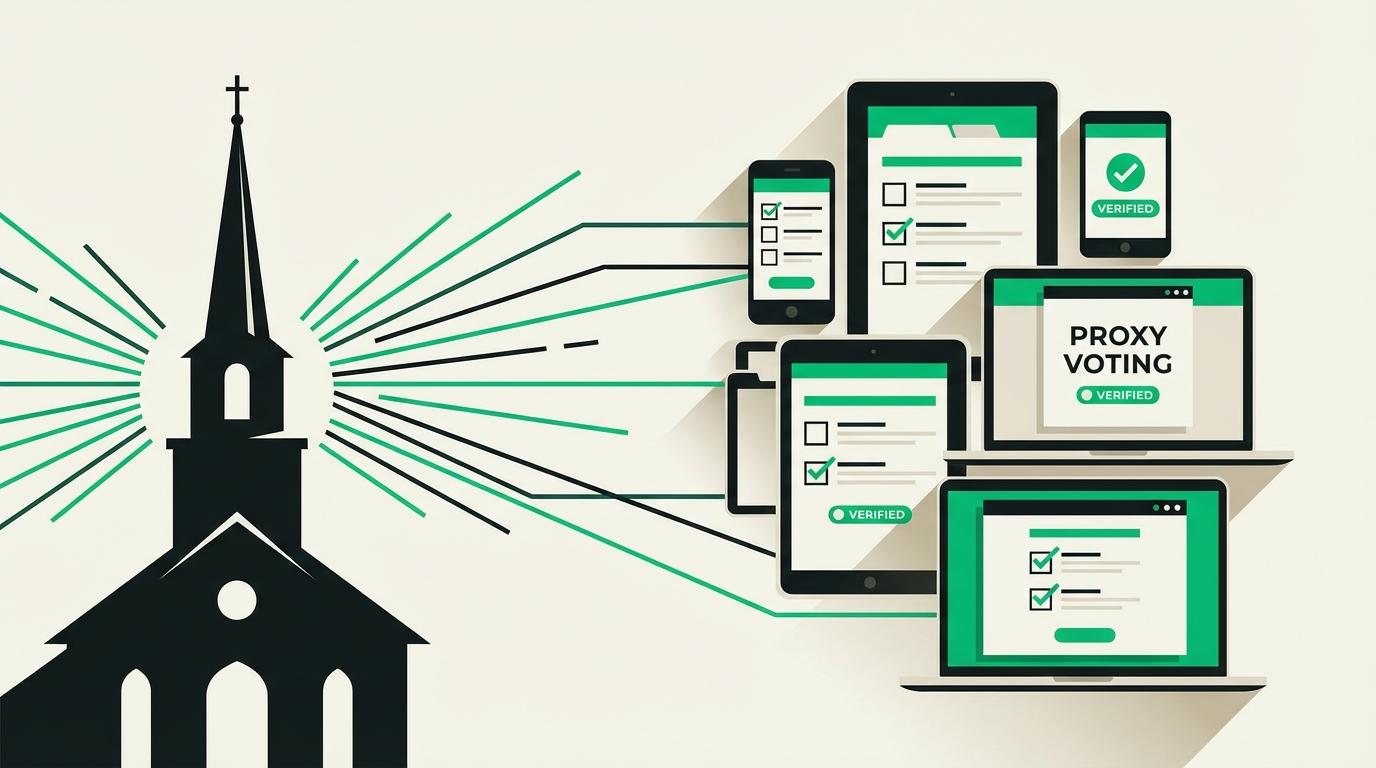
- 3Allow absentee/proxy voting (if bylaws permit), let members who can't attend still participate
- 4Use digital voting: Extended voting windows dramatically increase participation
- 5Hold votes on high-attendance Sundays: Easter, Christmas Eve, or annual meeting Sunday
Step-by-Step: Running a Church Vote
Step 1: Verify Authority
Before calling a vote, confirm:
- Your bylaws authorize a vote on this matter
- The proper body is calling the vote (pastor, board, or petition by members)
- Any denominational requirements have been met (presbytery approval, bishop consent, etc.)
Step 2: Give Proper Notice
Most church bylaws require written notice a specific number of days before a congregational meeting. Common requirements:
| Denomination | Typical Notice | Method |
|---|---|---|
| Southern Baptist Convention | 7–14 days | Announced from pulpit + bulletin |
| Presbyterian (PCUSA) | 10 days | Written notice to all members |
| United Methodist | 10 days | Announced at worship services |
| Assemblies of God | 2 weeks | Written notice posted |
| Nondenominational | Per bylaws (commonly 14–30 days) | Varies |
Best practice: Regardless of minimums, provide at least two Sundays of verbal announcements plus written notice via email and mail to all voting-eligible members. Include the specific item(s) to be voted on, not just "business meeting."
Step 3: Determine Voter Eligibility
Define clearly who can vote. Common criteria:
- Membership status: Active members in good standing
- Age requirement: Some churches set 16 or 18 as minimum voting age
- Attendance: Some bylaws require regular attendance (e.g., attended within past 6 months)
- Financial support: Some churches require members to be current on tithes/pledges (controversial)
Prepare a voter roll before the meeting and have a process for checking eligibility at the door or online.
Honest question
Would you trust an online vote to decide your community's annual budget?
Step 4: Conduct the Meeting
Follow your parliamentary authority (usually Robert's Rules):
- 1Call to order: The moderator (usually the pastor or board chair) opens the meeting
- 2Establish quorum: Count or verify that quorum is met before proceeding
- 3Present the motion: Read the exact wording of the proposal
- 4Allow discussion: Give members a fair opportunity to speak for and against
- 5Call the question: When discussion is complete, call for the vote
- 6Take the vote: Using the appropriate method (ballot for important matters)
- 7Announce the result: State the vote count and whether the motion passed or failed
- 8Record in minutes: The church secretary records the vote in official minutes
Step 5: Handle Special Situations
Pastoral calls: Most Baptist and congregational churches require a supermajority (typically 75–80%) to call a pastor. Some require unanimous consent or near-unanimous (90%+). This is the most consequential vote a church can take, use secret ballot.
Property decisions: Many states require congregational approval for property sales or mortgages by religious corporations. Check your state's religious corporation statute.
Bylaws amendments: Robert's Rules requires previous notice (typically one meeting in advance) and a 2/3 supermajority to amend bylaws.
Why Digital Voting Works for Churches
The Attendance Problem
The fundamental challenge of church voting is attendance. Most churches have one primary worship service per week, and even the most engaged members don't attend every Sunday. A business meeting scheduled after worship may capture 40–60% of active members, and far fewer in a multi-site or multi-service church.
How Digital Voting Solves It
| Traditional Meeting | Digital Voting |
|---|---|
| One time slot, one location | Vote anytime during a 7–14 day window |
| Excludes snowbirds, travelers, shift workers | Every member can participate from anywhere |
| Measure attendance against the last comparable meeting | Measure digital participation against the same eligible-member denominator |
| Show of hands creates social pressure | Anonymous ballot protects relationships |
| Manual counting, potential errors | Automatic tabulation, instant results |
Common Objection: "We've Always Done It at a Meeting"
Many church leaders worry that digital voting feels impersonal or undermines community. But consider:
- Homebound members can participate: Elderly or disabled members who can't attend meetings can finally have a voice
- Working members are included: Members who work Sunday mornings or evenings are no longer disenfranchised
- Military families and college students: Members temporarily away from the area can still participate
- Introverts feel safer: Not everyone is comfortable voting publicly in front of their faith community
At vote.direct, a church can use Anonymous mode to keep the voter-to-choice link out of organizer views and exports (the underlying link stays in restricted platform storage so members can change a ballot and proxies work) or Sealed ballot mode, which stores the ballot with no link to the voter at all, plus an optional assisted government-ID check. The church still decides membership eligibility and supplies the roster.
Denomination-Specific Guidelines
Baptist Churches
Baptist polity is fully congregational, the local church is autonomous, and every member has an equal vote. Key requirements:
- Every member in good standing can vote
- Pastoral calls typically require 75–80%+ supermajority
- Business meetings should be announced at least one week in advance
- No denominational body can override the local church's decision
Presbyterian Churches (PCUSA)
Presbyterian polity uses a representative model (session of elders), but the congregation votes on specific matters:
- Elder/deacon elections: Congregation nominates and elects
- Pastoral calls: Congregation must concur
- Property matters: Require presbytery permission
- The Book of Order governs meeting procedures
United Methodist Churches
Methodist governance is connectional, the congregation has limited voting authority:
- Church conference votes on certain matters (officers, property)
- The district superintendent must approve pastoral changes
- The Book of Discipline governs procedures
Nondenominational Churches
Without a denominational authority, nondenominational churches rely entirely on their articles of incorporation and bylaws. This makes well-drafted bylaws critically important:
- Define voting membership clearly
- Specify quorum requirements
- Outline the process for pastoral calls, budget approval, and property decisions
- Establish the parliamentary authority (usually Robert's Rules)
- Include a conflict resolution process
Frequently Asked Questions
Q: Can a church vote be conducted by email?
Email voting is risky for the same reasons it's risky in any organizational election: no voter verification, no ballot secrecy, and a weak audit trail. If your bylaws authorize electronic voting, use a platform that provides identity verification and anonymous ballots, not forwarded emails.
Q: Do churches need to follow Robert's Rules?
Only if your bylaws designate Robert's Rules as the parliamentary authority (most do). If your bylaws are silent on parliamentary procedure, Robert's Rules applies by default in many states. Even if not legally required, following Robert's Rules provides a fair, structured process that protects minority opinions.
Q: Can members vote by proxy?
Only if your bylaws explicitly authorize proxy voting. Robert's Rules does not permit proxy voting by default. Many churches specifically prohibit proxies to ensure that only informed, present members influence decisions.
Q: What if a church vote is split 50/50?
Under Robert's Rules, a tie vote means the motion fails (a majority of those voting must favor the motion for it to pass). For sensitive matters, consider whether a 50/50 split indicates the church needs more discussion before voting.
Q: Are church votes legally binding?
Yes, when conducted according to the church's governing documents and applicable state law. Churches incorporated as religious nonprofits are bound by their articles of incorporation and bylaws, just like any other corporation.
The Bottom Line
A church vote is more than a parliamentary exercise, it's an expression of corporate discernment. When the process is fair, transparent, and inclusive, the congregation can trust the outcome and move forward together, even when they disagree.
The churches that handle voting well don't wing it. They follow their bylaws, use their parliamentary authority, achieve quorum, and create a record that proves the decision was legitimate. And increasingly, they use tools that let every member participate, not just those who can make it to a Tuesday evening meeting.
Your congregation deserves a voting process worthy of the decisions you're making.
Sources:
- 1Robert, Henry M.: "Robert's Rules of Order Newly Revised" (12th Edition, 2020)
- 2Southern Baptist Convention: Church governance resources and model bylaws
- 3Presbyterian Church (U.S.A.): Book of Order, governance provisions
- 4United Methodist Church: Book of Discipline, conference and voting procedures
- 5National Association of Church Business Administration: Best practices for church governance
- 6State religious corporation statutes (varies by state)
This article is general information, not legal advice. We recommend you do your own research and confirm anything you plan to act on. Where this article states law, the section is cited so you can read the primary source yourself rather than take our word for it. That is what the citations are for. Election requirements also turn on your own governing documents, which we have not seen, and statutes are amended. For advice about your community, consult a qualified attorney licensed in your state.
We work hard to verify every citation against the primary source, but laws change and errors happen. If you spot an inaccuracy, email support@vote.direct and we will correct it. See our editorial standards for how these pages are researched and checked.