Quick Answer
In Baptist polity the congregation is the deciding body. Elders, deacons, pastors, and committees may lead, recommend, and administer, but on the matters the church has reserved to itself, the members vote and the vote settles it. That is what congregational government means, and it is the reason procedure matters more in a Baptist church than in traditions where a bishop or presbytery decides.
Four things are almost always true, and one thing is almost never true.
Almost always:
- 1Only members vote. Regular attenders, visitors, and children of members who have not themselves joined are typically not eligible.
- 2The congregation itself calls its pastor. A search committee recommends; the church calls.
- 3Major matters require a properly called meeting with notice — usually announced from the pulpit and in writing, on a schedule your constitution and bylaws set.
- 4The bylaws control. Baptist churches are autonomous. There is no denominational rulebook that overrides your own documents.
Almost never: that a national or state convention can decide any of this for you. Associations and conventions are voluntary and cooperative. They do not govern the local church.
This article describes common Baptist practice. It is general information, not legal or denominational advice, and it does not override your church's constitution and bylaws. Where this article and your bylaws disagree, your bylaws win.
Why Procedure Carries So Much Weight Here
In a congregational church, procedure is not bureaucracy. It is the mechanism by which the congregation's authority is actually exercised rather than merely asserted.
A church that decides a hard question in a meeting nobody knew about, on a motion nobody could read in advance, with a count nobody wrote down, has not exercised congregational government. It has produced a decision that the people who lost will reasonably describe as having been done to them. Church splits far more often trace to how something was decided than to what was decided.
The procedures below exist to make the outcome believable to the people who voted against it. That is their whole purpose.
Who Is a Voting Member
This is the question that causes the most trouble, and it is answered by your church's bylaws rather than by general practice. Most Baptist bylaws set some combination of:
- Membership received by the congregation — by profession of faith and baptism, by letter or transfer, or by statement of faith, in each case voted or affirmed by the church.
- A minimum age, often 16 or 18, sometimes tied to baptism rather than age.
- Good standing, defined by your documents. Some churches require attendance or giving within a stated period; many do not define it at all, which becomes a problem exactly once.
- Presence at the meeting. This is the significant one. Historically most Baptist churches vote in person at a business meeting, and absent members simply do not vote.
The practical failure: many churches have a membership roll listing hundreds of people, a third of whom moved away years ago. The roll matters because quorum and percentage thresholds are calculated from it. A church whose bylaws require a two-thirds majority of the membership, rather than of those present and voting, may be mathematically unable to pass anything until the roll is cleaned up. Reviewing the roll is not a spiritual judgment on anyone. It is arithmetic hygiene, and it should be done well before a contested vote, not during one.
What Requires a Congregational Vote
This varies, but a typical Baptist constitution reserves the following to the church:
| Matter | Typical threshold |
|---|---|
| Calling or dismissing a pastor | Supermajority, often 2/3 or 3/4 of those present and voting |
| Receiving and dismissing members | Simple majority, often by affirmation |
| Electing deacons | Simple majority or supermajority, by ballot |
| Electing trustees and officers | Simple majority |
| Adopting the annual budget | Simple majority |
| Buying, selling, or mortgaging property | Supermajority, and often required by state law and the deed |
| Amending the constitution or bylaws | Supermajority, usually with prior written notice |
| Affiliating or disaffiliating with an association or convention | Supermajority, often with two readings |
Day-to-day spending inside an adopted budget, staff hiring below the pastoral level, and ministry scheduling are usually delegated. If your documents are silent on something, the safe reading in congregational polity is that the church retains it.
Deacons and trustees are not the same office
Search traffic suggests this confuses a lot of people, so plainly: in most Baptist churches deacons hold a spiritual and servant office, with qualifications drawn from 1 Timothy 3 and Acts 6, elected by the congregation. Trustees hold a legal office — they sign deeds, hold property, and represent the corporation in civil matters, and in many states their existence and election are required by the statute the church incorporated under. Some churches combine the roles; many do not. Check your articles of incorporation, not just your bylaws, before assuming.
Is the pastor a voting member?
Usually yes, because the pastor is normally a member of the church, and members vote. Many churches nonetheless have a settled custom that the pastor does not vote on matters concerning their own salary, tenure, or family, and some bylaws require abstention. Where the bylaws are silent, abstaining on your own compensation is the practice that ages best.
Calling a Pastor: The Vote Most Churches Get Wrong
This is the highest-stakes congregational vote a Baptist church takes, and the sequence is fairly standard.
Step 1: The church elects a search committee
Elected by the congregation, not appointed by the outgoing pastor or the deacons alone. The committee's authority is to search and recommend, and it should be told in writing what it may and may not commit to.
Step 2: The committee brings one candidate
Baptist practice overwhelmingly favours presenting a single candidate rather than a slate. Presenting two candidates turns a call into a contest and leaves the person who arrives having beaten someone the congregation may have preferred.
Step 3: The candidate preaches in view of a call
The congregation hears the candidate, usually on a Sunday announced well in advance, and there is a real opportunity to ask questions.
Honest question
Would you trust an online vote to decide your community's annual budget?
Step 4: The vote is taken at a called meeting, by ballot
Notice requirements come from your bylaws and are typically read from the pulpit on two consecutive Sundays and posted in writing. The vote is normally by secret written ballot rather than a show of hands — this is not modern squeamishness, it is long practice, and it exists so that members can vote honestly without their neighbours watching.
Step 5: The result is announced as a number
This is where churches most often stumble. A pastor called on a "strong majority" that turns out to have been 68 percent begins ministry with a third of the church knowing it and the pastor not. Announce the actual count. Many churches have a bylaw or custom that a candidate receiving less than a stated percentage will not be extended a call even if the threshold was technically met, precisely to avoid starting a ministry on a divided church.
Notice, Quorum, and the Motion
Notice. Nearly every Baptist constitution requires advance notice of a called business meeting, and specifies how it is given. Pulpit announcement on one or two Sundays plus written notice is typical. Notice defects are the single most common reason a church decision gets reopened, and they are entirely avoidable.
Quorum. Many Baptist bylaws set a low quorum, or none at all. If yours sets none, the members present are the meeting, which is workable in a congregation with a habit of attending and dangerous in one without. Our quorum guide covers how thresholds are normally calculated, and the quorum calculator will do the arithmetic against your own roll.
The motion. Business meetings in Baptist churches generally follow Robert's Rules of Order where the bylaws do not say otherwise, though usually in a relaxed form. What matters is that the exact wording being voted on is stated before the vote and recorded after it. "We voted to move forward with the building" is not a record. The motion as adopted, the count, and the date are.
How the Count Is Taken
Baptist churches use, in rough order of formality:
Voice vote or show of hands. Fine for uncontested and routine business. Poor for anything close, because nobody can verify it and the moderator's judgment becomes the result.
Standing count. Better, and still awkward in a divided room.
Written secret ballot. The norm for calling a pastor, electing deacons, and anything contested. Tellers are appointed, ballots are counted, the number is reported, and the ballots are usually retained for a stated period before being destroyed.
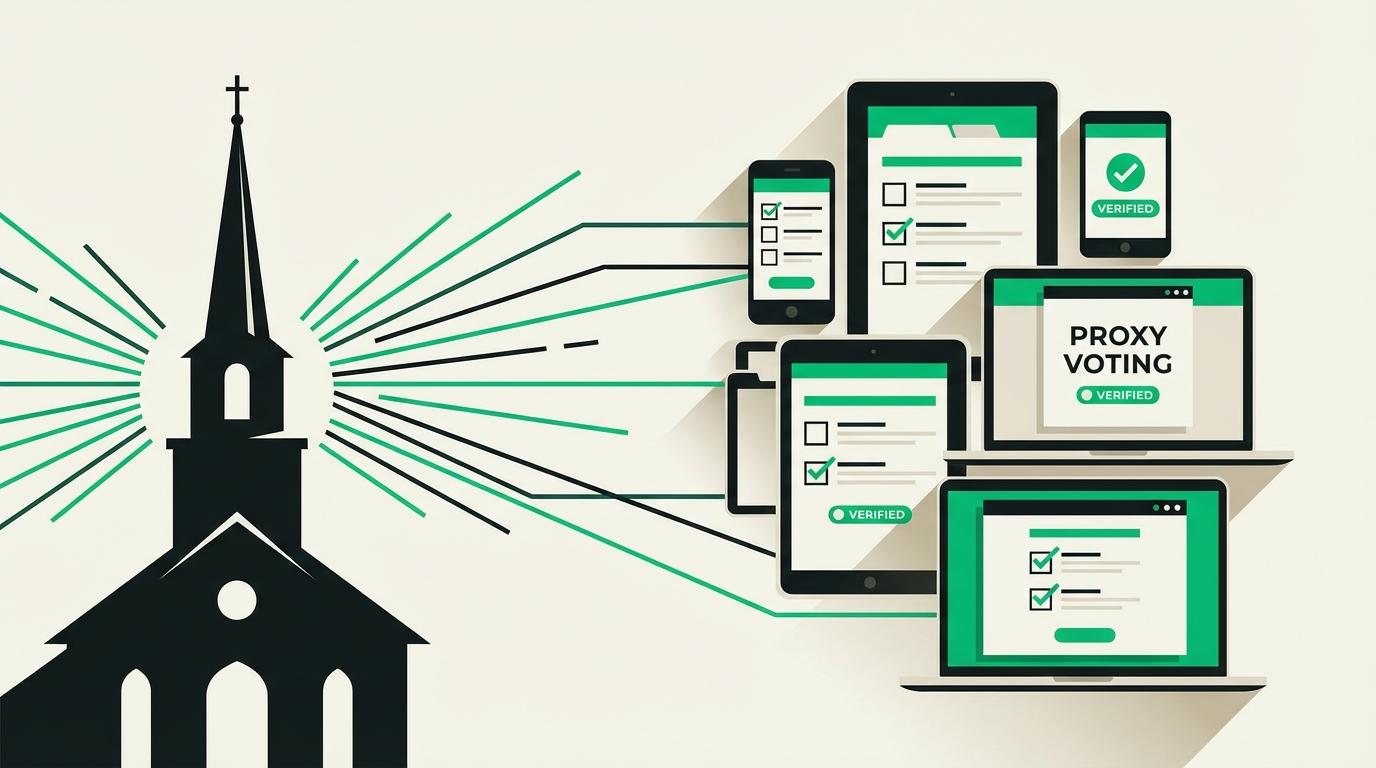
Absentee and electronic ballots. Here practice genuinely varies, and your bylaws may not contemplate it at all. Many Baptist churches historically required presence, on the theology that the gathered congregation acts as a body. Others have amended their documents to allow members who are homebound, deployed, or travelling to participate. If your bylaws do not authorize voting by anyone not present, adding it requires a bylaw amendment first — not an announcement that this year we are trying something new.
Running a Church Vote Online
Churches that have amended their documents to allow it use online ballots for the same reasons everyone else does: homebound and elderly members, members who work Sundays, college students, military families, and a count that does not depend on volunteers tallying paper at nine on a Sunday night.
What matters when you do:
- The roll is the roster. Only members vote, so the eligible list has to be your membership roll, reviewed and fixed before the ballot opens.
- Secrecy has to be real. If the congregation has always voted by secret ballot for a pastoral call, an online ballot that lets the church administrator see individual choices is a downgrade dressed up as an upgrade.
- The record goes in the minutes. The count, the date, and the motion as adopted, attached to the church minutes the way the paper tally was.
- Do not lose the meeting. The strongest argument against online-only voting in congregational polity is a good one: the meeting is where members hear each other, and a ballot emailed to people who never gathered is not congregational deliberation. Most churches that do this well hold the meeting and open the ballot to those who genuinely cannot attend.
We wrote more on the mechanics in how to hold a church vote and on officer elections in the church board election process.
FAQ
Q: Who can vote in a Baptist church business meeting?
Members in good standing, as defined by that church's constitution and bylaws. Baptist churches are autonomous, so eligibility, minimum age, and any good-standing requirement are set locally rather than by a denomination.
Q: What vote is required to call a pastor in a Baptist church?
Most Baptist bylaws require a supermajority of members present and voting, commonly two-thirds or three-fourths, taken by secret ballot at a called meeting with advance notice. Check your own bylaws, as the threshold and the notice period vary.
Q: Can a Baptist church vote without a business meeting?
Generally no. Congregational polity locates the decision in the gathered church, and most bylaws require a properly called meeting with notice. Some churches have amended their documents to allow absentee or electronic ballots, but that requires an amendment rather than a practice change.
Q: How much notice is required for a church business meeting?
Whatever your constitution and bylaws specify, commonly announcement from the pulpit on one or two consecutive Sundays plus written notice. Notice defects are the most common reason a church decision is later reopened.
Q: Are deacons and trustees the same thing?
Usually not. Deacons hold a spiritual and servant office elected by the congregation. Trustees hold a legal office that signs deeds and represents the corporation, and in many states their election is required by the statute the church incorporated under. Some churches combine them.
Q: Does the pastor vote?
In most Baptist churches the pastor is a member and therefore may vote. Many churches have a custom or bylaw of abstaining on matters concerning their own salary, tenure, or family.
Q: Can church members vote online or by absentee ballot?
Only if your governing documents allow it. Many Baptist bylaws assume voting in person. Churches that want remote participation normally amend the bylaws first, then run the ballot.
Q: What if our membership roll is out of date?
Clean it up before a significant vote, not during one. Quorum and percentage thresholds are usually calculated from the roll, so an inflated roll can make a required supermajority arithmetically unreachable.
The Bottom Line
Baptist procedure is not complicated, but it is specific, and it is yours. Read your own constitution and bylaws before the meeting rather than during it, give the notice they require, state the motion in the words being voted on, take a secret ballot on anything that matters, and announce the real number.
Do that and even the people who lose the vote will be able to say the church decided. That is the whole point of congregational government.
If your bylaws allow members who cannot attend to participate, vote.direct will send each member on your roll a private ballot link, count each ballot once, and give you a tally with a timestamp to attach to the minutes. Church votes start at $4.99 and cover up to 50 members.
Working through a pastoral call or a bylaw amendment and not sure your documents allow what you are planning? Call or text (512) 222-8191, or email [email protected] with the clause. We will read it with you.
This article is general information, not legal advice. We recommend you do your own research and confirm anything you plan to act on. Where this article states law, the section is cited so you can read the primary source yourself rather than take our word for it — that is what the citations are for. Election requirements also turn on your own governing documents, which we have not seen, and statutes are amended. For advice about your community, consult a qualified attorney licensed in your state.
We work hard to verify every citation against the primary source, but laws change and errors happen. If you spot an inaccuracy, email [email protected] and we will correct it. See our editorial standards for how these pages are researched and checked.