The Petition That Looked Like a Mandate, Until Someone Checked
A 300-unit HOA in South Florida collected 187 signatures on a paper petition to recall three board members. The signatures represented 62% of the community, above the majority of total voting interests a Florida HOA recall requires (§720.303(10)). The homeowners celebrated. The board panicked.
Then the board's attorney reviewed the petition.
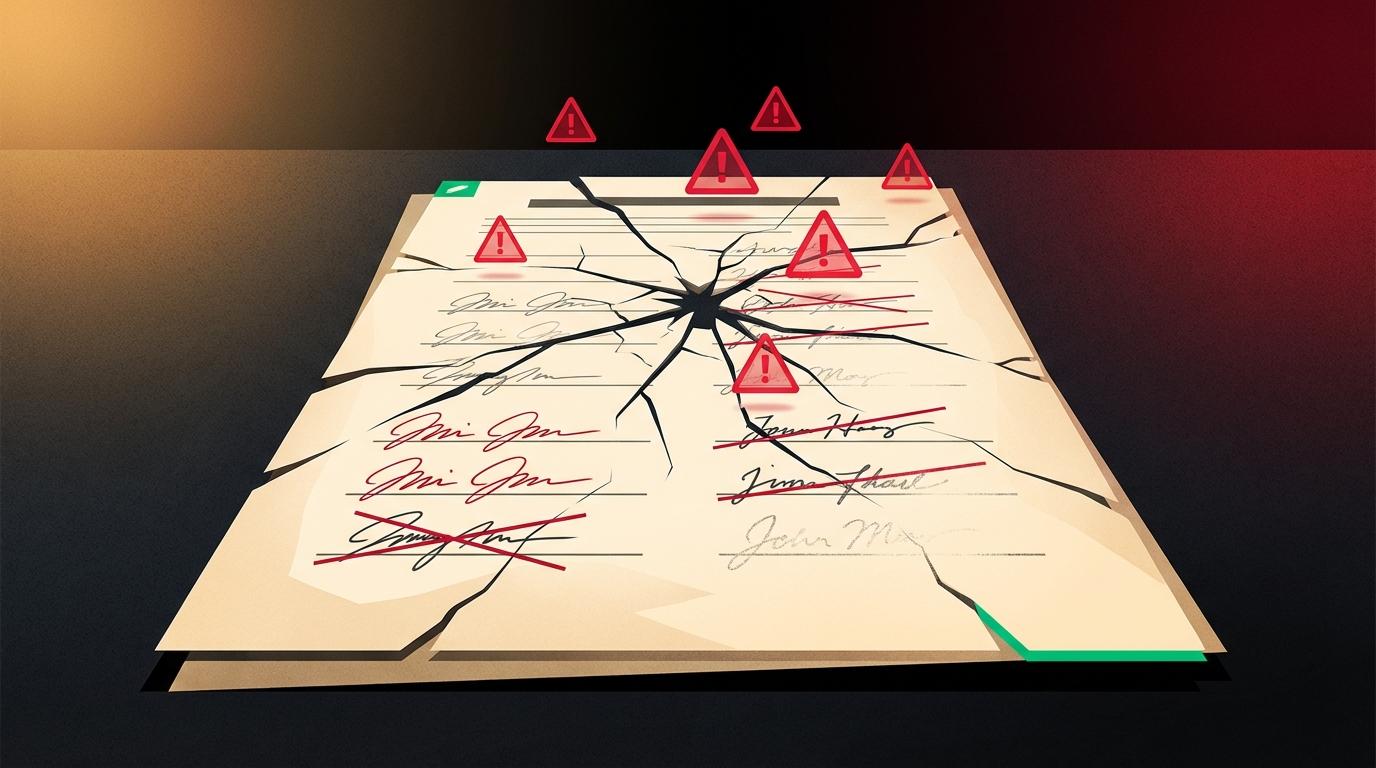
47 signatures were from tenants, not owners. Disqualified. 23 signatures appeared twice, same person, different handwriting, different dates. Disqualified. 11 signatures came from owners who were delinquent on assessments and not in good standing under the bylaws. Disqualified. 8 signatures were illegible and couldn't be matched to any owner on record. Disqualified.
The 187 signatures became 98 valid signatures, still above the 10% threshold, but the board challenged the entire petition on procedural grounds. The challenge succeeded. The recall was blocked. Six months of organizing was undone in a single board meeting.
This isn't an edge case. This is what happens to most unverified petitions.
This article is for informational purposes only and does not constitute legal advice. Petition requirements vary by state, governing documents, and organization type. Consult a qualified attorney for advice specific to your situation.
The Scale of the Problem
How Many Signatures Are Actually Valid?
Research and case data from petition challenges across HOA, nonprofit, and union contexts paint a consistent picture:
| Signature Issue | Typical Rate in Unverified Petitions |
|---|---|
| Duplicate signatures | 8–15% of total |
| Ineligible signers (tenants, former members, non-members) | 10–25% of total |
| Expired signatures (collected outside validity window) | 5–12% of total |
| Illegible or unmatchable | 3–8% of total |
| Contested signatures ("I didn't sign that") | 2–5% of total |
In aggregate, unverified petitions typically lose 20–40% of their signatures when subjected to scrutiny. A petition that appears to have 200 signatures may have only 120–160 that survive a challenge.
For petitions with tight margins, where the organizers collected just enough signatures to meet the threshold, this attrition is fatal.
Why This Matters More Than You Think
When a petition fails, it doesn't just delay the outcome. It creates a cascade of consequences:
- 1The requested action is blocked: The recall doesn't happen. The meeting isn't called. The amendment doesn't advance.
- 2A cooldown period kicks in: Many governing documents prohibit a second petition on the same topic for 6–12 months
- 3Organizer credibility is damaged: The community sees a failed petition as proof that leadership is legitimate
- 4Legal costs accumulate: Both sides spend money on attorneys to argue about petition validity
- 5The opposition is emboldened: A successful challenge strengthens the position of whoever the petition targeted
The Three Most Common Petition Failures
Failure Mode 1: The Duplicate Problem
Paper petitions circulated at multiple events, door-to-door campaigns, and community meetings almost always collect duplicate signatures. A homeowner signs at the pool on Tuesday and again at the clubhouse on Thursday. A union worker signs an authorization card at a lunchroom meeting and another at a parking lot event.
Why it happens:
- Collectors don't cross-reference sheets in real time
- Signers don't remember if they already signed
- Multiple collection teams operate independently
- No central database tracks who has signed
Why it kills petitions:
- Boards and employers specifically look for duplicates as a first line of defense
- Courts treat duplicate signatures as evidence of disorganization or intentional inflation
- Removing duplicates often drops the count below the threshold
The verification control: A roster-controlled petition can accept one response per eligible credential. Email, phone, or assisted government-ID checks add evidence, but shared credentials, a bad roster, or identity fraud remain possible.
Failure Mode 2: The Eligibility Problem
This is the most expensive failure mode because it often requires legal interpretation:
Who counts as an "eligible member"?
| Organization | Common Eligibility Disputes |
|---|---|
| HOA | Owner vs. tenant, delinquent assessments, trust ownership, co-owners |
| Union | Full-time vs. part-time, probationary employees, management exclusions |
| Nonprofit | Dues status, membership expiration, emeritus members, corporate members |
| Co-op | Shareholder vs. resident, proprietary lease status, subletters |
| Church | Active vs. inactive members, membership transfer, age requirements |
The worst-case scenario: An HOA petition includes signatures from both spouses in a unit where only one is the legal owner. The opposing side argues that the unit has only one vote, not two. If this dispute affects enough signatures, the entire petition falls below the threshold.
The verification solution: Cross-reference signers against the eligible member list at the moment of signing. If a signer isn't on the list, they can't sign. No gray areas. No post-collection cleanup.
Failure Mode 3: The Chain of Custody Problem
Paper petitions have a fundamental vulnerability: they exist as physical objects that can be lost, damaged, forged, or tampered with.
Real scenarios that have invalidated petitions:
- Sheet went missing: One of four petition sheets disappeared between collection and delivery. The lost sheet contained 23 signatures. Without them, the petition fell below threshold.
- Signature challenged as forged: A board member whose recall was being petitioned claimed their name appeared on the petition without their knowledge. With no way to prove the signature was authentic, the challenge succeeded.
- Sheets stored insecurely: A petition was stored in a volunteer's car for two weeks. The opposing side argued that signatures could have been added during that period with no oversight.
- Transfer dispute: The petition was hand-delivered to the property manager, who claimed it was never received. No proof of delivery existed.
The verification solution: Digital petitions eliminate physical custody entirely. Every signature is recorded at the moment it's made, with the signer's verified identity, timestamp, IP address, and device information logged cryptographically. There's nothing to lose, forge, or challenge.
The Change.org Problem
Change.org is the world's most popular petition platform, with over 100 million users and millions of petitions. It's also the platform most likely to produce a petition with zero legal standing.
Why Change.org Petitions Don't Count
| Issue | Change.org | Legally Valid Petition |
|---|---|---|
| Identity verification | Optional email only | Email, phone, or government ID |
| Eligibility check | None | Cross-referenced against member list |
| Duplicate prevention | Email-based only | Identity-based |
| Geographic verification | None | Address verification available |
| Audit trail | Basic | Cryptographic, timestamped, exportable |
| Legal standing | None (by their own ToS) | Full (when properly verified) |
Change.org's own Terms of Service state that petitions on the platform are not legal documents and that the platform does not verify signature authenticity. Any organization that receives a Change.org petition can legally ignore it.
What keeps you up at night?
What concerns you most about your organization's current voting process?
When "Going Viral" Backfires
A common scenario: an HOA homeowner creates a Change.org petition that collects 2,000 signatures opposing a special assessment. They present it to the board at a meeting. The board's attorney points out:
- 1Change.org doesn't verify that signers are homeowners in the community
- 2The petition includes signatures from people in other states and countries
- 3The platform's Terms of Service explicitly disclaim legal validity
- 4The petition doesn't meet the formal requirements of the state's HOA statute
The board disregards the petition. The homeowner has spent weeks promoting it on social media. The community is divided. And the formal petition process, which could have produced a legally binding result, hasn't even started.
The Real Cost of Unverified Petitions
Direct Costs
| Cost Category | Unverified Petition | Verified Petition |
|---|---|---|
| Petition creation | $0–$100 (printing) | $50–$500 (platform fee) |
| Signature collection | $200–$500 (volunteer time, events) | $0 (digital distribution) |
| Attorney review (pre-delivery) | $500–$2,000 | $0 (compliance built in) |
| Challenge defense | $5,000–$25,000 | Rarely challenged |
| Second petition (if first fails) | $500–$2,000 + 6–12 month delay | N/A |
| Total potential cost | $6,200–$29,600 | $50–$500 |
Indirect Costs
- Time: Unverified petitions take 6–12 weeks to organize, collect, and deliver. Digital petitions can reach threshold in days.
- Community impact: A failed or disputed petition can deepen division; a clearly documented process gives reviewers better facts.
- Opportunity cost: Every month spent on a failed petition is a month the underlying issue goes unresolved.
How Organizations Exploit Unverified Petitions
Boards, employers, and leadership teams that want to block a petition have a playbook:
Step 1: Challenge Every Signature
Request a complete signer list. Cross-reference against the membership roll. Disqualify every tenant, every delinquent member, every non-member, every duplicate. This alone eliminates 20–40% of signatures.
Step 2: Challenge the Process
Argue that the petition didn't follow proper procedures:
- Wrong delivery method
- Missing required language
- Signatures were collected under duress or with misleading information
- Petition sheets were not properly supervised
Step 3: Run Out the Clock
Some jurisdictions impose validity windows on signatures. If the board can delay its review long enough, early signatures expire and the petition falls below threshold.
Step 4: Dispute and Litigate
If all else fails, threaten litigation. Most volunteer organizers don't have the resources or appetite for a legal fight over petition validity. The threat alone is often enough to make petitioners give up.
A useful response to those risks: start with the controlling procedure, maintain a current eligible-signer list, choose a proportionate credential method, preserve the exact petition language, and export the record. A platform cannot stop a recipient from raising legal or factual objections.
Building a Petition That Is Easier to Review
The Verification Checklist
Before launching any petition, ensure:
- [ ] Eligible signer list is current: Updated membership/owner roll with good-standing status
- [ ] Verification method matches the stakes: Document what email, phone, or an assisted identity check establishes and what it does not
- [ ] Statement of purpose follows the governing procedure: Have counsel review legally consequential petition language
- [ ] Signature threshold is correct: Based on the actual requirement (of total members, not just of those who the petition reaches)
- [ ] Deadline is within the validity window: All signatures will remain valid at the time of delivery
- [ ] Delivery method is documented: Proof of delivery (certified mail, timestamped electronic submission)
- [ ] Audit trail is exportable: Complete record of every signature with verification status and timestamp
The Platform Matters
At vote.direct, petitions use the same verification infrastructure as elections:
- Email verification (included in flat rate): Confirms the signer controls the email address
- Phone verification (included in flat rate): Confirms the signer controls the phone number
- Assisted government-ID verification ($3.00/checked signer): Records the configured document and selfie-check result; signer eligibility still comes from the organizer’s roster and governing rule
Accepted signatures are timestamped and included in exportable platform records with hash-linked events. The dashboard can track progress against the organizer’s configured threshold. These records do not certify that the petition language, threshold, delivery, or signer list satisfies a statute.
For a 200-unit HOA recall petition requiring 10% support (20 signatures), the cost of government ID verification is $60 ($3.00 x 20), less than one hour of the attorney time that would be needed to defend an unverified paper petition.
The Bottom Line
Any petition can be challenged. A roster-controlled workflow can improve credential, timestamp, progress, and export records, but it cannot cure defective language, the wrong threshold, an inaccurate signer list, or improper delivery.
If the issue matters enough to petition over, it matters enough to petition correctly.
Sources:
- 1Florida Statutes §718.112(2)(l): Condominium recall petition requirements
- 2Florida Statutes §720.303(10): HOA recall petition provisions
- 3California Corporations Code §7510(e)–(f): Special meeting petition rights
- 4National Labor Relations Act (NLRA) §9(c): Union authorization petition procedures
- 5Change.org Terms of Service: Disclaimer of legal validity
- 6Nevada NRS 116.31036: Special meeting petition and recall
- 7Arizona ARS §33-1813: Planned community board removal and special meetings
- 8Colorado C.R.S. §7-127-102: Special meeting demand
- 9Community Associations Institute: Quorum and petition failure statistics
- 10American Bar Association: HOA governance dispute data
This article is general information, not legal advice. We recommend you do your own research and confirm anything you plan to act on. Where this article states law, the section is cited so you can read the primary source yourself rather than take our word for it. That is what the citations are for. Election requirements also turn on your own governing documents, which we have not seen, and statutes are amended. For advice about your community, consult a qualified attorney licensed in your state.
We work hard to verify every citation against the primary source, but laws change and errors happen. If you spot an inaccuracy, email support@vote.direct and we will correct it. See our editorial standards for how these pages are researched and checked.