The Trust Question
Every organization considering online voting asks the same question: "How do we know it's secure?"
It's the right question. Election integrity depends in part on three things: a correct eligible-voter list, controls against duplicate ballots, and accurate tabulation. A platform should document what it controls and state what remains with the organizer, inspector, or election committee.
This guide explains the specific security mechanisms that modern voting platforms use, how they compare to traditional paper methods, and what to evaluate when choosing a platform for your organization.
The Five Pillars of Election Security
1. Identity Verification
The problem it solves: Ensuring the person casting a vote is actually the eligible voter they claim to be.
This is where most elections, paper and digital, are weakest. A paper ballot mailed to a household can be filled out by anyone who opens the mailbox. A show-of-hands vote at a meeting can include non-members who walked in. An email link forwarded to a friend allows proxy voting without authorization.
Modern verification methods:
Email One-Time Passcode (OTP)
- Platform sends a unique 6-digit code to the voter's registered email address
- Voter enters the code before accessing the ballot
- Code expires after 10-15 minutes
- Proves the voter has access to the registered email account
- Strength: Moderate. Sufficient for most organizational elections.
- Weakness: If someone has access to the voter's email, they can vote on their behalf.
SMS One-Time Passcode
- Code sent via text message to the voter's registered phone number
- Stronger than email because phone numbers are harder to share than email passwords
- Proves possession of a physical device tied to the voter's identity
- Strength: Good. Phone numbers provide stronger identity assurance than email.
- Weakness: SIM swapping attacks (rare, targeted, and unlikely for organizational elections).
Government ID Verification
- Voter photographs their driver's license, passport, or state ID
- AI compares the document photo to a real-time selfie using biometric matching
- Document authenticity checks detect altered, expired, or fraudulent IDs
- Name on the ID is matched against the voter roll
- Strength: Very strong. The same technology used by banks and financial institutions.
- Weakness: Cost ($3.00/voter add-on) and friction (adds 2-3 minutes to the voting process).
| Verification Level | What It Proves | Cost | Fraud Resistance |
|---|---|---|---|
| None (link only) | Nothing | Free | Very low |
| Email OTP | Access to registered email | Included | Moderate |
| SMS OTP | Possession of registered phone | Included | Good |
| Government ID | Physical identity match | $3.00/voter | Very high |
2. Ballot Integrity
The problem it solves: Ensuring votes cannot be altered after they are cast.
Once a voter submits their ballot, the record must be immutable. No administrator, platform operator, or attacker should be able to change a vote.
How modern platforms protect ballot integrity:
Write-once storage: Votes are written to append-only database records that cannot be updated or deleted, even by system administrators. The database schema enforces immutability at the storage layer.
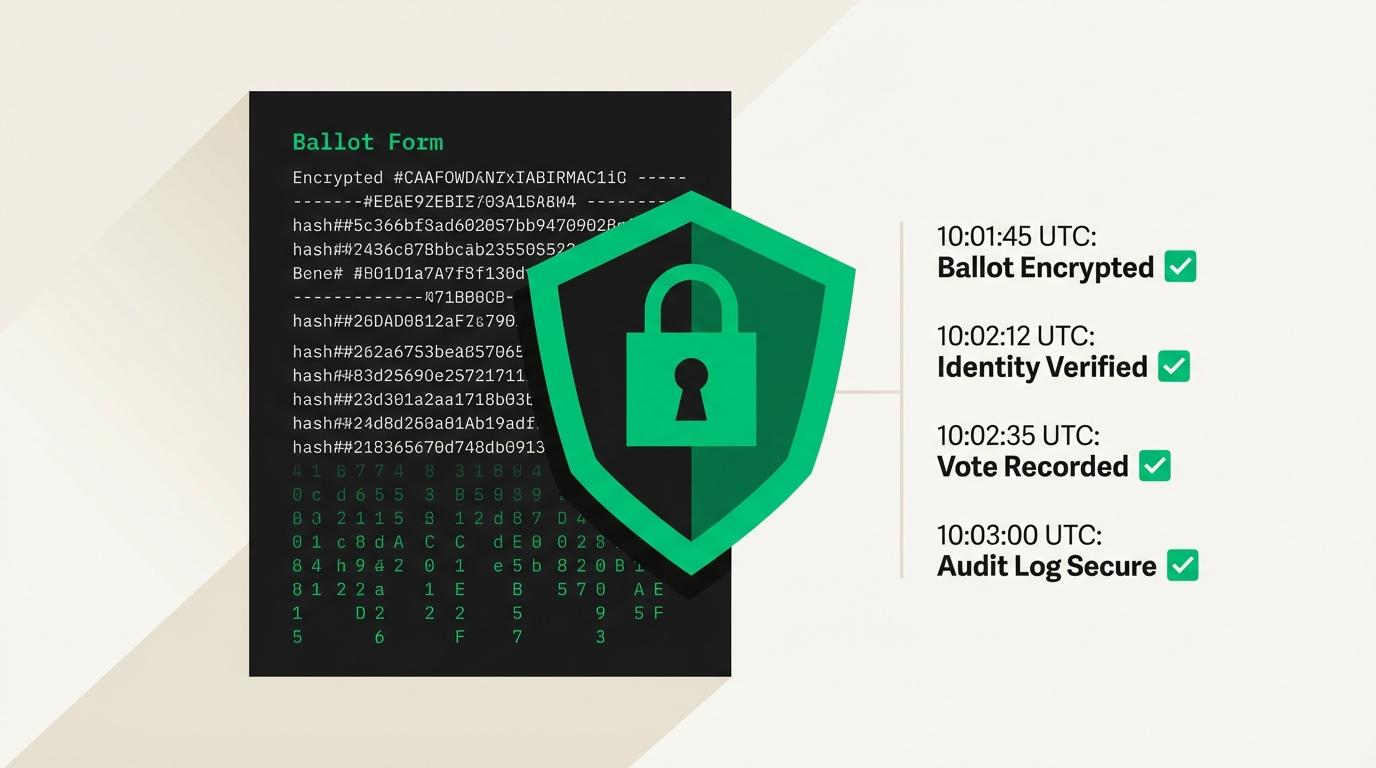
Cryptographic hashing: Each ballot is hashed (a one-way mathematical function) at the moment of submission. The hash serves as a fingerprint: if any data changes, the hash changes. Audit systems periodically verify that all ballot hashes match their stored values.
Timestamp verification: Every ballot receives a cryptographically signed timestamp at submission. This proves when the vote was cast and that it falls within the election's voting window.
Separation of identity and vote: Verification records and ballot contents can be withheld from the organization's ordinary views and exports. Ask where that control ends: on many platforms the link is restricted by access control rather than destroyed at submission, which is different from permanent technical separation. Ask every vendor which model it implements; vote.direct offers both, chosen per election, as Anonymous (link kept in restricted storage for vote changes, proxies and recounts) and Sealed ballot (stored with no link to the voter at all).
3. Access Control
The problem it solves: Preventing unauthorized access to election administration and results.
Platform-level controls:
- Role-based access: Election creators, administrators, and viewers have different permission levels. Only the creator can modify the election. Administrators can view participation rates but not individual votes.
- API key authentication: For organizations using the API, every request is authenticated with a unique API key tied to the organization's account.
- Rate limiting: Automated throttling prevents brute-force attacks on voter verification codes, API endpoints, and login forms.
- Session management: Administrative sessions expire after inactivity and require re-authentication.
Infrastructure controls:
- TLS encryption: All data in transit is encrypted using TLS 1.3 (the same encryption used by banks)
- Encryption at rest: Stored data is encrypted using AES-256. Even if the underlying storage is compromised, data is unreadable without decryption keys.
- Network isolation: Vote processing systems are isolated from public-facing application servers.
4. Audit Trails
The problem it solves: Providing a complete, tamper-evident record of every election event for post-election verification.
A good audit trail records every significant event in the election lifecycle:
- Election created (timestamp, creator identity)
- Voter roll uploaded (timestamp, hash of voter data, total eligible voters)
- Election published and voting opened (timestamp)
- Each voter verification attempt (timestamp, method, success/failure, but NOT the voter's ballot choice)
- Each ballot submission (timestamp, hash, but NOT voter identity)
- Election closed (timestamp)
- Results calculated (timestamp, method)
What makes an audit trail trustworthy:
- Append-only: Events can be added but never edited or deleted
- Timestamped: Every event has a cryptographically verified timestamp
- Complete: No gaps in the event sequence
- Available: The full trail can be exported for independent review
- Anonymized: The trail proves integrity without revealing how individuals voted
What keeps you up at night?
What concerns you most about your organization's current voting process?
5. Availability and Resilience
The problem it solves: Ensuring the election platform is available throughout the voting window and doesn't lose data.
Redundancy:
- Database replication across multiple availability zones
- Automatic failover if a primary server goes down
- Regular automated backups of all election data
DDoS protection:
- Traffic filtering at the network edge
- Rate limiting to prevent flood attacks
- Automatic scaling to handle legitimate traffic spikes
Monitoring:
- Real-time alerting on unusual patterns (sudden spike in verification failures, unusual geographic access patterns)
- Automated health checks on all system components
- 24/7 infrastructure monitoring during active elections
How Digital Security Compares to Paper
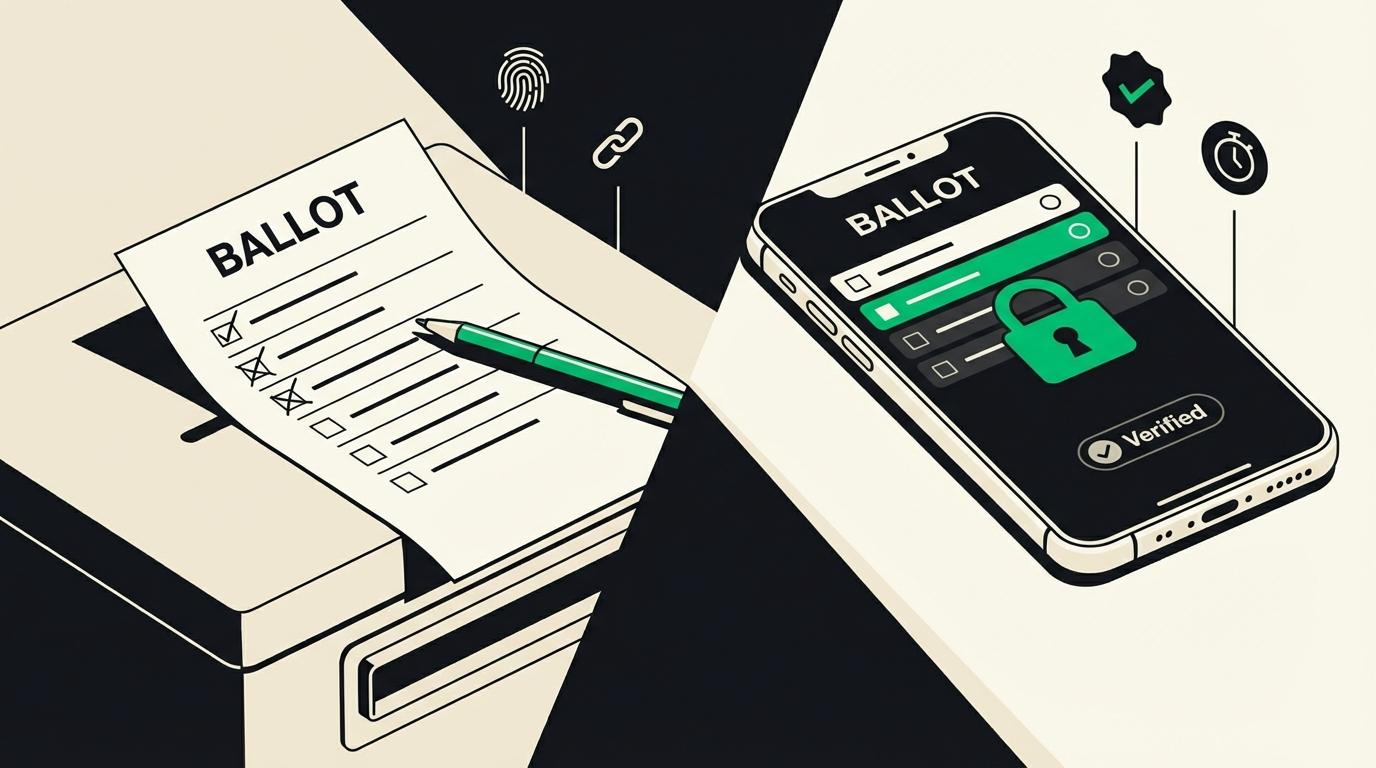
The security comparison between digital and paper voting isn't as simple as "paper is more secure" or "digital is more secure." Each has different strengths.
| Security Property | Paper | Digital |
|---|---|---|
| Voter identity verification | Weak (signature comparison, if any) | Strong (OTP, SMS, biometric) |
| Double voting prevention | Moderate (check name off list) | Strong (system-enforced one-vote limit) |
| Ballot tampering | Moderate (physical custody required) | Strong (cryptographic integrity) |
| Chain of custody | Weak (depends on human oversight) | Strong (automated, logged) |
| Counting accuracy | Moderate (human error in tallying) | Strong (automated, verifiable) |
| Ballot secrecy | Strong (physical anonymity) | Strong (identity/vote separation) |
| Auditability | Weak (paper can be lost, damaged, altered) | Strong (complete digital trail) |
| Accessibility | Moderate (must be present or mail) | Strong (any device, any location) |
The key insight: Paper voting's security depends on human processes (chain of custody, honest tellers, physical security). Digital voting's security depends on technical architecture (encryption, access controls, audit logs). Technical architecture is more consistent, auditable, and scalable than human processes.
Red Flags: What to Avoid in a Voting Platform
When evaluating a platform, these are warning signs:
No independent identity verification. If the platform only uses a shared link (anyone with the URL can vote), it cannot prove voter identity. This is not a secure election platform: it's a survey tool.
Administrator can view individual votes. If the platform allows anyone, including the election administrator, to see how specific individuals voted, ballot secrecy is compromised. This creates the potential for retaliation and undermines voter confidence.
No audit trail export. If you can't export a complete record of election events for independent review, you're trusting the platform blindly. A trustworthy platform lets you verify its work.
Results can be edited. If the platform allows administrators to modify vote tallies after the election closes, the entire integrity model collapses. Results should be calculated automatically and immutable.
No encryption in transit or at rest. This is table stakes. Any platform handling election data without TLS and AES-256 encryption is not taking security seriously.
Vague security claims. "Military-grade encryption" and "blockchain-secured" are marketing terms, not technical specifications. Ask for specifics: What encryption standard? What verification methods? Can you export the audit trail?
Building a Security-First Election
For organizations that take election integrity seriously, here's a practical checklist:
Before the election:
- [ ] Verify voter roll accuracy against membership records
- [ ] Select identity verification level appropriate to the stakes
- [ ] Test the voting process with a small group before launching
- [ ] Ensure the platform produces an exportable audit trail
- [ ] Communicate the security measures to members (transparency builds trust)
During the election:
- [ ] Monitor participation rates and verification failure rates
- [ ] Do not access or share partial results
- [ ] Document any irregularities immediately
After the election:
- [ ] Export the complete audit trail
- [ ] Verify result totals against participation records
- [ ] Certify results and distribute to membership
- [ ] Archive all election records for at least 7 years
Secure Your Next Election
Vote.direct was built with security as the foundation, three tiers of identity verification, append-only audit trails, encrypted storage, and automated result calculation that no administrator can modify.
Start with flat-rate pricing from $4.99/election (email + SMS included), or add government ID verification at $3.00/voter when you need the strongest possible integrity.
This article is general information, not legal advice. We recommend you do your own research and confirm anything you plan to act on. Where this article states law, the section is cited so you can read the primary source yourself rather than take our word for it. That is what the citations are for. Election requirements also turn on your own governing documents, which we have not seen, and statutes are amended. For advice about your community, consult a qualified attorney licensed in your state.
We work hard to verify every citation against the primary source, but laws change and errors happen. If you spot an inaccuracy, email support@vote.direct and we will correct it. See our editorial standards for how these pages are researched and checked.