Quick Answer
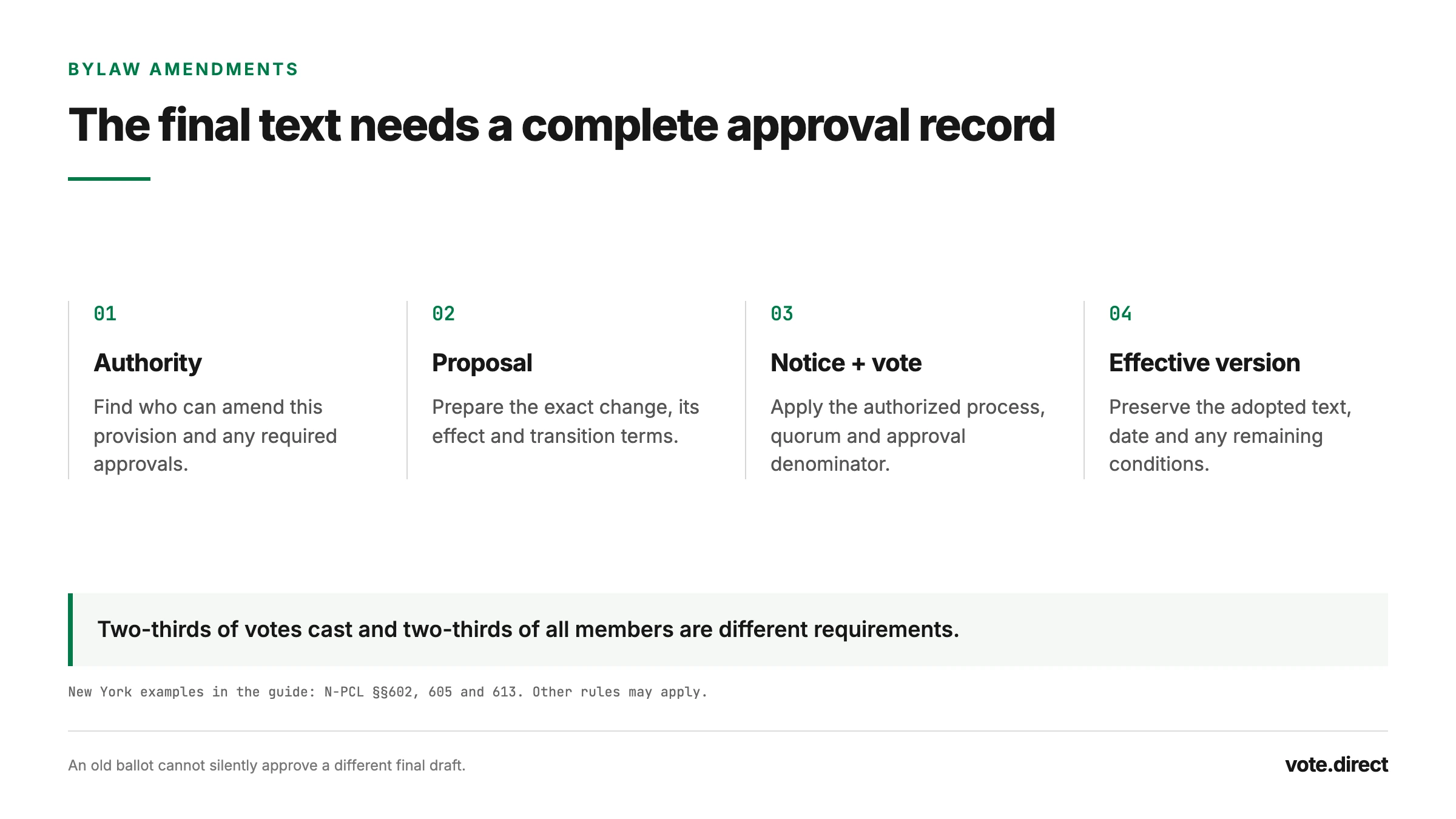
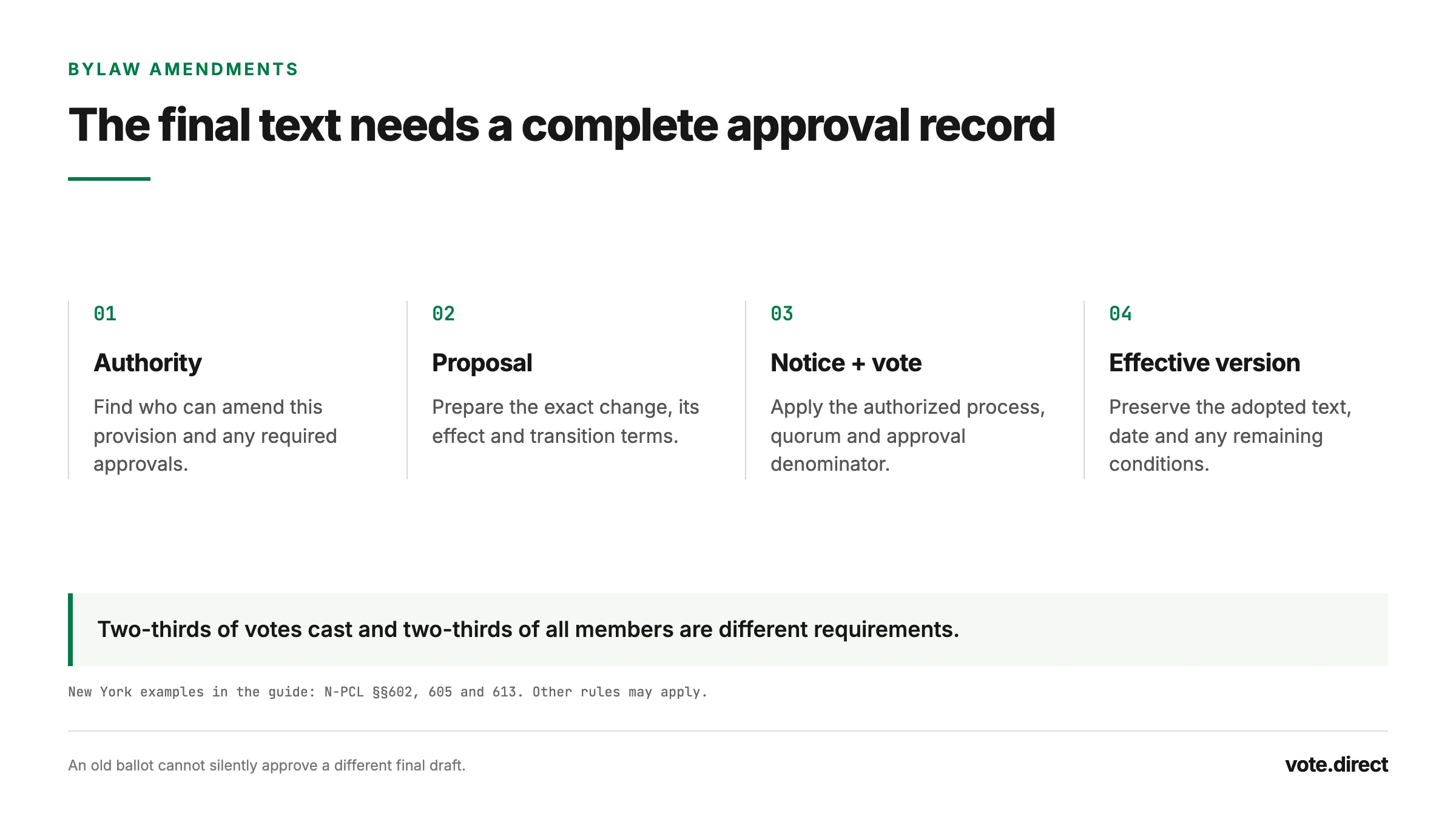
To amend association bylaws, identify who has amendment power under the applicable law and current documents, prepare the exact proposed change, give the required notice, use the authorized voting process, and apply the correct quorum and approval threshold. Preserve the adopted text and effective date. There is no universal rule that every association amendment requires exactly two-thirds.
This is general U.S. membership-association guidance with New York nonprofit examples. HOA declarations, religious constitutions, business-corporation certificates and other documents may have different amendment procedures.
Begin with the current authority
Find the current amendment clause and any statute or superior document limiting it. Determine whether the board, members, a membership class or another body must approve the change. Some proposals require more than one approval.
New York N-PCL §602 addresses member and board bylaw powers subject to statutory and document-based limits. It also requires notice of certain board-made changes regulating an impending director election. This illustrates why “the board can edit bylaws” is not a complete answer. Read §602.
If the proposal changes articles or a certificate rather than bylaws, use the proper process for that document. Renaming the file does not remove a filing or approval requirement.
Prepare a change sheet members can actually use
| Field | What to include |
|---|---|
| Current provision | Section number and the text currently in force |
| Proposed provision | The exact replacement, addition or deletion |
| Reason | The operational problem the change addresses |
| Related effects | Other clauses, voting classes or officer terms affected |
| Transition | Which current members, officers or elections are affected and when |
| Approval route | The authorities and process used to adopt it |
Keep a clear distinction between explanation and operative language. Members should know which text they are actually approving. A ballot labeled “modernize the bylaws” is difficult to interpret if several drafts circulate at the same time.
Check notice before fixing the meeting date
Identify how far ahead notice must be given, who receives it, permitted delivery methods and what the notice must contain. Some procedures require the full amendment; others require a described purpose or another specified form. Check the exact rule.
For New York nonprofits, §605 provides meeting-notice requirements, including a special meeting's purposes and delivery-dependent timing rules. The current published text contains separately amended versions; read the applicable provisions carefully rather than copying a deadline from an old checklist. Read N-PCL §605.
Work backward from the applicable deadline and preserve the delivery record. An internal reminder to the committee is not member notice. If the proposal changes materially after notice, determine whether it remains within the authorized scope or requires new notice.
Separate quorum from amendment approval
Quorum establishes whether the body can act. The approval rule determines the affirmative support needed for this proposal. A class vote or another special condition can add another check.
Assume a fictional association has 240 eligible members and a valid rule requiring at least 25 percent participation for quorum. Eighty members participate. For this illustration, its amendment rule requires two-thirds of valid yes-or-no votes cast, with no other affirmative-vote minimum. Fifty vote yes, twenty no and ten abstain.
| Check | Result |
|---|---|
| Quorum | 240 × 25% = 60; 80 participate |
| Votes cast | 50 + 20 = 70 |
| Two-thirds required | 70 × 2/3 = 46.67; at least 47 yes |
| Outcome | 50 yes meets the assumed threshold |
Under a different rule requiring two-thirds of all 240 members, 160 yes votes would be needed. The example's 50 would not suffice. Do not switch denominators after voting. Some statutes impose additional affirmative-vote conditions, so the example is deliberately not presented as the New York statutory result. New York member voting provisions.
Count the final proposition, not an earlier draft
Use a version identifier for the proposal. If amendments from the floor are permitted, record the final text before the deciding vote. If earlier absentee or electronic ballots are involved, review whether and how the process permits a changed proposition. A vote on Draft A is not automatically approval of Draft B.
Avoid bundling unrelated changes solely to force a single yes-or-no answer. Determine which questions can be separated under the authorized procedure. Explain consequences clearly, including a proposed change in eligibility or voting rights.
Adoption and effectiveness need separate records
After a valid approval, preserve the tally, applicable threshold, minutes or consent record, exact adopted text and any required certification or filing. Record the effective date and transition conditions.
Publish or distribute the current version through the association's required access process. Keep the superseded version and adoption history in the archive. Update election procedures and member communications that depend on the changed clause. A bylaw amendment is not complete operationally while the next ballot still uses the old rule.
Frequently Asked Questions
Can the board amend bylaws without asking members?
Sometimes, within the applicable authority and limits. Other amendments require members, a class or another approving body. Check the statute, certificate or articles and current bylaws for the specific change.
Does every amendment require a two-thirds vote?
No. Use the controlling provision, including its denominator and any special conditions. “Two-thirds” alone does not say whether it refers to votes cast, members present or all eligible members.
Can new election rules apply to an election already underway?
Do not assume so. Check notice, transition, member-rights and election provisions before changing an active process. Establish and communicate the effective date through the authorized procedure.
Source notes and next steps
Primary sources checked September 5, 2026: New York N-PCL §§602, 605 and 613. The change sheet and 240-member scenario are original illustrations with expressly assumed rules.
Review membership and record dates, supermajority calculations, and the association library. For administration of an authorized amendment vote, explore managed elections.
This article is general information, not legal advice. We recommend you do your own research and confirm anything you plan to act on. Where this article states law, the section is cited so you can read the primary source yourself rather than take our word for it. That is what the citations are for. Election requirements also turn on your own governing documents, which we have not seen, and statutes are amended. For advice about your community, consult a qualified attorney licensed in your state.
We work hard to verify every citation against the primary source, but laws change and errors happen. If you spot an inaccuracy, email support@vote.direct and we will correct it. See our editorial standards for how these pages are researched and checked.