Quick Answer
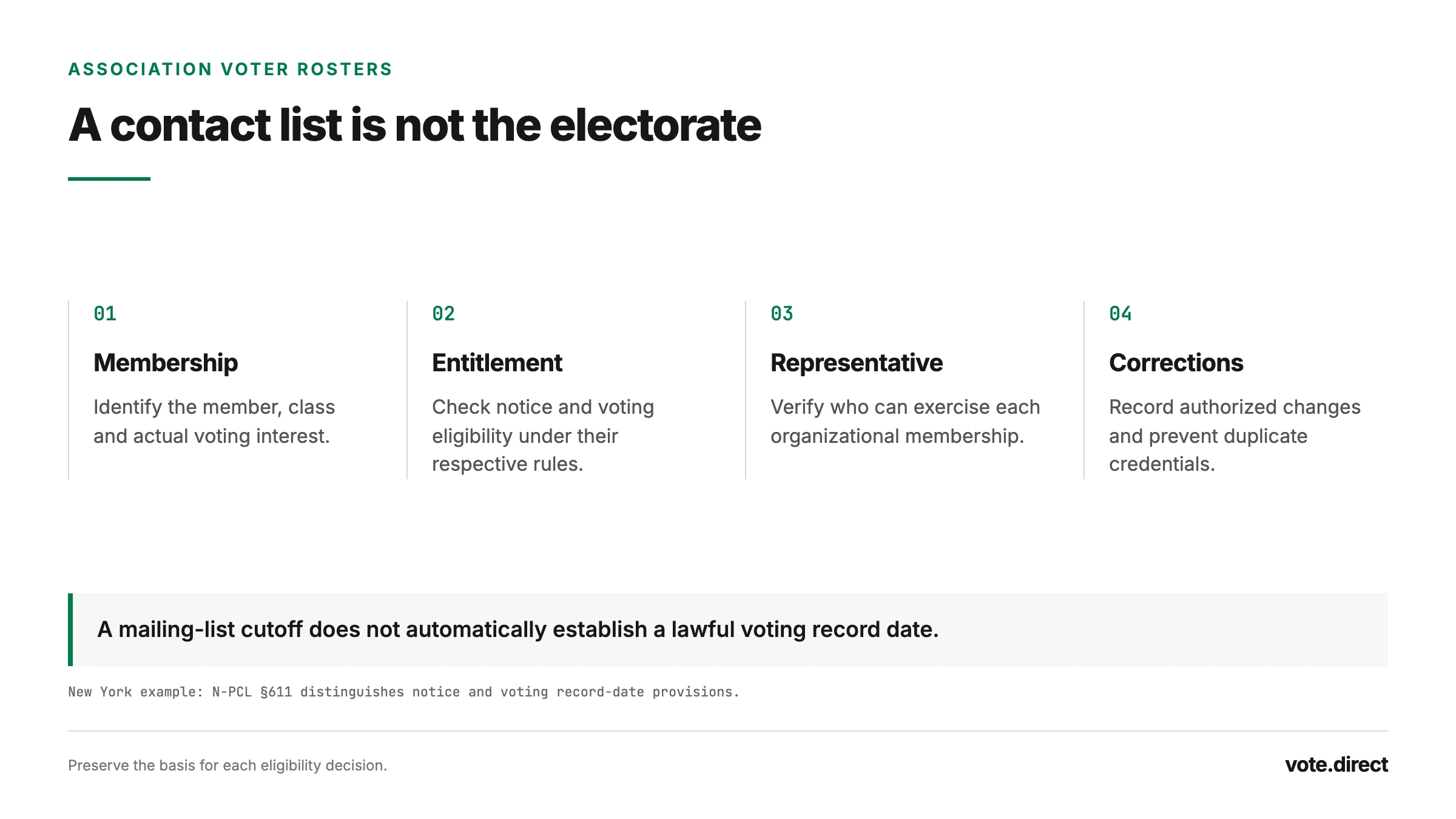
An association's electorate comes from its applicable law and governing documents, not simply its email list or event registrations. Identify voting membership, any authorized record date, class rights, dues or standing rules, and representative authority. Notice eligibility and voting eligibility may have different rules. Resolve corrections through an authorized process and preserve what changed.
This is a U.S. membership-association planning guide with a New York nonprofit example. It does not assume every organization has statutory members or the same record-date powers.
Begin with the legal membership structure
Some associations have individual members, others have organizations as members, and some have multiple membership classes. People described informally as “members” may be donors, subscribers or event participants without governance voting rights.
Find the definition of voting membership and the provisions establishing eligibility. Identify who admits members, whether a standing requirement applies, and how a status change becomes effective. Do not let an administrator's spreadsheet label silently decide a person's rights.
Separate the dates and entitlements
| Item | Question it answers |
|---|---|
| Membership admission date | When did the person or organization become a member? |
| Notice eligibility | Who must receive this meeting or election notice? |
| Voting eligibility or record date | Which membership interests may participate in this decision? |
| Dues status date | What status must be assessed under the actual rule? |
| Representative confirmation | Who may exercise an organizational member's entitlement? |
| Voting deadline | When must a valid vote be received under the authorized process? |
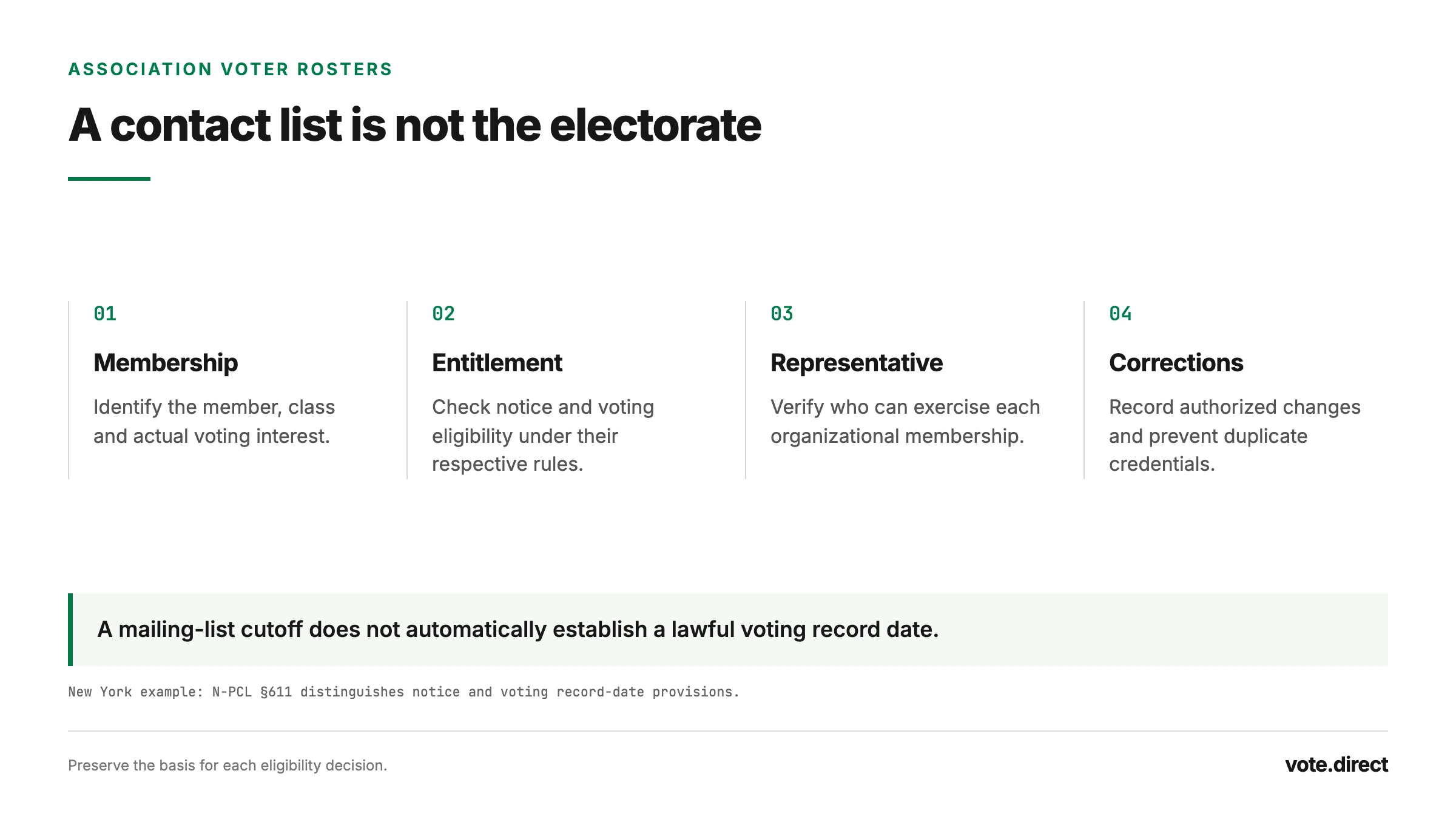
These dates may coincide, but that must be established rather than assumed. Freezing a mailing list for convenience does not necessarily create a lawful voting record date.
New York example: notice and voting provisions differ
N-PCL §611(a) addresses a record date for determining members entitled to notice. Section 611(b) separately addresses voting entitlement and an authorized voting record date. Both describe a 10-to-50-day meeting window when the respective record-date mechanism applies, but the authority conditions differ. The section also provides defaults and rules for adjournments. Read §611.
Do not collapse this into “every New York association freezes voters 10 days before the meeting.” Read the conditions, the organization's own provisions and the actual purpose of the date being fixed. The person entitled to receive notice is not automatically determined by whatever date the election software happens to use.
Dues status needs an actual rule
“Not paid” and “not entitled to vote” are not inherently the same status. Establish whether applicable rules connect the two, how the amount and deadline are determined, and whether notice, grace, appeal or restoration procedures apply.
Distinguish a payment still processing from a member whose status has lawfully changed. A billing-system error should have a correction route. Conversely, a late payment should not be treated as automatically restoring rights if the applicable rule requires another step.
When a dispute concerns someone's right to vote, refer it to the body or officer authorized to decide. Record the interpretation and evidence, while limiting access to personal financial details.
Build a roster that can be reconciled
Use a stable member identifier, voting class, entitlement or weight, authorized representative where applicable, contact route and status. Preserve the source of the eligibility determination. Keep the public result report separate from personal contact and financial information.
Consider a fictional association with 200 confirmed eligible voting memberships. Its contact database contains 214 rows: eight duplicate contacts for joint or organizational memberships and six newsletter subscribers who are not voting members. Issuing 214 independent voting credentials would not reflect the verified 200 interests.
This illustration does not authorize excluding anyone based on a vague data label. It shows why every included or excluded row should trace to the actual membership and voting rules.
Offer a correction process before opening voting
Tell members how to report a missing invitation, wrong contact detail or disputed eligibility. Set internal review targets that leave time to investigate, while preserving any rights or deadlines the governing rules require.
A correction log can record the member identifier, issue, supporting evidence, decision-maker, resolution, time and whether a credential was replaced. If a replacement is issued, prevent duplicate use of the same entitlement. Preserve a record of the replacement without revealing a secret ballot choice.
Do not publish the whole roster merely to make corrections convenient. Give members a proportionate way to verify their own details and use the applicable member-access rules for broader inspection requests.
Reconcile again when the meeting changes
An adjournment, new meeting date, withdrawal of a delegate or organizational representative change can require further review. Check whether the original record date and credentials remain effective. A new date in the calendar should trigger a procedural check, not a blind reuse of the previous export.
For meetings covered by New York N-PCL §605, the notice provision also addresses certain adjournments and a new record date. Read §605(b). Other jurisdictions may handle the situation differently.
Frequently Asked Questions
Can members who join after notice vote?
The answer depends on the applicable membership and voting-record-date rules. Do not assume the notice date is also the voting cutoff. Establish the rule before accepting or rejecting a late admission.
Does every employee of a member company receive a vote?
Not automatically. Identify whether the company is the member, how many voting rights it holds and who is authorized to exercise them. Several employee contacts do not necessarily create several memberships.
Can we remove duplicate email addresses automatically?
Use email as a contact field, not the sole definition of a voting interest. One address may legitimately represent more than one authorized interest, while several addresses may belong to one interest. Review the underlying membership records.
Source notes and next steps
Primary sources checked September 5, 2026: New York N-PCL §§611 and 605. The field list, correction process and 214-row example are original administrative guidance, not a legal eligibility determination.
Continue with delegate credentials, association amendment votes, and the association governance library. For an election run by a team, see managed election administration.
This article is general information, not legal advice. We recommend you do your own research and confirm anything you plan to act on. Where this article states law, the section is cited so you can read the primary source yourself rather than take our word for it. That is what the citations are for. Election requirements also turn on your own governing documents, which we have not seen, and statutes are amended. For advice about your community, consult a qualified attorney licensed in your state.
We work hard to verify every citation against the primary source, but laws change and errors happen. If you spot an inaccuracy, email support@vote.direct and we will correct it. See our editorial standards for how these pages are researched and checked.