Quick Answer
Abstaining means not casting a vote. Recusing means stepping out of a matter because a conflict rule or other disqualification applies; the required steps may include disclosure and leaving deliberations as well as not voting. Neither label, by itself, determines quorum or the number of yes votes required. Read the applicable rule and record what actually happened.
This is general U.S. governance guidance with a New York nonprofit example. A parliamentary default does not override a statute, governing document or applicable conflict policy.
Three different events need three different records
| Event | What happened | What the secretary needs to establish |
|---|---|---|
| Abstention | An eligible participant chose not to vote | Whether that person remained present and how the threshold treats nonvoters |
| Recusal | A conflict or disqualification procedure applied | Disclosure, participation restrictions, departure and return, and applicable quorum treatment |
| Absence | The person did not participate at the relevant time | Attendance at the moment of the decision and whether remote participation was valid |
Someone may abstain because they lack information. That is not automatically a conflict disclosure. Someone may disclose a conflict and remain available to answer factual questions, then leave before deliberation if the applicable procedure requires it. A single “abstain” checkbox cannot describe every one of those events.
Worked example: the same count, two outcomes
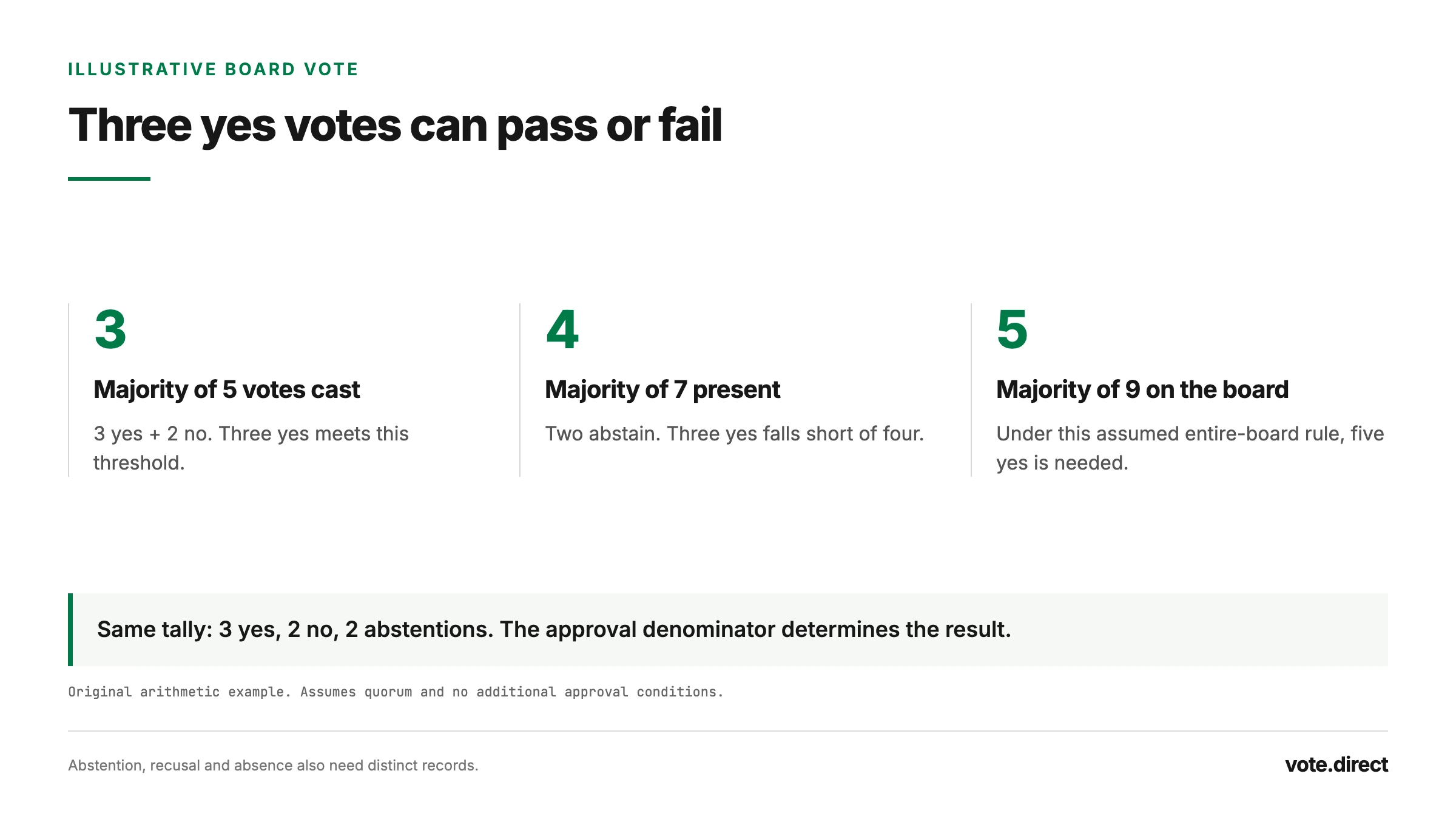
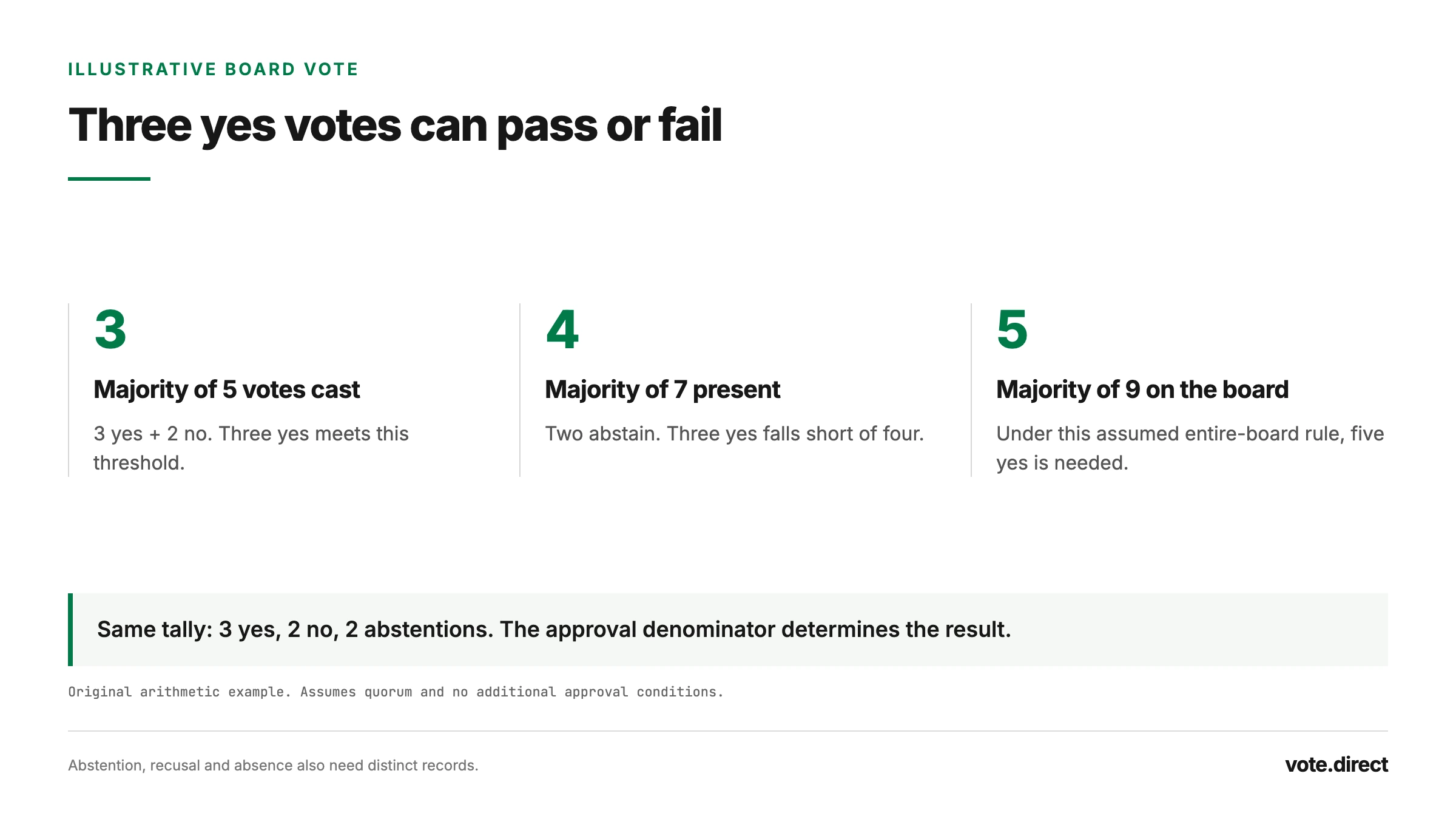
Assume seven eligible people are present, quorum is independently satisfied, and the tally is three yes, two no and two abstentions. Assume there are no special minimum-affirmative-vote requirements.
| Hypothetical approval rule | Denominator | Yes votes needed | Result with three yes |
|---|---|---|---|
| More than half of votes cast | 5 votes | 3 | Passes |
| More than half of members present | 7 people | 4 | Fails |
| More than half of a nine-person entire board | 9 positions under this assumed rule | 5 | Fails |
For whole-number votes, a simple majority requires the integer immediately above half the relevant denominator. The table's rules are alternatives, not an assertion that your board may choose whichever produces its preferred result.
Robert's Rules distinguishes votes-cast thresholds from thresholds based on members present or the entire membership. Abstentions are not votes, but they can affect the practical outcome when the denominator includes nonvoters. Official FAQ, question 6.
Before counting, state the exact rule aloud and in writing. “Majority approved” is incomplete if nobody has identified the majority of what. Our supermajority guide covers another common denominator problem.
Recusal is a procedure, not just a ballot choice
Use the organization's applicable conflict process to identify the decision, the person's interest, who determines the required restrictions, and what the person may do before leaving. A participant should not turn a conflict discussion into informal lobbying while the rest of the board is trying to decide independently.
New York Not-for-Profit Corporation Law §715 requires disclosure of material facts concerning a related-party interest and restricts the interested party's participation in deliberation and voting. The board may request background information before that stage. The statute adds specific review and documentation duties for certain charitable-corporation transactions. Read §715.
That is a statutory example, not a universal definition of every conflict. A church, housing association, club or cooperative may have different governing provisions. Identify them before designing the ballot or asking the conflicted person to remain in the room.
Do not assume a recusal reduces quorum
Attendance, voting entitlement and quorum can have different legal treatments. For example, New York's nonprofit board-action statute expressly addresses quorum treatment for a director who leaves a vote because of a conflict or related-party transaction. It also supplies a board-vote default based on directors present at the time of the vote. N-PCL §708(d).
The useful practice is to keep separate counts: the board's relevant membership, people present, people eligible to vote on this item, votes cast and affirmative votes. Apply the governing provisions to those facts. Do not simply subtract every abstaining or recused person from every number.
A useful minutes entry
For a fictional contract decision, an action record could say: “Director A disclosed an ownership interest in the proposed vendor. The board applied its conflict procedure. A answered requested factual questions, left before deliberation and voting, and returned after the result. The remaining participants voted 3 in favor and 1 opposed. The board recorded its quorum determination and approval basis.”
This is an example of the facts to capture, not a legal conclusion that this tally approves every conflicted transaction. Attach or reference the appropriate disclosure and supporting analysis. Do not publish unnecessary personal detail in a public summary. Keep the adopted decision intelligible without exposing a secret ballot's individual choices.
Frequently Asked Questions
Is abstaining the same as voting no?
No. Record an abstention separately. Its practical effect depends on the approval denominator: a person who does not vote may still be included in a members-present or entire-membership requirement.
Does choosing “abstain” satisfy a conflict policy?
Not necessarily. The policy or statute may require disclosure, a determination by others, exclusion from deliberation, departure from the room, and a particular record. Follow the entire applicable process.
Can a board lower its threshold because several directors recused?
Only if the governing law and documents provide the relevant treatment. A difficult vote does not authorize the board to invent a new quorum or approval rule. Obtain a specific interpretation when the provisions are unclear.
Source notes and next steps
Primary sources checked September 5, 2026: the Robert's Rules Association FAQ and New York N-PCL §§708 and 715. Worked counts and the minutes entry are original illustrations. Read board voting procedures, meeting records, and the meeting and voting library.
This article is general information, not legal advice. We recommend you do your own research and confirm anything you plan to act on. Where this article states law, the section is cited so you can read the primary source yourself rather than take our word for it. That is what the citations are for. Election requirements also turn on your own governing documents, which we have not seen, and statutes are amended. For advice about your community, consult a qualified attorney licensed in your state.
We work hard to verify every citation against the primary source, but laws change and errors happen. If you spot an inaccuracy, email support@vote.direct and we will correct it. See our editorial standards for how these pages are researched and checked.