Quick Answer
Run a club officer election by identifying the offices and governing rules, confirming candidate and voter eligibility, giving the required notice, accepting nominations, establishing quorum, using the authorized ballot and counting method, and recording the result. Check whether members elect officers directly or elect directors who then select officers. Those are different elections.
This is a U.S. planning guide for voluntary clubs. National affiliate rules, the club's legal form and its own governing documents can change the procedure.
1. Define the offices being filled
Create a seat list before asking for candidates. Include the office, term, start date, eligibility requirements and body that elects it. A club may elect a president directly; another may elect a board that chooses its own president. A committee appointment should not accidentally appear as an elected position.
Record whether the election fills a regular term or the remainder of a vacancy. Tell candidates the expected workload, meeting schedule and handover responsibilities. Informed consent to serve prevents an apparent election from becoming another vacancy immediately afterward.
2. Establish the rules and calendar
Work backward from the required election date. Identify nomination deadlines, meeting notice, candidate information, any membership eligibility date, and the opening and closing of an authorized voting period. Label internal preparation targets separately from binding deadlines.
Toastmasters provides a useful example of why affiliate rules matter: its club constitution specifies nomination and election procedures, including secret ballots unless unanimously dispensed with and a majority of active members present and voting to elect each officer. Those are Toastmasters provisions, not defaults for every club. Club constitution, Article VI.
3. Open a fair nomination process
Use the permitted nomination routes and apply candidate qualifications consistently. Give each candidate the same information limits and submission opportunity. If floor nominations are allowed, explain how they will work before preparing a ballot that assumes the candidate list is final.
An election notice should distinguish a nomination deadline from a candidate withdrawal deadline. If a candidate withdraws after a ballot is distributed, use the established procedure to explain what happens to that selection and preserve the notice of the change. Do not silently substitute another name.
4. Confirm the eligible voter list
Start with the club's membership record and applicable definition of voting membership. Check inactive status, dues rules, family memberships and organizational members where relevant. Do not assume every subscriber on the newsletter list has a vote.
Give members a practical way to report an error before voting. Preserve the reason for a correction and the authorized decision on disputed eligibility. A list that changes without a record is difficult to defend even when the underlying correction was sensible.
5. Establish participation and use the permitted method
Confirm quorum under the actual club rule. Decide whether the authorized event is an in-person meeting, a permitted live remote meeting, or an election conducted by a separately authorized ballot process. An online form that remains open for a week is not automatically equivalent to attendance at a meeting.
Toastmasters' own election FAQ identifies a quorum of more than half of active members and says an election without quorum must be postponed until a meeting with quorum. Another club's rule may differ. Toastmasters election FAQ.
6. Count against the correct winning rule
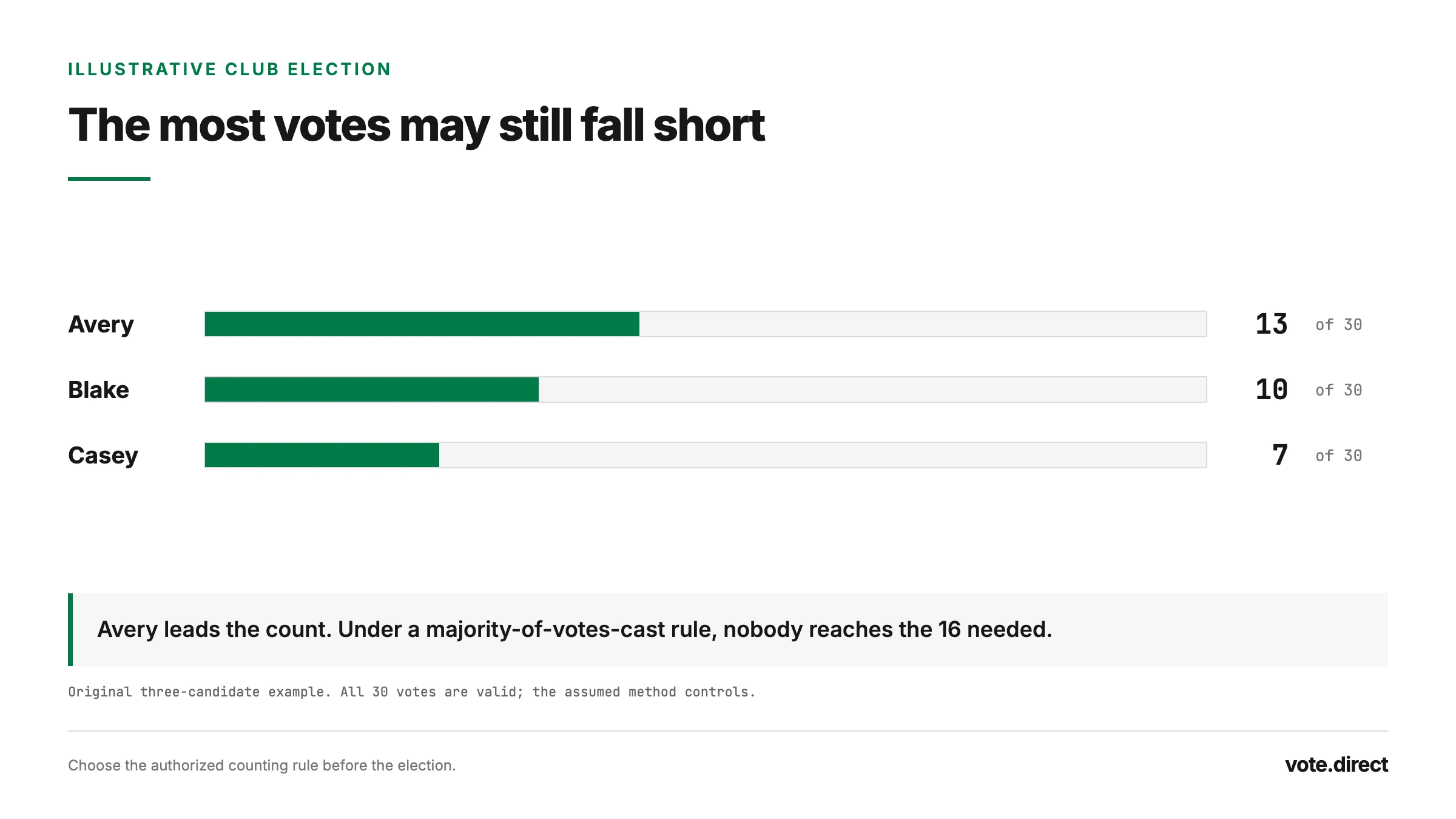
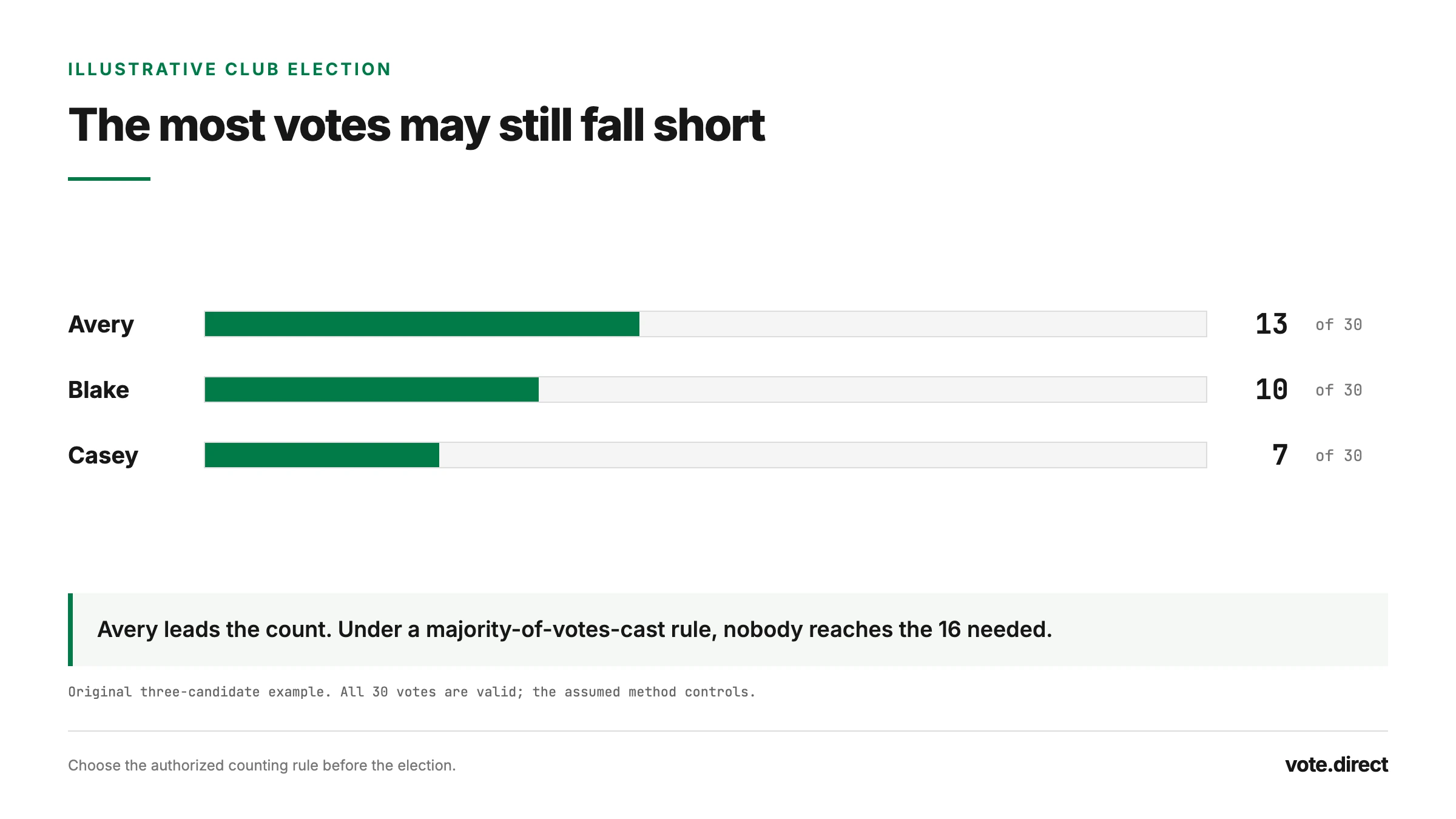
Imagine a fictional club with 30 valid votes for one office: Avery receives 13, Blake 10 and Casey 7.
| Adopted method | What the tally means |
|---|---|
| Plurality | Avery has the most votes |
| Majority of votes cast | No candidate reaches the 16 needed |
| Ranked-choice method | First choices alone do not determine the final result; apply the adopted counting rules |
Do not change from majority to plurality because the first ballot produced no majority. Follow the applicable repeat-ballot, runoff or other adopted procedure. A tie also needs its established rule, not an improvised chair's extra vote. See voting methods explained.
7. Announce a result that can be checked
Identify the office and term, voting method, eligible participation, counted votes and outcome. Explain how blank, invalid or challenged ballots were handled under the rules. Preserve any tellers' report and the motion or decision accepting the result if required.
When ballot secrecy applies, publish useful totals without publishing a person-to-choice list. A result report and a voter-eligibility record can be retained separately.
8. Complete the handover
An elected treasurer needs the financial records and the organization's process for changing account authority. A secretary needs the member list, minutes, governing documents and deadlines. Update public contact details at the proper time. Arrange access through organizational accounts instead of asking outgoing officers to transfer personal passwords.
Frequently Asked Questions
Can an unopposed candidate simply be declared elected?
Only if the applicable procedure permits that outcome. A ballot requirement can still apply to an uncontested office. Review unopposed candidates and acclamation alongside the club's own rules.
Can candidates vote for themselves?
Apply the club's candidate and voter rules; being a candidate does not by itself establish a disqualification. Do not create a new restriction after nominations have opened.
Can we combine an election with a membership survey?
You can collect feedback separately, but clearly distinguish an advisory survey from a binding election. The election still needs the applicable eligibility, notice, method and counting process.
Source notes and next steps
Primary sources checked September 5, 2026: the Toastmasters club constitution and official election FAQ. The workflow and three-candidate count are original examples; affiliate requirements apply only to the named organization.
Review club bylaw voting provisions, officer vacancies, and the club governance library. vote.direct offers self-serve and managed options, including in-person election staff.
This article is general information, not legal advice. We recommend you do your own research and confirm anything you plan to act on. Where this article states law, the section is cited so you can read the primary source yourself rather than take our word for it. That is what the citations are for. Election requirements also turn on your own governing documents, which we have not seen, and statutes are amended. For advice about your community, consult a qualified attorney licensed in your state.
We work hard to verify every citation against the primary source, but laws change and errors happen. If you spot an inaccuracy, email support@vote.direct and we will correct it. See our editorial standards for how these pages are researched and checked.