Quick Answer
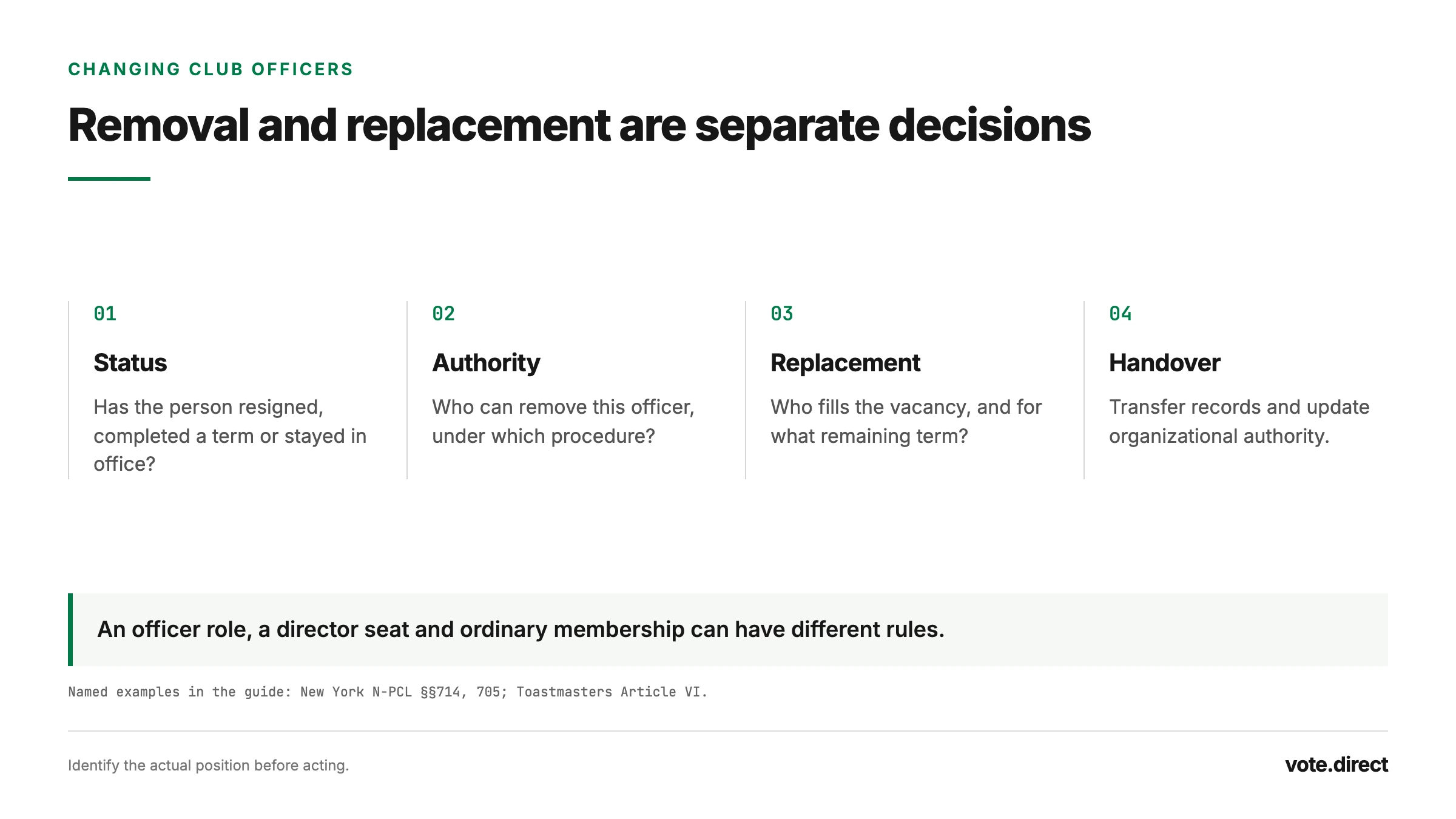
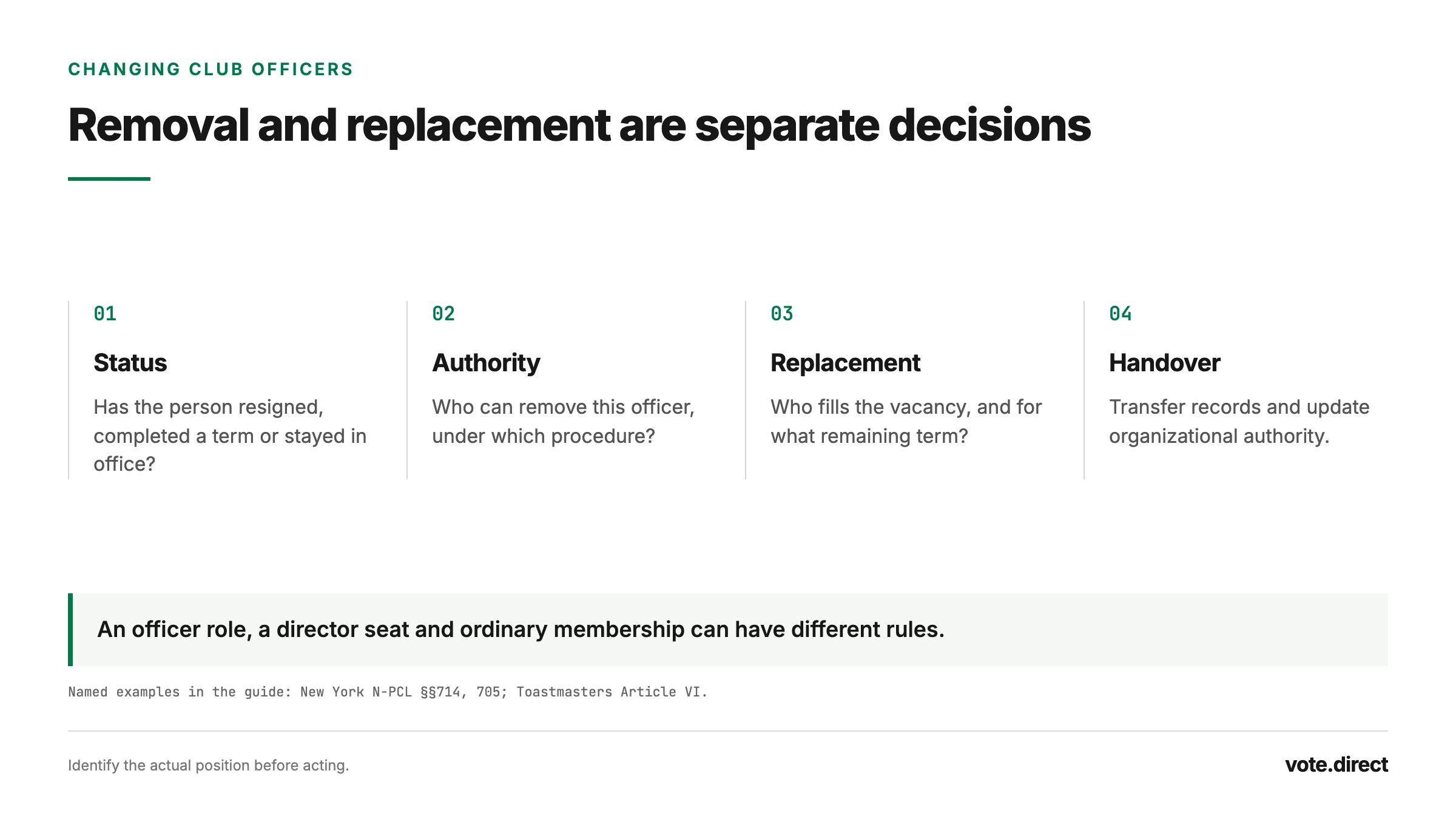
Before replacing a club officer, establish whether the person resigned, completed a term or must be removed through an applicable procedure. Then identify who can fill the resulting vacancy and for how long. Removing an officer, removing a director and ending someone's membership are separate actions. A dissatisfied majority cannot safely treat them as one decision.
This guide offers U.S. planning questions with New York nonprofit and Toastmasters examples. A club's own legal form and affiliate rules determine which provisions apply.
Start with the position, not the person
Write down every role the person holds: president, director, committee chair, employee and ordinary member. A change in one role does not necessarily change the others. A director selected as president by the board may leave the presidency while retaining the director seat, depending on the applicable provisions.
Record how the position was obtained, the stated term, who elected or appointed the person, and any separate removal rule. If the concern is financial access, identify the existing authority for protective administrative steps without misrepresenting those steps as a completed removal vote.
Has a vacancy actually occurred?
Check the resignation's wording, delivery and effective date against the applicable rule. “I might step down next month” is not a clear record of an immediate vacancy. A conditional resignation should not be stripped of its condition in the minutes.
The Toastmasters club constitution, for example, specifies how an officer delivers a written resignation and when it becomes effective. Its removal and vacancy provisions are separately stated. Other clubs should read their own text rather than borrow that result. Club constitution, Article VI.
Use a dated position record: current holder, current authority, effective end date, vacancy start and any interim arrangement. This prevents two people from believing they are authorized to act at the same time.
Who has removal authority?
| How the role was filled | What to investigate |
|---|---|
| Members elected the officer | Whether members must act and what notice, vote and other procedure apply |
| Board elected or appointed the officer | The board's removal power and any governing restrictions |
| A chapter, district or membership class selected the seat | Whether that selecting body retains the relevant power |
| Officer also holds a director seat | The separate director-removal process |
New York N-PCL §714 distinguishes board-selected officers from officers elected by members or a membership class. It also addresses suspension for cause and contract rights. For a club governed by that statute, the identity of the selecting body matters. Read §714.
A statement of no confidence does not, under Robert's Rules alone, remove an officer. Official FAQ, question 7. If the proposed action is removal, use the applicable removal procedure and describe the action accurately.
Prepare the decision without improvising the rules
Identify the required grounds, if any; notice; opportunity to respond; voting body; quorum; threshold; and effect of approval. Follow any applicable disciplinary or affiliate process. Keep factual allegations distinct from findings already made through an authorized process.
The meeting notice should be checked against the action actually proposed. “General club business” may not supply the notice required for a particular removal. Record the final motion and outcome clearly, including which role is affected and when the change takes effect.
If the situation concerns an employment contract, access to funds or a contested legal right, the club may need specific advice beyond a parliamentary answer. Those questions should not be hidden inside the ballot wording.
Fill the vacancy using its own rule
The body that removes someone does not necessarily have unlimited authority to choose the successor. Check the replacement procedure, eligibility, temporary appointment powers and remaining term. A vice president's ability to preside during an absence does not necessarily make that person the permanent president.
For a New York nonprofit director vacancy, §705 supplies rules for vacancies and newly created directorships, with document-based and seat-selection distinctions. That is a director provision; it should not be applied automatically to every officer vacancy. Read §705.
A fictional two-role example
Riley was elected by members to a three-year director term, then selected by the board as president for one year. The board proposes to change presidents. Before acting, it must identify the rule for the presidency and any relevant contract provisions. It should not announce that Riley has also ceased to be a director unless the separate director-removal process authorizes that outcome.
After a valid change, the record should identify the new president's authority and term while accurately preserving Riley's remaining status. This is a planning illustration, not an interpretation of a particular club's rules.
Finish the practical handover
Prepare a checklist covering bank-signatory procedures, organizational account access, current contracts, member records, keys, pending correspondence and upcoming deadlines. Preserve records before changing access. Give members a factual announcement of the authorized result without unnecessary personal accusations.
Frequently Asked Questions
Can the president appoint a replacement for any vacant office?
Only where the applicable rules grant that power. Some vacancies require a board vote, a member election or action by the body that originally selected the seat.
Does removing an officer remove their membership?
Not automatically. Officer status and membership are distinct. A membership suspension or expulsion requires its own applicable authority and procedure.
Does the replacement receive a full new term?
Check the vacancy provision. The replacement may serve the remainder of an existing term, until a specified election, or under another authorized arrangement. State the actual end point in the record.
Source notes and next steps
Primary sources checked September 5, 2026: New York N-PCL §§714 and 705, the Toastmasters club constitution and the Robert's Rules Association FAQ. The two-role example and handover checklist are original material.
Review club voting provisions, plan a replacement election, and explore the club governance library.
This article is general information, not legal advice. We recommend you do your own research and confirm anything you plan to act on. Where this article states law, the section is cited so you can read the primary source yourself rather than take our word for it. That is what the citations are for. Election requirements also turn on your own governing documents, which we have not seen, and statutes are amended. For advice about your community, consult a qualified attorney licensed in your state.
We work hard to verify every citation against the primary source, but laws change and errors happen. If you spot an inaccuracy, email support@vote.direct and we will correct it. See our editorial standards for how these pages are researched and checked.