Quick Answer
Church meeting minutes should make the authorized decision understandable: identify the body, meeting date, attendance and quorum determination, final motion, result and required follow-up. Preserve supporting voting records separately where appropriate. Minutes need not expose individual choices in a secret ballot, and a transcript of discussion is not a substitute for a clear action record.
This is a practical U.S. church-recordkeeping guide. Your constitution, applicable law, denominational requirements and records policy determine the required contents, access and retention period.
Give each record a specific job
| Record | What it should help establish |
|---|---|
| Notice and agenda | What meeting was called and what members were told |
| Eligibility roster | Who was entitled to participate under the applicable rule |
| Attendance or participation record | Whether quorum was satisfied at the relevant point |
| Motion and amendments | The precise proposition put to a vote |
| Tally report | How the ballots or votes were counted and the applicable result |
| Minutes | The business conducted, decision reached and next responsibility |
Keeping these distinct avoids two common failures: a lengthy narrative with no identifiable decision, and a bare result with no supporting evidence. Store related files under a common meeting identifier so the next secretary can reconstruct the sequence.
Robert's Rules treats minutes as a record of action rather than a summary of speeches. That is a parliamentary default; additional legal or denominational requirements may apply. Official FAQ, question 15.
Use the correct roster, not Sunday attendance
The number of people attending worship is not necessarily the number entitled to vote. Establish the voting membership under the church's own provisions and preserve the relevant roster version. Resolve duplicate entries, transfers and eligibility questions through the authorized process.
For example, the ELCA model constitution assigns the Congregation Council an annual membership-roster review at C12.07 and an annual congregational report at C12.09. These are specific denominational provisions, not a substitute for checking local voting eligibility. ELCA model constitution, chapter 12.
When someone arrives late or leaves before a vote, update the participation record if that change matters to quorum or the denominator. Preserve a correction trail instead of overwriting the initial list without explanation.
Worked example: quorum and approval are separate
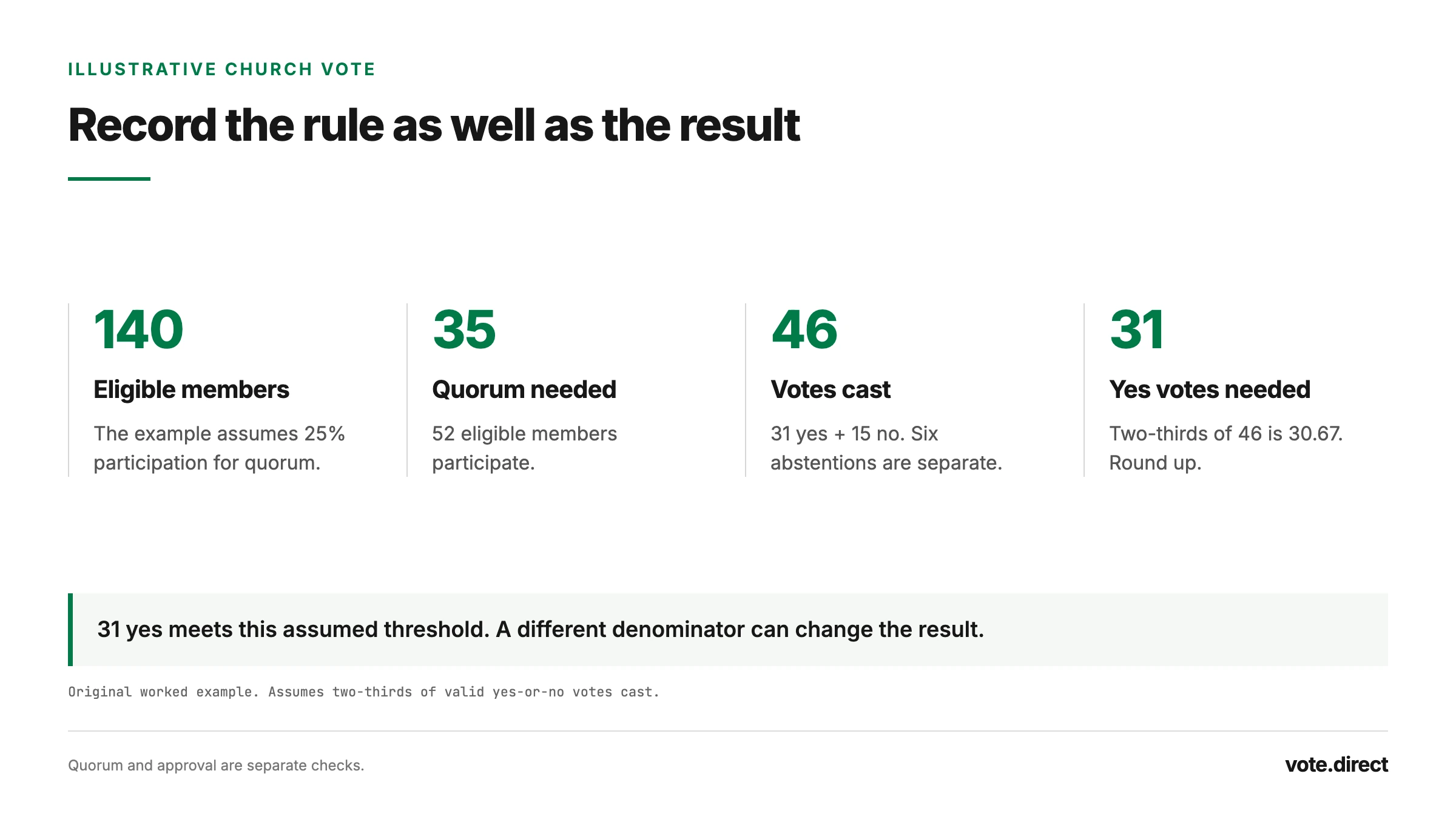
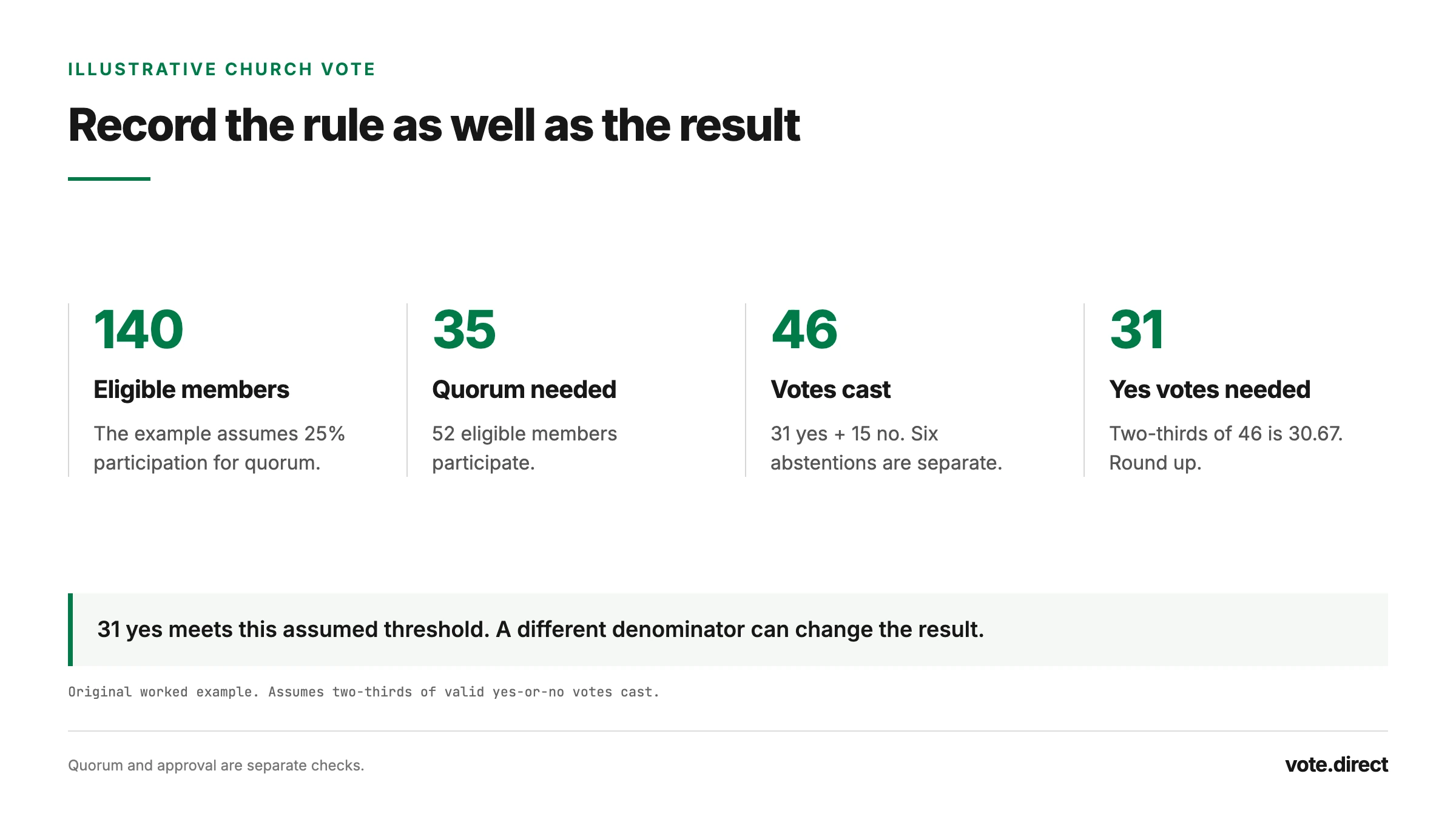
Assume a fictional church has 140 eligible voting members. Its adopted rule requires at least 25 percent for quorum and two-thirds of valid yes-or-no votes cast for this particular decision. Fifty-two eligible members participate. Thirty-one vote yes, fifteen vote no and six abstain. There are no other special approval conditions in this example.
| Check | Calculation | Finding |
|---|---|---|
| Quorum | 140 × 25% = 35 | 52 participants exceed the assumed minimum |
| Votes cast | 31 yes + 15 no = 46 | The six abstentions are recorded separately |
| Approval needed | 46 × 2/3 = 30.67, rounded up | At least 31 yes votes are required |
| Outcome | 31 yes | The motion meets the assumed voting threshold |
The minutes should identify the actual rule, not just say “passed by two-thirds.” A rule using all members present would produce a different calculation. The church quorum guide explains the first check, while supermajority thresholds explains the second.
An original minutes example
For the fictional meeting above, the record might read: “The congregation considered Motion 2026-09-01, authorizing the equipment purchase described in the attached final proposal, within the stated spending limit. The secretary confirmed 52 eligible participants against the required quorum of 35. The tally report recorded 31 in favor, 15 opposed and 6 abstentions. Under the applicable two-thirds-of-votes-cast rule, the motion carried. The treasurer will arrange the approved purchase and report completion at the next meeting.”
This example includes a motion identifier and reference to the final proposal. In a real record, identify the precise authorization, including any condition or limit. If the vote only authorizes further research, do not write the minutes as though it approves a contract.
Keep secret choices and sensitive supporting material separate
A result report can show totals without naming each person's ballot selection. Maintain the eligibility and ballot-handling evidence the procedure requires, with access appropriate to each record. “Transparent results” does not mean publishing a voter-to-choice list.
Employment matters, pastoral care, discipline and personal financial details can require special handling. Determine the applicable access rules before publishing minutes broadly. A public summary and a restricted supporting file may serve different purposes, but neither should contradict the actual decision.
Approval, correction and handover
Label unapproved minutes as a draft. Route them through the church's actual approval procedure, retain the final version, and preserve subsequent corrections with the authority and date of the correction. Do not silently rewrite an approved decision to match what someone later wishes the meeting had authorized.
Before the secretary changes, transfer the document index, location of original records, access responsibilities, retention policy and unresolved action list. Put organizational records in an account controlled by the church so they do not disappear when a volunteer's personal email or laptop changes.
Frequently Asked Questions
Must church minutes list how every member voted?
Not as a universal rule. The required record depends on the voting method and applicable authorities. For a secret ballot, preserve the result and supporting process evidence without defeating ballot secrecy.
How long should church ballots and minutes be kept?
There is no single retention period supplied by this guide. Apply the church's approved records policy and relevant legal or denominational requirements, including any applicable dispute or preservation obligation. Minutes and individual ballots need not have identical retention rules.
Can we publish the draft minutes immediately?
Follow the church's access and approval requirements. If a draft is circulated, label it clearly and avoid presenting an unconfirmed record as the final approved minutes. Review confidential material before public distribution.
Source notes and next steps
Primary sources checked September 5, 2026: the Robert's Rules Association FAQ and ELCA model constitution. The record structure, numerical example and sample minutes are original educational material.
Use the board minutes template, review church business meetings, or browse the church governance guides. If you want a team to administer the election itself, explore managed election services.
This article is general information, not legal advice. We recommend you do your own research and confirm anything you plan to act on. Where this article states law, the section is cited so you can read the primary source yourself rather than take our word for it. That is what the citations are for. Election requirements also turn on your own governing documents, which we have not seen, and statutes are amended. For advice about your community, consult a qualified attorney licensed in your state.
We work hard to verify every citation against the primary source, but laws change and errors happen. If you spot an inaccuracy, email support@vote.direct and we will correct it. See our editorial standards for how these pages are researched and checked.