Quick Answer
Many primary cooperatives use one member, one vote, but do not infer your legal voting rule from the word “cooperative.” Check the incorporation statute, articles or certificate, bylaws and the particular class of decision. Some housing cooperatives organized as business corporations use share-based voting. Joint membership, organizational members and separate classes can also affect the roster.
This U.S. guide distinguishes cooperative principles from binding rules. It does not assume that a worker cooperative, a consumer cooperative and a New York housing corporation have identical legal structures.
Principle and legal structure answer different questions
The International Cooperative Alliance identifies equal member voting rights in primary cooperatives as part of democratic member control. That statement describes cooperative identity; it is not a substitute for the statute and governing documents of a particular entity. ICA cooperative identity and principles.
For a New York business corporation, BCL §612(a) supplies a default of one vote per share held of record unless the certificate provides otherwise. A housing cooperative organized under that framework must examine the applicable corporate provisions rather than assume equal votes per resident. Read BCL §612.
USDA's housing-cooperative sample documents illustrate another structure: a membership interest carries one vote, including a jointly held membership. It is a model to study, not a law or proof that your cooperative adopted that arrangement. USDA housing-cooperative sample documents.
Four questions before importing the roster
| Question | Why it matters |
|---|---|
| What is the legal member or voting interest? | A person, household, membership certificate, shareholder or member organization may be the relevant unit |
| Who is entitled to exercise it? | Contact details alone do not establish voting authority |
| How much weight does it carry? | Equal votes, shares, authorized class weights or another rule must be represented correctly |
| Which decision is being made? | A class vote or director election can require a different setup from an ordinary resolution |
Keep voting weight distinct from the number of candidates a voter may select. One member may have one equally weighted ballot that permits selecting several directors. That does not necessarily give the member several times another member's influence.
Worked example: equal membership and share weight
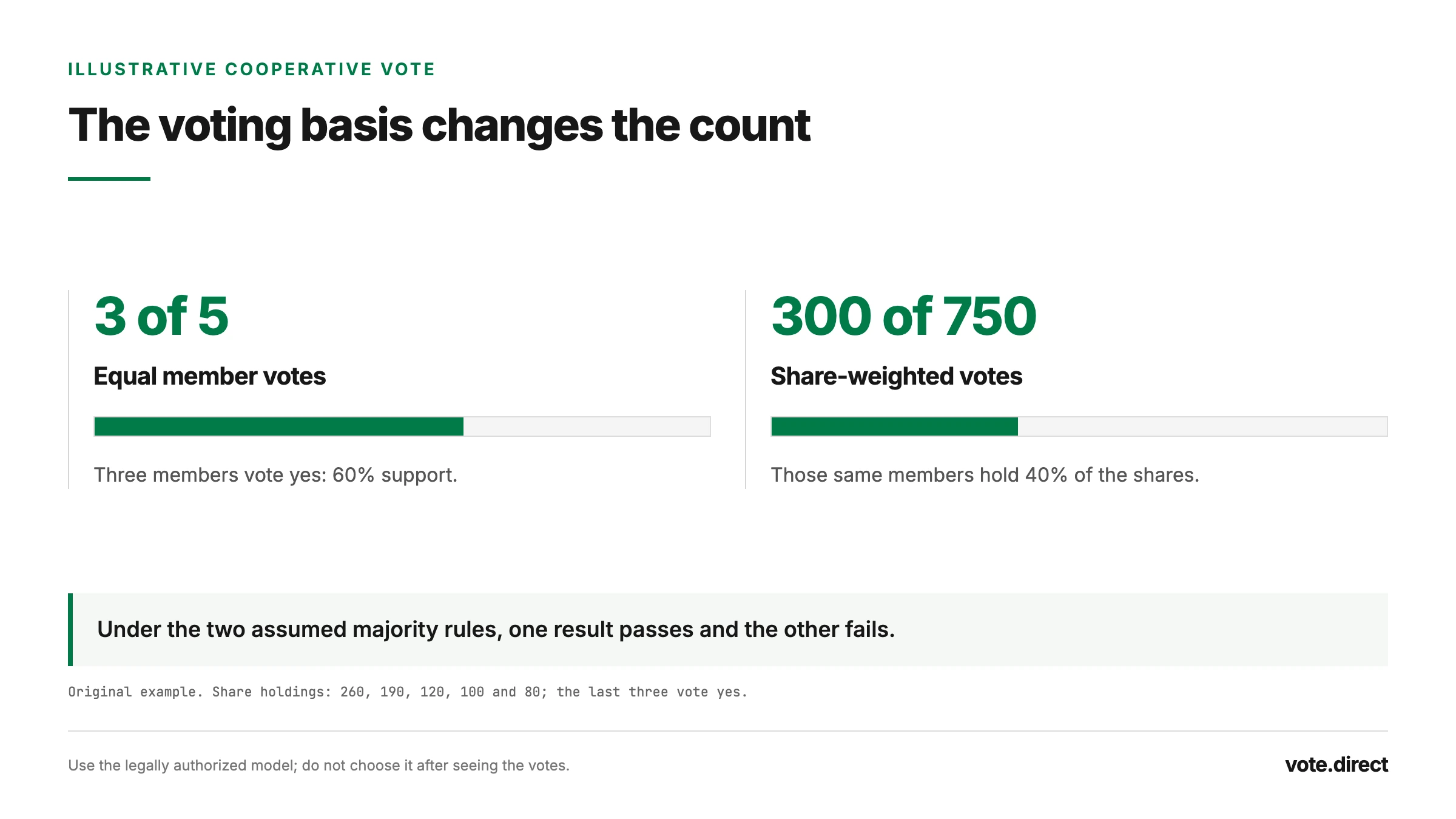
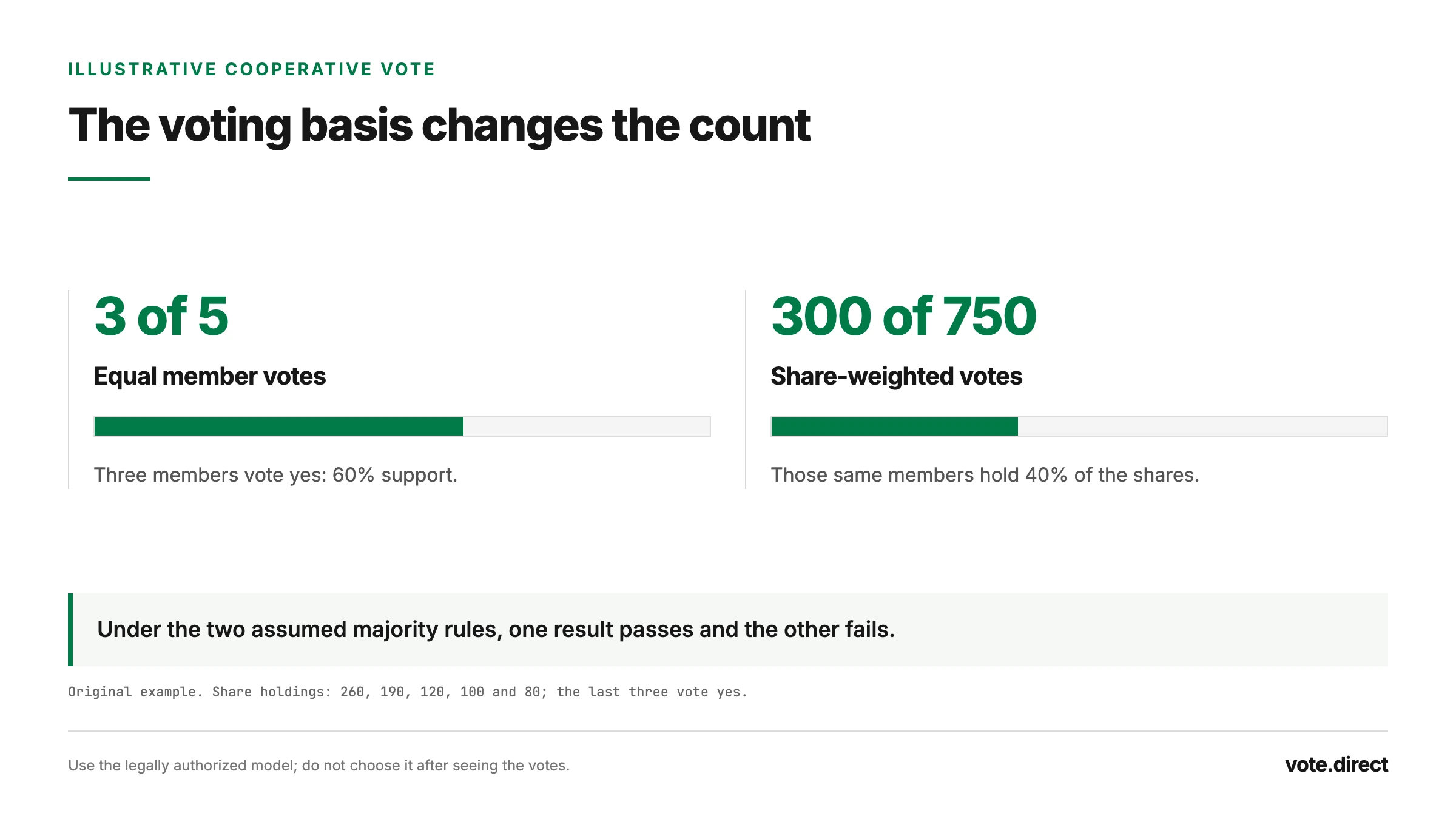
Imagine five fictional members. Their holdings and preferences are shown below. Compare two hypothetical rules: a majority of equal member votes, and a majority of shares voting. Assume all eligible interests participate and no other approval conditions apply.
| Member | Shares in the illustration | Choice |
|---|---|---|
| A | 260 | No |
| B | 190 | No |
| C | 120 | Yes |
| D | 100 | Yes |
| E | 80 | Yes |
With equal member votes, three of five vote yes: 60 percent. With share weighting, the same yes voters hold 300 of 750 shares: 40 percent. The first assumed rule approves the proposal; the second does not.
This is not a suggestion to choose the favorable model. It shows why the authorized voting basis must be settled before the election. Changing weights after seeing the preferences changes the decision rather than clarifies it. See weighted voting for counting mechanics.
Handle joint interests without duplicating them
Two email addresses do not necessarily mean two voting interests. If two people jointly hold one membership or the same shares, establish who may exercise the interest and how conflicting submissions are treated. Do not simply upload both contacts with the full voting weight.
The roster should connect each voting interest to its authorized participation record. Preserve the basis for the weight and any authorized representative. If a transfer occurs near the meeting, apply the relevant eligibility or record-date rule instead of casually moving the ballot to the newest contact.
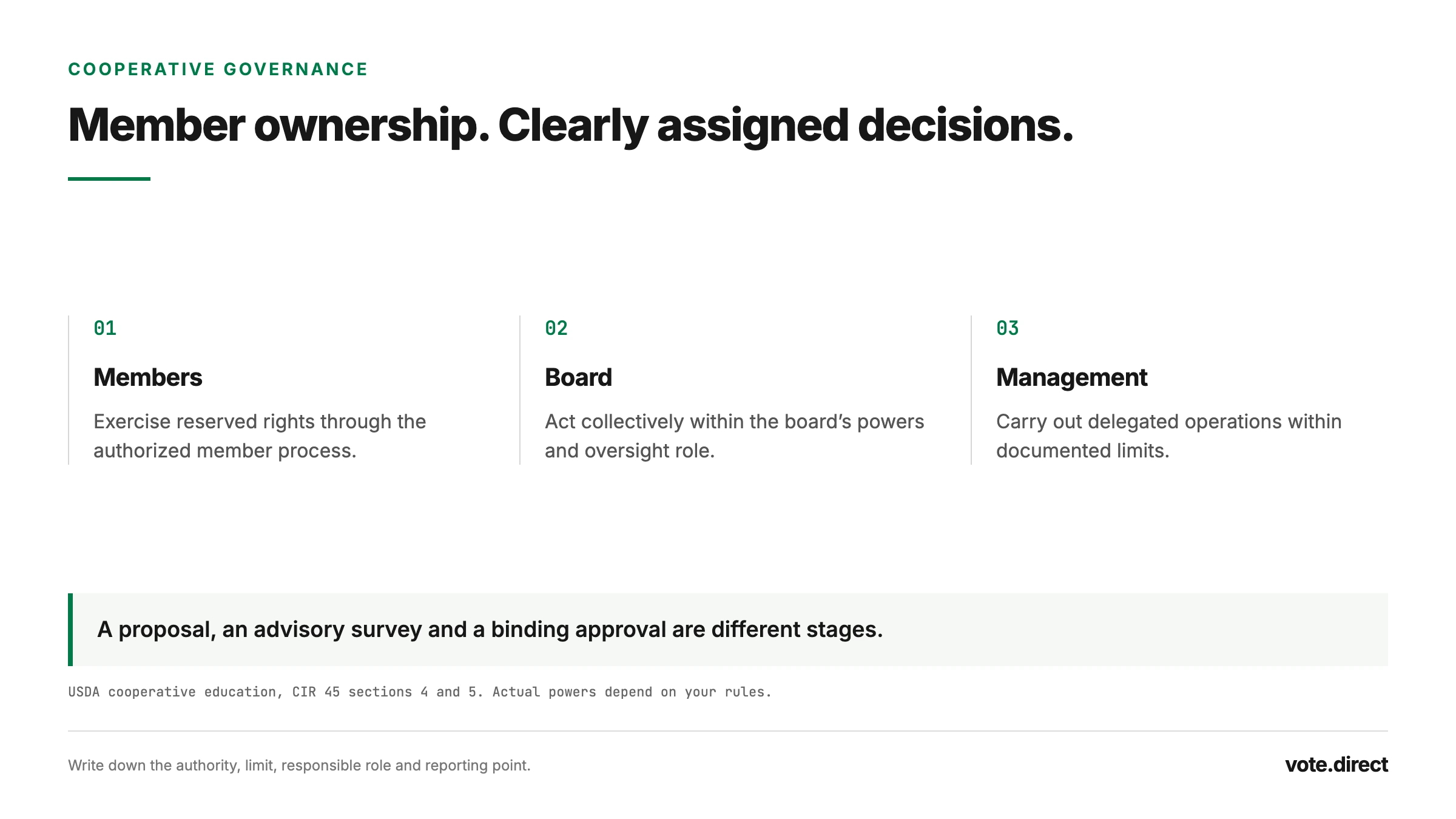
Member votes and director votes remain separate
A director's ownership stake does not automatically determine the weight of that person's board vote. Likewise, a member's right to use a proxy does not establish a director's right to send a substitute to a board meeting.
Name the body and capacity on each record. A cooperative may hold a membership election, followed by a board organizational meeting. Use separate eligibility and counting rules for each. See board director proxies and cooperative board versus member decisions.
Test the setup with a small example
Before opening voting, create a nonbinding test roster with a few fictional interests. Check the total eligible weight, duplicate prevention, permitted candidate selections, blank ballots and expected result. Ask a second reviewer to calculate the sample independently from the governing rule.
Do not use real members' secret choices as testing material. Document the approved configuration and preserve the underlying rule reference with the final election report. A correct sum is useful only when it sums the right voting interests.
Frequently Asked Questions
Does owning more capital always give a cooperative member more votes?
No. Capital participation and voting rights can be structured differently. Identify the legal voting basis and relevant class rights rather than assuming investment size determines the vote.
Does each person in a jointly owned apartment receive a ballot?
Not necessarily. The relevant voting interest and joint-holder rules determine participation. Multiple people linked to one interest should not accidentally receive duplicate full-weight votes.
Can software convert a share-based election to one member, one vote?
A software setting cannot amend the legal voting structure. Any change requires the applicable governing-document and legal process before the new rule is used.
Source notes and next steps
Primary sources checked September 5, 2026: ICA principles, New York BCL §612 and USDA housing-cooperative sample documents. The five-member tally is original. USDA's sample is educational material, not a current legal opinion or a mandatory form.
Explore NYC co-op shareholder elections, cooperative election planning, and the cooperative governance library. Managed cooperative elections cover the administration, online and by mail.
This article is general information, not legal advice. We recommend you do your own research and confirm anything you plan to act on. Where this article states law, the section is cited so you can read the primary source yourself rather than take our word for it. That is what the citations are for. Election requirements also turn on your own governing documents, which we have not seen, and statutes are amended. For advice about your community, consult a qualified attorney licensed in your state.
We work hard to verify every citation against the primary source, but laws change and errors happen. If you spot an inaccuracy, email support@vote.direct and we will correct it. See our editorial standards for how these pages are researched and checked.