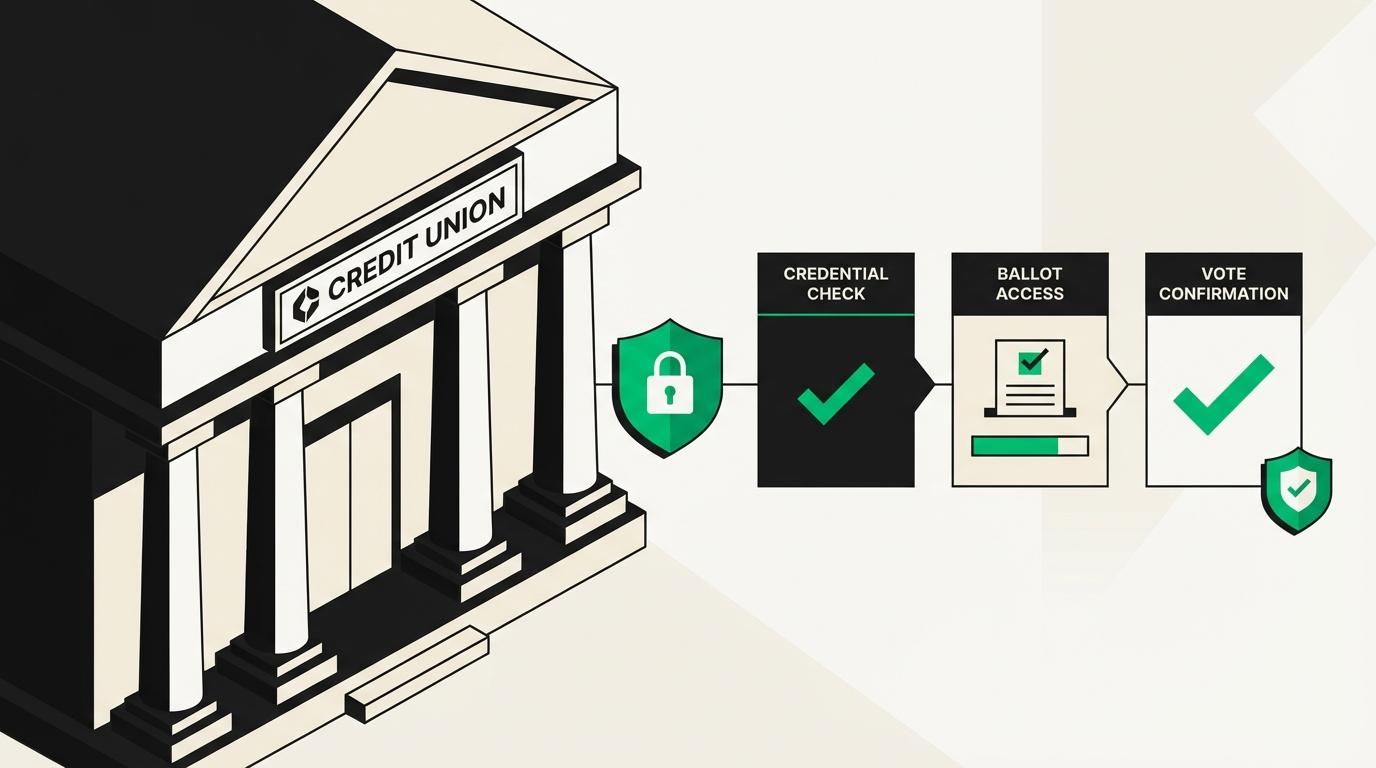
The $5,000 Election Problem
Credit unions are member-owned financial cooperatives. Every member gets one vote, regardless of deposit size. This democratic structure is the foundation of the credit union movement and a core regulatory requirement.
But running a compliant board election costs real money. Most credit unions hire third-party election vendors, companies like Survey & Ballot Systems, YesElections, or Association Voting Solutions, to manage the process. These vendors charge $3,000 to $8,000 per election, depending on membership size and services required.
For a credit union with $50 million in assets and 5,000 members, that annual election cost is a line item that directly reduces the operating budget available for member services: better rates, lower fees, and branch improvements.
And for the 3,200+ credit unions with fewer than 5,000 members, the election cost is disproportionately large relative to their operating budget. A $5,000 election bill hits differently when your total operating budget is $500,000.
This article is for informational purposes only and does not constitute legal advice. Credit union election requirements vary by charter type, state, and individual bylaws. Consult your credit union's legal counsel and NCUA examiner for advice specific to your institution.
What the Federal Credit Union Act Requires
The Federal Credit Union Act (12 U.S.C. §1761) and NCUA regulations establish the framework for credit union governance. Board elections are among the most closely regulated aspects of credit union operations.
Key Regulatory Requirements
| Requirement | Authority | What It Means |
|---|---|---|
| Democratic governance | 12 U.S.C. §1761(a) | One member, one vote, regardless of share balance |
| Board composition | 12 U.S.C. §1761(a) | Odd number of directors, minimum 5, maximum per bylaws |
| Annual meeting | FCU Bylaws, Appendix A to 12 C.F.R. Part 701, Article IV | Must hold annual meeting; election of directors required |
| Nominating committee | FCU Bylaws, Appendix A to 12 C.F.R. Part 701, Article V | Nominating committee must be appointed; members may also petition |
| Secret ballot | Model bylaws & most FCU bylaws | Ballot secrecy required for contested elections |
| Record retention | FCU bylaws & examiner guidance | Election records must be retained for specified periods |
The Nominating Committee Process
NCUA regulations require federal credit unions to have a Nominating Committee that is responsible for identifying and vetting board candidates. The process follows a specific timeline:
- 1The board appoints a Nominating Committee: at least 3 members, typically 60–90 days before the annual meeting
- 2The committee identifies candidates: reviews qualifications, conducts interviews, recommends a slate
- 3Nomination by petition: Members may also nominate candidates by collecting signatures from 1% of the membership (minimum 20, maximum 500 signatures)
- 4Notice requirements: Candidates and election procedures must be communicated to members at least 30 days before the election for federal credit unions
- 5Ballot distribution: For mail ballot elections, ballots must be sent to all eligible members

How Credit Unions Run Elections Today
Traditional Vendor Model
Most credit unions outsource their elections to specialized vendors. A typical vendor engagement includes:
| Service | Cost Range |
|---|---|
| Ballot design and printing | $500–$1,500 |
| Mailing (outbound + return) | $1,000–$3,000 |
| Tabulation and certification | $500–$1,000 |
| Online voting portal (add-on) | $1,000–$2,000 |
| Candidate statement distribution | $300–$800 |
| Total per election | $3,000–$8,000 |
For a credit union with 10,000 members, the cost per eligible voter is $0.30–$0.80, just for the election infrastructure, before any staff time is counted.
The Participation Problem
Credit union board elections consistently suffer from low member participation. Industry data suggests:
- Mail ballot elections: 5–15% participation
- In-branch voting: 2–5% participation
- Annual meeting attendance: typically 1–3% of membership
- Uncontested elections: often declared by acclamation with no ballot at all
Low participation weakens the democratic mandate of the board and creates governance concerns for NCUA examiners during supervisory examinations.
Common Election Challenges
- 1Uncontested elections: In many credit unions, the nominating committee slate runs unopposed year after year. While this reduces cost (no ballot required), it raises questions about genuine democratic governance.
- 2Petition candidate hurdles: Collecting signatures from 1% of membership is a significant barrier. A credit union with 20,000 members requires 200 petition signatures, a logistical challenge that discourages member nominations.
- 3Ballot return rates: Mail ballot response rates have declined steadily, mirroring the broader trend in physical mail engagement. Many members discard election materials along with marketing mail.
- 4Cost pressure: The fixed costs of printing and mailing make elections expensive regardless of participation. A $5,000 election with 8% participation means the credit union spent $6.25 per actual vote cast for a 10,000-member institution.
Digital Voting for Credit Unions
How Verified Digital Elections Work
- 1Upload your member roster: Import eligible voters from your core banking system
- 2Create the ballot: Add board positions, candidates, and any other resolutions
- 3Set verification level: Email, SMS, or government ID verification
- 4Define the voting window: Typically 7–21 days before the annual meeting
- 5Members vote securely: Each member receives a unique voting link, verifies their identity, and casts their secret ballot
- 6Results certified instantly: When the voting window closes, results are available with full audit trail
Compliance Alignment
| NCUA Requirement | How Digital Voting Satisfies It |
|---|---|
| One member, one vote | System-enforced: verified members can vote exactly once |
| Secret ballot | Anonymous mode: identity verified, ballot choices private |
| Member notification | Automated email/SMS delivery with delivery confirmation |
| Record retention | Digital records stored and exportable for examination |
| Equal access | Available on any device, 24/7 during the voting window |
| Audit trail | Timestamped logs of every verification and ballot submission |
This one gets heated
Should community boards be required to use independent election administrators?
Cost Comparison
For a credit union with 5,000 members:
| Component | Traditional Vendor | Digital Verified (Email) | Digital Verified (SMS) |
|---|---|---|---|
| Ballot creation | $500 | $0 (included) | $0 (included) |
| Distribution | $1,500 | $0 (included) | $0 (included) |
| Tabulation | $750 | $0 (automated) | $0 (automated) |
| Election fee (flat rate) | Included | $249.99 (2,001–5,000 voters) | $249.99 (2,001–5,000 voters) |
| Total | $3,000–$5,000 | $249.99 | $249.99 |
| Cost per voter | $0.60–$1.00 | $0.05 | $0.05 |
| Savings | Baseline | $2,750–$4,750 (91–95%) | $2,750–$4,750 (91–95%) |
With flat-rate pricing, a 5,000-member credit union pays $249.99 per election (email + SMS included), compared to $3,000–$5,000 with a traditional vendor. Credit unions with more than 5,000 members can contact us for enterprise pricing.
Participation Impact
Credit unions that adopt digital voting consistently report 3–5x higher participation than mail-only elections:
| Method | Typical Participation | 5,000-Member CU |
|---|---|---|
| Mail-only ballot | 5–15% | 250–750 voters |
| In-branch only | 2–5% | 100–250 voters |
| Digital (email verified) | 25–40% | 1,250–2,000 voters |
| Hybrid (digital + mail) | 30–50% | 1,500–2,500 voters |
Higher participation strengthens the board's democratic mandate and demonstrates robust governance practices to NCUA examiners.
State-Chartered Credit Union Considerations
State-chartered credit unions are regulated by state regulators in addition to (or instead of) NCUA. Election requirements may differ:
- California (DFPI): Follows California Corporations Code for credit union elections; electronic voting permitted
- Texas (TDSML): Texas Credit Union Act; electronic ballots permitted if bylaws authorize
- New York (NYDFS): Follows Banking Law; specific board composition requirements
- Illinois (IDFPR): Illinois Credit Union Act; bylaws govern election procedures
- Florida (OFR): Florida Statutes Chapter 657; specific nominating committee requirements
In all cases, check your specific charter type and state regulations. Most state regulators have followed NCUA's lead in permitting electronic voting when properly implemented.
The NCUA Examiner Perspective
During supervisory examinations, NCUA examiners evaluate governance practices including board elections. Examiners look for:
- Documented election procedures: written policies governing the election process
- Proper notice to members: evidence that all eligible members were informed
- Ballot secrecy: procedures ensuring secret ballot for contested elections
- Record retention: election records maintained per regulatory requirements
- Nominating committee compliance: proper appointment and functioning of the committee
Digital voting platforms that produce exportable audit trails, verification records, and compliance certificates provide exactly the documentation examiners expect, often in more detail than traditional vendor-managed elections.
Implementing Digital Voting at Your Credit Union
Step 1: Bylaw Review
Review your credit union's bylaws for election provisions. Most federal credit union model bylaws authorize "ballot" without specifying the format, paper vs. electronic. If your bylaws explicitly require paper ballots, a bylaws amendment is needed (which itself requires a member vote).
Step 2: Board Resolution
Adopt a board resolution authorizing electronic voting for board elections. The resolution should specify the verification method, voting window, and fallback provisions for members without internet access.
Step 3: Pilot Election
Consider running a non-binding survey or advisory vote electronically first. This familiarizes members with the process, identifies any access issues, and builds confidence before the first official board election.
Step 4: Member Communication
Communicate the change well in advance. Emphasize the benefits: convenience (vote from home), security (identity verification), and accessibility (available 24/7 during the voting window).
Step 5: Maintain a Paper Fallback
For federal credit unions, best practice is to maintain a paper ballot option for any member who requests one. This ensures no member is disenfranchised by the technology transition.
FAQ
Q: Does NCUA explicitly authorize electronic voting for board elections?
NCUA has not prohibited electronic voting. NCUA's model bylaws refer to "ballots" without mandating a physical format. Many credit unions have adopted electronic voting with NCUA examiner awareness, and the practice has become broadly accepted across the industry. However, verify with your specific examiner before implementation.
Q: Can we use email verification, or do we need government ID?
For most credit union board elections, email or SMS verification (included in flat rate) provides sufficient identity assurance. Government ID verification ($3.00/voter add-on) provides the strongest identity confirmation and may be appropriate for merger votes or other high-stakes decisions.
Q: What about members without internet access?
Maintain a paper ballot option for any member who requests one. In practice, credit unions report that fewer than 5% of members request paper ballots after digital voting is introduced.
Q: Will our election vendor be upset if we switch?
Your obligation is to your members, not your vendor. A $4,000 annual savings that gets redirected to better member rates or lower fees is precisely what the cooperative model is designed to achieve.
The Bottom Line
Credit unions exist to serve their members, not to enrich election vendors. A board election should cost the minimum necessary to achieve compliance and integrity, with every dollar saved redirected to member services.
Digital verified voting cuts election costs by 75–90%, increases participation by 3–5x, and produces audit documentation that exceeds what traditional vendors provide. For a member-owned cooperative built on democratic principles, that combination isn't optional. It's aligned with the mission.
Sources:
- 1Federal Credit Union Act: 12 U.S.C. §1761 (Board of Directors provisions)
- 2NCUA: Federal Credit Union Bylaws, Appendix A to 12 C.F.R. Part 701, Article V (Nominating committee and election procedures)
- 3NCUA: Federal Credit Union Bylaws, Appendix A to 12 C.F.R. Part 701, Article IV (Annual meeting requirements)
- 4NCUA Examiner's Guide and FCU bylaws: Election-record retention guidance
- 5NCUA: Federal Credit Union Bylaws (model bylaws, election provisions)
- 6CUNA: Best practices for credit union governance and elections
- 7Survey & Ballot Systems: Credit union election service pricing (industry reference)
This article is general information, not legal advice. We recommend you do your own research and confirm anything you plan to act on. Where this article states law, the section is cited so you can read the primary source yourself rather than take our word for it. That is what the citations are for. Election requirements also turn on your own governing documents, which we have not seen, and statutes are amended. For advice about your community, consult a qualified attorney licensed in your state.
We work hard to verify every citation against the primary source, but laws change and errors happen. If you spot an inaccuracy, email support@vote.direct and we will correct it. See our editorial standards for how these pages are researched and checked.