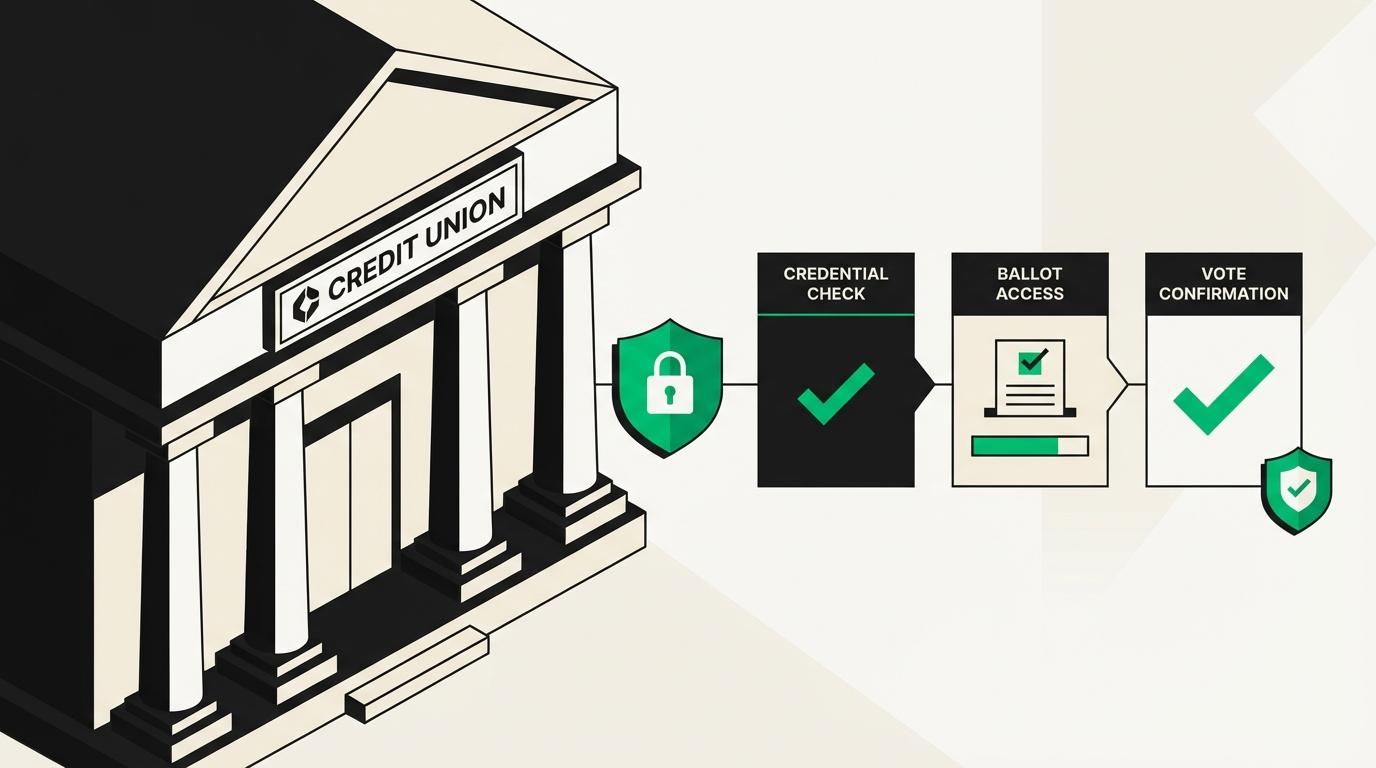
What Your Examiner Looks For (And What Most Credit Unions Get Wrong)
Every NCUA examination includes a review of your credit union's governance practices, and board elections are a focal point. Examiners don't just check whether you held an election. They evaluate how you conducted it, whether your procedures met regulatory requirements, and whether your documentation is complete enough to demonstrate compliance.
This guide walks through the specific items NCUA examiners check during an election review, common findings that lead to examiner concerns, and the documentation standards that make examination day stress-free.
This article is for informational purposes only and does not constitute legal or regulatory advice. Consult your NCUA examiner and legal counsel for guidance specific to your credit union.
The NCUA Election Compliance Framework
Regulatory Authority
NCUA's election requirements for federal credit unions come from three sources:
| Source | What It Covers |
|---|---|
| Federal Credit Union Act (12 U.S.C. §1761) | Board composition, member voting rights, annual meetings |
| FCU Bylaws (Appendix A to 12 C.F.R. Part 701) | Detailed election procedures, nominating committee rules |
| FCU Bylaws (Standard or Amended) | Specific procedures for your credit union (notice periods, petition requirements, voting methods) |
The Examiner's Checklist
During a governance review, NCUA examiners typically evaluate:
| Item | What They Check | Common Finding |
|---|---|---|
| Nominating committee composition | At least 3 members, none are board/supervisory committee members or employees | Committee includes a board member (violation) |
| Nominating committee independence | Committee operates independently from the board | Board directed the committee on who to nominate |
| Petition nomination opportunity | Members had the chance to nominate by petition | No petition process was announced |
| Notice timing | 30–75 days before annual meeting | Notice sent too late or too early |
| Notice content | Includes nominees, meeting details, voting instructions | Missing candidate information |
| Ballot integrity | Secret ballot, one member/one vote, independent tellers | Tellers were related to candidates |
| Results certification | Official count recorded in minutes | No formal certification in records |
| Record retention | All materials preserved for examination | Ballots discarded after meeting |
The Seven Most Common Examination Findings
Finding 1: Nominating Committee Not Independent
The rule: Nominating committee members cannot be current board members, supervisory committee members, or credit union employees.
Why it matters: The nominating committee exists to provide an independent slate of candidates. If board members control the committee, the election is not genuinely democratic.
Fix: Appoint committee members from the general membership. The board chair makes the appointment, but the appointees must be independent.
Finding 2: No Petition Nomination Process
The rule: Members must have the right to nominate candidates by petition, independent of the nominating committee.
Why it matters: The petition process ensures that any qualified member can run, not just those chosen by the committee.
Fix: Announce the petition process in the same notice as the annual meeting. Specify the petition deadline, required number of signatures, and submission instructions.
Finding 3: Inadequate Notice
The rule: At least 30 days but not more than 75 days before the annual meeting.
Why it matters: Too little notice prevents members from participating. Too much notice means members forget.
Fix: Build a compliance calendar. Set the annual meeting date first, then work backward to calculate notice deadlines.
Finding 4: Election by Acclamation Without Petition Period
The rule: You can conduct an election by acclamation (without a ballot) only if the number of nominees equals the number of open seats AND the petition period has passed with no additional nominations.
Why it matters: Skipping the petition period denies members their right to nominate candidates.
Fix: Always conduct the full petition period, even if you expect no additional nominees. Document that the petition period occurred and that no petitions were received.
Finding 5: Insufficient Ballot Security
The rule: All board elections must use a secret ballot (unless election is by acclamation).
Why it matters: Secret ballot protects member privacy and prevents intimidation. Non-secret voting methods (show of hands, voice vote) are never acceptable for board elections.
Fix: Use sealed paper ballots with independent tellers, or an electronic voting platform with verified anonymity.
Finding 6: Teller Conflicts of Interest
The rule: Tellers (vote counters) should not be candidates, board members, or employees with a stake in the outcome.
Why it matters: Conflicted tellers undermine ballot integrity.
Fix: Appoint independent tellers from the general membership, or use an electronic voting platform that provides automatic, auditable tabulation.
Finding 7: Records Not Retained
The rule: All election records should be retained through at least one full examination cycle (typically 12–18 months, but 3 years is safest).
Why it matters: If the examiner asks to see your election records and you can't produce them, it raises serious governance concerns.
Fix: Create an election file that includes: notice copies with send dates, nominee list, petition announcements, ballots (anonymized), teller reports, meeting minutes with results, and any member complaints.
Building Your Compliance Documentation Package
The Election File
Every credit union should maintain a complete election file containing:
- 1Board resolution appointing the nominating committee (with dates and member names)
- 2Nominating committee report listing all candidates considered and the final slate
- 3Petition nomination announcement with deadline and instructions
- 4Any petitions received (or documentation that none were received)
- 5Annual meeting notice with proof of delivery (mail receipt, email delivery log)
- 6Candidate biographical statements
- 7Ballot template (blank ballot copy)
- 8Teller appointment documentation
- 9Teller certification of results (signed by tellers)
- 10Meeting minutes recording the election results
Using Digital Voting for Compliance
Electronic voting platforms can dramatically simplify compliance documentation:
| Manual Process | Digital Platform |
|---|---|
| Paper notice with uncertain delivery | Email/SMS notice with delivery confirmation |
| Ballots counted by volunteer tellers | Automatic tabulation with audit trail |
| Results certified by hand | Timestamped certification report |
| Records stored in filing cabinet | Exportable digital archive |
At [vote.direct](https://vote.direct), credit union elections generate a complete compliance package that includes voter verification logs, ballot secrecy confirmation, timestamped results, and exportable reports, exactly what your NCUA examiner needs.
Frequently Asked Questions
Q: How often does NCUA review election procedures?
Election procedures are reviewed as part of every regular examination, which occurs on a 12–18 month cycle for most credit unions. High-risk credit unions may be examined more frequently.
Q: What happens if NCUA finds a violation?
Findings are documented in the examination report. Minor findings result in a recommendation for corrective action. Serious or repeated violations can lead to formal enforcement actions, including cease-and-desist orders or removal of officials.
Q: Do state-chartered credit unions face the same requirements?
State-chartered credit unions follow their state's credit union act, which may differ from federal requirements. However, if the credit union is federally insured, NCUA also has oversight authority for safety and soundness, which can include governance concerns.
Q: Can we use the same election procedures every year?
Yes, as long as your procedures comply with current regulations and your bylaws. However, review your procedures annually to ensure they reflect any regulatory changes or bylaw amendments.
The Bottom Line
NCUA examination is not an adversarial process. It's a quality check on your credit union's governance. Credit unions that maintain complete election documentation, follow their bylaws precisely, and use systems that create defensible records find examinations straightforward.
The credit unions that struggle are the ones that treat elections as a formality rather than a compliance obligation. Don't be that credit union.
Sources:
- 1Federal Credit Union Act, 12 U.S.C. §1761–§1761a
- 2NCUA Rules and Regulations, 12 C.F.R. Part 701
- 3NCUA Examiner's Guide: Chapter on governance and elections
- 4NCUA Letter to Federal Credit Unions 06-FCU-03: Electronic voting
- 5NCUA Supervisory Letter 15-01: Governance best practices
- 6Credit Union National Association: Election compliance resources
This article is general information, not legal advice. We recommend you do your own research and confirm anything you plan to act on. Where this article states law, the section is cited so you can read the primary source yourself rather than take our word for it. That is what the citations are for. Election requirements also turn on your own governing documents, which we have not seen, and statutes are amended. For advice about your community, consult a qualified attorney licensed in your state.
We work hard to verify every citation against the primary source, but laws change and errors happen. If you spot an inaccuracy, email support@vote.direct and we will correct it. See our editorial standards for how these pages are researched and checked.