The Debate That Won't Die
Ask ten people whether digital or paper ballots are more secure and you'll get ten different answers, mostly based on gut feeling rather than evidence. The paper camp says you can't hack a piece of paper. The digital camp says you can't audit a box of papers. Both are partly right and partly wrong.
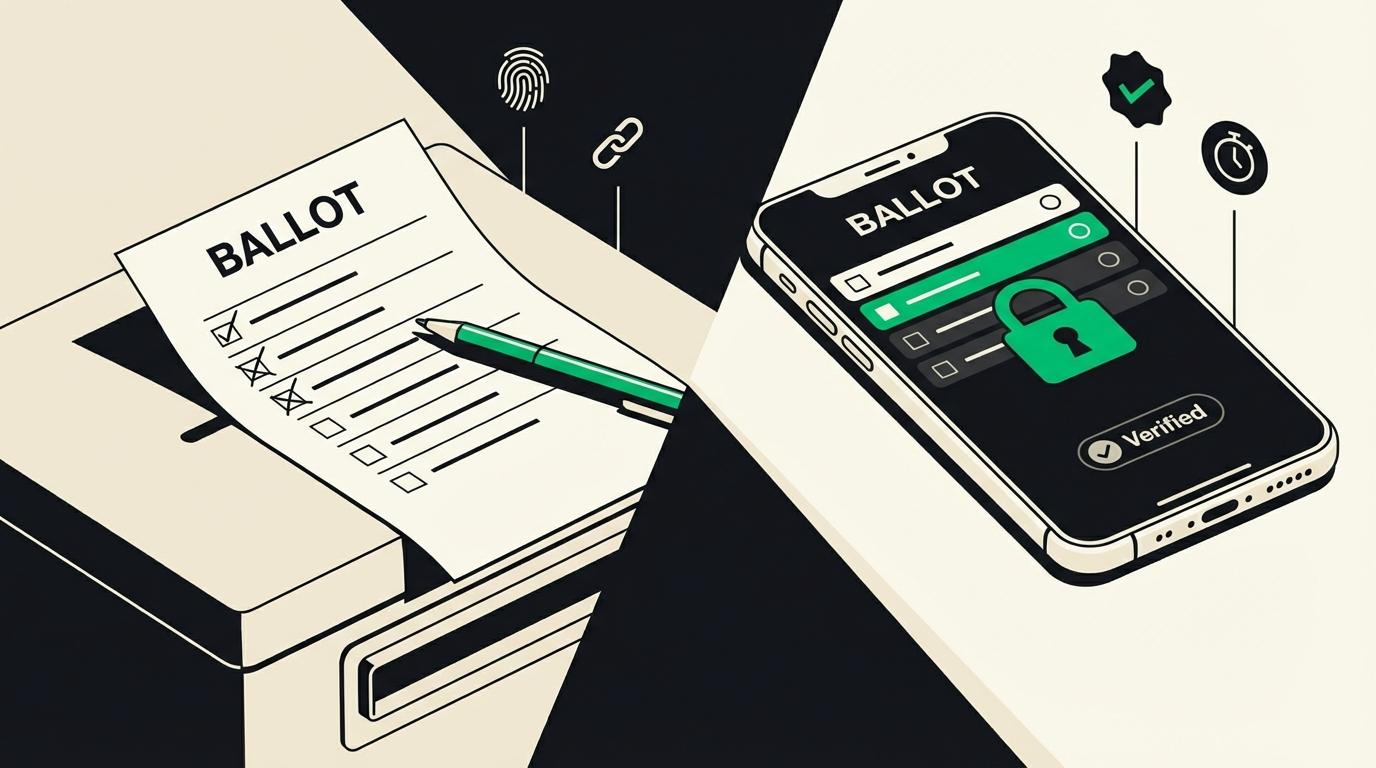
The truth is more nuanced: paper and digital ballots have different security profiles, with different strengths and different failure modes. The "right" choice depends on the specific threats your organization faces and the security properties you prioritize.
This analysis is specifically about organizational elections, HOAs, nonprofits, cooperatives, unions, and clubs. Government elections have different requirements and constraints that don't apply here.
The Seven Security Properties
Every election must deliver seven security properties. Let's compare how paper and digital perform on each.
1. Voter Identity Verification
The question: Can you prove that the person who cast a ballot is the eligible voter they claim to be?
Paper ballots:
In a typical HOA paper election, a homeowner shows up to a meeting, is checked off a list by a volunteer, and receives a paper ballot. The verification is visual, the volunteer recognizes them, or they state their name and unit number. There's rarely any formal ID check.
For mailed paper ballots, the verification is even weaker. A ballot is mailed to an address. Whoever opens the mailbox fills it out and returns it. The only verification is often a signature on the outer envelope, and most organizations don't have signature samples on file to compare against.
Digital ballots:
Verification options range from email OTP (proves access to the registered email account) to SMS OTP (proves possession of the registered phone) to government ID with biometric matching (proves physical identity). Each level is independently verifiable and logged.
Winner: Digital. Paper elections rely on trust and visual recognition. Digital elections can cryptographically prove voter identity at the level appropriate to the stakes.
2. One-Credential-One-Ballot Enforcement
The question: Can a single voter cast more than one ballot?
Paper ballots:
A check-off list at the meeting prevents in-person double voting, assuming the volunteer is attentive. For mailed ballots, there's typically no mechanism to prevent a household member from filling out multiple ballots from different residents in the same unit.
A real case: In the Hammocks HOA election fraud case in Miami (18,000+ residents), investigators found instances where individual unit owners had submitted multiple ballots in different names. The paper system had no mechanism to detect this until after the fact.
Digital ballots:
The system enforces one-vote-per-verified-identity at the technical level. Once a voter submits their ballot, their unique voting link is deactivated. There's no way to submit a second ballot without a new verification, and the system won't issue one because the voter roll shows them as already voted.
Winner: Digital. Technical enforcement is absolute. Human enforcement (checking a list) has error rates.
3. Ballot Secrecy
The question: Can anyone determine how a specific individual voted?
Paper ballots:
Physical ballot secrecy is generally strong in a well-run election. Voters fill out their ballot in private, fold it, and deposit it in a box with other ballots. Once mixed, individual ballots are indistinguishable.
However, secrecy can be compromised: ballots with distinctive handwriting, stray marks, or numbered ballot stubs can be traced. In small elections (under 20 voters), the specific mix of choices on a ballot might uniquely identify the voter.
Digital ballots:
On a well-architected platform, voter identity and ballot contents are stored in separate database tables with no linking key. The system records that "Voter #47 verified and submitted a ballot at 3:14 PM" and separately records "Ballot #892 contains votes for Alice and Bob", but there's no field connecting voter 47 to ballot 892.
This architectural separation makes ballot attribution technically impossible, even for database administrators.
Winner: Tie. Both can provide strong ballot secrecy when properly implemented. Paper has a slight edge in simplicity (no architecture to trust), but digital has a slight edge in consistency (doesn't depend on volunteers handling ballots correctly).
4. Tampering Resistance
The question: Can votes be altered after they are cast?
Paper ballots:
Paper ballots are vulnerable to physical tampering during any period when they're not under direct observation. Between the meeting room and the counting location, between the mailbox and the counting table, during any "break" in counting, these are opportunities for ballots to be added, removed, or altered.
The chain of custody is only as strong as the people maintaining it. And in most organizational elections, the "chain of custody" is a volunteer carrying a box across a parking lot.
Digital ballots:
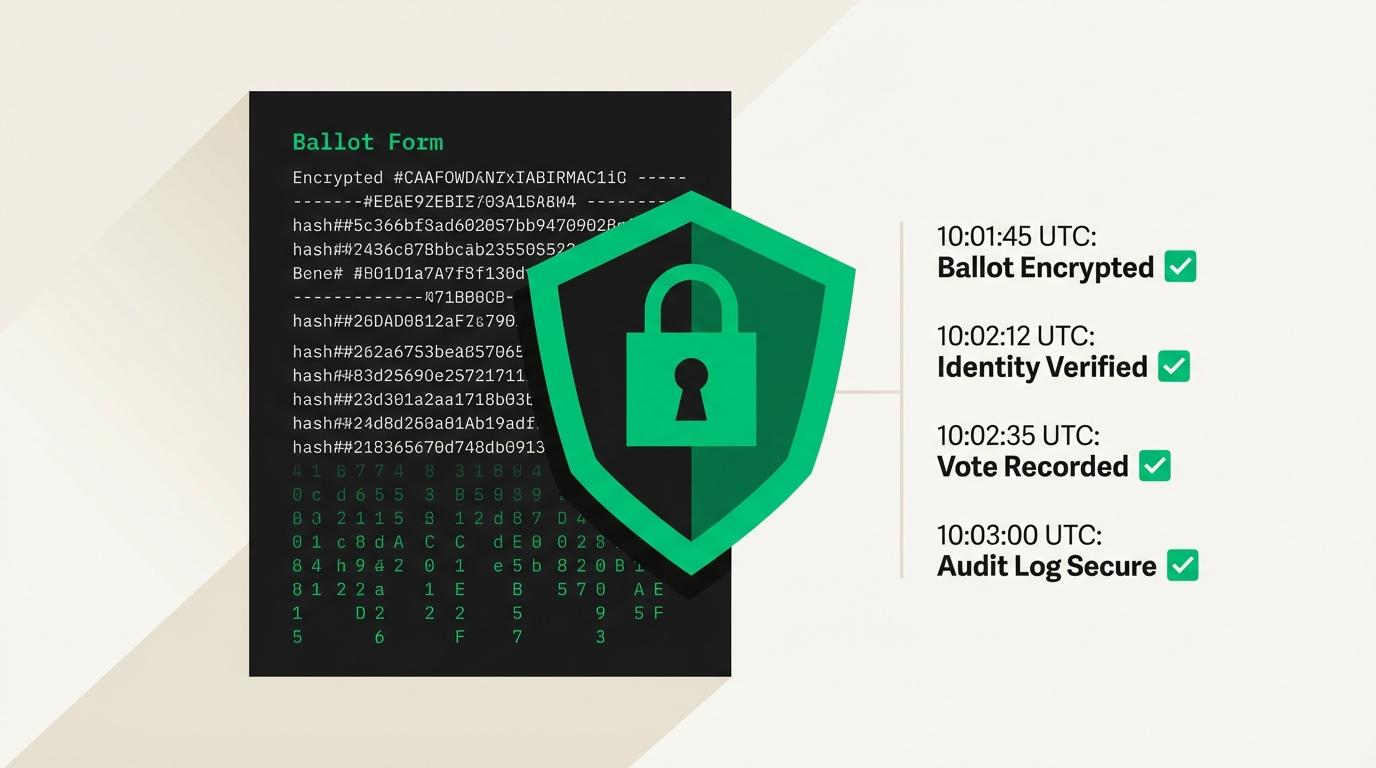
Properly stored digital ballots are cryptographically hashed at submission. Any alteration to the data changes the hash, which is immediately detectable by automated integrity checks. The ballots are stored in append-only database structures that prevent updates and deletions.
Winner: Digital. Cryptographic integrity checks are mathematically provable. Physical custody checks depend on human behavior.
5. Counting Accuracy
The question: Are votes tallied correctly?
Paper ballots:
Hand counting introduces human error. Studies of hand-counted elections have found error rates of 1-2% for simple races and higher for complex ballots. When ballots have multiple questions, write-in candidates, or ranked choices, error rates increase.
The Florida 2000 presidential election (while a government election) demonstrated the core problem with paper counting: "hanging chads," "dimpled chads," and ballots where intent was ambiguous led to different counts by different counting teams.
In organizational elections, the stakes are lower but the counting rigor is also lower. Two volunteers counting 200 paper ballots at 10 PM after a 3-hour meeting is not a recipe for accuracy.
Digital ballots:
Counting is performed by software. The algorithm is deterministic, given the same inputs, it produces the same outputs every time. There's no fatigue, no ambiguity, no "was that a checkmark or a stray mark?" The results are available within seconds of the election closing.
For ranked choice elections, the advantage is even more stark. Manual ranked choice counting (sorting and resorting physical ballots through multiple elimination rounds) takes hours and has significant error potential. Digital platforms process the same election in under a second.
Winner: Digital. Software counting is faster, more accurate, and deterministic. The only caveat: the software must be correct, which is why reputable platforms publish their counting methodology and produce results that can be independently verified.
What keeps you up at night?
What concerns you most about your organization's current voting process?
6. Auditability
The question: Can the election be independently verified after the fact?
Paper ballots:
Paper ballots are their own audit trail, in theory. In practice, paper degrades, gets misfiled, is accidentally discarded, or is stored in conditions that make it unusable. Many organizations don't have formal retention procedures, and the "audit trail" is a box of ballots in a storage closet.
Even when paper ballots are well-preserved, they can only prove what marks were made on paper. They can't prove who made those marks, when they were made, or whether the box contains the same ballots that were originally deposited.
Digital ballots:
A complete digital audit trail includes:
- Timestamped voter verification events
- Cryptographic ballot hashes
- Participation records
- System access logs
- Result calculation records
- All exportable as a permanent record
This trail can be independently reviewed by any party to verify that the election was conducted correctly, that voter verification occurred, and that results match the ballots.
Winner: Digital. A digital audit trail is more complete, more durable, and more verifiable than a box of paper.
7. Accessibility
The question: Can all eligible voters participate?
Paper ballots (in-person):
Requires physical presence at a specific time and place. Members who travel, work evening shifts, have mobility limitations, or are seasonal residents are effectively disenfranchised.
Paper ballots (mailed):
Better accessibility but slow. Members must receive the ballot, fill it out, and return it, all within the mailing window. USPS delays and wrong addresses reduce participation.
Digital ballots:
Any device, anywhere, on the voter's own schedule during the voting window. A 7-14 day voting window with email reminders produces participation rates 2-3 times higher than in-person-only elections.
Winner: Digital. Accessibility isn't just a convenience feature, it's a security feature. Higher participation rates mean the results better represent the actual will of the membership, making elections harder to challenge as unrepresentative.
The Scorecard
| Security Property | Paper | Digital | Winner |
|---|---|---|---|
| Identity verification | Weak | Strong | Digital |
| Duplicate-ballot controls | Moderate | Strong | Digital |
| Ballot secrecy | Strong | Strong | Tie |
| Tampering resistance | Moderate | Strong | Digital |
| Counting accuracy | Moderate | Very strong | Digital |
| Auditability | Weak | Strong | Digital |
| Accessibility | Weak | Strong | Digital |
Overall: Digital ballots are more secure than paper for organizational elections when the platform implements proper identity verification, cryptographic integrity, and separation of voter identity from ballot contents.
When Paper Still Makes Sense
Paper ballots have a role in two scenarios:
1. Members without internet or email access. A small percentage of your membership may not have reliable internet access. Offering mail-in paper ballots alongside digital voting ensures universal access. Platforms like vote.direct support hybrid elections where most voters use digital ballots and a subset receive physical mail-in ballots with USPS delivery tracking.
2. Extreme distrust of technology. In communities where members fundamentally distrust digital systems, forcing an all-digital election may create more conflict than it resolves. Offering paper as an option alongside digital can bridge the trust gap while still capturing the security benefits for the majority of voters.
The Hybrid Approach
The best organizational elections offer digital-first with paper backup:
- 1Primary channel: Digital ballots with identity verification, audit trails, and automated counting
- 2Backup channel: Physical mail-in ballots for members without email, with USPS delivery tracking and unique PIN codes for verification
- 3In-person option: Members can vote at the meeting on a shared device or receive a paper ballot on-site
This approach captures the security advantages of digital verification and audit trails while ensuring no member is excluded from the process.
Making the Switch
If your organization currently uses paper ballots and you're considering digital voting:
- 1Check your bylaws. Do they authorize electronic voting? If not, amend them first (many states now explicitly authorize electronic voting for HOAs and nonprofits).
- 2Start with a low-stakes vote. Run a non-binding survey or informal poll digitally before using it for board elections. This builds member comfort.
- 3Communicate the security benefits. Members who understand the identity verification and audit trail features are more likely to trust the process.
- 4Offer paper as a backup. Don't eliminate paper entirely in the first year. Offer it as an option while demonstrating that digital is both easier and more secure.
This article is general information, not legal advice. We recommend you do your own research and confirm anything you plan to act on. Where this article states law, the section is cited so you can read the primary source yourself rather than take our word for it. That is what the citations are for. Election requirements also turn on your own governing documents, which we have not seen, and statutes are amended. For advice about your community, consult a qualified attorney licensed in your state.
We work hard to verify every citation against the primary source, but laws change and errors happen. If you spot an inaccuracy, email support@vote.direct and we will correct it. See our editorial standards for how these pages are researched and checked.