Quick Answer
Credit union board elections are governed first by your own bylaws and, for federal credit unions, by the [NCUA's Federal Credit Union Bylaws](https://www.ncua.gov/files/bylaws/federal-credit-union-bylaws-2020.pdf), which expressly contemplate voting by electronic device as one of the permitted methods. State-chartered credit unions follow their state supervisory authority and their own bylaws instead.
What that means when you shop for software:
| Requirement | What to ask a vendor |
|---|---|
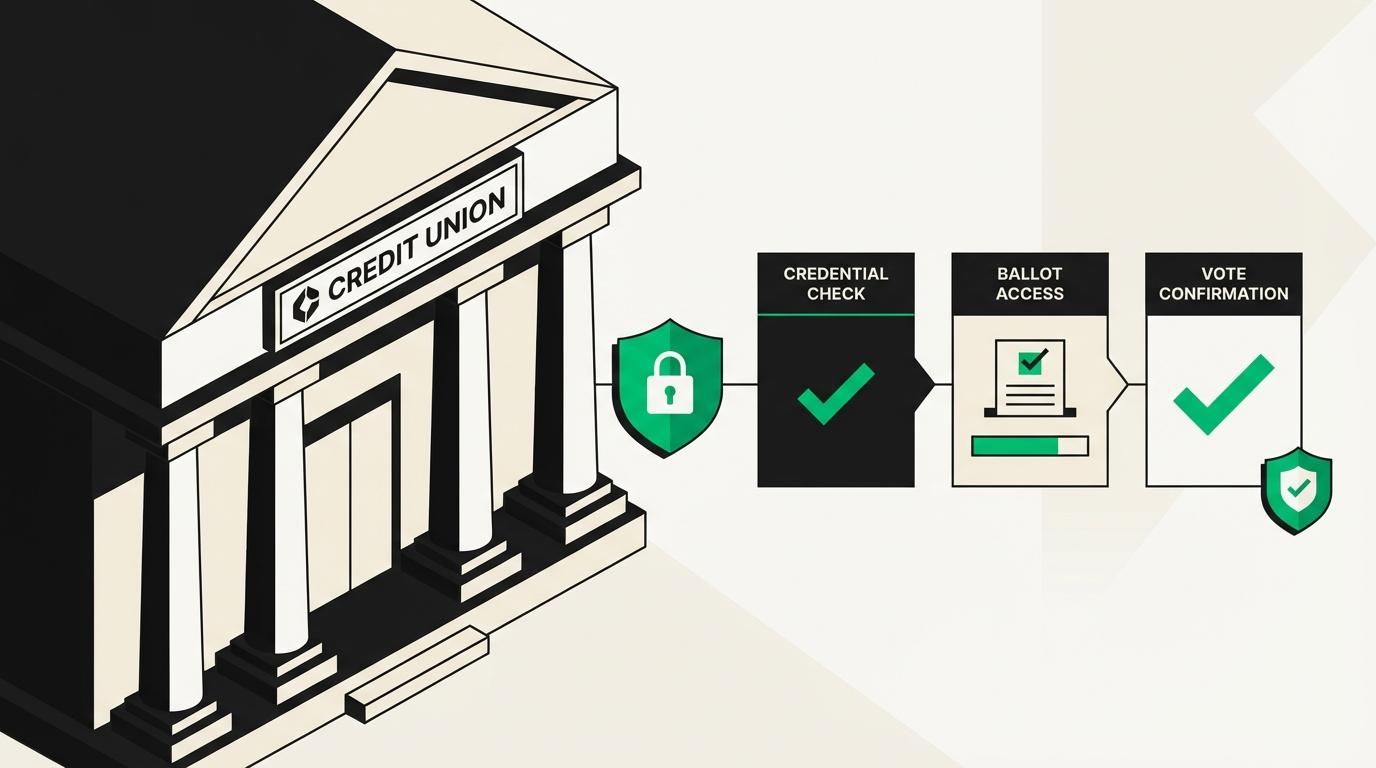
| Member verification | Can you check a voter against our membership roster before opening a ballot, by email, SMS, or ID? |
| One vote per member | Not per account, per share balance, or per household. How is that enforced? |
| Secret ballot | Can staff see how an individual member voted? If not, what prevents it? |
| Nominations by petition | Can the ballot carry petition candidates alongside nominating-committee candidates? |
| Records | What do we get afterwards, and can we still get it next year? |
The number that drives the purchase is participation. Credit union annual meeting turnout is frequently reported in the low single digits of membership, and the gap between an in-person annual meeting and a ballot a member can complete on their phone is the whole argument. Published increases come from vendor-reported customer cases and self-selected samples, so treat any specific promised percentage as marketing. CUES has covered the practical experience of moving to e-voting.
Cost: a credit union with 1,000 eligible voting members can run a verified election for $69.99 on per-election pricing here, with email and SMS verification included.
Disclosure: vote.direct publishes this comparison and sells one of the products in it.
The 3% Problem
The average large credit union achieves 3% member participation in board elections. For a credit union with 50,000 members, that means 1,500 people choose the leaders who oversee billions of dollars in member assets.
Compare that to public company shareholder elections, where proxy voting drives participation rates of 70-80%. Credit unions, organizations built on democratic member control, are being out-participated by Fortune 500 corporations.
The root cause isn't member apathy. It's method failure. Most credit unions still rely on annual meeting attendance or mail-in paper ballots, methods designed for a world where members visited their branch weekly.
This guide compares every approach to credit union elections, with real cost data, participation rates, and compliance ratings.
This article is for informational purposes only and does not constitute legal advice. Consult your regulators and legal counsel for guidance on election procedures.
The Four Approaches
Approach 1: Annual Meeting Only
Members vote by paper ballot at the annual meeting.
| Factor | Details |
|---|---|
| Cost (50,000 members) | $3,000-$8,000 (venue, printing, food) |
| Participation | 0.5-3% |
| NCUA Compliance | Moderate, depends on execution |
| Examiner Documentation | Weak, manual records |
| Setup Time | 30-50 hours staff time |
Approach 2: Mail-In Ballots
Mail ballots to all members with return envelopes.
| Factor | Details |
|---|---|
| Cost (50,000 members) | $15,000-$40,000 (printing + postage) |
| Participation | 5-12% |
| NCUA Compliance | Good, established precedent |
| Examiner Documentation | Moderate, return envelopes provide trail |
| Setup Time | 40-80 hours staff + vendor time |
Approach 3: Third-Party Election Services
Hire a specialized election vendor to manage the entire process.
| Factor | Details |
|---|---|
| Cost (50,000 members) | $20,000-$50,000 |
| Participation | 8-15% |
| NCUA Compliance | High, experienced vendors |
| Examiner Documentation | Strong, professional reports |
| Setup Time | 10-20 hours (your time) |
Approach 4: Digital Voting Platform
Use an online voting platform with identity verification and compliance documentation.
| Factor | Details |
|---|---|
| Cost (50,000 members) | $5,000-$15,000 |
| Participation | 15-35% |
| NCUA Compliance | High, built for compliance |
| Examiner Documentation | Strong, automatic audit trail |
| Setup Time | 5-10 hours |
Head-to-Head Comparison
| Factor | Meeting Only | Mail-In | Third-Party | Digital Platform |
|---|---|---|---|---|
| Cost per vote | $20-$50 | $8-$15 | $15-$30 | $1-$5 |
| Participation | 0.5-3% | 5-12% | 8-15% | 15-35% |
| Time to results | Same day | 2-4 weeks | 1-2 weeks | Instant |
| Staff hours | 30-50 | 40-80 | 10-20 | 5-10 |
| Examiner-ready docs | Manual assembly | Partial | Professional | Automatic |
| Member experience | Attend meeting | Open mail, return envelope | Varies | Vote on phone in 2 min |
The ROI Case for Digital Voting
For a credit union with 50,000 members:
| Metric | Mail-In Election | Digital Election | Savings |
|---|---|---|---|
| Direct cost | $25,000 | $8,000 | $17,000 |
| Staff hours | 60 hrs ($3,000) | 8 hrs ($400) | $2,600 |
| Member participation | 3,000 (6%) | 12,500 (25%) | 4x increase |
| Time to results | 3 weeks | Instant | 3 weeks |
| Examiner prep time | 8 hours | 1 hour | 7 hours |
Total estimated savings: $19,600 per election with 4x higher participation.
What to Look For in Credit Union Election Software
Must-Have Features
- Member identity verification: Not just email; actual identity confirmation against your membership database
- One member, one vote enforcement: System-level prevention of duplicate voting
- Anonymous ballot: Verified identity separated from ballot choices
- NCUA-ready compliance reports: Exportable documentation package
- Bylaws-configurable: Support for your specific notice periods, petition rules, and voting methods
Important Features
- Integration with core system: Import member eligibility from your core banking platform
- Multi-channel delivery: Email, SMS, and mail notification
- Real-time participation dashboard: Monitor voting in progress
- Candidate profile pages: Present nominee statements alongside the ballot
- Custom branding: Your credit union's logo and colors
vote.direct for Credit Union Elections
At vote.direct, credit union elections include:
- Assisted government-ID verification at $3.00 per checked voter, when arranged
- Anonymous voting withholding identity from results, admin views and exports
- Compliance certificate documenting the complete election process
- Real-time participation tracking visible to the election committee
- Exportable audit trail for NCUA examination documentation
For a 50,000-member credit union, a fully verified board election costs approximately $8,000-$12,000, less than half the cost of mail-in ballots, with 3-5x the participation.
Sources:
- 1Federal Credit Union Act, 12 U.S.C. §1761
- 2NCUA Rules and Regulations, 12 C.F.R. Part 701
- 3NCUA Letter to FCUs 06-FCU-03: Electronic voting
- 4Credit Union National Association: Election participation data
- 5Filene Research Institute: Credit union governance studies
- 6vote.direct: Credit union election case studies
This article is general information, not legal advice. We recommend you do your own research and confirm anything you plan to act on. Where this article states law, the section is cited so you can read the primary source yourself rather than take our word for it. That is what the citations are for. Election requirements also turn on your own governing documents, which we have not seen, and statutes are amended. For advice about your community, consult a qualified attorney licensed in your state.
We work hard to verify every citation against the primary source, but laws change and errors happen. If you spot an inaccuracy, email support@vote.direct and we will correct it. See our editorial standards for how these pages are researched and checked.