Schools Run More Elections Than Any Other Organization Type
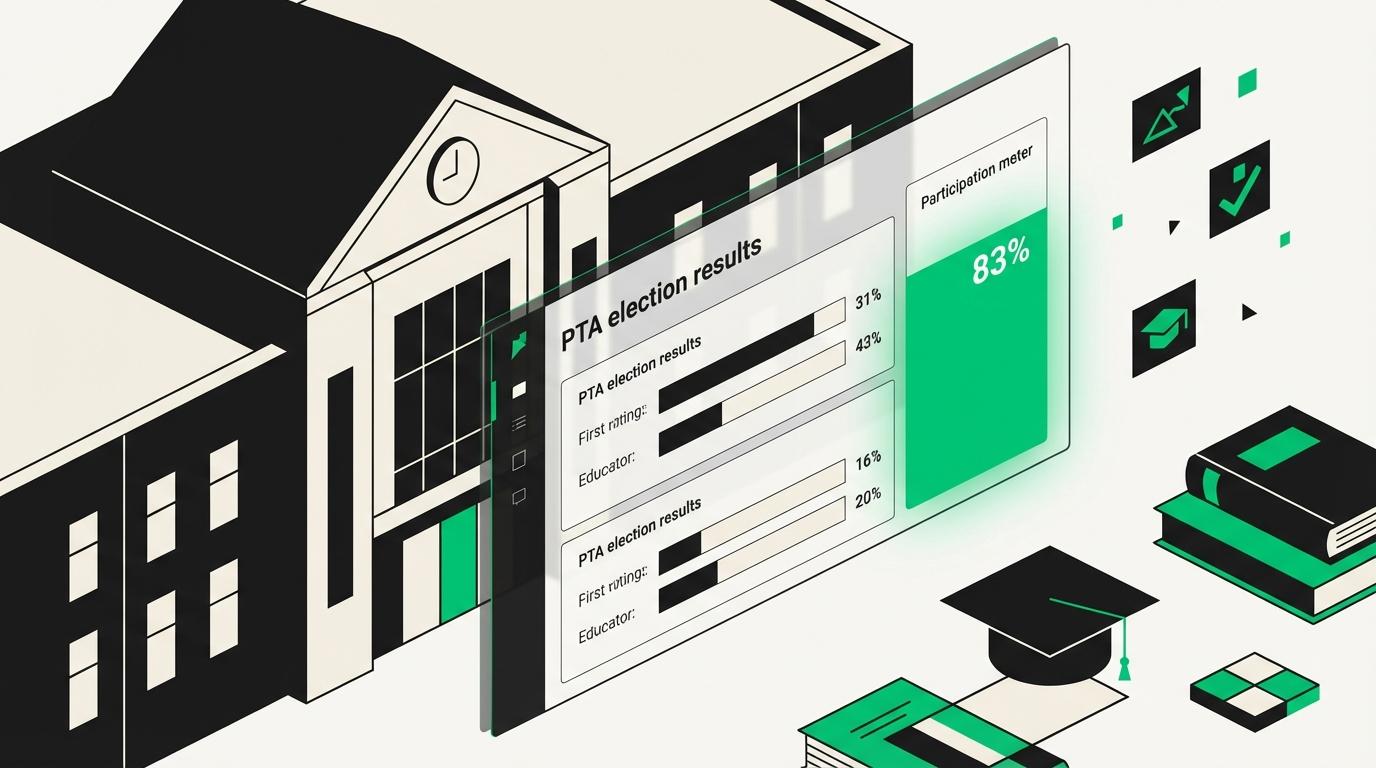
Think about it: your average school runs 5-10 elections or votes per year, PTA/PTO officer elections, student government elections, school board advisory committees, parent surveys on policy changes, teacher-of-the-year awards, fundraiser decisions, and more.
Yet most schools handle every one of these with the same tool: a show of hands at a meeting, or maybe a Google Form. Neither approach produces reliable, trustworthy results.
This guide compares every approach to school elections, from free tools to purpose-built platforms, for four types of school votes: PTA/PTO, student government, school board advisory, and parent surveys.
This article is for informational purposes only. Election requirements vary by organization type and governing documents.
The School Election Landscape
Four Types of School Elections
| Type | Who Votes | Typical Frequency | Stakes |
|---|---|---|---|
| PTA/PTO officer elections | Parent members | Annual | Moderate, 501(c)(3) governance |
| Student government | Students | Annual/semester | Lower, educational experience |
| School board advisory | Parents, sometimes staff | As needed | Moderate, policy influence |
| Parent surveys/votes | All parents | Multiple per year | Variable |
Tool Comparison
Option 1: Google Forms / SurveyMonkey
| Factor | Rating |
|---|---|
| Cost | Free (Google) / $0-$25/mo (SurveyMonkey) |
| Voter verification | None, anyone with the link can vote |
| Ballot secrecy | Partial, can be anonymous but not verified |
| Duplicate prevention | Weak, can restrict to one per email but easily bypassed |
| Audit trail | Very weak |
| Best for | Informal parent surveys only |
Verdict: Fine for "Should we have pizza or tacos at the fundraiser?" Not appropriate for PTA officer elections or any vote with governance implications.
Option 2: Show of Hands / Paper Ballots at Meetings
| Factor | Rating |
|---|---|
| Cost | $0-$50 (paper/printing) |
| Voter verification | Manual sign-in |
| Ballot secrecy | None (show of hands) / Good (paper ballot) |
| Duplicate prevention | Manual |
| Audit trail | Weak, depends on minutes-taking |
| Best for | Small PTAs with high meeting attendance |
Verdict: Procedurally sound if done with paper ballots and proper tellers. But participation is limited to meeting attendees, which excludes most parents.
Option 3: Email Voting
| Factor | Rating |
|---|---|
| Cost | Free |
| Voter verification | Weak, relies on email address |
| Ballot secrecy | None, votes visible to the collector |
| Duplicate prevention | Manual checking |
| Audit trail | Moderate, emails are records |
| Best for | Nothing, avoid for any election |
Verdict: Email voting creates records that link voters to their choices (destroying ballot secrecy) and is trivially easy to manipulate. Not appropriate for any election with governance implications.
Option 4: Social Media Polls
| Factor | Rating |
|---|---|
| Cost | Free |
| Voter verification | None |
| Ballot secrecy | None |
| Duplicate prevention | Platform-dependent |
| Audit trail | None |
| Best for | Informal engagement only |
Verdict: Social media polls are entertainment, not governance. Never use for PTA elections or any binding vote.
Option 5: Purpose-Built Election Platforms
| Factor | Rating |
|---|---|
| Cost | $100-$500 per election |
| Voter verification | Strong, identity verification available |
| Ballot secrecy | Full, verified identity separated from ballot |
| Duplicate prevention | System-enforced |
| Audit trail | Strong, timestamped, exportable |
| Best for | PTA/PTO elections, any vote requiring governance standards |
Verdict: The only option that meets basic election integrity requirements for PTA officer elections. Also excellent for student government when age-appropriate verification is used.
Head-to-Head Comparison
| Feature | Google Forms | Paper Ballot | Social Media | Digital Platform | |
|---|---|---|---|---|---|
| Cost | Free | $50 | Free | Free | $100-$500 |
| Voter verification | None | Manual | Weak | None | Strong |
| Ballot secrecy | Partial | Good | None | None | Full |
| Participation | Moderate | Low | Low | Low | High |
| Time to results | Instant | Hours | Days | Instant | Instant |
| Audit trail | Weak | Weak | Moderate | None | Strong |
| PTA election appropriate | No | Yes (limited) | No | No | Yes |
Use Case Recommendations
PTA/PTO Officer Elections
Recommended: Purpose-built digital platform
PTA officer elections have real governance implications, officers manage 501(c)(3) nonprofit funds, sign contracts, and represent the school community. Use a tool that provides voter verification, ballot secrecy, and an audit trail.
Student Government Elections
Recommended: Digital platform or simplified paper ballot
Student government elections are both governance and educational exercises. Digital platforms teach students about modern democratic processes. For younger students (elementary), supervised paper ballots provide a tactile civic experience.
School Board Advisory Votes
Recommended: Digital platform
When school administration wants parent input on policy decisions, a digital platform reaches the broadest cross-section of families. Verified identity prevents manipulation by organized factions.
Informal Parent Surveys
Recommended: Google Forms
For non-binding, low-stakes questions (event dates, menu choices, t-shirt designs), Google Forms is perfectly adequate. Save the governance-grade tools for governance-grade decisions.
vote.direct for School Elections
At vote.direct, school elections include:
- Simple member verification for PTA/PTO membership confirmation
- Anonymous voting to protect parent and student relationships
- Multi-language ballots for diverse school communities
- SMS and email delivery to reach busy parents on their phones
- Instant results with exportable reports for PTA records
For a typical school PTA with 200-500 members, a fully managed election costs approximately $200-$500, less than most PTA meeting budgets.
Frequently Asked Questions
Q: Is Google Forms OK for PTA elections?
For informal surveys, yes. For officer elections, no. Google Forms cannot verify voter identity, prevent duplicate voting reliably, or maintain ballot secrecy. If a member challenges PTA election results conducted via Google Forms, the results are indefensible.
Q: Can students vote in PTA elections?
This depends on your PTA/PTSA bylaws. PTSA (Parent Teacher Student Association) units include student members who may have voting rights. PTA units typically limit voting to adult members.
Q: What about student government elections, do we need a platform?
For high school student government, a digital platform teaches real-world democratic processes and produces credible results. For elementary school, supervised paper ballots provide age-appropriate civic education. Either way, the "whoever shouts loudest wins" approach teaches the wrong lessons.
Q: How do we handle a PTA with very few candidates?
If you have exactly one candidate per position (an uncontested election), most PTA bylaws allow election by acclamation, a motion to elect the entire slate without a ballot. This is procedurally simple and saves time and cost.
The Bottom Line
Schools teach students about democracy. The way a school handles its own elections, whether PTA, student government, or advisory votes, sends a message about what democratic processes really look like.
If the PTA election is a show of hands at a meeting where 8 parents raise their arms, students learn that democracy is a formality. If the PTA election is a verified, anonymous digital vote where 300 parents participate, students learn that democracy means everyone has a voice.
Choose accordingly.
Sources:
- 1National PTA: Model bylaws and governance toolkit
- 2Robert, Henry M.: "Robert's Rules of Order Newly Revised" (12th Edition, 2020)
- 3National School Boards Association: Advisory committee governance
- 4State PTA organizations: Bylaws and standing rules
- 5IRS: 501(c)(3) nonprofit governance requirements for PTAs
This article is general information, not legal advice. We recommend you do your own research and confirm anything you plan to act on. Where this article states law, the section is cited so you can read the primary source yourself rather than take our word for it. That is what the citations are for. Election requirements also turn on your own governing documents, which we have not seen, and statutes are amended. For advice about your community, consult a qualified attorney licensed in your state.
We work hard to verify every citation against the primary source, but laws change and errors happen. If you spot an inaccuracy, email support@vote.direct and we will correct it. See our editorial standards for how these pages are researched and checked.