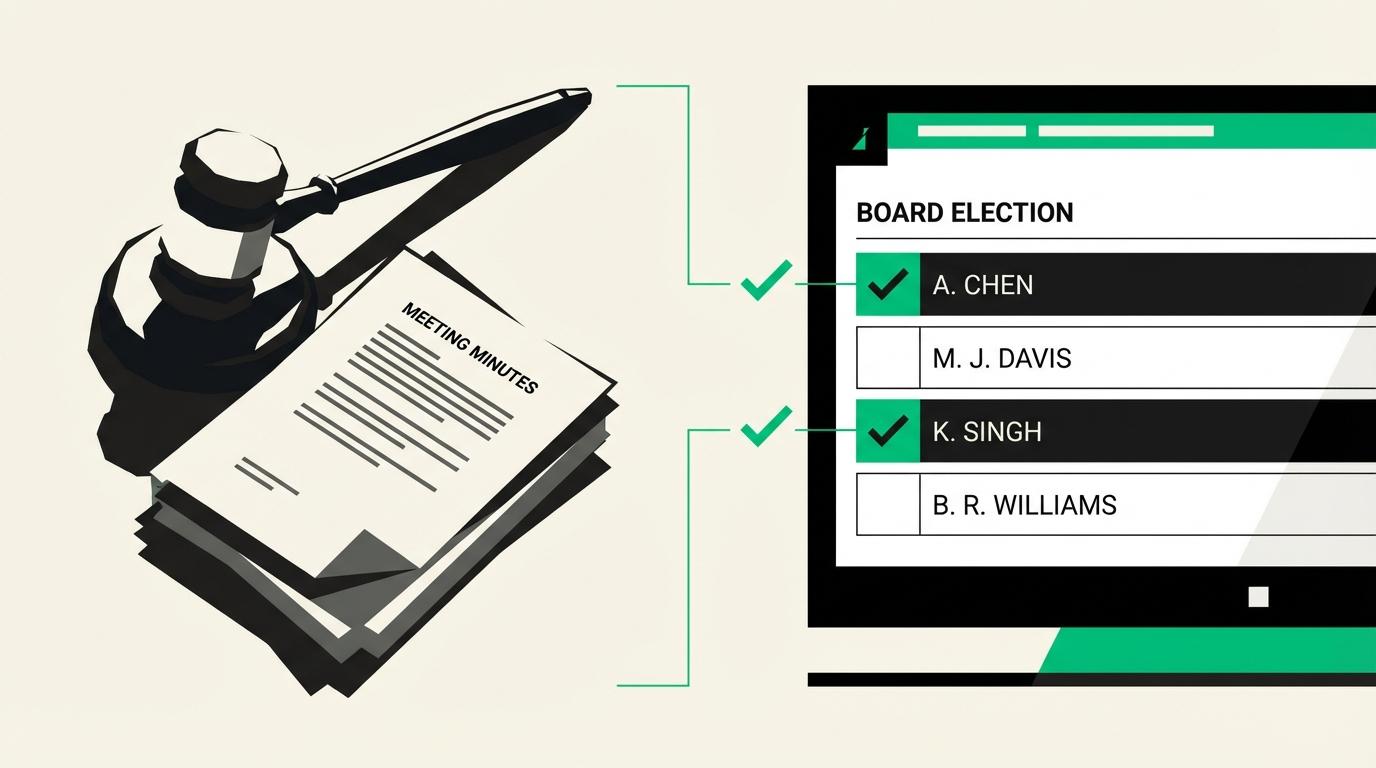
The Small HOA Paradox
The Foundation for Community Association Research estimates 373,000 U.S. community associations in 2025, ranging from small self-managed properties to large professionally managed communities. Its national report does not supply the “150,000 under 50 units” figure previously used on this page, so this guide does not repeat it.
A small association does not necessarily follow the exact same election rules as a 500-unit community. Jurisdiction, condominium or HOA status, vote type, declaration, articles, bylaws, election rules, and adopted procedures can all change the requirements.
The practical constraint is real: a volunteer board may have fewer administrative resources while still needing to identify and document the procedure that applies to its exact vote.
The result is predictable. Small HOAs either:
- 1Skip elections entirely: board members serve indefinitely by default
- 2Hold informal hand-raise votes: at a kitchen table meeting with no records
- 3Spend disproportionately: paying $500–$1,500 for a single paper ballot election that costs the same per unit as a community 10x their size
Whether any method is permitted depends on the governing rules and facts. Compare the complete procedure rather than assuming paper is invalid or digital is automatically better.
There's a fourth option: an online election priced by its own size, $4.99 for a 50-unit community, with no subscription.
This article is for informational purposes only and does not constitute legal advice. HOA election requirements vary by state, governing documents, and local regulations. Consult a qualified attorney for advice specific to your community.
How to Compare Voting Costs for a Small HOA
Compare published prices and the scope behind them:
Minimum Spend Problem
Most election platforms have pricing structures that don't scale down properly:
| Platform | Minimum Annual Spend | Cost Per Unit (50-Unit HOA) | Cost Per Unit (500-Unit HOA) |
|---|---|---|---|
| Simply Voting | Not published | Not published | Not published |
| AssociationVoting | $299 | $5.98 | $0.60 |
| Full-service election vendor | $800+ | $16.00+ | $1.60 |
| vote.direct | None, priced per election | $0.10 for one election | $0.14 for one election |
When a 500-unit community pays $300/year for election software, that's $0.60 per unit, easily absorbed into the operating budget. When a 20-unit community pays that same $300, it's $15 per unit, which may represent a meaningful percentage of their entire operating budget.
Do not compare only the license line. Include required notices, printing and postage, inspectors or independent administration, meeting costs, staff or volunteer time, accessibility, legal review, optional identity checks, and records retention.
What Each Election Includes
Every vote.direct election is priced on its own, by the number of voters you invite. For a 50-unit community that is $4.99 an election. Here's what's included:
A Year of Votes
Run the votes you need: the annual board election, budget ratification, special assessments, bylaw amendments, pool rules, vendor selections. Each one is priced when you publish it, with no limit on the number of ballots or questions. For a 50-unit community:
| Vote Type | Frequency | Annual Cost |
|---|---|---|
| Board election | 1x/year | $4.99 |
| Budget ratification | 1x/year | $4.99 |
| Special assessment | 1 to 2x/year | $4.99 to $9.98 |
| Bylaw amendment | 0 to 1x/year | $0.00 to $4.99 |
| Community decisions | 2 to 4x/year | $9.98 to $19.96 |
| Total (6 elections) | $29.94 |
There is no subscription and no minimum spend.
Email and SMS Credentials
Every election can send roster-controlled access through email or SMS:
- Email credential: Shows control of the configured email link or code.
- SMS credential: Shows control of the configured phone channel.
One accepted ballot is recorded per roster credential. Neither channel proves that the organizer’s roster is correct or that the credential holder is legally entitled to exercise the vote.
Quorum Tracking
The platform monitors participation in real-time and shows you exactly how close you are to quorum. This matters enormously for small communities where every vote counts:
- 25% quorum in a 50-unit community = 13 voters needed
- 25% quorum in a 20-unit community = 5 voters needed
The organizer can see which roster credentials have participated without seeing their ballot choices in Anonymous or Sealed ballot mode, then follow up under the association’s approved communication rules.
Automatic Voter Reminders
The platform can send configured email and SMS reminders to non-voters. Reminders may reduce manual follow-up, but vote.direct does not promise a particular turnout or quorum result.
Results and Audit Exports
After an election, the platform can export:
- Total eligible voters
- Total votes cast
- Quorum threshold and whether it was met
- Vote tallies
- Timestamped audit trail summary
- Verification method used
Keep the exports with the governing authority, notices, roster source, appointments, consent, meeting materials, paper-channel records, and human certification required for the vote. The export is a platform record, not a legal-compliance certificate.
Illustrative Scenarios, Not Customer Case Studies
The numbers below are planning examples. They are not measured vote.direct customer outcomes, legal-cost predictions, or participation promises. Replace every assumption with the association’s actual roster, governing threshold, approved procedure, vendor quotes, and prior turnout.
Honest question
Would you trust an online vote to decide your community's annual budget?
Scenario 1: The 20-Unit Townhouse Annual Meeting
The community: 20 townhouses, self-managed, 3-member board, $1,200/month total assessments.
The old way: Board president prints 20 ballots, mails them ($28 postage), rents the community room ($0, it's the president's garage), counts ballots by hand with two witnesses, writes results in the meeting minutes. Total time: 8 hours. Total cost: $40 in materials.
The problem: No voter verification. No audit trail. If Unit 14 claims their ballot was never counted, there's no way to prove otherwise. If the outgoing treasurer is alleged to have miscounted ballots, there's no independent verification.
Possible digital workflow: Upload the approved 20-voter roster, configure the authorized ballot and voting window, test access, send unique links, complete required notices and meeting steps, and export the result and event record. Setup and review time varies; the platform does not promise a ten-minute election.
Scenario 2: The Emergency Special Assessment
The community: 35-unit condo building. The parking garage needs $175,000 in emergency waterproofing. The board levies a $5,000 special assessment per unit amid significant homeowner opposition.
The old way: Print and mail 35 ballots ($49 postage + $20 printing). Wait 30 days. 15 ballots returned, below the 25% quorum threshold (9 votes needed, only 15 out of 35 = 43%, quorum is met, but barely). Final count done by hand. Three homeowners demand a recount. An attorney sends a letter questioning the process. Legal response costs $3,500.
Possible digital workflow: After confirming that electronic voting is authorized for this vote, upload the approved roster, configure the actual quorum and approval thresholds, send secure email or SMS links, and export the participation, tabulation, and hash-linked event record. Do not assume a specific turnout, that an assessment vote is authorized online, or that a platform export will end a challenge or reduce legal cost to zero.
Scenario 3: The Board That Couldn't Hold a Meeting
The community: 45-unit HOA. Annual meeting quorum requires 25% (12 voters). Last three annual meetings failed quorum. Board members are holdovers who want to resign but can't because there are no replacements. The community hasn't had a valid election in 2 years.
Why it keeps failing: Meetings are held on Tuesday evenings at 7 PM. Of 45 owners, 12 are non-resident investors who will never attend. 8 are snowbirds in Florida from November through April (when the annual meeting happens). That leaves 25 owners who could potentially attend, and you need 12 of them to show up on a Tuesday night.
Possible digital workflow: If permitted, an extended access window and documented reminders can reach non-resident owners without requiring physical attendance. The association should model several turnout scenarios; the platform does not promise 84% participation, first-day quorum, or resolution of a governance dispute.
Setup Workflow
Step 1: Confirm Authority and Create the Account
Before collecting ballots, confirm the permitted voting method, authority, notices, consent, inspectors, secrecy model, threshold, meeting procedure, and retention duties. Then sign up at vote.direct. Flat-rate pricing starts at $4.99/election.
Step 2: Create the Election
- Name your election ("2026 Annual Board Election")
- Add positions ("Board Member: 3 seats available")
- Add candidates (name and optional statement)
- Set the voting window (start date, end date)
Step 3: Add the Approved Voter Roster
- Enter email addresses for each eligible voter
- Option: add phone numbers for SMS verification
- Review duplicates, shared contacts, weighted rights, and corrections against the authoritative record
Step 4: Review, Test, and Launch
- Review the ballot preview
- Click "Launch Election"
- Voters receive their unique voting links immediately
The platform can handle configured invitations, reminders, participation tracking, tabulation, and exports. The association remains responsible for the legal and offline procedure.
Comparing the Total Cost
For three elections a year, compare the live per-election tier total ($14.97 for a 50-unit community) with each vendor's annual price. Then add the costs that software pricing excludes: required mail, inspectors, independent administration, meeting services, optional assisted ID checks, accessibility support, legal review, and volunteer or staff time. Do not insert an invented “challenge probability” or assume any method has zero legal cost.
Frequently Asked Questions
"Does my state allow electronic voting?"
It depends on the jurisdiction, community type, vote, governing documents, and procedure. California Civil Code §5105 now sets detailed conditions for electronic secret ballots and excludes certain votes, while §5110 still requires independent inspectors. Florida HOA §720.317 requires a board resolution, member consent, authentication, system testing, secrecy, and records. Check the current official law for every other state instead of relying on a six-state generalization.
"Do I need an Inspector of Elections?"
California requires an Inspector of Elections for all HOA elections (Civil Code §5110). The inspector can be a volunteer member who is not a board member or candidate. The vote.direct platform can serve as the inspector's tabulation and record-keeping tool, but the inspector still needs to be a named person who certifies the results.
Other jurisdictions and governing documents differ. Confirm whether an inspector, monitor, chair, counter, or independent administrator is required.
"Can non-resident owners vote electronically?"
Yes, this is one of the primary advantages of electronic voting. Non-resident investors, seasonal residents, and owners who travel frequently can vote from anywhere with an internet connection during the entire voting window.
"What if my bylaws say 'in-person voting only'?"
Do not assume a platform can override that language. Read the current statute and the complete governing documents, identify the amendment procedure if needed, and consult association counsel before collecting electronic ballots.
"Is the price all-inclusive?"
The $4.99 flat rate for a 50-unit community includes email and SMS credential options, configured quorum tracking, reminders, results exports, and hash-linked audit events. Optional assisted government-ID checks cost $3.00 per checked voter, and mailed access letters or other services cost extra. The organization must choose a proportionate method; vote.direct does not promise “maximum legal defensibility.”
The Bottom Line
Small HOAs shouldn't pay enterprise prices for basic governance. They also shouldn't skip elections, gut legal protections, or burn out volunteer board members with 40 hours of manual election administration.
Each election is priced on its own, $4.99 for a 50-unit community, with email or SMS verification included. Setup time varies with the roster, ballot, governing rules, and required review.
Compare the live price and product boundary with the association’s approved paper, hybrid, or electronic procedure, then choose the method that fits the actual vote.
Sources:
- 1Community Associations Institute: Size distribution of community associations in the United States
- 2Foundation for Community Association Research: Governance statistics and board participation data
- 3California Civil Code §5110: Inspector of Elections requirements
- 4California AB 2159 (2024): Electronic voting authorization for HOA elections
- 5Florida HB 1021 (2024): Electronic voting for HOAs and condominiums
- 6USPS: First-class postage rates (2026)
- 7Community Associations Institute: Quorum failure statistics (40% first-attempt failure rate)
This article is general information, not legal advice. We recommend you do your own research and confirm anything you plan to act on. Where this article states law, the section is cited so you can read the primary source yourself rather than take our word for it. That is what the citations are for. Election requirements also turn on your own governing documents, which we have not seen, and statutes are amended. For advice about your community, consult a qualified attorney licensed in your state.
We work hard to verify every citation against the primary source, but laws change and errors happen. If you spot an inaccuracy, email support@vote.direct and we will correct it. See our editorial standards for how these pages are researched and checked.