Why This Comparison Exists
If you search for "best online voting tool," you'll find listicles written by content farms that clearly never used the products. They copy feature lists from pricing pages and declare winners based on vibes.
This one is written by vote.direct, which sells one of the six tools below. That is a real conflict of interest, and the honest thing is to tell you the rules this article follows so you can check whether it kept them:
- 1The six platforms are listed alphabetically, not ranked. vote.direct appears last because of its name. There is no "winner" section, because the right answer depends on what you are running.
- 2Every competitor price was read off that vendor's own public pricing page in August 2026. Where a competitor is cheaper than vote.direct, the number says so plainly.
- 3vote.direct is a newer provider. Read the dated third-party reviews linked from our homepage and compare the track record relevant to your election. This article is vendor-authored, not an independent ranking.
Here's what actually matters when choosing a voting platform:
- 1Identity verification: Can you prove who voted?
- 2Ballot flexibility: Does it support your voting method?
- 3Pricing transparency: What does it actually cost?
- 4Legal defensibility: Will the results hold up if challenged?
- 5Ease of use: Can a non-technical board member run an election?
- 6API access: Can developers integrate voting into their own products?
The Platforms
1. ElectionBuddy
Best for: Large organizations running frequent elections with high voter counts
Overview: ElectionBuddy is the most well-known online voting platform, particularly popular with unions, associations, and universities. They've been around since 2012 and process millions of votes annually.
Strengths:
- Mature platform with extensive track record
- Phone and live chat support
- Supports very large elections (10,000+ voters)
- Multiple notification channels (email, SMS, postal mail)
- Good documentation and onboarding
Weaknesses:
- No SMS or government ID verification. Email and access codes are the ceiling, which is the gap that matters for a contested board election.
- No public API for creating elections programmatically, as of August 2026.
- Live motion voting is a separate product (MeetingVote) rather than part of the election product.
Pricing: ElectionVote, the product comparable to vote.direct, is free up to 20 voters, $29 up to 350, $99 up to 1,000, and from $299 above that. Checked on ElectionBuddy's own pricing page in August 2026. vote.direct is free up to 25 voters. Compare the current price for the same eligible roster and required features on both vendors' pricing pages.
2. Google Forms
Best for: Completely informal polls where verification doesn't matter at all
Overview: Google Forms isn't a voting platform. It's a survey tool. But it's free and familiar, so many organizations use it for elections. This is almost always a mistake for anything beyond a casual straw poll.
Strengths:
- Free
- Everyone knows how to use it
- Quick to set up
- Real-time response tracking
Weaknesses:
- No identity verification whatsoever. Anyone with the link can vote. One person can vote multiple times from different browsers.
- No secret ballot. If you require Google sign-in, votes are tied to names. If you don't, you have no verification.
- No weighted voting.
- No ranked choice.
- No audit trail. Results can be edited by the form creator.
- Not purpose-built for an election procedure. Google Forms can collect responses, but it does not supply vote.direct's roster, verification, quorum, result-certificate, and hash-linked audit workflow.
- No election-specific features. No quorum tracking, no voter reminders, no results certification.
Pricing: Free.
Our honest take: If you're choosing between Google Forms and a real voting platform, you're deciding whether the election matters. If members are voting on where to hold the holiday party, use Google Forms. If they're electing board members or approving a $500,000 special assessment, use literally anything else.
3. Helios Voting
Best for: Academic institutions and technically sophisticated organizations that want open-source, mathematically verifiable elections
Overview: Helios is an open-source platform developed by Ben Adida (now at VotingWorks). It uses cryptographic techniques to create mathematically verifiable election results: anyone can verify that votes were counted correctly without revealing individual ballots.
Strengths:
- Open source: you can audit the code yourself
- Cryptographic verification: mathematical proof that results are correct
- Free for basic use
- Strong academic credibility
Weaknesses:
- Not designed for non-technical users. Setup and administration require technical comfort.
- No identity verification beyond email. Cryptographic verification proves votes were counted correctly but doesn't prove who cast them.
- Self-hosted or use the demo server. No commercial SaaS option with support.
- No mobile optimization. The interface predates the mobile era.
- No API, no mail-in ballots, no SMS verification, no weighted voting.
- Limited ongoing development. The project's focus has shifted to VotingWorks (government elections).
Pricing: Free (open source). Self-hosting costs vary.
4. OpaVote
Best for: Organizations specifically using ranked choice voting or STV
Overview: OpaVote specializes in ranked choice and single transferable vote elections. It's popular with academic organizations, professional societies, and political groups that use preference-based voting methods.
Strengths:
- Excellent ranked choice voting support with detailed elimination round reporting
- Supports multiple counting methods (IRV, STV, Condorcet, Borda)
- Simple, clean interface
- Affordable for basic elections
Weaknesses:
- Minimal identity verification. Relies on unique voting links sent via email: no OTP, SMS, or ID verification. If someone forwards their link, another person can vote in their place.
- Limited ballot types. Primarily designed for candidate elections, not bylaw amendments or multi-question ballots.
- No real-time monitoring. Limited administrator dashboard during voting.
- No API.
- No mail-in ballot support.
Pricing: Free for up to 25 voters and 10 candidates per election (3 elections at once, data kept 10 weeks). Beyond that, $10 for every 125 voters, with unlimited elections. Checked July 2026.
Let's talk money
What's a fair price for a roster-controlled community election with exportable records?
5. Simply Voting
Best for: Canadian organizations and unions requiring bilingual support
Overview: Simply Voting is a Canadian platform focused on unions, associations, and academic institutions. They emphasize compliance with Canadian electoral regulations and offer bilingual (English/French) elections.
Strengths:
- Strong union election expertise
- Bilingual election support
- Good customer service reputation
- Detailed audit reports
Weaknesses:
- Pricing is entirely quote-based. No public pricing information at all. You must contact sales for every election.
- No API.
- US-specific compliance knowledge is limited. Not ideal for US HOAs subject to state-specific statutes.
- Interface feels dated compared to modern platforms.
- Verification relies primarily on access codes distributed by the administrator, not independent identity verification.
Pricing: Quote-based. Industry reports suggest elections typically cost $500-$5,000 depending on voter count and services.
6. Vote.direct
Best for: HOAs, nonprofits, cooperatives, and any organization running identity-verified elections
Overview: vote.direct provides self-serve online voting and full-service election administration. You can run a single election without a subscription, or hire our team for online and mailed elections.
Managed services: Digital election management starts at $199 for up to 100 voters, platform fee included. Managed elections that need our staff physically present, such as an in-person vote or count, are paused for now. Managed digital elections remain available, and so does paper: mailed ballots returned to our mail scanning address, which we tabulate remotely, and self-serve paper ballots your team prints, hands out at its own meeting and scans in. See in-person elections and the inspector scope.
Strengths:
- Flat-rate software pricing: Free up to 25 voters with email verification; paid elections from $4.99 include email and SMS verification. Government ID checks add $3.00 per checked voter. Management is priced separately.
- Embeddable voting widgets: Drop a one-line iframe into any website to embed live voting, branded to match your site. Members never leave your portal.
- Mail-in ballot support: Printed ballot packets at $6.00 each with postage both ways. A mailed access letter at $3.00 carries a code for an online ballot and is a different service.
- Weighted voting: Native support for percentage-based or share-based voting weights, critical for HOAs and cooperatives.
- Self-serve without a subscription: Run one election free up to 25 voters, or use the paid roster tiers. Managed engagements have a written scope and quote.
- You reach the founder directly: The published support number, (512) 222-8191, is answered by the founder, who is also the engineer who writes the software. Call or text, any day of the week. This is a small company, which is the same reason it has almost no reviews yet.
Weaknesses:
- A shorter operating history than the established providers in this comparison. Check the dated customer reviews and ask for evidence relevant to your election.
- On-site staffing is paused for now. Inspector availability depends on the state and organization type.
- Smaller brand recognition, which matters if your board wants a vendor it has heard of
Pricing: Self-serve per election: Free for up to 25 voters, $4.99 for 26–50 voters, $9.99 for 51–100 voters, $19.99 for 101–200 voters, $24.99 for 201–400 voters, $69.99 for 401–1,000 voters, $149.99 for 1,001–2,000 voters, $249.99 for 2,001–5,000 voters. Above 5,000 voters, talk to us. Email verification is included; SMS is included in paid tiers. Gov ID: $3.00 per checked voter. Mailed ballot packets: $6.00 each. Each $6.00 packet includes domestic US mail, up to 4 pages, and a return envelope with prepaid postage: the packet goes out, and it comes back in an envelope that already has the postage paid on it, so the member never buys a stamp. There is no separate postage line on your invoice. Managed digital elections start at $199; on-site staffing is paused for now. Current pricing and service scope.
Feature Comparison Matrix
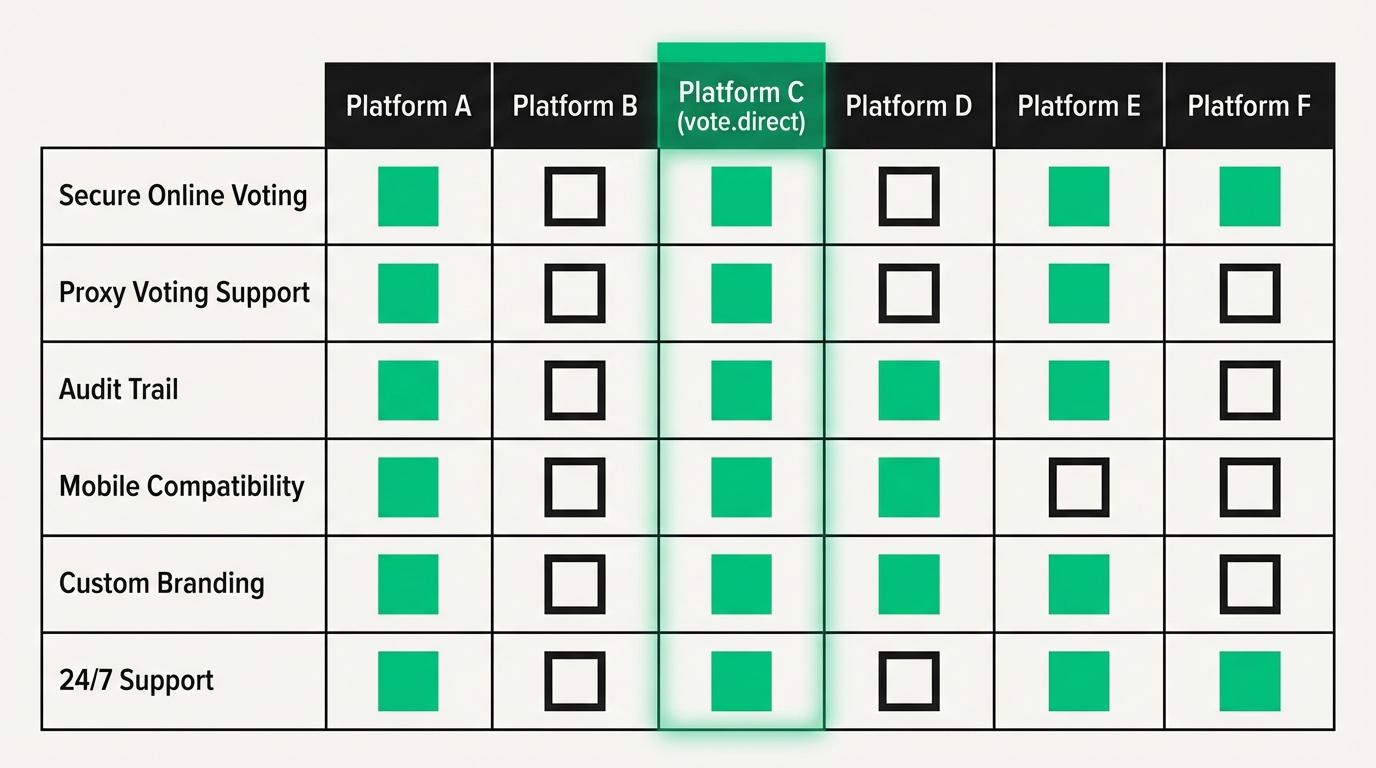
| Feature | Vote.direct | ElectionBuddy | OpaVote | Simply Voting | Helios | Google Forms |
|---|---|---|---|---|---|---|
| Email verification | Yes (included) | Yes | Link-only | Access codes | Email-only | No |
| SMS verification | Included in paid tiers | Limited | No | No | No | No |
| Government ID | Yes ($3.00/voter) | No | No | No | No | No |
| Ranked choice voting | Yes | Yes | Excellent | Yes | Yes | No |
| Weighted voting | Yes | Yes | No | Yes | No | No |
| Embeddable widgets | Yes | No | No | No | Limited | No |
| Mail-in ballots | Yes ($6.00 per packet, postage both ways) | Yes | No | No | No | No |
| Real-time monitoring | Yes | Yes | Limited | Yes | No | Basic |
| Audit trail | Yes | Yes | Basic | Yes | Cryptographic | No |
| Starting price | Free up to 25 voters, then from $4.99/election | $0 up to 20 voters, then $29 | $0 up to 25 voters, then $10 per 125 | Quote only | Free (open-source) | Free |
| Quorum tracking | Yes | Yes | No | Yes | No | No |
How to Choose
Choose ElectionBuddy if:
- You run very large elections (10,000+ voters) regularly
- You need phone support
- Brand recognition matters to your stakeholders
Choose Google Forms if:
- The vote is truly informal and non-binding
- You need results in 5 minutes with zero budget
- Nobody will challenge the outcome
Choose Helios if:
- You need open-source, auditable election code
- Your organization has technical staff to administer elections
- Mathematical verifiability is a requirement
Choose OpaVote if:
- Ranked choice voting is your primary use case
- Your elections are small (under 100 voters)
- Budget is extremely tight
Choose Simply Voting if:
- You're a Canadian organization needing bilingual elections
- You're a union with specific Canadian compliance requirements
Choose Vote.direct if:
- You want a team to run an online or mailed election
- You need identity verification stronger than email
- You're a developer who needs an API
- You want flat-rate pricing without per-vote charges
- You're an HOA, nonprofit, or cooperative
- You need weighted voting
The Verification Gap
The single most important differentiator across all these platforms is identity verification. Most election disputes don't challenge how votes were counted. They challenge who voted.
A platform that counts votes perfectly but can't prove voter identity is like a bank vault with no lock on the door. The contents might be perfectly organized inside, but anyone could have put anything in there.
If your election may be reviewed or challenged, match the verification method to the risk while also documenting authority, notice, eligibility, oversight, secrecy, tabulation, and retention.
This article is general information, not legal advice. We recommend you do your own research and confirm anything you plan to act on. Where this article states law, the section is cited so you can read the primary source yourself rather than take our word for it. That is what the citations are for. Election requirements also turn on your own governing documents, which we have not seen, and statutes are amended. For advice about your community, consult a qualified attorney licensed in your state.
We work hard to verify every citation against the primary source, but laws change and errors happen. If you spot an inaccuracy, email support@vote.direct and we will correct it. See our editorial standards for how these pages are researched and checked.