Quick Answer
Under Robert's Rules, a motion carries on a majority of the votes cast, not a majority of the members present, and not a majority of the membership. Abstentions are not votes cast, so they do not count against a motion. A tie means the motion fails.
The five voting methods, and when each is correct:
| Method | Use it for | Result recorded |
|---|---|---|
| Voice vote | Routine, uncontested business | "Motion carried" |
| Show of hands or rising vote | When the chair is unsure, or a member doubts a voice vote | Count, if a count was taken |
| Counted rising vote | When a member calls for a division | Exact count |
| Ballot | Elections, and anything where members should vote without being watched | Count, and usually the tellers' report |
| Roll call | When members must be individually accountable to a constituency | Each member's vote by name |
Four rules that settle most disputes:
- Two-thirds is required to close debate, suspend the rules, or take away a member's rights. Ordinary motions need a majority.
- The chair votes in a small board (roughly a dozen or fewer). In a large assembly the chair votes only to break or create a tie, or when the vote is by ballot.
- A ballot required by the bylaws must be taken, even when a candidate is unopposed. See unopposed candidates and acclamation.
- Your bylaws outrank Robert's Rules, and a statute outranks both. Robert's Rules only fills the gaps.
What Are Robert's Rules of Order?
Robert's Rules of Order is the most widely used manual of parliamentary procedure in the United States. Originally published in 1876 by Army officer Henry Martyn Robert, it provides a structured framework for running meetings, making decisions, and conducting votes.
If you serve on an HOA board, nonprofit board, club, union, cooperative, or any organization that holds meetings, your bylaws almost certainly reference Robert's Rules (or a simplified version of them) as the governing authority for meeting procedure.
The current edition is Robert's Rules of Order Newly Revised, 12th Edition (2020), often abbreviated as RONR.
This guide focuses specifically on the voting procedures: how proposals come to a vote, what voting methods are available, what vote thresholds mean, and how to handle common voting situations.
The Path to a Vote: Motions and Seconds
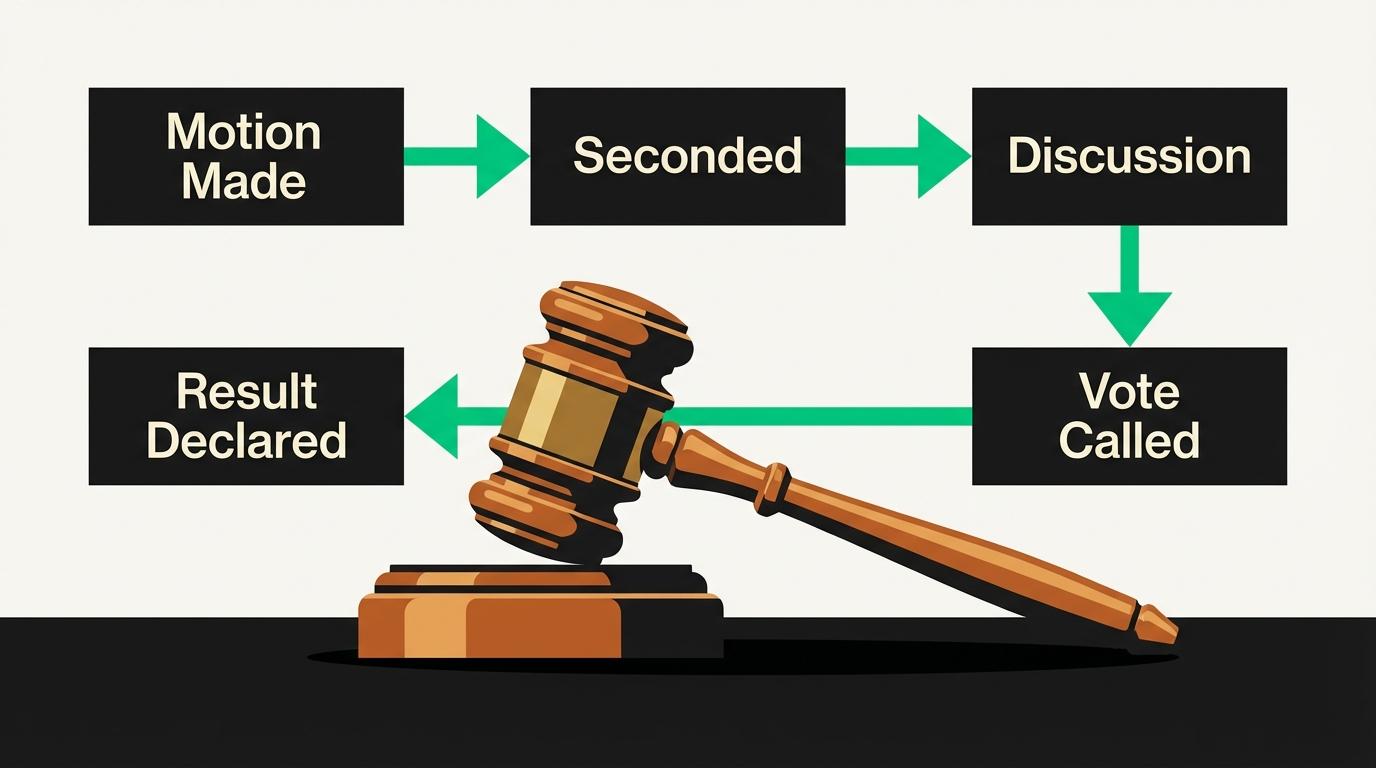
Under Robert's Rules, nothing gets voted on spontaneously. Every vote follows a structured sequence:
1. A Member Makes a Motion
A motion is a formal proposal for the group to take an action or make a decision. The member says:
> "I move that we approve the 2026 operating budget as presented."
The person making the motion is called the mover or the maker of the motion.
2. Another Member Seconds the Motion
A second indicates that at least one other person thinks the motion is worth discussing. The member says:
> "I second the motion."
Important: A second does not mean the seconder agrees with the motion, only that they believe it deserves discussion. Without a second, the motion dies (unless it's a motion that doesn't require a second, like a point of order or a question of privilege).
3. The Chair States the Motion
The presiding officer (chair/president) repeats the motion so everyone knows exactly what's being considered:
> "It has been moved and seconded that we approve the 2026 operating budget as presented. Is there any discussion?"
4. Discussion/Debate
Members discuss the motion. The chair manages the discussion, ensuring members speak in turn and stay on topic. The mover has the right to speak first.
5. The Chair Calls the Vote
When discussion is complete (or when a member calls the question and it's adopted by a two-thirds vote), the chair puts the motion to a vote:
> "The question is on the adoption of the motion to approve the 2026 operating budget. All those in favor say 'aye.' All those opposed say 'no.'"
6. The Chair Announces the Result
> "The ayes have it, and the motion is adopted. The 2026 operating budget is approved."
Or:
> "The noes have it, and the motion is lost."
Voting Methods Under Robert's Rules
Robert's Rules recognizes several voting methods. The chair selects the appropriate method, or the assembly can vote to use a specific method.
Voice Vote (Viva Voce)
The most common method for routine decisions. Members call out "aye" or "no" and the chair judges which side is louder.
When to use: Routine motions where the outcome is expected to be clear, like approving minutes or adopting non-controversial motions.
Limitation: Imprecise. If the result is close, any member can call for a more precise method: "Division!"
Rising Vote (Division of the Assembly)
Members stand to indicate their vote. The chair (or tellers) count those standing for and against.
When to use: When a voice vote result is disputed, or when the chair is uncertain. Any member can demand a division by calling "Division!" This is a demand, not a motion, and doesn't require a second or vote.
Limitation: Still visible, not secret. Members may feel pressure to vote with the majority.
Show of Hands
Similar to a rising vote but members raise their hands instead of standing. Common in smaller meetings.
Roll Call Vote
The secretary calls each member's name, and they respond "aye," "no," or "abstain." Each vote is recorded in the minutes.
When to use: When a record of each member's individual vote is required, common for legislative bodies and public boards where transparency is mandated. In many states, HOA board votes on financial matters must be by roll call.
Limitation: No secrecy. Every vote is publicly attributed.
Ballot Vote (Secret Ballot)
Members write their vote on paper (or enter it electronically). Ballots are collected and counted by tellers. Individual votes are not attributed.
When to use: Elections of officers, contested decisions where members might feel pressured, or any time bylaws require a ballot vote. Robert's Rules specifically recommends ballot voting for elections of officers to protect members from retaliation.
Requirement: If your bylaws specify a ballot vote for a particular action, you must use a ballot vote. The assembly cannot suspend this requirement even by unanimous consent.
General Consent (Unanimous Consent)
The chair asks, "Is there any objection to [action]?" If no one objects, the action is adopted without a formal vote.
When to use: Non-controversial, routine actions like approving the agenda or adjourning. Saves time by skipping the full motion-second-vote sequence.
Limitation: A single objection defeats general consent, requiring a formal vote.
Comparison of Voting Methods
| Method | Speed | Secrecy | Precision | Record | Best For |
|---|---|---|---|---|---|
| Voice vote | Fast | No | Low | Result only | Routine motions |
| Rising/Hands | Moderate | No | Medium | Count | Close voice votes |
| Roll call | Slow | No | Exact | Individual | Public accountability |
| Ballot | Slow | Yes | Exact | Aggregate | Elections, sensitive votes |
| General consent | Fastest | No | N/A | Result only | Non-controversial items |
Vote Thresholds: Majority, Two-Thirds, and More
Not every vote requires a simple majority. Robert's Rules specifies different thresholds depending on what's being decided.
Majority Vote
More than half of the votes cast. This is the default for most motions. Note: majority means more than half, not half. If 100 votes are cast, 51 is a majority; 50 is not.
Important: Majority of votes cast, not majority of members present or total membership. Abstentions do not count as votes cast. If 100 members are present, 60 vote, and 31 vote in favor, the motion passes (31 is a majority of 60 votes cast).
Two-Thirds Vote
At least two-thirds of the votes cast. Required for motions that:
- Limit or close debate (calling the question)
- Suspend the rules
- Amend bylaws (unless bylaws specify differently)
- Rescind or amend something previously adopted (without prior notice)
If 90 votes are cast, 60 "aye" votes are needed (two-thirds of 90).
Majority of the Entire Membership
Some bylaws require a majority of the entire membership, not just those voting. If your organization has 200 members, you need 101 votes regardless of how many actually participate.
This is a much higher bar and is common in bylaws provisions for major actions like removing a board member, amending the declaration/CC&Rs, or approving special assessments.
Unanimous Vote
Every member voting must agree. Rare except for certain bylaw provisions. Not the same as general consent: unanimous vote is a formal count where every vote must be affirmative.
The uncomfortable question
What's the single biggest problem with how community boards operate?
Can the Chair or President Vote?
This is the most-asked question about Robert's Rules voting, and the answer turns on the size of the body.
On a small board or committee, such as an HOA board or a nonprofit executive committee, the presiding officer is a full member and votes on every motion exactly like everyone else. Nothing is held back.
In a large assembly, such as a membership meeting or a convention, the chair holds the same right to vote but by custom does not exercise it, to preserve the appearance of impartiality. That custom is set aside in two situations:
- When the vote is by ballot. The chair votes along with everyone else, at the same time, because a secret ballot reveals nothing about how they voted.
- When their vote would change the result. The chair may vote to break a tie, or to create one, since a tie defeats the motion either way.
The chair does not get a second vote or a casting vote. A presiding officer who is a member has exactly one vote. "Breaking a tie" is simply that one vote being cast at a moment when it happens to decide the question. A chair who is not a member of the body, such as a hired parliamentarian or an outside facilitator, has no vote at all.
Your bylaws override all of this. Plenty of HOA and nonprofit bylaws restrict or expand the president's voting rights explicitly, and where the bylaws speak, they control.
Elections, Nominations, and Voting by Acclamation
Electing officers runs on different defaults than an ordinary motion, which is where most boards go wrong.
Nominations do not need a second. A nomination is not a motion. The chair opens the floor, members name candidates, and nobody has to second them. A nominating committee's slate does not close the floor either: members may add names from the floor unless the bylaws say otherwise.
Robert's Rules expects a ballot vote for officer elections, because secrecy protects members from retaliation over how they voted. If your bylaws require a ballot, you must ballot, and the assembly cannot waive that even by unanimous consent.
Election by acclamation applies only to an uncontested seat. When exactly one candidate has been nominated for an office and the bylaws do not require a ballot, the chair may declare that candidate elected by acclamation with no vote taken at all. Both conditions have to hold. Where the bylaws require a ballot vote, an unopposed candidate still has to be balloted.
A majority elects, not a plurality. The Robert's Rules default is a majority of the votes cast. With three or more candidates that often means nobody wins on the first ballot, and the assembly re-ballots until someone does. Low finishers are not dropped between rounds unless the bylaws say so. Bylaws may substitute a plurality, electing whoever has the most votes on a single ballot, but that has to be written down to apply. For the mechanics of running one of these end to end, see our guide to running a nonprofit board election.
Quorum: The Prerequisite for Any Vote
A quorum is the minimum number of members who must be present for the meeting to conduct business. No quorum means no valid votes.
Default quorum under Robert's Rules: A majority of the entire membership. However, most organizations set a lower quorum in their bylaws because achieving a majority presence is difficult.
Common quorum thresholds:
- HOAs: 20-33% of eligible voters (varies by state statute)
- Nonprofits: 10-25% of members
- Corporate boards: Majority of directors
What happens if you lose quorum mid-meeting?
- Votes taken before quorum was lost remain valid
- No new votes can be taken
- The assembly can only: fix the time to adjourn, adjourn, recess, or take measures to obtain a quorum
Work out your own threshold with the quorum calculator.
Quorum problems are the #1 reason organizations adopt digital voting. When members can vote remotely over a multi-day window, participation typically jumps from 15-20% to 45-65%.
Special Voting Situations
Abstentions
A member who abstains neither votes for nor against the motion. Abstentions are not counted as votes cast and do not affect the result. A member might abstain due to a conflict of interest or insufficient information.
Common misconception: "An abstention counts as a 'no' vote." This is wrong under Robert's Rules. Abstentions have zero effect on the outcome.
A vote can still be unanimous when members abstain. Unanimous means every vote actually cast was affirmative. Ten members voting yes with four abstaining is a unanimous vote. What defeats unanimity is a single vote in the negative, not silence.
Nobody can be compelled to vote. The chair cannot require a member to break an abstention. A member with a personal or financial interest in the question generally should abstain, and the minutes should record that abstention so the recusal is documented.
Tie Votes
If the vote is tied, the motion fails. A tie is not a majority. The chair, if they are a member, may vote to break a tie (or to create a tie, which also defeats the motion). However, many bylaws restrict the chair's voting rights. Check your governing documents.
Proxy Voting
Robert's Rules does not permit proxy voting by default. A proxy is when a member authorizes another person to vote on their behalf. However, if your bylaws or state law specifically authorizes proxy voting, it is permitted.
Many HOA statutes (California Civil Code §5130, Florida Statute 720.306) address proxy voting directly. If your state allows proxies and your bylaws don't prohibit them, members can designate proxies.
Changing Your Vote and Reconsidering
A member can change their own vote freely until the chair announces the result. After that the vote stands, and the only route back is the motion to Reconsider, which Robert's Rules deliberately makes hard to use:
- It can only be moved by a member who voted on the prevailing side. If the motion passed, only someone who voted for it can move to reconsider it.
- It must be moved the same day the vote was taken, or the next day within the same session.
- It needs a second, it is debatable, and it carries by a majority, even when the original motion required two-thirds.
If reconsideration carries, the original question comes back to the floor exactly as it stood, and the assembly votes again. This is the "re-vote" boards are usually looking for: Robert's Rules has no free re-vote, only reconsideration moved by a member of the winning side.
Mail and Electronic Voting
Robert's Rules Newly Revised (12th Edition, Section 45) addresses mail and electronic voting. The key rule: absentee voting (mail or electronic) is permissible only if specifically authorized in the bylaws.
If your bylaws authorize electronic voting, members can vote remotely during a defined voting period. Our comparison of voting methods covers how each one translates to a remote ballot. The vote must still meet all other requirements (quorum, proper notice, correct threshold).
How Digital Voting Modernizes Robert's Rules
Robert's Rules was written for in-person meetings with voice votes and paper ballots. The principles (fairness, order, and majority rule) remain exactly the same with digital voting. What changes is the mechanics:
| Traditional | Digital |
|---|---|
| Voice vote in a meeting room | Secure online ballot over 7-14 days |
| Paper ballots collected by tellers | Electronic ballots with audit trail |
| Manual counting (error-prone) | Automatic tabulation (instant, accurate) |
| Roll call by secretary | Automated participation tracking |
| Proxy forms on paper | Digital authorization or direct remote voting |
| Quorum by head count | Real-time participation dashboard |
The legal standard hasn't changed. A motion still requires a maker and a second. The vote still requires proper notice and quorum. The threshold (majority, two-thirds, etc.) still depends on the type of motion. The only difference is that the ballot is delivered and collected electronically.
Quick Reference: Motion Types and Vote Requirements
| Motion | Second Required? | Debatable? | Vote Threshold |
|---|---|---|---|
| Main motion | Yes | Yes | Majority |
| Amend a motion | Yes | Yes | Majority |
| Table (postpone temporarily) | Yes | No | Majority |
| Call the question (end debate) | Yes | No | Two-thirds |
| Refer to committee | Yes | Yes | Majority |
| Amend bylaws | Yes | Yes | Two-thirds (or as specified) |
| Suspend the rules | Yes | No | Two-thirds |
| Rescind (with prior notice) | Yes | Yes | Majority |
| Rescind (without notice) | Yes | Yes | Two-thirds |
| Order that a vote be by roll call | Yes | No | Majority |
| Reconsider a vote | Yes | Yes | Majority |
| Divide the assembly (a demand, not a motion) | No | No | No vote needed |
| Point of order | No | No | Chair rules |
| Appeal chair's ruling | Yes | Yes | Majority |
FAQ
Can the chair vote under Robert's Rules?
Yes. The presiding officer is a member of the body and holds the same single vote as anyone else. On a small board the chair simply votes on everything. In a large assembly the chair customarily abstains to appear impartial, and votes anyway when the ballot is secret or when their vote would change the result. A chair who is not a member of the body has no vote.
Can the chair break a tie vote?
Yes, by casting their one ordinary vote. A tie defeats a motion, so a chair who has not yet voted can vote in the affirmative to pass it, or vote in the negative to make a tie and defeat it. This is not a special tie-breaking power and it is not a second vote.
Does an abstention count as a no vote?
No. An abstention is not a vote cast, so it has no effect on the outcome. Thresholds under Robert's Rules are measured against the votes actually cast, unless your bylaws require a majority of the entire membership.
Can a vote be unanimous if some members abstain?
Yes. Unanimous means every vote cast was in the affirmative. Abstentions do not break unanimity, because they are not votes. A single vote in the negative does.
What happens if no one seconds a motion?
The motion dies without discussion or a vote, and the chair moves on. A second only signals that one other member thinks the question is worth debating, not that the seconder agrees. Some motions, including a point of order and a question of privilege, need no second at all.
Does Robert's Rules allow voting by email or electronically?
Only if your bylaws specifically authorize it. Robert's Rules treats email and electronic ballots as absentee voting, which is not permitted by default because it denies members the chance to hear debate before voting. Once the bylaws authorize it, an electronic vote still needs proper notice, a quorum, and the correct threshold.
Are proxy votes allowed under Robert's Rules?
Not by default. Robert's Rules does not permit proxy voting unless your bylaws or a governing statute authorize it. Many HOA statutes do authorize proxies, so check your state law and your governing documents before rejecting or accepting one.
What is a vote by acclamation?
It is the declaration of a candidate as elected without any vote being taken, available only when a single candidate has been nominated for the office and the bylaws do not require a ballot vote. If the bylaws require a ballot, even an unopposed candidate has to be balloted.
Can a member change their vote after it is cast?
Freely, until the chair announces the result. After the announcement the vote is final, and the only way to revisit it is the motion to Reconsider, which must be moved by a member who voted on the prevailing side, on the same day or the next day of the session.
Is a motion for a roll call vote debatable?
No. Motions about the method of voting are incidental motions: they are not debatable, they can be amended, and they pass by a majority. Note the difference from a division of the assembly, which is a demand any single member can make with no second and no vote.
What vote threshold applies if the bylaws do not specify one?
A majority of the votes cast, meaning more than half. Two-thirds is reserved for motions that take away members' rights, such as closing debate, suspending the rules, or amending the bylaws.
Can someone who is not a member of the board vote?
No. Only members of the body that is meeting may vote on its questions. A secretary, manager, or staff member who is not a member of the board records the vote but does not cast one, even when they are present for the whole discussion.
Running Your Next Vote
Whether you're conducting a voice vote at an in-person meeting or running a week-long electronic ballot, the underlying principles are the same: proper notice, a quorum of members, a clear motion, and an accurate count.
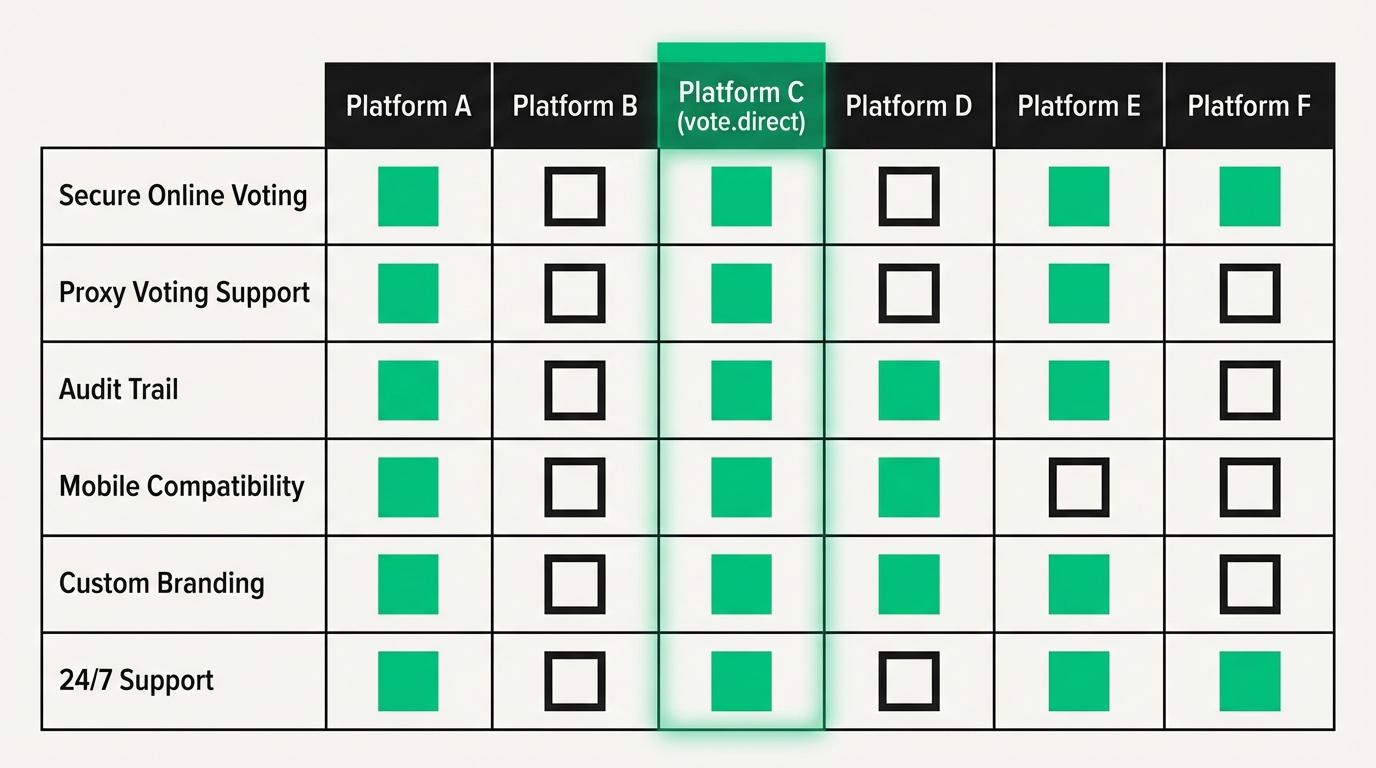
Digital platforms like vote.direct handle the mechanical side (identity verification, ballot delivery, automatic tabulation, and audit trails) so you can focus on the governance decisions that matter.
This article is general information, not legal advice. We recommend you do your own research and confirm anything you plan to act on. Where this article states law, the section is cited so you can read the primary source yourself rather than take our word for it. That is what the citations are for. Election requirements also turn on your own governing documents, which we have not seen, and statutes are amended. For advice about your community, consult a qualified attorney licensed in your state.
We work hard to verify every citation against the primary source, but laws change and errors happen. If you spot an inaccuracy, email support@vote.direct and we will correct it. See our editorial standards for how these pages are researched and checked.