The Quorum Crisis
You reserved the community room. You printed the agenda. You prepared the financial report. Seven people showed up.
This scenario plays out every week across America's 365,000 homeowner associations and 1.5 million nonprofit organizations. The math is brutal: most governing documents require a quorum of 20-51% of eligible voters, but typical in-person meeting attendance hovers at 15-20%.
When you can't reach quorum, you can't conduct business. Board elections get delayed. Budget approvals stall. Special assessments sit in limbo. Bylaw amendments, which often require supermajority thresholds, become nearly impossible.
This isn't just inconvenient. It's expensive. Every failed quorum attempt costs money in re-mailing notices, rebooking facilities, and board member time. Some HOAs report spending $2,000-$5,000 per failed meeting when notice requirements, facility rentals, and management company time are factored in.
Here are seven strategies that actually work, ranked from easiest to implement to most impactful.
Strategy 1: Fix Your Notice Timing
Impact: Low to Medium | Cost: $0 | Implementation: Immediate
Most organizations send election notices 10-14 days in advance because that's the statutory minimum. This is a mistake.
The problem: Members get the notice, mentally file it as "sometime next week," and forget. By meeting day, the notice is buried under two weeks of mail and email.
The fix:
- Send the official notice 30 days out (even if your state only requires 10-14)
- Send a reminder at 14 days
- Send another reminder at 7 days
- Send a final reminder 24-48 hours before with the exact time, location, and agenda
This multi-touch sequence is standard in direct marketing because it works. The 48-hour reminder consistently produces the biggest attendance bump: people need a trigger close to the event.
For digital voting: This is even easier. Platforms like vote.direct can automate the entire reminder sequence. Set it once, and voters get nudged at optimal intervals throughout the voting window.
Strategy 2: Make Proxy Voting Easy
Impact: Medium | Cost: Low | Implementation: 1-2 weeks
If your state and bylaws allow proxy voting, you're leaving participation on the table every time a member can't attend. The problem is usually friction: the proxy form is confusing, members don't know how to fill it out, or they can't get it to the board in time.
The fix:
- Include a pre-filled proxy form with every meeting notice (name, unit, date already completed)
- Accept proxies via email, fax, and in-person, not just one method
- Set a clear proxy deadline (48 hours before the meeting, not the day-of scramble)
- Designate a default proxy holder (usually the board president or management company) so members can grant their proxy without finding someone to carry it
State-specific rules:
- California (Civil Code §5130): Proxies must be in writing, directed to a specific person, and revocable
- Florida (Statute 720.306): Limited proxies must be used for specific votes, general proxies for quorum only
- Texas (Property Code §209.00592): Electronic proxy authorization is permitted
Important: Proxy voting helps with quorum but doesn't actually increase engagement. Members who routinely send proxies aren't participating in the discussion. Consider proxies a bridge strategy while you implement more impactful changes.
Strategy 3: Offer Multiple Participation Channels
Impact: Medium-High | Cost: Varies | Implementation: 2-4 weeks
Your members didn't all join the community for the same reasons, and they won't all participate in the same way. Offering only in-person attendance is like a store that only accepts cash: you're rejecting customers who are willing to pay, just not in the format you require.
The channels:
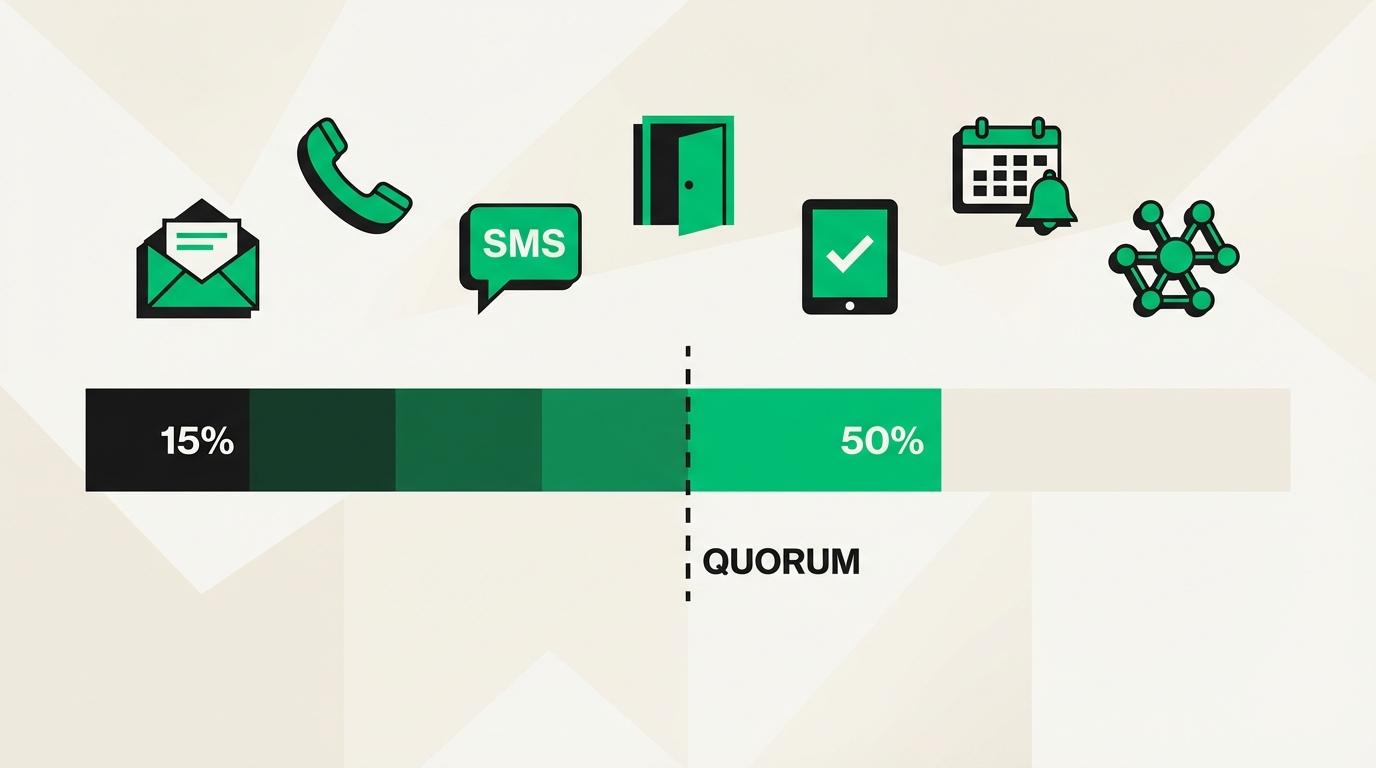
- 1In-person attendance at the meeting
- 2Digital voting before and during the meeting (email/SMS ballot delivery)
- 3Mail-in ballots for members without email or internet access
- 4Proxy voting as a fallback
Organizations that offer all four channels consistently reach quorum. The reason is simple: each channel removes a different barrier.
| Barrier | Channel That Solves It |
|---|---|
| Can't attend the meeting (travel, work, health) | Digital voting |
| Doesn't have email/internet | Mail-in ballot |
| Forgot about the meeting | Digital reminders |
| Doesn't care enough to attend but will vote if easy | Digital voting (2-minute process) |
| Snowbird / seasonal resident | Digital voting or mail-in |
Real-world impact: A 300-unit HOA in Florida switched from in-person-only voting to offering digital + mail-in alongside the annual meeting. Participation went from 22% to 58% in the first year.
Strategy 4: Lower Your Quorum Threshold
Impact: High | Cost: $0 (but requires a vote) | Implementation: Varies
If your quorum is 51% and you consistently hit 25-35%, you have a structural problem that tactics alone won't fix. Consider amending your bylaws to lower the quorum threshold.
Common quorum thresholds:
- 51%: Difficult for large communities; common default in older documents
- 33% (one-third): Achievable for active communities with good communication
- 25%: Realistic for communities with 200+ units
- 20%: Common for very large associations (500+ units)
- 10-15%: Used by some state statutes as defaults when bylaws are silent
The catch: Lowering quorum requires a vote, which itself requires quorum. You may need to use strategies 1-3 first to get enough participation to amend the threshold.
State defaults, and note that a "default" is not a floor:
- California: there is no statutory minimum. Corp. Code §7512(a) makes one-third of the voting power a quorum and lets a bylaw set a *different* number, higher or lower; a bylaw amendment that raises it needs member approval, and where the bylaw quorum is under one-third, §7512(b) limits a thinly attended regular meeting to matters described in the notice. The 20% figure people repeat is the reduced quorum for a reconvened board-election meeting under Civ. Code §5115(d) (AB 1458), not a floor.
- Florida (§720.306(1)(a)): 30% of total voting interests, and the bylaws may only provide a lower number, not a higher one.
- Colorado (§38-33.3-309(1)): 20% of the votes that may be cast for the executive board, or 10% for an association with over 1,000 unit owners, unless the bylaws provide otherwise.
Pro tip: Some organizations adopt a declining quorum provision: if the first meeting fails quorum, a second meeting can be held with a lower threshold (often 50% of the original requirement). This is specifically authorized in some states and avoids the dead-end of perpetually failed meetings.
Quick question for community leaders
What would actually get more members to vote?
Strategy 5: Run Election Campaigns (Yes, Really)
Impact: Medium-High | Cost: Low | Implementation: 2-4 weeks
Board elections in HOAs and nonprofits typically feature zero campaigning. The nominating committee puts forward candidates, the candidates submit a brief bio, and members vote (or don't) based on name recognition.
This is backwards. Competitive, visible elections drive participation.
What a board "election campaign" looks like:
- Candidate statements distributed to all members (200-300 words each, emailed and posted in the community)
- Candidate Q&A session, a 30-minute Zoom call or in-person event where members can ask candidates questions
- Issue framing: instead of "Vote for candidates," frame it as "Your vote decides whether we repair the pool this year or replace the roof"
- Personal outreach: Have board members personally call or email members encouraging participation. This is the single most effective tactic for driving turnout.
The psychology: People skip votes when they don't believe their vote matters. Making elections visible, competitive, and consequential changes the perception from "boring meeting I can skip" to "important decision I should influence."
Strategy 6: Switch to Digital Voting
Impact: Very High | Cost: From $4.99/election | Implementation: 1-2 weeks
This is the highest-impact single change an organization can make. The data is unambiguous:
Average participation rates by method:
| Voting Method | Typical Participation |
|---|---|
| In-person only | 15-20% |
| In-person + proxy | 25-35% |
| In-person + mail-in | 30-40% |
| Digital + in-person | 45-55% |
| Digital + mail-in + in-person | 50-65% |
Why digital voting works:
- No travel required: Members vote from their phone, tablet, or computer
- Extended voting window: Instead of a 2-hour meeting, members get 7-14 days to vote at their convenience
- Automated reminders: The platform sends reminders to non-voters on a schedule you set
- Real-time quorum tracking: You can see exactly how close you are to quorum and target reminders to non-voters
- Reduced friction: The entire process takes 2-3 minutes from opening the email to casting a vote
Legal authorization: Most states now explicitly authorize electronic voting for HOAs:
- California AB 2159 (2024)
- Florida HB 1021 (2024)
- Texas Property Code §209.0058
- Colorado CCIOA electronic voting provisions
- Nevada NRS 116.31036
If your state isn't listed, check whether your bylaws authorize electronic voting, or consult with your association attorney. Many states allow it under general corporate/nonprofit law even without specific HOA provisions.
Strategy 7: Schedule Smart
Impact: Medium | Cost: $0 | Implementation: Immediate
When you hold the meeting matters more than most boards realize.
Worst times for quorum:
- Monday evenings (people are catching up from the weekend)
- Friday evenings (people have plans)
- Summer months (vacations, seasonal residents gone)
- Major holiday weeks
- Same night as regularly scheduled community events
Best times:
- Tuesday, Wednesday, or Thursday evenings (6:30-7:00 PM start time)
- Late September through mid-November (seasonal residents are back, holidays haven't started)
- January-February (after holidays, before spring travel)
For digital voting: Timing matters less because the voting window spans days. But the launch day still matters: send the initial ballot on a Tuesday or Wednesday morning for the highest open rates.
Combining Strategies: A Quorum Action Plan
Here's a practical implementation sequence:
Week 1: Immediate wins (Strategies 1 + 7):
- Schedule the next meeting for an optimal date/time
- Set up a 4-touch notice sequence (30 days, 14 days, 7 days, 48 hours)
Week 2-3: Add channels (Strategies 2 + 3):
- Create an easy proxy form and distribute it with the first notice
- Select a digital voting platform and set up your first election
Week 4+: Structural changes (Strategies 4 + 5 + 6):
- If quorum is achieved, propose a bylaw amendment to authorize electronic voting (if not already authorized) and adjust quorum thresholds if needed
- Implement candidate campaigns for the next election cycle
Measuring Success
Track these metrics across elections to measure improvement:
| Metric | Before | Target |
|---|---|---|
| Participation rate | __% | 50%+ |
| Quorum achieved? | Often no | Always |
| Reminder emails needed | N/A | 3-4 per election |
| Time to reach quorum | N/A | Within 5 days of voting window opening |
| Member complaints about access | Common | Rare |
Start Reaching Quorum
Digital voting is the single highest-impact change for reaching quorum. Vote.direct lets you set up an election in minutes with real-time quorum tracking, automated reminders to non-voters, and multiple participation channels.
Elections start at $4.99 per election, less than the postage cost of one mailed notice.
This article is general information, not legal advice. We recommend you do your own research and confirm anything you plan to act on. Where this article states law, the section is cited so you can read the primary source yourself rather than take our word for it. That is what the citations are for. Election requirements also turn on your own governing documents, which we have not seen, and statutes are amended. For advice about your community, consult a qualified attorney licensed in your state.
We work hard to verify every citation against the primary source, but laws change and errors happen. If you spot an inaccuracy, email support@vote.direct and we will correct it. See our editorial standards for how these pages are researched and checked.