Quick Answer
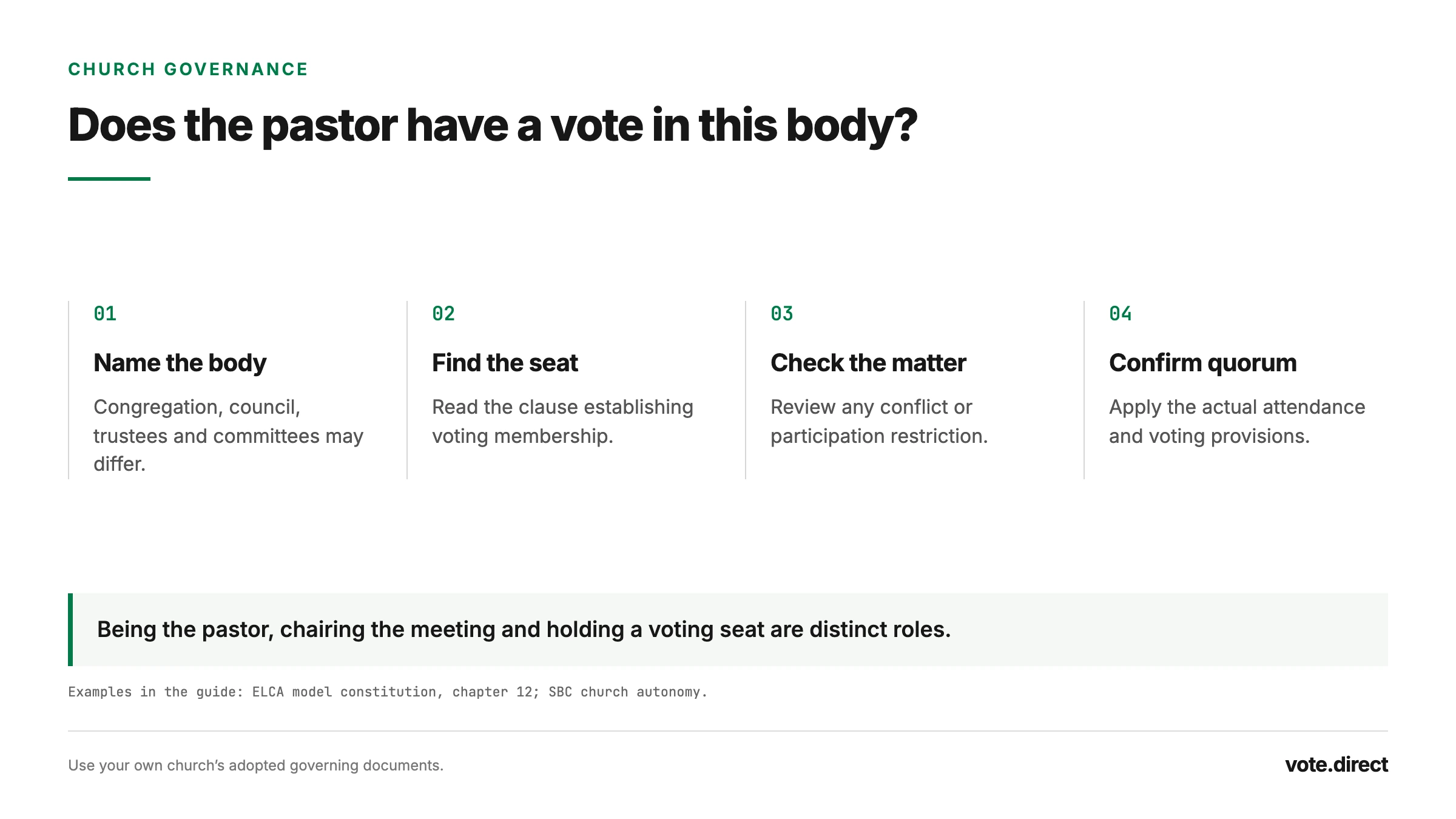
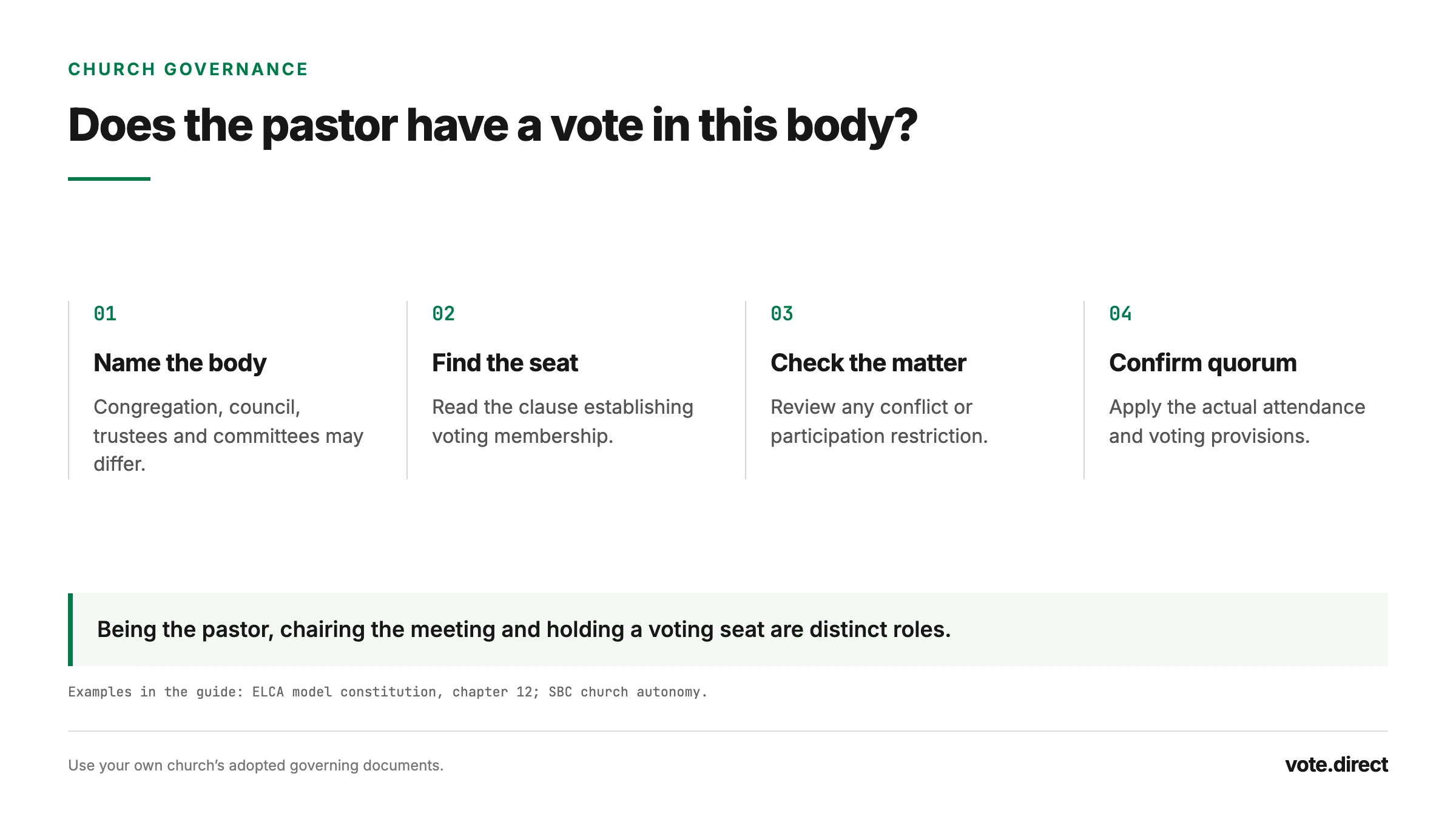
A pastor can vote when the applicable governing rules make the pastor a voting member of that particular body and no rule excludes participation in that matter. There is no single rule for every church. Check the congregation, council, trustees and committees separately. A right to attend or speak is not automatically a voting seat, and chairing a meeting does not create a second vote.
This guide addresses organizational procedure in U.S. churches. It uses named denominational examples, without treating one church's polity as another church's rule.
Ask which body is meeting
A congregation may have a member meeting, a church council, a trustee board and several ministry committees. The pastor's role can be different in each. Start by writing the full name of the body above the attendance list.
| Body | Documents and provisions to check |
|---|---|
| Congregational meeting | Voting membership, eligibility, reserved decisions and meeting rules |
| Council or governing board | Composition, pastor seats, terms, vacancies and quorum |
| Trustees | Legal or property responsibilities and the rules creating that body |
| Committee | Appointment authority, membership and delegated decision limits |
Do not import a council rule into a congregational ballot. Likewise, a pastor who sits on one committee is not necessarily a member of all committees. Our church trustee guide explains why the legal and spiritual offices should be identified clearly.
ELCA example: the model expressly includes pastors
The ELCA's model constitution, included in its April 2026 governing-document compilation, lists pastors in the voting membership of the Congregation Council at C12.01. Its C12.12 quorum provision also addresses the pastor's presence and specified exceptions. Review the congregation's adopted constitution and applicable synod guidance rather than applying a model clause in isolation. ELCA governing documents, model constitution chapter 12.
That answers a different question from whether the pastor votes at a congregation meeting or on a particular employment matter. Identify the governing provision for each decision. When the pastor will be absent, resolve any applicable attendance, agenda and consultation requirements before assuming that the remaining council can proceed.
Baptist example: local governing documents matter
The Southern Baptist Convention describes cooperating churches as autonomous and self-governing. SBC membership therefore does not supply one universal council-voting provision for every local congregation. SBC legal documentation.
For a Baptist church, look at its adopted constitution and bylaws, the provisions creating the board or council, and any applicable state corporate rules. “We have always let the pastor vote” is useful history, but the secretary should still find the authority. If the documents conflict or the practice is disputed, resolve the interpretation before the result depends on it. See Baptist church voting procedures.
What does ex officio actually tell you?
Under Robert's Rules, ex officio describes membership by virtue of another office; it does not itself mean nonvoting. Specific governing provisions can change the applicable rights or quorum treatment. Official FAQ, question 2.
Read the entire clause. “The pastor attends as an adviser” and “the pastor is a voting member” describe different arrangements. Record the exact wording instead of relying on a label from a previous spreadsheet. If someone holds two qualifying roles, do not automatically create two voting credentials for the same person.
A practical seat-count example
Imagine a fictional council whose adopted rules provide for six elected voting members and one pastor voting member. Its ordinary voting membership is seven, not six. If its applicable quorum rule simply requires a majority of those seven members, the numerical requirement is four. A real constitution may add a pastor-presence requirement or provide another denominator, so this illustration is not the ELCA quorum rule.
Suppose the pastor also chairs the meeting. That fact alone does not add an eighth seat. Before enabling a chair's casting vote or an extra credential, locate the rule that authorizes it. The administrative roster should express the actual seats and powers accurately.
A conflict question needs a separate decision
Whether the pastor holds a voting seat is not the same question as how the council handles the pastor's compensation, a related-party contract or another personal interest. Use the applicable conflict, employment and denominational procedures. Check who is permitted to deliberate, who votes, who chairs, and what quorum treatment applies.
Do not label a required recusal as an ordinary abstention and move on. Record disclosure and participation restrictions accurately. The abstention and recusal guide includes a worked count and recordkeeping example.
Prepare a one-page answer before the meeting
The church secretary can give the chair a short reference containing the body name, governing-document version, composition clause, eligible voting seats, relevant quorum rule and any restrictions for the scheduled item. Preserve the interpretation and who confirmed it. A member asking why a vote was counted should receive a clear explanation tied to the governing provision.
If a disputed vote has already been counted, preserve the original result and records. Identify whether the disputed participation could change the outcome, then use the applicable correction or challenge process. Silently editing the tally creates a second problem.
Frequently Asked Questions
Does being an employee make the pastor a nonvoting adviser?
Not automatically. Employment status and membership in a church governing body are separate questions. Read the provision creating the seat and any restrictions that apply to the particular matter.
Can the pastor vote on every issue if the constitution gives a voting seat?
A voting seat does not eliminate conflict, disqualification or other subject-specific rules. Review sensitive employment and financial matters separately before deciding who may participate.
What should a church do if its documents do not say?
Locate the other applicable authorities, including state law and denominational provisions, and obtain an interpretation from the appropriate church authority or qualified adviser. Do not invent a new voting arrangement during a close vote.
Source notes and next steps
Primary sources checked September 5, 2026: ELCA governing documents, SBC legal documentation and the Robert's Rules Association FAQ. The seven-seat council is a fictional arithmetic example, not a denominational model.
Continue with church quorum, who can vote in church, and the church governance library. vote.direct can support online and mailed elections using an authorized process.
This article is general information, not legal advice. We recommend you do your own research and confirm anything you plan to act on. Where this article states law, the section is cited so you can read the primary source yourself rather than take our word for it. That is what the citations are for. Election requirements also turn on your own governing documents, which we have not seen, and statutes are amended. For advice about your community, consult a qualified attorney licensed in your state.
We work hard to verify every citation against the primary source, but laws change and errors happen. If you spot an inaccuracy, email support@vote.direct and we will correct it. See our editorial standards for how these pages are researched and checked.