The Paper That Controls Your Election
In a sprawling Miami community with over 18,000 residents, voter participation in a board election hit 115 %, more votes were cast than homeowners existed. Four former board members were later charged in a scheme involving $3 million in misappropriated funds. The tool they used to manufacture their majority wasn't sophisticated technology or hidden ballot boxes. It was paper proxies.
Proxy voting, where one person authorizes another to vote on their behalf, is a legitimate and often necessary part of HOA governance. But it's also the most commonly exploited mechanism in community association elections. And the rules around it vary so dramatically from state to state that a practice perfectly legal in California could be a statutory violation in Arizona.
This article breaks down how proxy fraud actually works, what your state's rules are (with the specific statutes to back it up), and what every board can do to prevent it.
This article is for informational purposes only and does not constitute legal advice. HOA election requirements vary by state, governing documents, and local regulations. Consult a qualified attorney for advice specific to your community.
How Proxy Fraud Actually Happens
Proxy fraud doesn't usually look like a Hollywood heist. It looks like a board president walking door-to-door collecting blank proxy forms. It looks like a property manager "helping" elderly residents fill out their voting preferences. It looks like a stack of pre-signed forms appearing at a meeting without explanation.
The most common patterns include:
1. Blank Proxy Harvesting
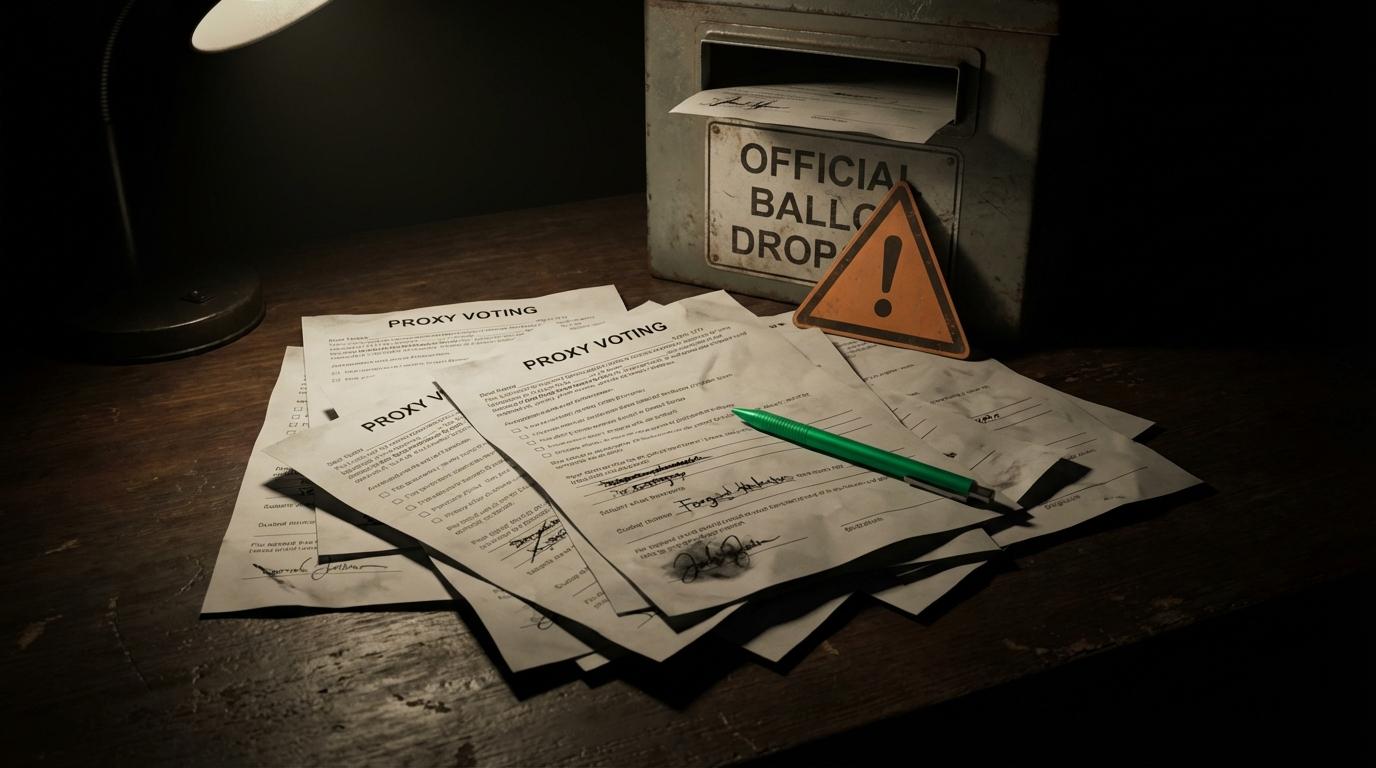
A board member or faction collects signed but unfilled proxy forms from residents, often under the guise of "making sure your voice is heard." The proxyholder then fills in the votes however they choose. The homeowner has no idea how their vote was cast.
2. Uninformed Proxy Solicitation
Residents are asked to sign proxy forms at a social event, by the pool, or during a casual conversation. The implications of the proxy aren't explained. The resident may not even realize they've given away their vote on a specific matter.
3. Proxy Stacking
One person accumulates a disproportionate number of proxies, sometimes dozens, giving them outsized control over the election outcome. In communities without per - person proxy limits, a single individual can functionally control the entire vote.
4. Forged Proxies
In the most egregious cases, proxy forms are fabricated entirely, signatures forged, forms backdated, or proxies created for homeowners who never agreed to participate.
5. Pressure Tactics
Board members or management companies pressure homeowners into signing proxies with implied threats. Some states have made this a criminal offense.
The Real Cost of Proxy Abuse
The Hammocks HOA case in Miami, one of South Florida's largest communities, illustrates the full damage. The community ultimately settled for the full $2 million D&O insurance policy limit. Total fraud exceeded $3 million. In the aftermath, the association discovered that during one election, voting had been cancelled mid-election by the board itself.
A separate Florida community generated 315 docket entries over three years in a lawsuit triggered by a single allegedly fraudulent proxy ballot, one that wouldn't have even changed the outcome. The legal cost: over $291,000.
Florida alone received 1, 908 condominium election fraud complaints in a single year, with proxy - related issues among the most frequent allegations.
State - by - State Proxy Rules: What Your State Allows
California: Allowed, Members Only
California permits proxy voting if the association's bylaws allow it (Civil Code §5130). Key restrictions:
- Proxies must be written and signed by the member
- Can only be given to another member of the association
- Expire after 11 months, with a maximum term of 3 years (Corporations Code §7613)
- Proxies cannot be used in lieu of a ballot (Civil Code §5130(a))
- Revocable by the member at any time before the inspector receives the ballot
Florida: Split Rules: HOAs vs. Condos
HOAs(Chapter 720): Proxies are allowed per governing documents. Must be written, dated, signed, and state the specific meeting. Valid only for that meeting, expiring 90 days after the meeting date(§720.306(8)).
Condominiums(Chapter 718): Proxies are PROHIBITED for board elections (§718.112(2)(b)). This is the single most common compliance mistake in Florida condo governance. Proxies are allowed for non-election votes only.
Florida's HB 1203 (HOAs) and HB 1021 (condos), both effective July 1, 2024, introduced criminal penalties for election fraud, including forged ballot envelopes and voting certificates.
Texas: Allowed by Statute, Broad Rights
Owners must be allowed to vote by proxy or absentee ballot(Property Code §209.00592). An association cannot bar a property owner from voting based on delinquent assessments or pending enforcement actions. If a member who submitted a proxy later votes in person, the in -person vote supersedes all prior votes.
Colorado: Allowed, Anyone Can Hold
Owners may appoint any person with legal capacity as their proxyholder, not just association members(C.R.S. §38 - 33.3 - 310(3)). Proxies expire 11 months after their date unless a different timeframe is specified.
Arizona: BANNED After Declarant Control
Both planned communities(ARS §33 - 1812) and condominiums(ARS §33 - 1250) prohibit proxy voting entirely after the period of declarant control ends. Owners who cannot attend must use absentee ballots: including email and fax.
Where do you stand?
What should happen to proxy voting in HOAs?
Nevada: Board Election Ban, Restricted Holders
Proxies are prohibited for board elections but allowed for general association votes(NRS 116.311). Even for general votes, proxyholders are restricted to immediate family, tenants, other unit owners, or authorized delegates. Fraudulently altering an election outcome is a Category D felony (1 - 4 years prison, NRS 116.31107).
Comparison Table
| State | Board Elections | General Votes | Who Can Hold? | Max Duration |
|---|---|---|---|---|
| California | Allowed(if bylaws permit) | Allowed | Members only | 11 months(max 3 years) |
| Florida HOA | Allowed | Allowed | Per governing docs | Specific meeting; 90 days max |
| Florida Condo | PROHIBITED | Allowed | Per governing docs | Specific meeting; 90 days max |
| Texas | Allowed(mandatory right) | Allowed | Per governing docs | 11 months default |
| Colorado | Allowed | Allowed | Any person with legal capacity | 11 months default |
| Arizona | PROHIBITED | PROHIBITED | N / A | N / A |
| Nevada | PROHIBITED | Allowed(restricted holders) | Family, tenant, unit owner, delegate | Per governing docs |
Your Prevention Checklist
If Your State Allows Proxies
- 1Set per - person limits in governing documents(e.g., maximum 3 proxies per holder)
- 2Require directed proxies: specific voting instructions, not blanket authority
- 3Verify signatures against membership records before accepting
- 4Set submission deadlines before the meeting, not at the door
- 5Provide electronic voting to reduce reliance on proxies
- 6Announce proxy counts at the meeting for transparency
For All States
- 1Use identity-verified voting: each vote from a verified, unique individual
- 2Maintain a complete audit trail: timestamps, verification records, immutable logs
- 3Consider electronic voting: every state either authorizes or doesn't prohibit it. Digital systems with voter authentication eliminate the paper proxy attack vector entirely
FAQ
Q: Can a board member collect proxies in my state?
In states that allow proxies, board members can technically hold proxies, but it's a governance best practice to prohibit it. In Arizona and Nevada board elections, the question is moot because proxies are banned.
Q: What happens if our Florida condo used proxies in a board election?
The election may be voidable. §718.112(2)(b) explicitly prohibits proxy use in condo board elections. A member could challenge through DBPR arbitration($200) or Circuit Court within 60 days.
Q: How do electronic votes prevent proxy fraud?
Electronic voting with identity verification ensures each vote comes from a specific, authenticated individual. There's no paper form to forge, no blank signature to exploit, and no stack of proxies to manipulate.
Q: Can a proxy be revoked?
In every state that allows proxies, yes. California: until the inspector receives the ballot(Corporations Code §7613). Texas: in -person vote supersedes any proxy(Property Code §209.00592).
The Bottom Line
Proxy voting exists to solve a legitimate problem: not every homeowner can attend every meeting. But paper proxies create opportunities for manipulation that have cost communities millions in legal fees and eroded trust in HOA governance.
Two states, Arizona and Nevada, have banned proxies for board elections. The trend is clear: the future of HOA voting is each owner casting their own verified vote, not handing a blank form to someone else. The most effective fraud prevention is replacing paper with verified digital voting, where every vote is authenticated, every ballot is encrypted, and the audit trail makes proxy manipulation obsolete.
Sources:
- 1California Civil Code §5130: Proxy voting requirements
- 2Corporations Code §7613: Proxy revocability and maximum 3 - year term
- 3Florida Statutes §718.112(2)(b): Condominium proxy prohibition for board elections
- 4Florida Statutes §720.306(8): HOA proxy rules
- 5Florida HB 1021(2024): Criminal penalties for election fraud
- 6Texas Property Code §209.00592: Mandatory proxy / absentee right; in -person supersession
- 7Colorado C.R.S. §38 - 33.3 - 310(3): Proxy to any person with legal capacity
- 8Arizona ARS §33 - 1812: Proxy prohibition after declarant control(planned communities)
- 9Arizona ARS §33 - 1250: Proxy prohibition after declarant control(condominiums)
- 10Nevada NRS 116.311: Proxy prohibition for board elections
- 11Nevada NRS 116.31107: Category D felony for election fraud
This article is general information, not legal advice. We recommend you do your own research and confirm anything you plan to act on. Where this article states law, the section is cited so you can read the primary source yourself rather than take our word for it. That is what the citations are for. Election requirements also turn on your own governing documents, which we have not seen, and statutes are amended. For advice about your community, consult a qualified attorney licensed in your state.
We work hard to verify every citation against the primary source, but laws change and errors happen. If you spot an inaccuracy, email support@vote.direct and we will correct it. See our editorial standards for how these pages are researched and checked.