The Election That Took Three Tries
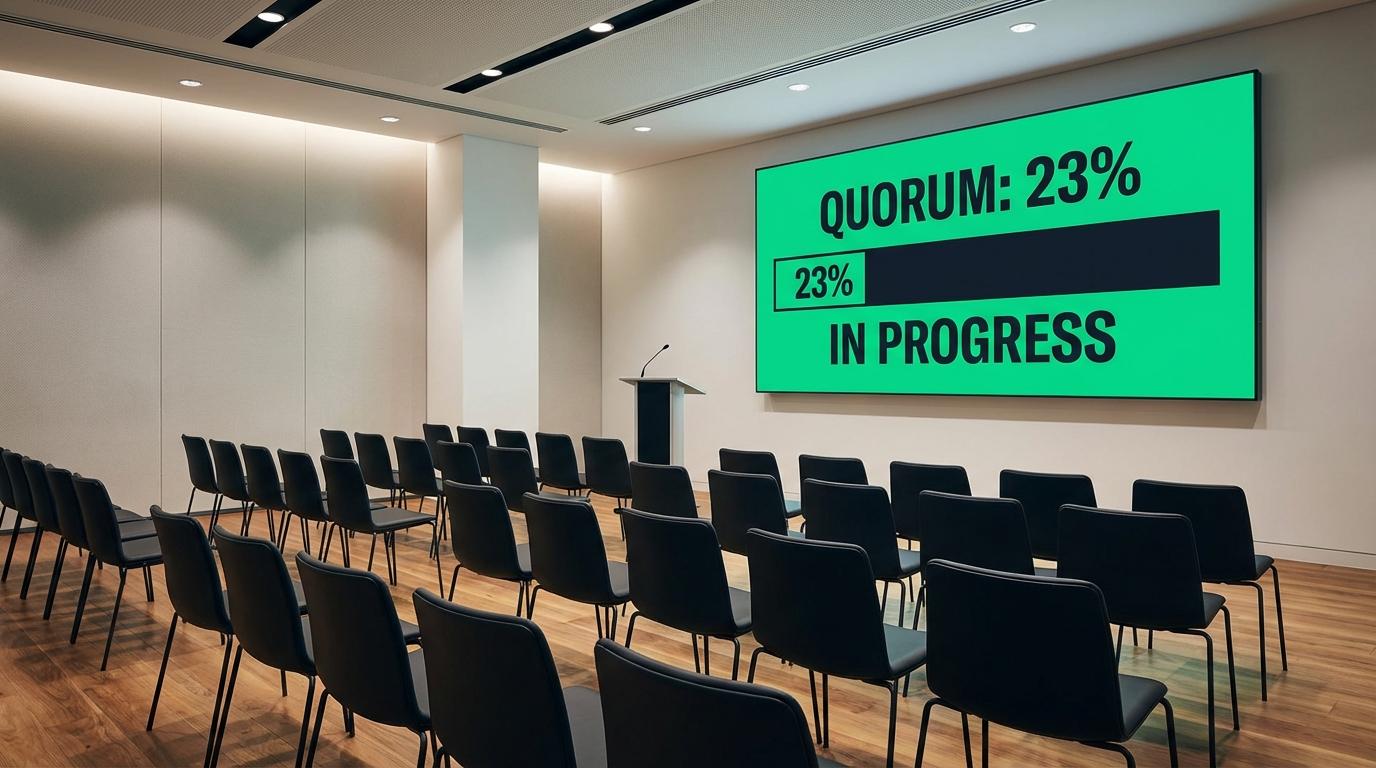
A 500 - unit condominium in suburban Phoenix scheduled its annual board election for a Tuesday evening in January. The board booked a meeting room, printed ballots, hired a neutral ballot counter, and sent notices to every owner. Twenty - three people showed up.
The election couldn't proceed. Quorum wasn't met. The board rescheduled for three weeks later, sent new notices, booked the room again, and hoped for better turnout. Thirty - one people came. Still not enough.
By the time the election finally happened, on the third attempt, four months after it was originally scheduled, the association had spent over $4, 500 on room rentals, mailing costs, and administrative time. The winners received a combined 47 votes out of 500 eligible owners.
This scenario plays out in HOA communities across the country every year. Quorum, the minimum number of members who must participate for a vote to be valid, is one of the most misunderstood and most consequential rules in community association governance.
This article is for informational purposes only and does not constitute legal advice. HOA election requirements vary by state, governing documents, and local regulations. Consult a qualified attorney for advice specific to your community.
What Is Quorum and Why Does It Matter?
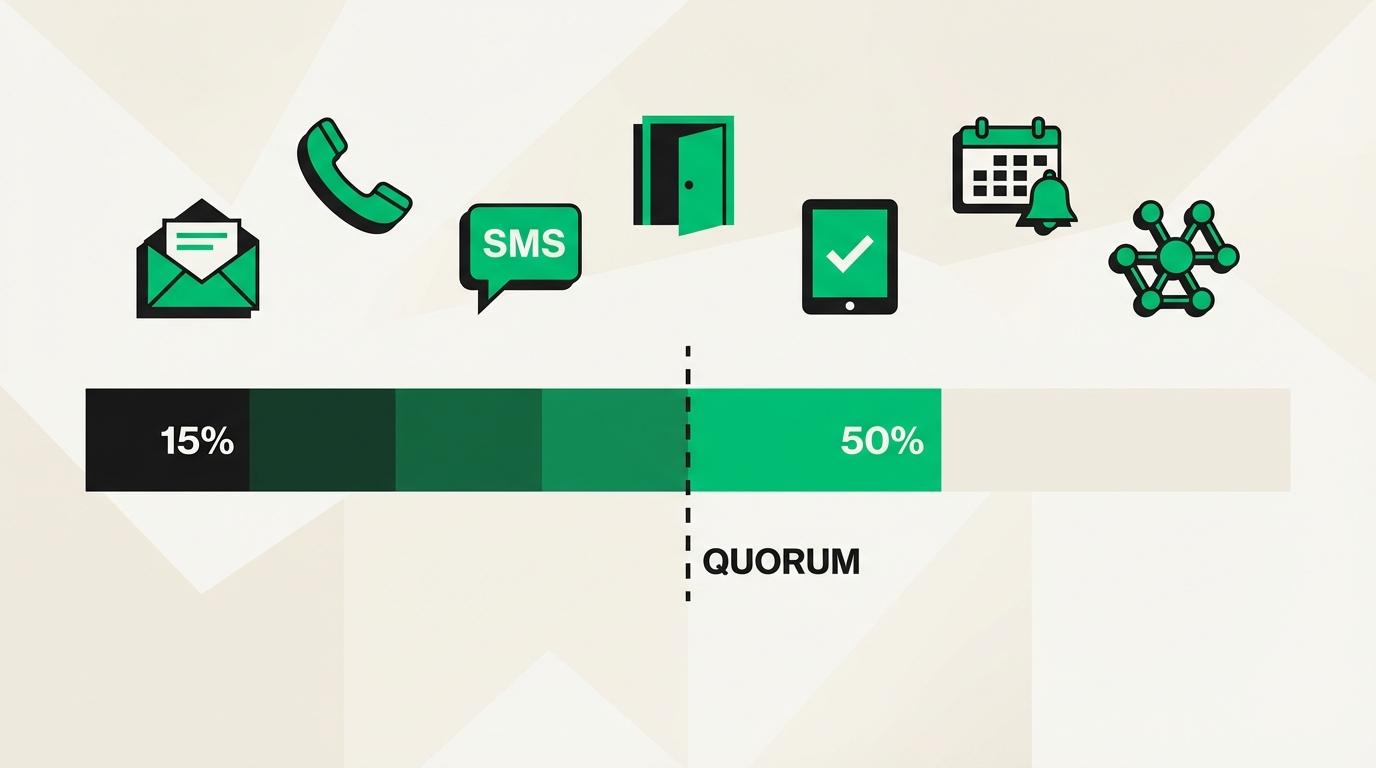
Quorum is the minimum number of members who must be present(in person, by proxy, or by ballot) for the association to conduct official business. It exists to prevent a small minority from making decisions that bind the entire community.
The problem: in many communities, reaching quorum is harder than it sounds. National surveys consistently show that HOA election participation rates hover between 15 % and 30 % for in -person meetings.
State - by - State Quorum Thresholds
Nevada: No Quorum Required
Nevada eliminated quorum for board elections entirely. Under NRS 116.31034: "A quorum is not required to be present when the secret ballots physically received by the association are opened and counted."
Practical impact: Every Nevada board election happens on schedule. No failed meetings, no rescheduled elections, no quorum games.
Colorado: 20 % (Small) or 10 % (Large)
Colorado sets the lowest statutory thresholds. Under C.R.S. §38 - 33.3 - 309:
- 20 % for associations with 1,000 or fewer unit owners
- 10 % for associations with more than 1,000 unit owners
These apply only if governing documents are silent on quorum.
Florida Condo: No Quorum, 20 % Participation Threshold
Under §718.112(2)(d), no quorum is required for condo board elections. Instead, at least 20 % of eligible voters must cast a ballot for the election to be valid.
Florida HOA: 30 % Default
Florida HOAs have a 30 % quorum unless bylaws set lower(§720.306(1)). Proxies count. No statutory reduced quorum provision for subsequent meetings.
California: Per Governing Documents, With a Safety Net
California's quorum comes from governing documents, and many bylaws set it at 50%. But under Civil Code §5115(d) (AB 1458, effective January 1, 2024):
If quorum isn't met for a board election:
- 1Meeting adjourns to a date at least 20 days later
- 2New notice sent at least 15 days before
- 3Quorum reduces to 20 % of members
Scope limitation: The 20 % reduced quorum applies only to board elections , not recalls, assessments, or amendments.
Texas: Per Governing Documents Only
Texas leaves quorum entirely to governing documents(Property Code §209.00592). No statutory default. Electronic ballots count toward quorum for items on the ballot.
Arizona: 25 % for Condominiums, Per Governing Documents for Planned Communities
Condominiums do have a statutory default. Under ARS §33-1249(A), unless the bylaws provide otherwise, a quorum is present if persons entitled to cast at least 25 % of the votes in the association are present in person or by proxy at the beginning of the meeting; §33-1249(B) sets 50 % for board meetings. The Planned Community Act has no quorum section, so a planned community looks to its community documents, or to the one-tenth nonprofit default in ARS §10-3722 if those are silent. Absentee ballots, including electronic votes, count toward quorum in both regimes (ARS §33-1812(B) for planned communities, §33-1250(D) for condominiums).
Quorum Comparison Table
| State | Default Quorum | Reduced Quorum? | Proxies Count? | Key Statute |
|---|---|---|---|---|
| Nevada | None required | N / A | N / A(banned for board elections) | NRS 116.31034 |
| Colorado | 20 % (≤1,000) / 10% (>1,000) | No | Yes | C.R.S. §38-33.3-309 |
| Florida Condo | None(20 % participation threshold) | N / A | N / A(banned for board elections) | §718.112(2)(d) |
| Florida HOA | 30 % | No | Yes | §720.306(1) |
| California | Per docs(often 50 %) | Yes: 20 % on retry (board only) | Yes | Civil Code §5115(d) |
| Texas | Per docs | No | Yes; electronic counts for ballot items | §209.00592 |
| Arizona (condo) | 25 % unless bylaws provide otherwise | No | N / A(banned); absentee counts | ARS §33-1249(A); §33-1250(D) |
| Arizona (planned) | Per docs; one-tenth if a nonprofit and docs are silent | No | N / A(banned); absentee counts | ARS §10-3722; §33-1812(B) |
What Happens When Quorum Fails
Quick question for community leaders
What would actually get more members to vote?
Direct Financial Costs
| Expense | Typical Cost |
|---|---|
| Meeting room re - booking | $200 - $800 |
| Reprinting / remailing ballots and notices | $300 - $1, 500 |
| Management company staff time | $200 - $600 |
| Inspector of elections rebooking(California) | $200 - $500 |
| Legal counsel for quorum procedures | $500 - $2,000 |
| Total per failed attempt | $1, 400 - $5, 400 |
Governance Paralysis
When elections can't proceed: board terms expire with no successors, budget approvals stall, contract decisions freeze, and assessment collection weakens because homeowners question the board's authority.
Legal Exposure
Actions taken by holdover directors may be challenged as unauthorized. Contracts signed by an expired board could be voidable. California's AB 1458 was specifically enacted because failed quorum was causing governance crises across the state's 50,000 + HOAs.
Strategies That Actually Increase Participation
1. Offer Electronic Voting
Every state in this analysis either authorizes or doesn't prohibit electronic voting. Traditional participation: 15-30%. With electronic voting option: 40-70%.
Electronic voting is authorized in California(AB 2159, Civil Code §5110(c)), Florida(§720.317 for HOAs; §718.128 for condos, expanded by HB 1021), Texas(Property Code §209.0058), Arizona(ARS §33 - 1812), and Nevada(NRS 116.31034). Colorado is silent but permissive.
2. Extend the Voting Window
Open voting days or weeks before the meeting. California requires ballots mailed 30 days before deadline(Civil Code §5115(c)). Nevada requires 15 days minimum(NRS 116.31034). Arizona requires 7 days minimum(ARS §33 - 1812(C)(4)).
3. Send Reminder Notifications
Track who hasn't voted (while maintaining ballot secrecy) and send targeted reminders. "Your election closes in 3 days. You haven't voted yet." is the lowest-cost, highest-impact tool for reaching quorum.
4. Lower Your Quorum in Governing Documents
If your bylaws set quorum at 50 % and your state doesn't mandate a minimum, amend to an achievable number. Colorado's 20 % default is a reasonable benchmark.
5. Maximize Absentee Ballot Collection
In proxy - ban states(Arizona, Nevada board elections), absentee ballots are the only way non - attending owners participate. Make the process simple: pre-addressed return envelopes, electronic submission, and follow - up before deadlines.
FAQ
Q: What does "quorum" include, just people in the room?
In most states, quorum includes members present in person, by proxy(where allowed), and by absentee ballot. Texas explicitly counts electronic ballots toward quorum for ballot items(§209.00592). Arizona explicitly counts absentee ballots toward quorum(ARS §33 - 1812(D)).
Q: Our HOA has never met quorum. Can the board just keep governing?
In most states, yes, holdover provisions allow existing board members to continue serving until successors are elected. But this creates legal gray areas. California addressed this with AB 1458's reduced quorum provision.
Q: Can we hold our election entirely by mail or electronically?
In many states, yes. California allows electronic voting(AB 2159). Florida authorizes electronic voting for HOAs under §720.317 and for condos under §718.128 (expanded by HB 1021). Texas allows electronic ballots as law. Arizona allows email and fax. Nevada allows electronic ballots. Colorado is silent but permissive.
Q: Does reaching quorum mean the election results are final?
Reaching quorum means the election can proceed, it doesn't prevent challenges. Quorum is necessary but not sufficient for a valid election.
The Bottom Line
Quorum exists to ensure elections have legitimacy, but in practice it often prevents elections from happening at all. Nevada solved this by eliminating quorum entirely. California created a reduced quorum safety net. Colorado set achievable defaults.
For boards struggling with quorum, the most impactful change is making it easier for owners to participate. Electronic voting, extended voting windows, and targeted reminders consistently push participation above quorum thresholds, turning quorum from a barrier into a non - issue.
Sources:
- 1Nevada NRS 116.31034: No quorum required for board elections
- 2Colorado C.R.S. §38 - 33.3 - 309: 20 %/10% quorum defaults
- 3Florida Statutes §718.112(2)(d): No quorum for condo elections; 20 % participation threshold
- 4Florida Statutes §720.306(1): 30 % quorum default for HOAs
- 5California Civil Code §5115(d): Reduced quorum to 20 % on second attempt(board elections)
- 6California AB 1458(2023): Reduced quorum provision
- 7Texas Property Code §209.00592: Electronic ballots count toward quorum
- 8Arizona ARS §33-1249: Condominium quorums, 25 % default; ARS §33-1812(B) and §33-1250(D): absentee ballots count toward quorum
This article is general information, not legal advice. We recommend you do your own research and confirm anything you plan to act on. Where this article states law, the section is cited so you can read the primary source yourself rather than take our word for it. That is what the citations are for. Election requirements also turn on your own governing documents, which we have not seen, and statutes are amended. For advice about your community, consult a qualified attorney licensed in your state.
We work hard to verify every citation against the primary source, but laws change and errors happen. If you spot an inaccuracy, email support@vote.direct and we will correct it. See our editorial standards for how these pages are researched and checked.