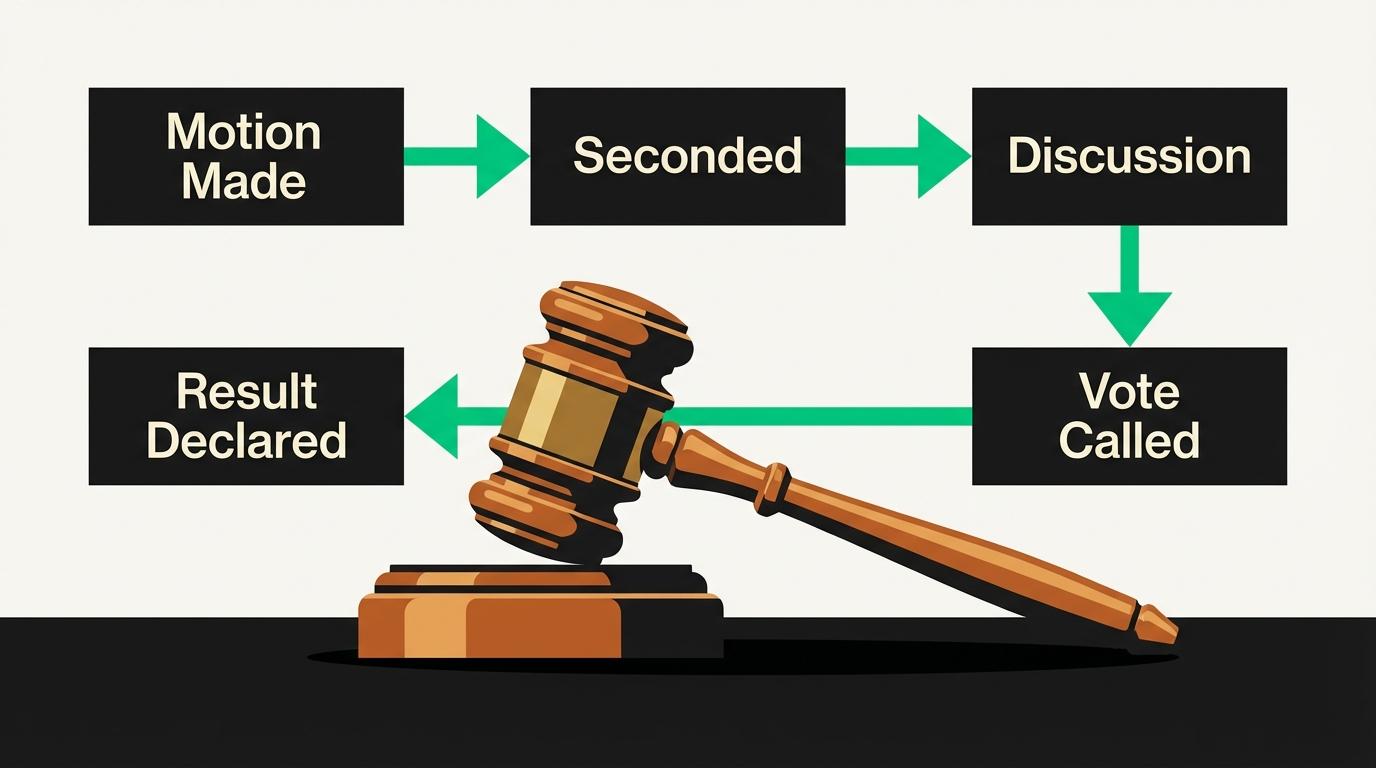
The Problem with "Pick One" Voting
Imagine your HOA is electing a new board president. There are four candidates: Alice, Bob, Carol, and Dan. Under traditional "pick one" voting (technically called plurality voting), the results come in:
- Alice: 35%
- Bob: 30%
- Carol: 20%
- Dan: 15%
Alice wins with 35% of the vote. But here's the problem: 65% of voters preferred someone else. And if Bob, Carol, and Dan supporters were asked, "Would you rather have Alice or Bob as president?" the answer might well be Bob. Alice won only because the opposition vote was split three ways.
This is the spoiler effect, and it happens constantly in elections with more than two candidates. The winner often isn't the candidate most people prefer, just the one whose opposition was most fragmented.
Ranked choice voting solves this.
How Ranked Choice Voting Works
Instead of picking one candidate, voters rank them in order of preference:
- 1st choice (favorite)
- 2nd choice (backup)
- 3rd choice
- And so on
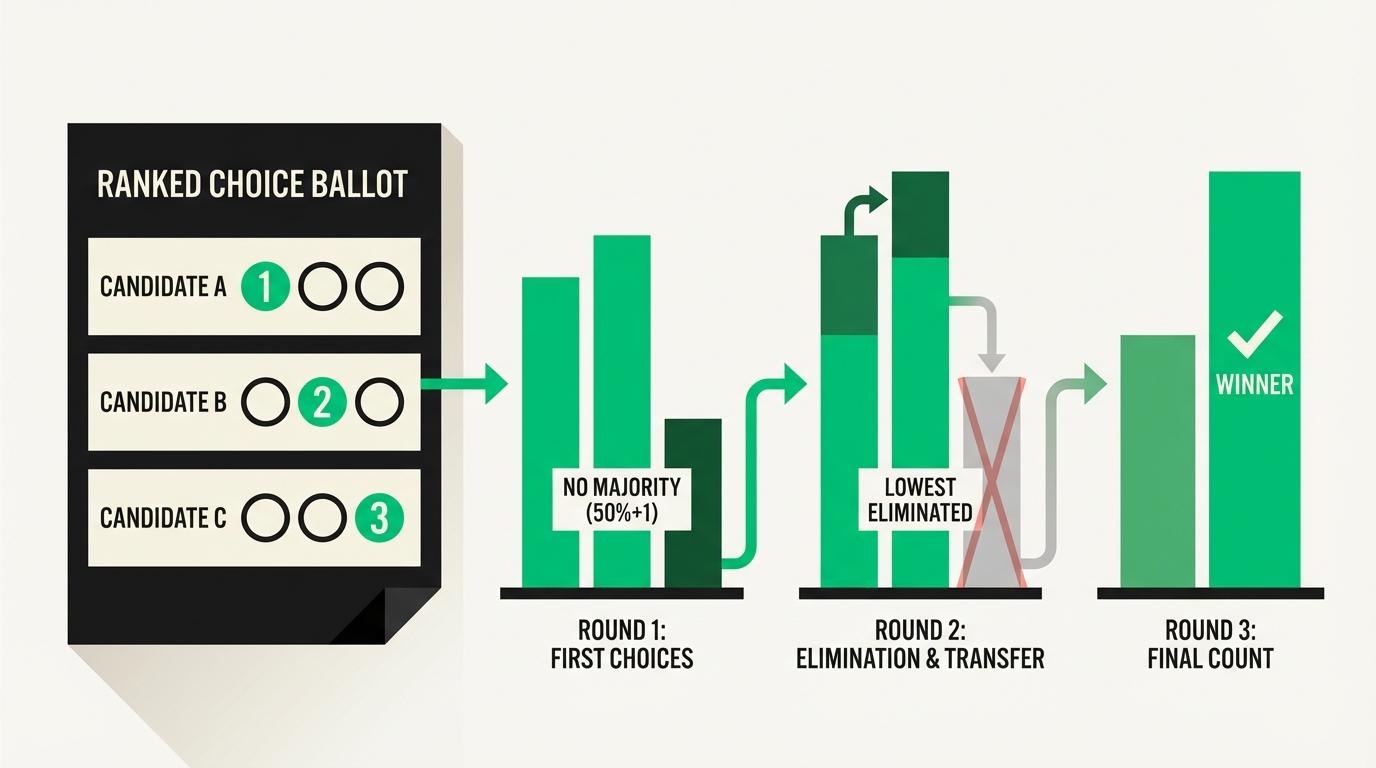
If no candidate wins a majority (50%+) of first-choice votes, the counting process works through a series of elimination rounds.
Step-by-Step: Instant Runoff
Round 1: Count all first-choice votes
Does any candidate have more than 50%? If yes, they win. If no, proceed to Round 2.
Round 2: Eliminate the last-place candidate
The candidate with the fewest first-choice votes is eliminated. Voters who ranked that candidate first now have their vote transferred to their second choice.
Round 3+: Repeat
Count again. Does any candidate have more than 50%? If yes, they win. If no, eliminate the new last-place candidate and transfer their voters' ballots to the next ranked choice on each ballot.
Continue until a candidate reaches a majority.
Worked Example: The Board Election
Let's walk through the same four-candidate election with ranked choice voting. There are 100 voters.
First-Choice Votes (Round 1)
| Candidate | First-Choice Votes |
|---|---|
| Alice | 35 |
| Bob | 30 |
| Carol | 20 |
| Dan | 15 |
No one has 50%+ votes. Dan is eliminated (lowest vote count).
Round 2: Dan Is Eliminated
Dan's 15 voters had these second-choice preferences:
- 8 ranked Bob as their second choice
- 5 ranked Carol as their second choice
- 2 ranked Alice as their second choice
Updated totals:
| Candidate | Votes After Round 2 |
|---|---|
| Alice | 35 + 2 = 37 |
| Bob | 30 + 8 = 38 |
| Carol | 20 + 5 = 25 |
Still no majority. Carol is eliminated.
Round 3: Carol Is Eliminated
Carol's 25 voters (her original 20 + the 5 transferred from Dan) had these next preferences:
- 16 ranked Bob next
- 9 ranked Alice next
Final totals:
| Candidate | Votes After Round 3 |
|---|---|
| Alice | 37 + 9 = 46 |
| Bob | 38 + 16 = 54 |
Bob wins with 54% of the vote.
What Happened?
Under traditional voting, Alice would have won with 35%. Under ranked choice, Bob won because he was the consensus candidate, more voters preferred him when their favorite couldn't win.
The ranked choice result better reflects the will of the majority: 54% of voters preferred Bob to Alice in a head-to-head comparison.
Types of Ranked Choice Voting
The example above uses Instant Runoff Voting (IRV), which is the most common form of ranked choice voting for single-winner elections. But there are other counting methods:
Instant Runoff Voting (IRV)
- Use case: Electing one winner (president, chair, representative)
- How it works: Eliminate last-place candidate each round, transfer votes to next preference
- Used by: New York City, Alaska, Maine, and dozens of cities for public elections; widely used by organizations for board elections
Single Transferable Vote (STV)
- Use case: Electing multiple winners (filling 3 board seats from 8 candidates)
- How it works: Similar to IRV but with a threshold for winning based on the number of seats. Candidates who exceed the threshold have their surplus votes transferred proportionally
- Used by: Cambridge, MA city council; many universities for student government; Irish national elections
Borda Count
- Use case: When you want to measure overall support across all preferences
- How it works: Points assigned to each ranking (e.g., 1st place = 4 points, 2nd = 3, 3rd = 2, 4th = 1). Highest total points wins
- Used by: Some academic awards, sports rankings, Eurovision Song Contest
Crystal ball time
In 5 years, how will most organizations make decisions?
Condorcet Method
- Use case: Finding the candidate who would beat every other candidate in head-to-head matchups
- How it works: Every possible pairwise comparison is calculated. The candidate who wins every head-to-head matchup (the Condorcet winner) wins the election
- Used by: Some political parties, academic organizations, and technical community elections
| Method | Best For | Complexity | Majority Guaranteed? |
|---|---|---|---|
| IRV | Single-winner elections | Low | Yes |
| STV | Multi-seat elections | Medium | Proportional |
| Borda Count | Consensus ranking | Low | No |
| Condorcet | Optimal single winner | High | When one exists |
Why Organizations Use Ranked Choice Voting
1. Eliminates the Spoiler Effect
With plurality voting, a popular candidate can lose because similar candidates split the vote. RCV ensures the winner is the candidate with the broadest support, not just the one who happened to have less competition in their lane.
2. Encourages Positive Campaigns
In plurality voting, attacking an opponent can help you by reducing their vote count. In RCV, you need to be a good second or third choice for other candidates' supporters. This incentivizes coalition-building and civility over negative campaigning.
3. Reduces Strategic Voting
In plurality elections, voters often vote "strategically", choosing the lesser of two evils rather than their actual favorite. With RCV, you can always rank your favorite first with zero risk. If they're eliminated, your vote transfers to your next choice automatically.
4. Better Outcomes for Multi-Seat Elections
When filling multiple board seats, STV produces proportional representation. If your community has two major factions, STV ensures both factions get representation proportional to their support, rather than the larger faction sweeping all seats.
5. Higher Voter Satisfaction
Studies of RCV elections consistently show higher voter satisfaction. A 2023 study by the Rank the Vote campaign found that 73% of voters in RCV elections described the process as "simple" or "very simple."
Common Misconceptions
"Ranked choice voting is too complicated for voters"
Voters rank candidates. That's it. You already rank preferences every day, deciding which restaurant to go to, which movie to watch. The counting method is more complex than plurality, but voters don't need to understand the counting algorithm any more than you need to understand how Google's search algorithm works to type a query.
"My vote counts more than once"
No. Your vote is counted once in each round. It counts for your highest-ranked remaining candidate. If your first choice is eliminated, your vote moves to your second choice, but you still only have one vote in that round.
"It's not transparent"
This depends entirely on the platform. A good RCV implementation publishes the full results of every elimination round, showing exactly how votes transferred. This is actually more transparent than plurality voting, which only shows final totals.
"It always helps or hurts a particular political leaning"
RCV is neutral. It doesn't inherently favor any ideology. It favors candidates with broad support over candidates with narrow but passionate support. Whether that helps "your side" depends on who's running.
Ranked Choice Voting for Organizations
RCV isn't just for public elections. It's increasingly popular for organizational voting:
HOA Board Elections
Electing 3 board members from 8 candidates? STV ensures the board reflects the community's diversity of opinion, not just the largest voting bloc.
Nonprofit Board Elections
Many nonprofits use IRV for president/chair elections and STV for at-large board seats. The National Nonprofit Governance Standards recommend considering ranked choice for contested elections.
Club and Association Elections
Any organization with competitive elections benefits from RCV. It's particularly valuable when candidates represent different constituencies or visions for the organization.
Budget Prioritization
Ranked choice isn't just for candidates. You can use it for prioritizing projects: "Rank these five capital improvement projects in order of priority." The result tells you the community's consensus priority order, not just the single top preference.
How to Run a Ranked Choice Election
Setting Up the Ballot
- 1List all candidates (or options) on the ballot
- 2Instruct voters to rank in order of preference
- 3Specify whether ranking all candidates is required or optional (optional is recommended, forcing voters to rank candidates they have no opinion on adds noise)
- 4Randomize candidate order to eliminate ballot position bias
During Voting
Voters rank candidates by dragging to reorder or numbering them 1, 2, 3, etc. Digital platforms make this intuitive with drag-and-drop interfaces.
After Voting Closes
The platform runs the elimination rounds automatically and produces:
- First-choice vote totals
- Each elimination round with vote transfers
- Final winner(s) with majority percentage
- Full audit trail
Digital vs. Paper RCV
Ranked choice voting on paper requires tellers to manually sort and resort ballots through multiple elimination rounds. For an election with 5 candidates and 200 ballots, this can take 2-4 hours of hand counting.
Digital platforms process the same election in under one second and produce a complete, auditable record of every round.
Example: Multi-Seat Election with STV
Your nonprofit needs to fill 3 board seats from 7 candidates. There are 200 voters.
Winning threshold: The standard STV formula is (votes / (seats + 1)) + 1 = (200 / 4) + 1 = 51 votes
Any candidate who reaches 51 votes is elected. Their surplus votes (votes above 51) are transferred proportionally to the next preferences on those ballots.
This process ensures that minority viewpoints get representation: if 30% of your members strongly support a particular candidate, that candidate will likely win a seat even if they're not the #1 choice of the majority.
Getting Started with Ranked Choice Voting
Vote.direct supports ranked choice voting for both single-winner (IRV) and multi-seat (STV) elections. The platform handles the elimination rounds automatically and produces round-by-round results with full transparency.
- 1Create an election at vote.direct/create
- 2Select "Ranked Choice" as the question type
- 3Add your candidates
- 4Set your voting window and verification level
- 5Launch, voters receive ballots with drag-and-drop ranking
Results include a complete breakdown of every elimination round, showing exactly how the winner was determined.
This article is general information, not legal advice. We recommend you do your own research and confirm anything you plan to act on. Where this article states law, the section is cited so you can read the primary source yourself rather than take our word for it. That is what the citations are for. Election requirements also turn on your own governing documents, which we have not seen, and statutes are amended. For advice about your community, consult a qualified attorney licensed in your state.
We work hard to verify every citation against the primary source, but laws change and errors happen. If you spot an inaccuracy, email support@vote.direct and we will correct it. See our editorial standards for how these pages are researched and checked.