A reading path / 17 guides
Meetings and votingGovernance guides
Start with the exact decision rule. These explainers separate participation from approval, member rights from director duties, and a clear tally from a legally authorized outcome.
Start here
Abstain vs. Recuse: How Each Affects a Board Vote and Its Record
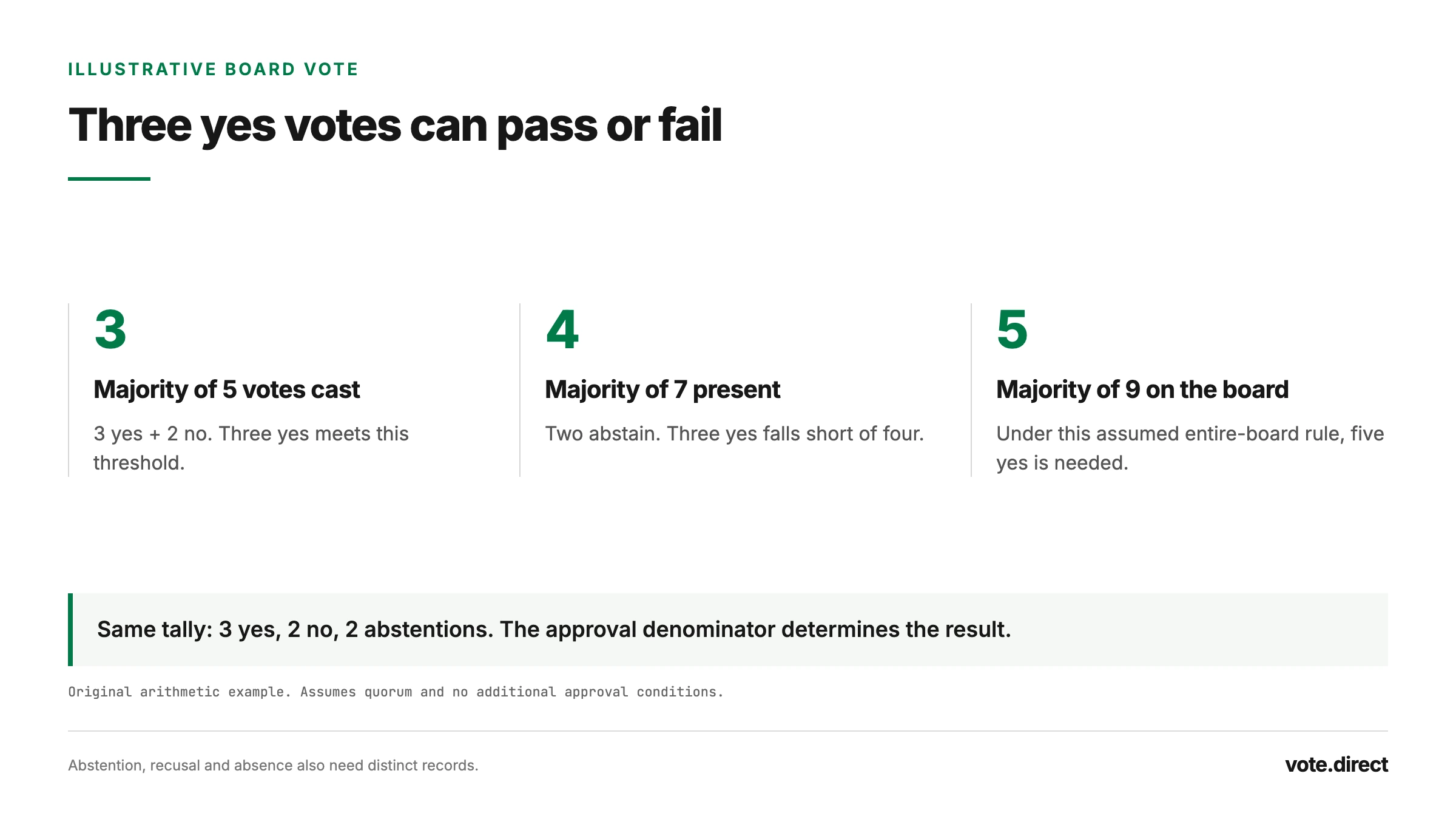
Three yes votes can pass one rule and fail another. A worked example and practical recordkeeping guide explain abstentions, conflict recusals and quorum.
Read the guideParticipation and decision rules
Resolve the denominator and the voting body before counting.
4 min read
Abstain vs. Recuse: How Each Affects a Board Vote and Its Record
Three yes votes can pass one rule and fail another. A worked example and practical recordkeeping guide explain abstentions, conflict recusals and quorum.
5 min read
Can a Board Director Vote by Proxy? Separate Board Votes from Member Votes
A proxy accepted at the annual membership meeting may be invalid at the board table. Learn which capacity a person is voting in and what alternatives to check.
7 min read
What Is a Quorum? Definition, Calculation, and What Happens Without One
Quorum is the single most common reason a meeting produces nothing. Here is what a quorum is, where your number comes from, how to calculate it correctly, who counts toward it, and what happens to decisions made without one.
5 min read
Supermajority Thresholds Explained: Two-Thirds of What, Exactly?
A motion passes 2 votes to 1. Is that two-thirds? Stored as 66.67 percent it fails, which is wrong. Thresholds, bases and abstentions decide amendments and special assessments, and almost every dispute about them is really a dispute about the denominator.
7 min read
Proxy Voting Explained: How It Works, the Types, and What Goes on the Form
A proxy lets a member who cannot attend authorize someone else to act for them. Here is how proxies work, the difference between general, directed, and quorum-only proxies, and the six things a valid proxy form must contain.
6 min read
Can a Board Vote by Email? The Rules, the Risks, and the Right Way to Do It
Most boards vote by email at some point, and most do it in a way that would not survive a challenge. Here is when an email vote is actually valid, why open meeting requirements often make it worse, and the three legitimate alternatives.
Choose and understand a counting method
Learn the mechanics of the method your rules authorize.
5 min read
Voting Methods Explained: How to Choose the Right One for Your Election
Ten ways to decide the same election, and they do not all produce the same winner. This is the index to our series on every voting method, with a comparison table and a decision guide for picking the one your bylaws actually allow.
5 min read
Plurality Voting Explained: How First Past the Post Works, and Where It Fails
The most votes wins, even if that is 34 percent. Plurality is the default almost everywhere, which is exactly why its two failure modes catch boards by surprise. Here is how it counts, when it is fine, and when it hands the seat to the wrong person.
5 min read
Block Voting Explained: How "Vote for Up to Three" Really Works
Almost every multi-seat board election uses block voting without naming it: pick up to three, top three win. It is simple, familiar, and the least proportional method there is. Here is the arithmetic, and why some members deliberately vote for only one candidate.
8 min read
What Is Ranked Choice Voting? Simple Explanation with Examples
Ranked choice voting lets voters rank candidates in order of preference instead of picking just one. Here is how it works, with real examples and step-by-step elimination rounds.
5 min read
Single Transferable Vote Explained: Quotas, Surpluses and Transfers
STV is the method that makes a board actually look like its membership. It is also the one people find hardest to explain. Here is the quota, the surplus transfer and the exclusion rule in plain language, with a worked count and the three published rulebooks.
4 min read
Cumulative Voting Explained: How It Works, With Examples
Cumulative voting lets a minority bloc guarantee board seats it could never win under ordinary voting. Here is how the math works, a worked example, and when to use it, plus a free calculator.
Turn a meeting into a usable record
Prepare the motion and preserve the actual outcome.
15 min read
Robert's Rules of Order Voting: All 6 Methods Explained
Voice votes, rising votes, roll call, ballot, show of hands, and general consent: when to use each, what vote thresholds apply, and the motion-to-vote process your board actually needs to follow.
8 min read
Robert's Rules of Order Motions: A Cheat Sheet for Real Boards
One page with every motion, whether it needs a second, whether it can be debated or amended, and what vote it takes to pass. Includes the order of precedence chart and the four motions boards misuse most often.
8 min read
How to Count Votes: Tabulation, Abstentions, Ties, and Certifying Results
Most disputed elections are not disputed over who won. They are disputed over how the counting was done. Here is how to tabulate a vote correctly, what to do with abstentions and spoiled ballots, how to break a tie, and how to certify a result that holds up.
7 min read
Board Meeting Minutes: What to Include, What to Leave Out, and a Template
Minutes are a legal record of decisions, not a transcript of the discussion. Here is exactly what belongs in them, what to leave out, how to record a vote so it holds up, and a template you can copy.
8 min read
How to Write a Board Resolution: Format, Templates, and Examples
A board resolution is the written record of a decision your board wants to be able to prove. Here is the standard format, three templates you can copy, and the difference between a resolution, a motion, and a policy.