Quick Answer
In 2026 a board election costs between $4.99 and a few hundred dollars per election, and vote.direct charges $4.99 for a board election of up to 50 eligible voters. That is the easy question. The hard one is what the tool leaves behind, because a board vote that cannot be reconstructed eighteen months later is a board vote that can be challenged.
Here is the whole market at two common board sizes, alphabetically, at each vendor's own published rates, read off their pricing pages in August 2026:
| Platform | 100 eligible voters | 500 eligible voters | Priced on |
|---|---|---|---|
| AssociationVoting | $99 | $199 | Flat fee per election, by band |
| ElectionBuddy | $29 | $99 | Flat fee per election, by band |
| Google Forms | $0 | $0 | Free, and not an election product |
| OpaVote | $10 | $40 | $10 per started block of 125 voters |
| Simply Voting | Not published | Not published | On-page calculator, no tiers published |
| vote.direct | $9.99 | $69.99 | Flat fee per election, by band |
Three things decide which of those is right for you, and none of them is the headline number:
- Almost every vendor prices on the roster, not the turnout. A 500-member association pays the 500-voter price whether 90 people vote or 400 do. Budget against the list you upload.
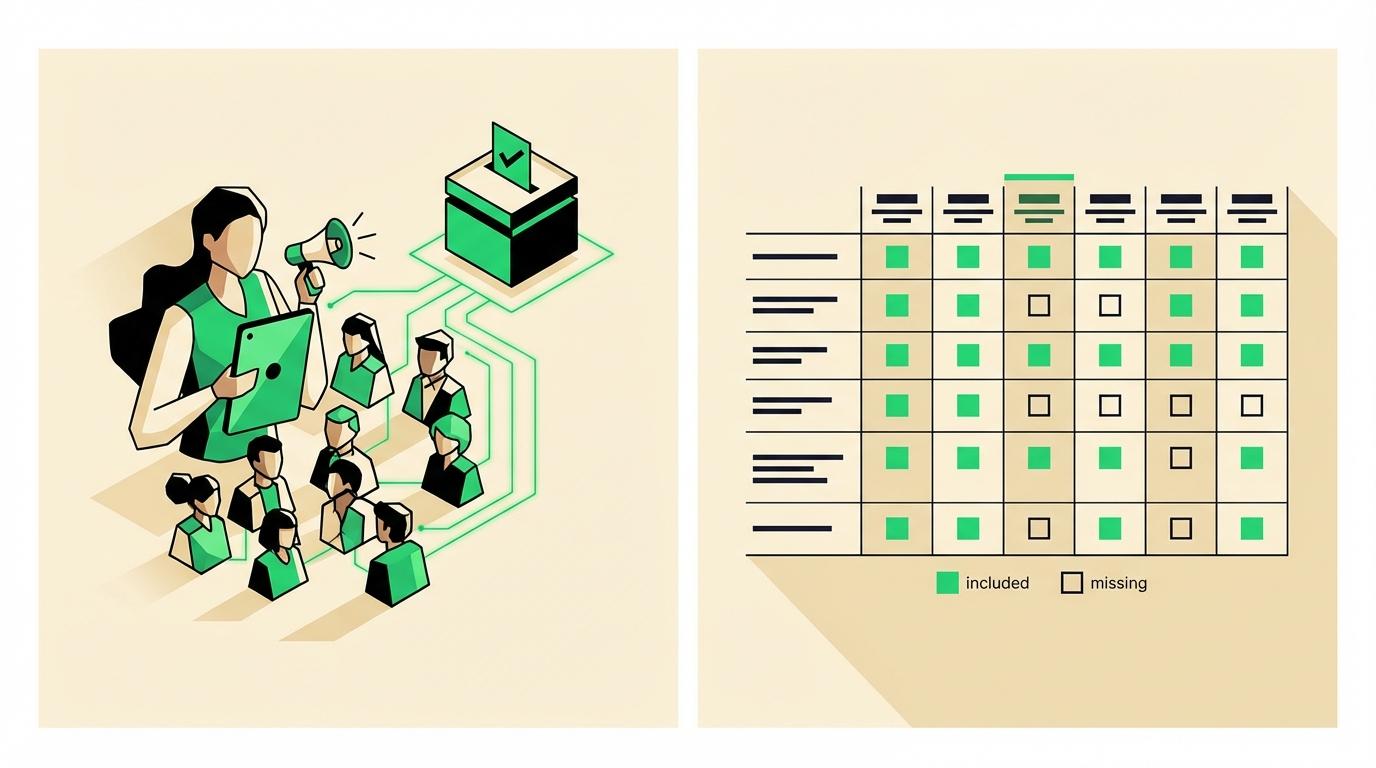
- The record is the product. Any of these will collect answers. The difference is whether, a year later, you can produce who was eligible, when the roster was frozen, and how the count was reached.
- Most board decisions should not go through any of them. Two different products get sold under this name: one for a handful of directors deciding something between meetings, one for a membership electing the board. A board of seven in the first case needs a properly noticed meeting or a correctly executed written consent, not a ballot — can a board vote by email is where that line actually sits.
Disclosure: vote.direct publishes this comparison and sells one of the products in it, so read it as a vendor making its case rather than as independent research. Competitor prices were read off each company's own pricing page in August 2026 and linked below so you can check them, and where a competitor is the better buy this article says so.
This article is general information, not legal advice. No software can make a board vote legally binding or guarantee it complies with your statute. What a valid vote requires depends on your state's corporation act, whether an open meeting law reaches you, and your bylaws. Confirm all three.
What a Board Vote Has to Record
Start here, because this requirement outlives the purchase. When a board vote is questioned, nobody asks which platform you used. They ask for seven things, and a board that cannot produce them loses the argument regardless of how the vote actually went.

| What has to be recorded | Why this is the one that gets challenged | Where it should live |
|---|---|---|
| Authority | Which bylaw or statute lets the board decide this way at all | Minutes, citing the clause |
| Notice | What went out, to whom, on what date, through the approved channel | Sent copy plus the recipient list |
| Eligibility | Who was entitled to vote, and when that list was fixed | Exported roster with a freeze timestamp |
| Quorum | The number present or consenting, against the number required | Minutes, as a count, not "we had enough" |
| The question | The exact words voted on, unchanged from first circulation | The resolution text |
| The count | For, against, abstain, and by name where the vote was recorded | Tally sheet or platform export |
| Retention | Who can produce all six in eighteen months when the treasurer has left | Somewhere that is not one person's inbox |
Two rows are where boards actually fail. Eligibility fails when somebody is added to the voter list on day three because they called and complained, which makes every result afterwards arguable. Retention fails quietly: the election ran correctly, and the only copy of the record is in a departed volunteer's login.
There is a federal angle, though not a voting rule. The IRS's Form 990 instructions make the boundary clear: federal tax law does not generally mandate a management structure, but Part VI asks a tax-exempt organization to disclose its governing body, its members' governance rights, and whether meetings and written actions were contemporaneously documented. To a Form 990 reviewer, an election with no documentation is an election that did not happen.
What software can do here is narrow and worth paying for: freeze a roster and timestamp it, tie each accepted ballot to a distinct eligible voter, keep identity separable from choice, and hand you an export a doubting member can read. What it cannot do is make an invalid vote valid. If your notice period was four days short, no vendor's compliance page fixes that.
Email Votes and Robert's Rules
Before pricing anything, check whether the vote you are running is a ballot at all. Most of what boards call "voting software" gets bought to replace an email thread, and in many organizations that thread was never a valid board action.

What Robert's Rules actually says
Robert's Rules of Order Newly Revised, 12th edition, is the authority most bylaws name. Three of its rules govern this directly:
- Electronic meetings require authorization. Board meetings may be held by videoconference or teleconference only if the bylaws specifically authorize it, and all participants must be able to hear each other at the same time (RONR 9:30–36). An email thread fails that test outright.
- Absentee voting requires authorization. Voting by mail or by electronic means is permissible only where the bylaws specifically authorize it (RONR, Section 45). Silence in the bylaws is a prohibition, not a permission.
- Proxy voting is not permitted in ordinary deliberative assemblies unless a law applicable to the organization requires it or the bylaws authorize it (RONR 45:70–71).
Robert's Rules is also the weakest authority in play: your bylaws outrank it, and a statute outranks both. The six voting methods under Robert's Rules covers where each one applies.
The narrow door: unanimous written consent
Nearly every corporation act leaves one route for a board to act without meeting, and it is narrower than boards assume. Not a majority by email. Every director, in writing, on file.
| Where the organization is incorporated | Board action without a meeting | What the statute actually says |
|---|---|---|
| California nonprofits | Unanimous written consent of every director | Corp. Code §5211(b): consents are filed with the minutes of the proceedings of the board and have the same force as a unanimous vote |
| New York nonprofits | Unanimous consent, with email expressly allowed | N-PCL §708(b): consent may be transmitted by electronic mail with information showing the director authorized it; resolution and consents are filed with the minutes |
| Florida nonprofits | Unanimous, signed written consents | §617.0821: evidenced by written consents describing the action and signed by each director. The section says nothing about electronic transmission |
| Delaware corporations | Unanimous, in writing or by electronic transmission | DGCL §141(f): all members of the board consent in writing or by electronic transmission |
| Everywhere else | Varies | Find the section titled "action by directors without a meeting" in your state's nonprofit or business corporation act, and read the filing requirement as carefully as the consent requirement |
Notice what every one of those provisions has in common. The consent is not the record. The filing is the record. Four directors replying "sounds good" produces neither.
Where an email vote is simply void
Open meeting requirements change the analysis completely, and they reach more boards than people expect. California community associations are the clearest published example: Civil Code §4910(a) states that the board shall not take action on any item of business outside of a board meeting, and may not conduct a meeting through a series of electronic transmissions including electronic mail. The one exception at §4910(b)(2) is an emergency, where all directors consent in writing and the consents are filed with the minutes.
Where a rule like that applies, unanimity does not save you: the members had a right to watch the decision being made, and no consent among directors gives them that retroactively. If an open meeting statute, a funding condition, or your charter reaches your board, assume email is for scheduling and information, never for deciding.
If you have already decided something in a thread, the usual remedy is ratification at the next properly noticed meeting, recorded in the minutes as a ratification rather than a fresh decision. The mechanics are in can a board vote by email.

When written consent is the right instrument, circulate the exact text as a board resolution, collect a consent from every director then in office, and file the signed consents with the minutes. "No objections by Friday" is not consent, and a director who never replied has not consented.
Six Tools, Priced
Listed alphabetically, because we publish this page and sell one of the products on it, and a vendor that puts itself at number one has told you nothing. These are per-election prices for the product comparable to a board election or member vote, not for a live motion during a meeting, which several vendors sell separately and price much higher. Every figure came off the vendor's own page in August 2026.
1. AssociationVoting
Flat fee per election by band, or an annual subscription. Free up to 25 eligible voters, then $99 to 125 voters, $199 to 500, and $299 to 5,000. Beyond 5,000 members it is a quote. Verification is email; a mailed voter verification announcement is a $100 add-on and election setup service is $250 extra. AssociationVoting pricing.
Read their two price lists carefully: the $299 to $699 figure widely quoted for this vendor is the annual subscription for unlimited non-concurrent elections, not the price of one.
2. ElectionBuddy
A flat fee per election by voter band, on the ballot-out product comparable to an election here. Free up to 20 voters; $29 for 21 to 350 voters; $99 for 351 to 1,000; a professional tier starting at $299 above that. Verification is email and access codes, with no SMS and no government ID. Their separate live-motion product, from $197, is a different job and not the fair comparison. ElectionBuddy pricing.
Choose it when your roster sits between 201 and 350 voters, where the flat $29 genuinely undercuts vote.direct's band for that size, and email verification is enough for you.
3. Google Forms, and other survey tools
Free, and on the list because it is what most small boards actually use. A form records responses. It does not establish who was eligible before voting opened, it does not confirm a response came from one of them, and the owner can generally see how each person answered. SurveyMonkey has the same gap at a subscription price: US individual plans run from $39 a month billed annually to $139 a month, with responses past the plan limit at $0.15 each.
Choose it when the vote has no legal effect and nobody will question it: gathering preferences, testing an idea, picking a meeting date. Do not choose it for anything that elects a director, spends money, or amends a governing document. There is no record to produce, because the tool was never built to produce one.
Be honest
What's actually stopping your organization from switching to online voting?
4. OpaVote
Pay as you go at $10 for every started block of 125 voters, with unlimited elections. Free up to 25 voters and 10 candidates. So a 100-voter board election is $10, and a 500-voter one is $40. Access is by emailed code only. Election data is kept three months free, then $40 a year to retain it — a retention cost nobody else here charges, and one the seven-row table above says to watch for. OpaVote pricing.
Choose it when you need single transferable vote or Condorcet counting, which vote.direct does not run, or when price alone decides. It is frequently the cheapest option here. What you give up is verification beyond an emailed link, staffed support, and the compliance record.
5. Simply Voting
No tiers are published at all. An on-page calculator prices self-administered elections against your number of eligible voters, elections with 10 electors or fewer are free, and managed elections are quoted through sales. Telephone voting, online nominations, weighted voting, and voter segmentation are priced separately as premium features. Simply Voting pricing.
Anyone quoting a specific Simply Voting figure, this article included, is guessing. Run their calculator.
6. vote.direct
Flat fee per election, by band of eligible voters, with no subscription. Email and SMS verification are included at every tier; government-ID verification is a per-voter add-on at $3.00.
| Voters | Price per election |
|---|---|
| up to 25 voters | Free |
| 26–50 voters | $4.99 |
| 51–100 voters | $9.99 |
| 101–200 voters | $19.99 |
| 201–400 voters | $24.99 |
| 401–1,000 voters | $69.99 |
| 1,001–2,000 voters | $149.99 |
| Above 2,000 | Talk to us |
The ladder above is current. Above 2,000 voters the election is quoted. A board running three votes a year at 100 voters spends $29.97 in total, which is where per-election pricing beats a subscription outright.
Choose it when the record is the reason you are buying: a roster you can export with the timestamp it was frozen, ballots tied to distinct eligible voters, and a result certificate with an audit package at the close. Skip it when you have twenty voters and no compliance exposure, because three of the tools above are free at that size.
Helios Voting is a further option for boards with a systems administrator: open source, free to run if you host and patch it yourself, community support only.
The comparison that actually matters
| AssociationVoting | ElectionBuddy | Google Forms | OpaVote | Simply Voting | vote.direct | |
|---|---|---|---|---|---|---|
| Email verification | Included | Included | None | Emailed codes | Included | Included |
| SMS verification | Not published | No | None | No | Not published | Included |
| Government ID | No | No | None | No | Not published | $3.00 per voter |
| Roster export with freeze time | Ask | Ask | No | Ask | Ask | Yes |
| Result certificate and audit package | Ask | Ask | No | Ask | Ask | Yes |
| Long-term retention | Ask | Ask | Your Drive | $40 per year after 3 months | Ask | Included |
"Ask" is deliberate and is not a criticism. Those are the five questions to put to any vendor before you buy: can I export the voter list with the timestamp it was frozen? What does the platform check before it opens a ballot? Can an administrator see how an individual voted, and if not, what stops them? What do I get at the close that I can hand to a doubting member? And what happens if I need it in eighteen months? A deeper version sits in the audit trail and compliance guide.
When You Need Somebody Else to Run It
A tool assumes somebody has time to use it, and plenty of boards do not. The chair is a volunteer, the secretary has a job, and the election lands in the same three weeks as the budget.
Nobody in this category publishes a managed price: on the vendor pages we checked in August 2026, Simply Voting quotes managed elections through sales and AssociationVoting quotes everything past its election setup service, so a board that wants somebody else to run the vote sits through a call before it hears a number. $199 is vote.direct's published price for that work — a digital election of up to 100 voters — in public, before any call.
| Service | Price | What it covers |
|---|---|---|
| Setup & Launch | From $99 | We build the ballot, load the roster, write and send the notices, and hand you a live election. |
| Full Managed Election | From $199 | Everything in Setup & Launch, then we run it: reminders, quorum, voter support, close, tally, certificate. |
| Managed + Mailed Packets | From $199 plus $6.00 per packet | A full managed election where the members who need paper get a printed packet with a postage-paid return envelope, and their returned ballots land in the same tally. |
| Managed + Inspector of Elections | From $499 | A full managed election where vote.direct also serves as your inspector of elections — Colorado, Nevada, Florida, Texas, Arizona and Maryland only. |
| Above 100 voters | Quoted | Same scope, priced on your roster (the platform itself is quoted above 2,000 voters) |
The headline $199 covers a digital election of up to 100 voters with the platform fee included: ballot build, roster load and dedupe, notices, the reminder cadence, the voter support inbox, daily quorum monitoring, the close and tally, and a result certificate with the audit package. Give us 10 days before ballots open. Above 100 voters, or once mailed packets are involved, it is quoted. The $6.00 covers the trip both ways: the packet out, and a return envelope that already has the postage paid on it, so the member never buys a stamp. There is no separate postage line on your invoice.
Three things stay with the board, better heard now than in week two: nominations and candidate statements, legal review, and adopting the election rules. A vendor cannot be your nominating committee or your attorney.
One boundary worth stating plainly: vote.direct serves as inspector of elections in Colorado, Nevada, Florida, Texas, Arizona and Maryland only, and never in California, because Cal. Civ. Code §5110(b) bars a vendor under contract to the association from holding that role. There, we help you find an independent one instead.
For a nonprofit running its first real election, the sequencing — nominating committee, notice, quorum, ballot, certification — is laid out step by step in how to run a nonprofit board election. State-by-state director rules sit in nonprofit board election rules by state, and the mechanics of a valid board vote in nonprofit board voting procedures.
FAQ
Q: What is board voting software?
It is software used to run a vote and produce a record of it. In practice the category splits in two: tools for directors recording decisions between meetings, and ballot platforms for members electing those directors. Most products do one of those jobs well and the other badly, so identify which one you have before comparing prices.
Q: How much does board voting software cost in 2026?
For a single board election, from $4.99 for a small board on vote.direct up to a few hundred dollars for a large membership. ElectionBuddy is $29 flat for 21 to 350 voters, AssociationVoting runs $99 to $299 by band, and OpaVote charges $10 per started block of 125 voters. Simply Voting publishes no tiers. All figures were read off vendor pricing pages in August 2026.
Q: Can a board of directors vote by email?
For an election or a member vote, use a ballot. For a board decision taken between meetings, most corporation acts permit action without a meeting only by unanimous written consent of every director, filed with the minutes — California Corp. Code §5211(b), New York N-PCL §708(b), Florida §617.0821 and Delaware DGCL §141(f) all take that form. Open meeting requirements may bar it entirely, as California Civil Code §4910 does for community association boards.
Q: Does Robert's Rules allow electronic voting?
Only where your bylaws authorize it. Robert's Rules of Order Newly Revised, 12th edition, permits electronic meetings only if the bylaws specifically authorize them and all participants can hear each other at the same time (9:30–36), and treats absentee voting by mail or electronic means as permissible only where the bylaws authorize it (Section 45).
Q: What is the best online voting platform for board meetings?
There is no single answer, and the honest split is by what you need recorded. If the vote is a live motion inside a meeting, look at products built for that rather than at ballot platforms. If members are electing directors over several days, compare the six above on verification, roster freeze, and what the export contains.
Q: Is a free tool good enough for a board election?
It depends on whether anyone might question the result. Free tiers on real election platforms — 20 voters on ElectionBuddy, 25 on AssociationVoting and OpaVote, 10 electors on Simply Voting — are genuine election products at small sizes and worth using. A survey tool is not, at any size, because it establishes no eligibility and produces no record.
The Bottom Line
Every platform here will collect votes. At the sizes most boards run they differ by roughly a hundred dollars, less than one hour of the attorney you will call if the election is questioned. They differ far more in what you can produce afterwards.
So buy on the record. Ask for the roster export with a freeze timestamp, what is checked before a ballot opens, what the closing package contains, and where it will live in eighteen months. Then check whether the vote is a ballot at all, because the most common board voting failure in existence is still four directors agreeing in an email thread.
vote.direct gives every eligible voter a private link, counts each ballot once, keeps identity separable from choice, and ends with a tally, a timestamp, and an exportable record for the minutes. Elections start at $4.99 for up to 50 voters, no subscription. A full managed election is $199 for up to 100 voters, or $99 to have it built and handed to you at open.
Not sure whether your bylaws allow the vote you are planning? Call or text (512) 222-8191, or email [email protected] with the clause and we will read it with you. If anything above about another vendor is out of date, tell us and it gets corrected.
Sources:
- 1California Corporations Code §5211(b) and Civil Code §4910(a), (b)(2) — leginfo.legislature.ca.gov
- 2New York Not-for-Profit Corporation Law §708(b) — nysenate.gov
- 3Florida Statutes §617.0821 — flsenate.gov
- 4Delaware General Corporation Law §141(f) — delcode.delaware.gov
- 5Robert's Rules of Order Newly Revised, 12th edition (2020): 9:30–36, Section 45, 45:70–71
- 6IRS, Instructions for Form 990, Part VI — https://www.irs.gov/instructions/i990
- 7Vendor pricing pages for ElectionBuddy, AssociationVoting, OpaVote, Simply Voting and SurveyMonkey, read in August 2026 and linked above
This article is general information, not legal advice. We recommend you do your own research and confirm anything you plan to act on. Where this article states law, the section is cited so you can read the primary source yourself rather than take our word for it — that is what the citations are for. Election requirements also turn on your own governing documents, which we have not seen, and statutes are amended. For advice about your community, consult a qualified attorney licensed in your state.
We work hard to verify every citation against the primary source, but laws change and errors happen. If you spot an inaccuracy, email [email protected] and we will correct it. See our editorial standards for how these pages are researched and checked.