Quick Answer
A nonprofit board vote is valid when a quorum of directors is present, the question is put clearly, and a majority of the votes cast approves it — with the interested director excluded on anything they have a conflict in. Everything else is detail, but the detail is where boards get into trouble.
The five answers people are actually looking for:
| Question | The usual answer |
|---|---|
| Does the president or chair vote? | On a small board, yes — on every question, like any other director. The "chair only breaks ties" rule comes from large assemblies and does not fit a board of nine. |
| Can a director vote by proxy? | Almost never. Most state nonprofit statutes prohibit it outright. Members may often vote by proxy; directors generally may not. |
| Does an abstention count as a no? | Usually not. It is not a vote cast, so a majority of votes cast still decides — but the abstaining director still counts toward quorum. |
| Can the board act without meeting? | Only by unanimous written consent of every director in most jurisdictions, not a majority. |
| What about a director with a conflict? | Disclose, leave the vote, and record it. Approval by a majority of disinterested directors is the standard most statutes and the IRS expect. |
This article is general information, not legal advice. Nonprofit corporation law is state law and varies, and your articles and bylaws may be stricter than the statute. Confirm all three before relying on any of this.
First: Two Different Votes Get Confused
Almost every question about nonprofit voting procedure gets easier once you separate these.
Members electing directors. If your organization has voting members, they elect the board. This is an election, it usually happens at an annual meeting, notice rules apply, and members can often vote by proxy or absentee ballot if your bylaws allow it. We cover running that event in how to run a nonprofit board election.
Directors voting as a board. This is a board meeting taking action. It includes electing officers from among the directors, approving budgets, hiring the executive director, and approving transactions. Different quorum, different rules, no proxies, and it is what this article is about.
A great many nonprofits have no voting members at all — the board is self-perpetuating and elects its own successors. If that is you, every vote below is a board vote, including the election of directors.
Quorum
The default in most states is a majority of the directors in office, and your bylaws can set it higher or, within limits, lower. Two things trip boards up.
Quorum is on directors in office, not seats authorized. A board authorized for eleven with four vacancies usually needs a majority of the seven serving, not of eleven. Check your statute and bylaws, because a minority of jurisdictions and a good number of bylaws do it the other way, and the difference can paralyse a board that has lost members. Vacancies are worth filling promptly for exactly this reason.
Quorum has to persist. If directors leave and the meeting drops below quorum, business after that point is not validly transacted. In practice the chair should confirm quorum before any significant vote late in a long meeting, and the minutes should reflect it.
Does the President Vote?
Yes, in nearly every nonprofit board, and this is the single most commonly misunderstood point in board procedure.
The belief that "the chair only votes to break a tie" comes from Robert's Rules as applied to large assemblies, where the presiding officer stays neutral to preserve the appearance of impartiality. Robert's Rules explicitly provides different treatment for small boards — commonly described as about a dozen members or fewer — where the chair may debate, may make motions, and votes on all questions.
More fundamentally: a nonprofit director holds a fiduciary duty to the organization that they discharge partly by voting. A president who is a director does not stop being a director while chairing. If your bylaws say the president votes only to break ties, follow your bylaws — but know that this is a choice your organization made, not a rule imposed on it.
Two related cases:
- A president who is not a director. Some organizations have a staff president or CEO who is an officer but not a board member. That person does not vote, because only directors vote.
- Tie votes. A tie means the motion fails. It does not pass, and it does not carry over. There is no casting vote unless your documents create one.
Directors and Proxies: Almost Always No
Most state nonprofit corporation statutes prohibit directors from voting by proxy, and the ones that permit it usually restrict it sharply.
The reasoning is straightforward. A director owes a personal duty of care that includes being informed and exercising independent judgment on the question actually before the board. That duty cannot be handed to somebody else, because the person holding the proxy did not hear the discussion the absent director's instruction was written before.
This surprises boards because members often can vote by proxy, and people assume the same rule applies upward. It does not. If a director cannot attend, the options are to attend remotely where your documents allow it, to let the board act without them, or to postpone.
Nor is a director's emailed "I vote yes, go ahead without me" a valid vote. It is not a proxy, it is not presence, and it does not count toward quorum.
Abstentions and What They Do to the Math
An abstention is a declaration that the director is not voting. Under the usual rule:
- It counts toward quorum — the director is present.
- It is not a vote cast, so a motion needing a majority of votes cast is not harmed by it.
- Six present, three yes, two no, one abstain: the motion carries three to two.
But watch the two exceptions.
If your bylaws require a majority of directors in office (rather than of votes cast), an abstention functions as a no, because the yes votes must reach a threshold measured against a fixed number. Bylaws phrased as "a majority of the entire board" do exactly this.
If abstentions drop participation below quorum requirements for a particular action — rare, but some statutes require a specific number of affirmative votes for particular decisions — the action fails.
A director abstaining because of a conflict should say so, and the minutes should record the reason. A director abstaining because they did not read the materials has a different problem.
Conflicts and Interested-Director Votes
This is the area where getting procedure wrong has consequences beyond the board.
Most state statutes provide that a transaction between the nonprofit and a director is not void solely because of the interest, if the material facts were disclosed and the transaction was approved in good faith by a majority of the disinterested directors, or it was fair to the organization when authorized.
Layered on top, the IRS expects tax-exempt organizations to have a written conflict of interest policy, asks about it on Form 990, and provides a well-known procedural safe harbour for compensation and property transactions with insiders: approval by an authorized body with no conflict of interest, reliance on appropriate comparability data, and contemporaneous documentation of the basis for the decision.
The practical procedure, every time:
- 1The interested director discloses the nature and extent of the interest, before discussion.
- 2They answer questions, then leave the room for deliberation and the vote.
- 3The remaining disinterested directors discuss and vote.
- 4The minutes record the disclosure, the recusal, who voted, and the basis for the decision — including what comparability data was considered, where relevant.
The step boards skip is the last one. A conflict handled perfectly and minuted as "the board approved the lease" leaves no evidence that it was handled perfectly. More on the wider duty in board ethics and conflicts of interest.
This one gets heated
Should community boards be required to use independent election administrators?
Electing Officers From Among the Directors
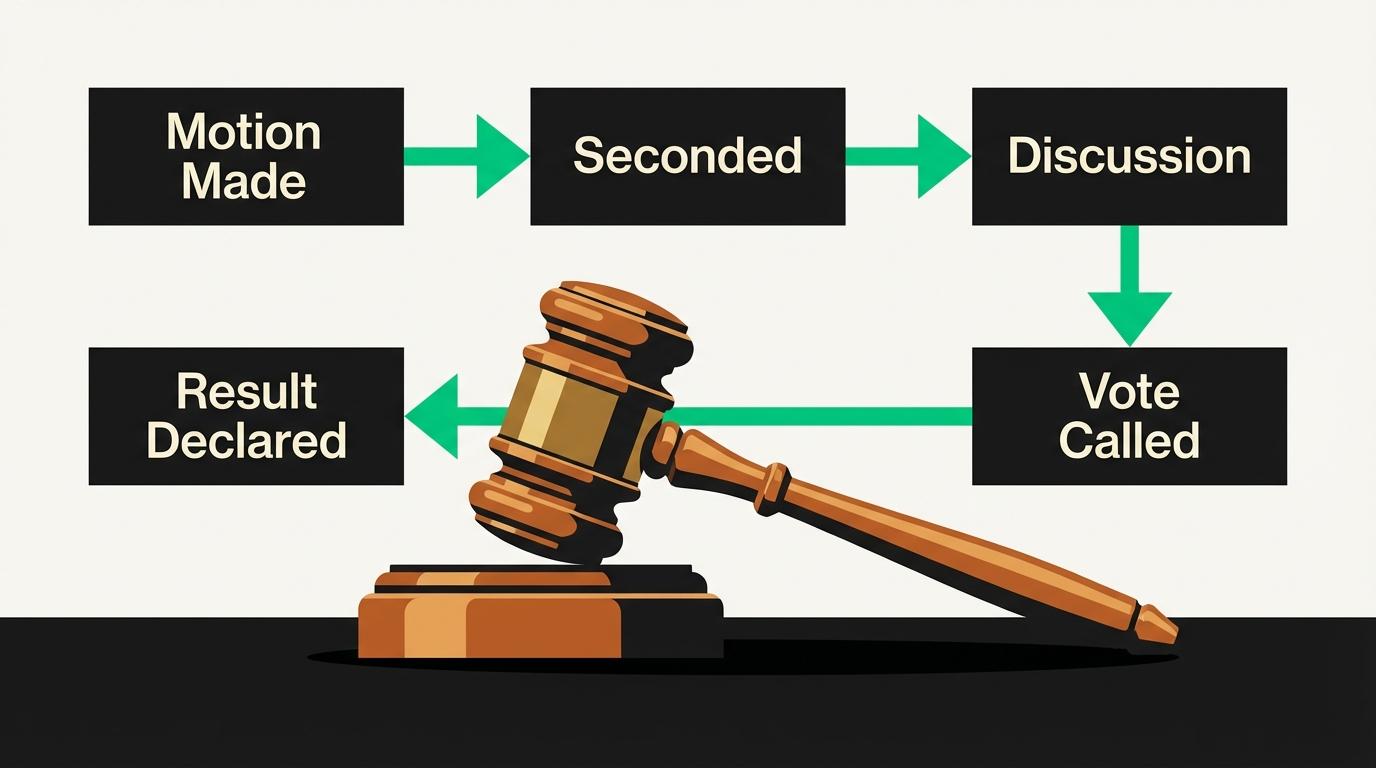
Officer elections are a board vote, and they are the one board vote most worth taking by ballot rather than by voice.
The reason is practical. Asking nine people to raise their hands for one of two colleagues, in front of both colleagues, is a poor way to get honest preferences. A written or electronic ballot removes that, and it is unremarkable — many bylaws already require it.
Two points of order:
- Where the bylaws require a ballot, take one even if a candidate is unopposed, for the reasons set out in Robert's Rules and unopposed candidates.
- The minutes record who was elected. Whether they record vote counts for a ballot election is usually a matter of custom and bylaws; many boards record the count, and recording it is the more defensible practice.
Acting Without a Meeting
Most nonprofit statutes permit board action without a meeting only by unanimous written consent of every director then in office. Not a majority. Every one.
That means an email thread where five of nine directors reply "agreed" is not a board action. It is five people agreeing. The mechanics, including how to fix one after the fact, are in can a board vote by email.
If your organization is also subject to an open meeting requirement — some are, by statute, funding condition, or charter — written consent may not be available at all for decisions the public or the membership has a right to observe.
What the Minutes Have to Say
A board vote that is not recorded properly is a board vote you cannot prove. For each action:
- The motion as adopted, in the words voted on
- That quorum was present
- The result, and the count where a count was taken
- Recusals and abstentions, with the reason where it was a conflict
- The date
What minutes should not contain is a transcript of the debate. Record what was decided and the basis for it, not who said what. Our board meeting minutes template covers the usual structure.
Voting Online
Nonprofit boards vote electronically for the ordinary reasons: directors in three time zones, an officer election that should be secret, a member vote that would otherwise need a mailing.
Three things to keep straight:
A board vote taken online is still a board vote. It needs the same quorum, the same motion, and the same record. A ballot link is not a substitute for the meeting unless your statute and documents permit action without one.
A member vote is an election. If your organization has voting members electing directors, that is the case for a real ballot platform: a roster of who is eligible, verification, secrecy, and a record. What to look for is in the nonprofit board voting tool guide, and current prices across vendors are in nonprofit voting software pricing.
Secret does not mean unaccountable. For an officer election among nine directors, secrecy of the ballot and a recorded count are both achievable, and you want both.
FAQ
Q: Can the president of a nonprofit board vote?
Yes, if the president is a director. On a small board Robert's Rules allows the chair to vote on all questions, and a director's fiduciary duty is discharged partly through voting. The "chair only breaks ties" convention applies to large assemblies. A president who is staff rather than a director does not vote.
Q: What is the quorum for a nonprofit board meeting?
Usually a majority of the directors in office, unless your bylaws set a different number. Quorum must also be maintained throughout — business transacted after members leave and quorum is lost is not validly taken.
Q: Can a nonprofit board member vote by proxy?
Generally no. Most state nonprofit statutes prohibit proxy voting by directors, because the duty of care requires personal, informed judgment. Members can often vote by proxy; directors usually cannot.
Q: Does an abstention count as a no vote?
Usually not. An abstention counts toward quorum but is not a vote cast, so a majority of votes cast still decides. If your bylaws require a majority of directors in office, an abstention has the practical effect of a no.
Q: What happens on a tie vote?
The motion fails. There is no casting vote for the chair unless your bylaws create one.
Q: How does a nonprofit board elect officers?
The directors vote, normally by ballot where the bylaws require it and often by ballot even where they do not. Record who was elected, and preferably the count.
Q: What should a director with a conflict of interest do?
Disclose the interest before discussion, answer questions, leave for deliberation and the vote, and make sure the minutes record the disclosure, the recusal, and the basis for the decision.
Q: Can a nonprofit board vote by email?
Only as unanimous written consent of every director, where your statute and bylaws allow action without a meeting. A majority agreeing in a thread is not a board action.
Q: Do nonprofit board votes have to be public?
Usually not — most nonprofits are private corporations. Some are subject to open meeting requirements by statute, funding condition, or charter, and those organizations should assume decisions must be made in an open meeting.
The Bottom Line
Valid board voting is four habits: confirm quorum before the vote, put the motion in the words being voted on, exclude the conflicted director and say so in the minutes, and write down the count.
Do those and almost nothing else matters. Skip them and a decision that was substantively right becomes procedurally arguable, usually eighteen months later when nobody remembers what happened. If you are choosing a tool to hold that record, board voting software compared prices six platforms on what each one leaves behind.
For officer elections that should be secret, and for member votes that elect the board, vote.direct gives each voter a private ballot, keeps identity separable from choice, and produces a timestamped tally you can put straight into the minutes. From $4.99 for up to 50 voters, with no subscription.
Not sure whether your bylaws let the board do what it is about to do? Call or text (512) 222-8191, or email [email protected] with the clause.
This article is general information, not legal advice. We recommend you do your own research and confirm anything you plan to act on. Where this article states law, the section is cited so you can read the primary source yourself rather than take our word for it — that is what the citations are for. Election requirements also turn on your own governing documents, which we have not seen, and statutes are amended. For advice about your community, consult a qualified attorney licensed in your state.
We work hard to verify every citation against the primary source, but laws change and errors happen. If you spot an inaccuracy, email [email protected] and we will correct it. See our editorial standards for how these pages are researched and checked.