The Short Answer
Sometimes, and less often than boards assume.
Most nonprofit and corporate statutes permit a board to act without a meeting only by unanimous written consent of every director. Not a majority. Every one. And boards subject to open meeting requirements may not be able to use that route at all for decisions members are entitled to observe.
An email thread where four of seven directors reply "sounds good" is not a board action in most jurisdictions. It is four people agreeing.
This article is general information, not legal advice. Whether your board may act by email depends on your state's statutes, whether an open meeting law applies to you, and what your bylaws say. Confirm all three before you rely on an email vote.
Why the Rule Is Strict
The requirement is not bureaucratic fussiness. A meeting does three things an email thread does not.
It supports deliberation. Directors can hear one another's reasoning before deciding. A staggered email thread may let early replies frame the question for everyone after them.
It supports consistent notice. The same meeting materials can be delivered through the approved channel. Email threads can leave out a director whose address bounced or who was omitted from an earlier chain.
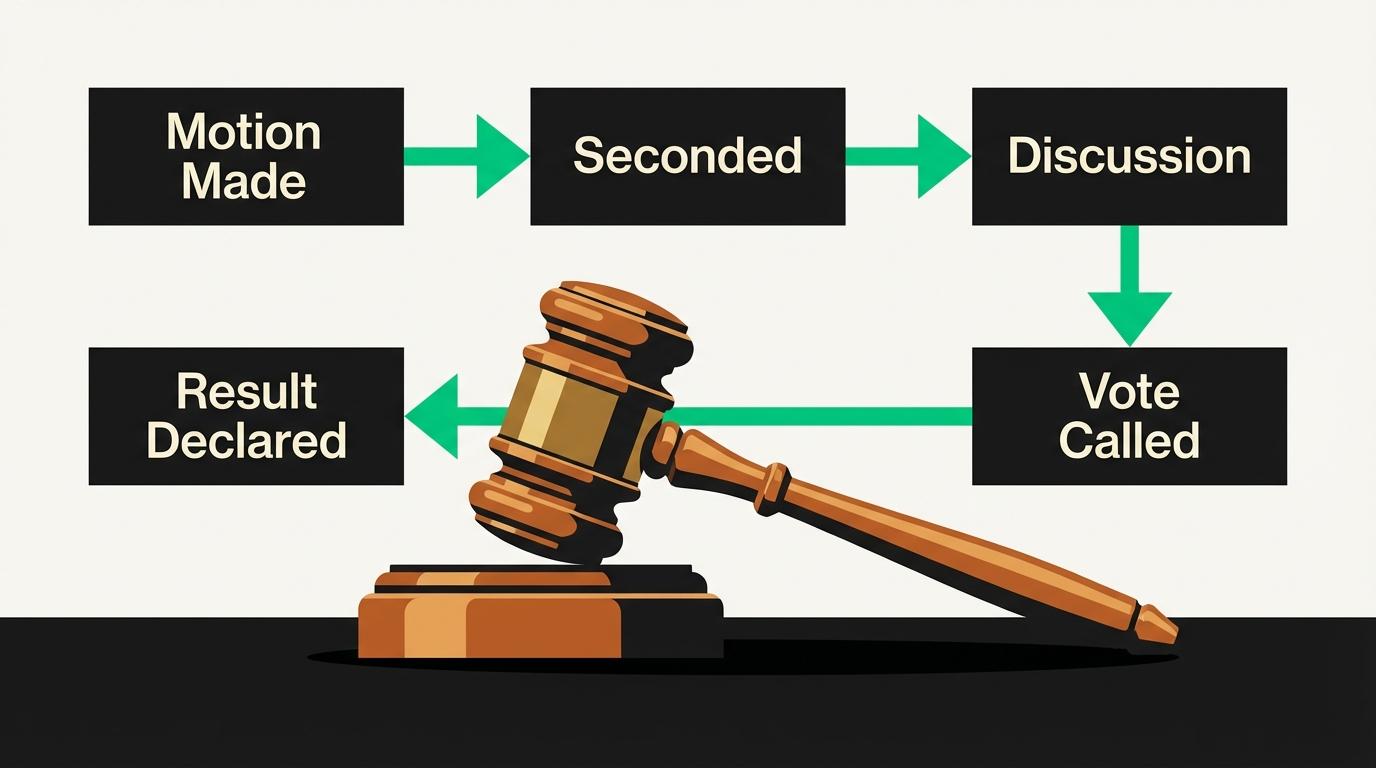
It creates a record. A meeting produces minutes with a motion, a second, and a count. An email thread produces forty messages that somebody has to reconstruct.
Unanimity is the substitute for all three. If literally every director agrees in writing, the statute treats deliberation as unnecessary because there is nothing to deliberate.
When an Email Vote Is Actually Valid
You generally need all four of these to be true.
- 1Your statute permits action without a meeting. Most nonprofit corporation acts do. Some community association statutes restrict it, and some public bodies are barred outright.
- 2Your bylaws permit it, or at least do not forbid it. Bylaws can be stricter than the statute.
- 3The consent is unanimous, from every director then in office, not just those who replied.
- 4The consent is in writing and filed with the corporate records. Most modern statutes treat email as writing, but some require an electronic signature or explicit authorization for electronic consent.
Miss any one of those and you have an action a single objecting director, or a single member, can put in doubt.
Where Open Meeting Requirements Change Everything
Many community associations and most public bodies operate under statutes requiring that board decisions be made at meetings open to members, with advance notice. Where that applies, the analysis is different: even unanimous written consent may not save a decision that members had the right to watch being made.
Statutes of this kind commonly carve out narrow exceptions, often for genuine emergencies, and often require the action to be ratified at the next open meeting. If you operate under one of these, the safe assumption is that email is for scheduling and information, not for deciding.
The Four Ways Email Votes Get Challenged
A director was left off the thread. Unanimity requires every director then in office. One missed address defeats it entirely, and reply-all chains are unreliable in exactly this way.
Someone never actually replied. Silence is not consent. A director who read it and did nothing has not consented, no matter how obvious their position seemed.
The question changed mid-thread. Director three suggests a change, director four agrees with the changed version, directors one and two consented to the original. Now nobody can say what was adopted.
There is no record. Six months later the thread is in four people's archives in four different states of completeness, and two of those directors have left the board.
What to Do Instead
Option 1: Hold a short electronic meeting
If your documents allow remote participation, a twenty-minute video or conference call meeting is a real meeting. Notice it, confirm quorum, take the motion, record the vote. This is the cleanest answer for most boards and it is faster than the email thread would have been.
Option 2: Use unanimous written consent, properly
When it is permitted and you genuinely have unanimity, do it correctly. Circulate the exact text as a resolution, collect a written consent from every director, and file the signed consents with the records. Do not treat "no objections by Friday" as consent.
Option 3: Use an actual ballot
For anything contested, or anything that goes to members rather than the board, use a ballot. Each director or member gets their own link, the question is identical for everyone, votes are recorded once, and the result comes with a tally and a timestamp. This removes the reply-all problem structurally rather than by discipline.
If You Already Did It
Boards discover this after the fact more often than before it. The usual remedy is ratification: put the action on the agenda at the next properly noticed meeting, state plainly what was done and when, and take a formal vote to ratify it. Record it in the minutes as a ratification, not as a fresh decision, so the record is honest about the sequence.
Ratification cures a great deal. What it cannot cure is a pattern. A board that ratifies one emergency decision looks like a board that had an emergency. A board that ratifies six a year looks like a board that does not hold meetings.
A Practical Rule of Thumb
| Situation | Email? |
|---|---|
| Scheduling, sharing documents, gathering questions | Yes |
| Truly ministerial, uncontested, and unanimous | Only as proper written consent |
| Spending money, hiring, enforcement, policy | No |
| Anything a member might later question | No |
| Anything requiring a member vote | No, and not a board vote either |
FAQ
Q: Can a board of directors vote by email?
In many jurisdictions a board may act without a meeting only by unanimous written consent of all directors, which can be given by email if the statute and bylaws permit. A majority agreeing by email is generally not a valid board action.
Q: What is unanimous written consent?
It is a statutory mechanism allowing a board to take action without meeting if every director consents in writing. The consents are filed with the corporate records and have the same effect as a vote at a meeting.
Q: Does silence count as consent in an email vote?
No. A director who does not reply has not consented. Unanimity means every director affirmatively agreed in writing.
Q: Can an HOA board vote by email?
It depends on your state. Some community association statutes require board decisions to be made at open meetings with notice to owners, which effectively prohibits email decisions except in narrow emergencies that must then be ratified at the next open meeting.
Q: What happens if a board votes by email improperly?
The action can be challenged and set aside. The usual fix is to ratify it by a formal vote at the next properly noticed meeting, recorded in the minutes as a ratification.
Q: Is a text message thread any different from email?
No. The legal question is whether the board acted without a meeting and whether every director consented in writing. Text threads have the same problems as email and are usually harder to preserve.
Q: Can members vote by email?
Member voting by email raises additional problems: no ballot secrecy, no reliable eligibility check, and no way to prevent duplicates. Most organizations that allow electronic member voting use a ballot system rather than email for exactly these reasons.
The Bottom Line
Email is a fine way to schedule a meeting and a poor way to hold one. If your board is deciding things in a thread, the fix is not more careful threads. It is a twenty-minute electronic meeting for board business, and a real ballot for anything that goes to the members.
vote.direct gives every voter a private link, records each vote once, and produces a timestamped tally with an audit trail, which is exactly the record an email thread cannot produce. Elections and member votes start at $4.99 and cover up to 50 voters.
Not sure whether your bylaws allow an email vote? Call or text (512) 222-8191, or email hello@vote.direct with the clause. We will read it with you before you rely on it.
This article is general information, not legal advice. We recommend you do your own research and confirm anything you plan to act on. Where this article states law, the section is cited so you can read the primary source yourself rather than take our word for it. That is what the citations are for. Election requirements also turn on your own governing documents, which we have not seen, and statutes are amended. For advice about your community, consult a qualified attorney licensed in your state.
We work hard to verify every citation against the primary source, but laws change and errors happen. If you spot an inaccuracy, email support@vote.direct and we will correct it. See our editorial standards for how these pages are researched and checked.