A reading path / 12 guides
CooperativesGovernance guides
Cooperatives differ in legal form, membership and allocation of powers. Use these guides to identify the actual voting interest, separate owner and director roles, and plan a process that fits your governing documents.
Start here
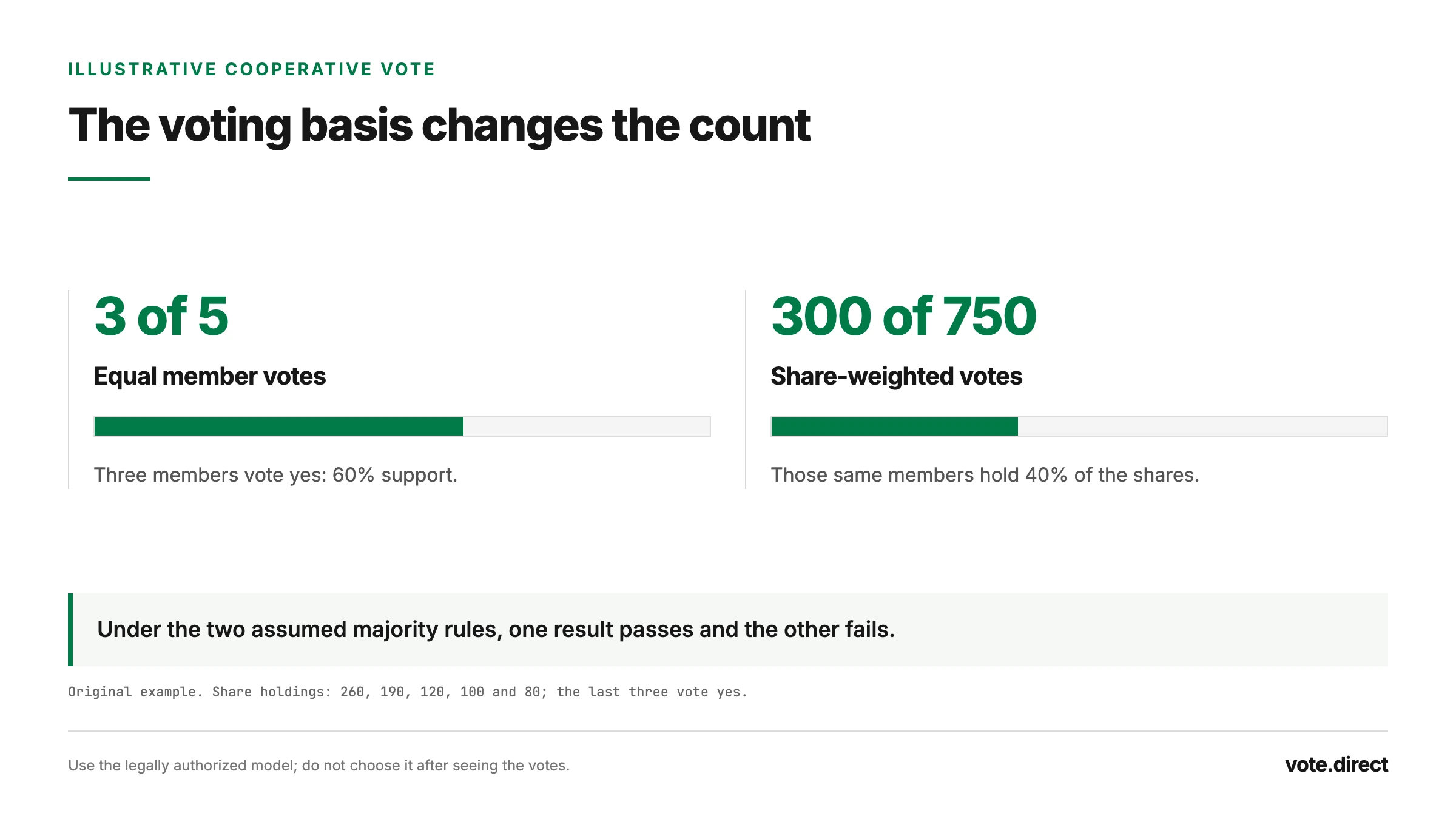
One Member, One Vote or Voting by Shares? How to Check a Cooperative’s Rule
A cooperative label does not identify every voting rule. Separate membership, shares, joint ownership and election method before creating the voter list.
Read the guideOwnership, voting and authority
Check what a membership or share actually permits its holder to do.
4 min read
One Member, One Vote or Voting by Shares? How to Check a Cooperative’s Rule
A cooperative label does not identify every voting rule. Separate membership, shares, joint ownership and election method before creating the voter list.
5 min read
Cooperative Governance: Which Decisions Belong to Members, the Board or Management?
Member ownership does not mean every operational decision uses a membership ballot. Build a clear authority map for the decisions your cooperative actually faces.
4 min read
Weighted Voting Explained: When One Member Does Not Mean One Vote
Condos allocate by percentage interest. Co-ops allocate by shares. Strata allocate by unit entitlement. In all three, a ballot is not worth one vote, and getting the arithmetic wrong is how a result gets overturned. Here is how weighting actually works.
5 min read
Per-Unit Voting Explained: One Ballot Per Home, Whoever Owns It
Your bylaws almost certainly say one vote per lot. That single sentence creates three problems nobody thinks about until election day: two spouses on one deed, an investor who owns nine units, and what quorum is actually a percentage of.
Plan the cooperative election
Match the legal structure and voting method to the election being held.
6 min read
How to Run a Cooperative Board Election: Democratic Principles, State Law, and Digital Solutions (2026)
Cooperatives are built on democratic member control. This guide covers how to run cooperative board elections that honor that principle while meeting state requirements, from housing co-ops to agricultural cooperatives.
5 min read
Cooperative Election Rules by Type: Housing, Electric, Agricultural, and Consumer Co-ops (2026)
Election rules differ dramatically across cooperative types. Housing co-ops follow real estate law, electric co-ops face USDA oversight, and agricultural co-ops have Capper-Volstead protections. This guide compares rules across all major cooperative types.
9 min read
NYC Co-op Elections: BCL Compliance, Proxy Reform, and Identity-Verified Shareholder Voting
New York City has 6,800+ cooperative apartment buildings where shareholders vote on boards, assessments, and building policies. Proxy abuse, low turnout, and $5,000 election costs plague the process. Verified digital voting fixes all three.
16 min read
Cooperative Election Software in 2026: Housing Co-ops, Ag Co-ops and Worker Co-ops
A cooperative election is not an HOA election with a different name. Patronage weighting, member classes and district directors change how the ballot has to be built, and most voting platforms scope eligibility in a way that quietly breaks district races. Here is what each kind of co-op needs, what six platforms cost, and where each one falls down.
Board participation and records
Distinguish membership rights from personal participation as a director.
5 min read
Can a Board Director Vote by Proxy? Separate Board Votes from Member Votes
A proxy accepted at the annual membership meeting may be invalid at the board table. Learn which capacity a person is voting in and what alternatives to check.
4 min read
Abstain vs. Recuse: How Each Affects a Board Vote and Its Record
Three yes votes can pass one rule and fail another. A worked example and practical recordkeeping guide explain abstentions, conflict recusals and quorum.
7 min read
Board Meeting Minutes: What to Include, What to Leave Out, and a Template
Minutes are a legal record of decisions, not a transcript of the discussion. Here is exactly what belongs in them, what to leave out, how to record a vote so it holds up, and a template you can copy.
6 min read
Can a Board Vote by Email? The Rules, the Risks, and the Right Way to Do It
Most boards vote by email at some point, and most do it in a way that would not survive a challenge. Here is when an email vote is actually valid, why open meeting requirements often make it worse, and the three legitimate alternatives.