Quick Answer
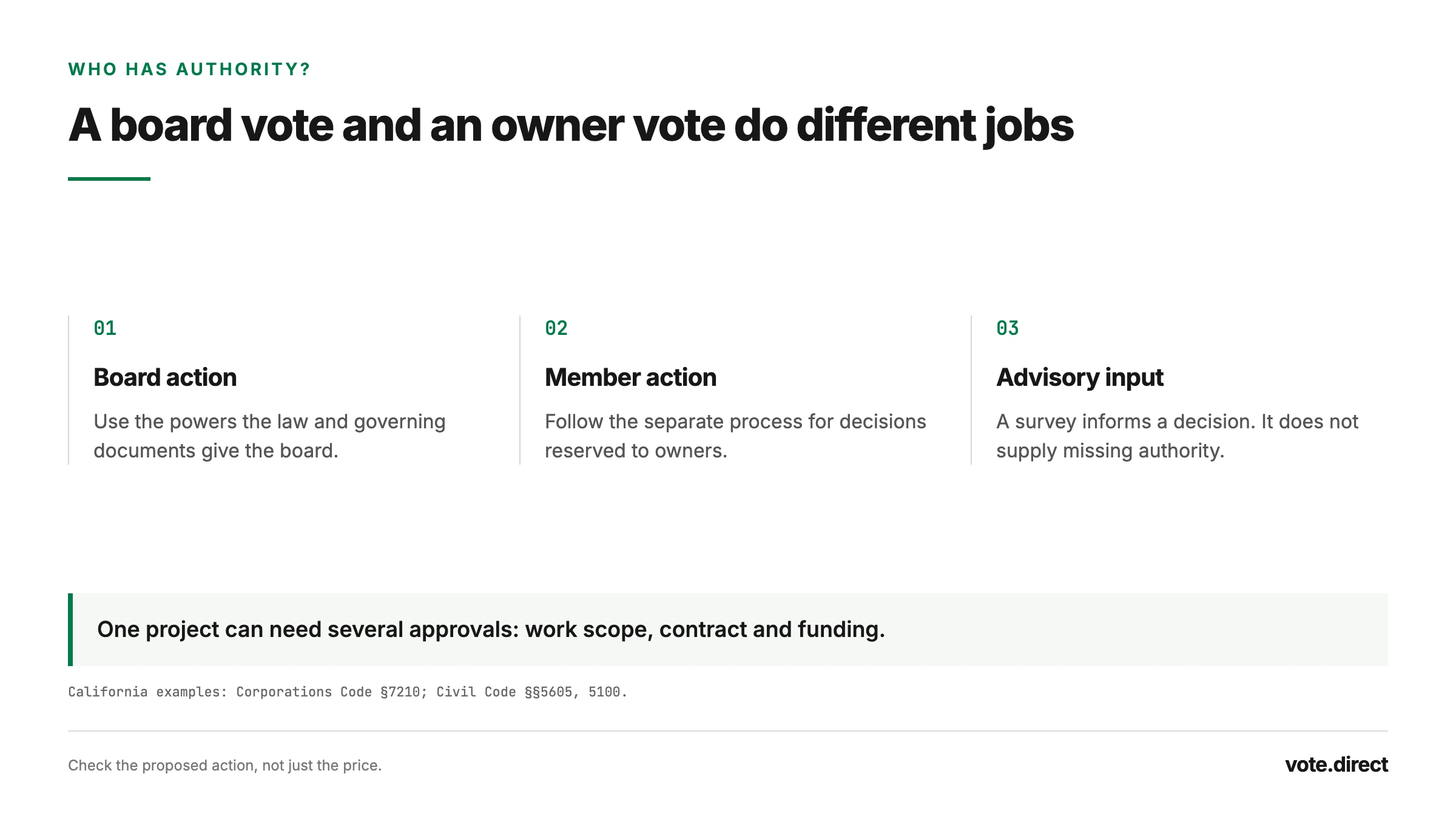
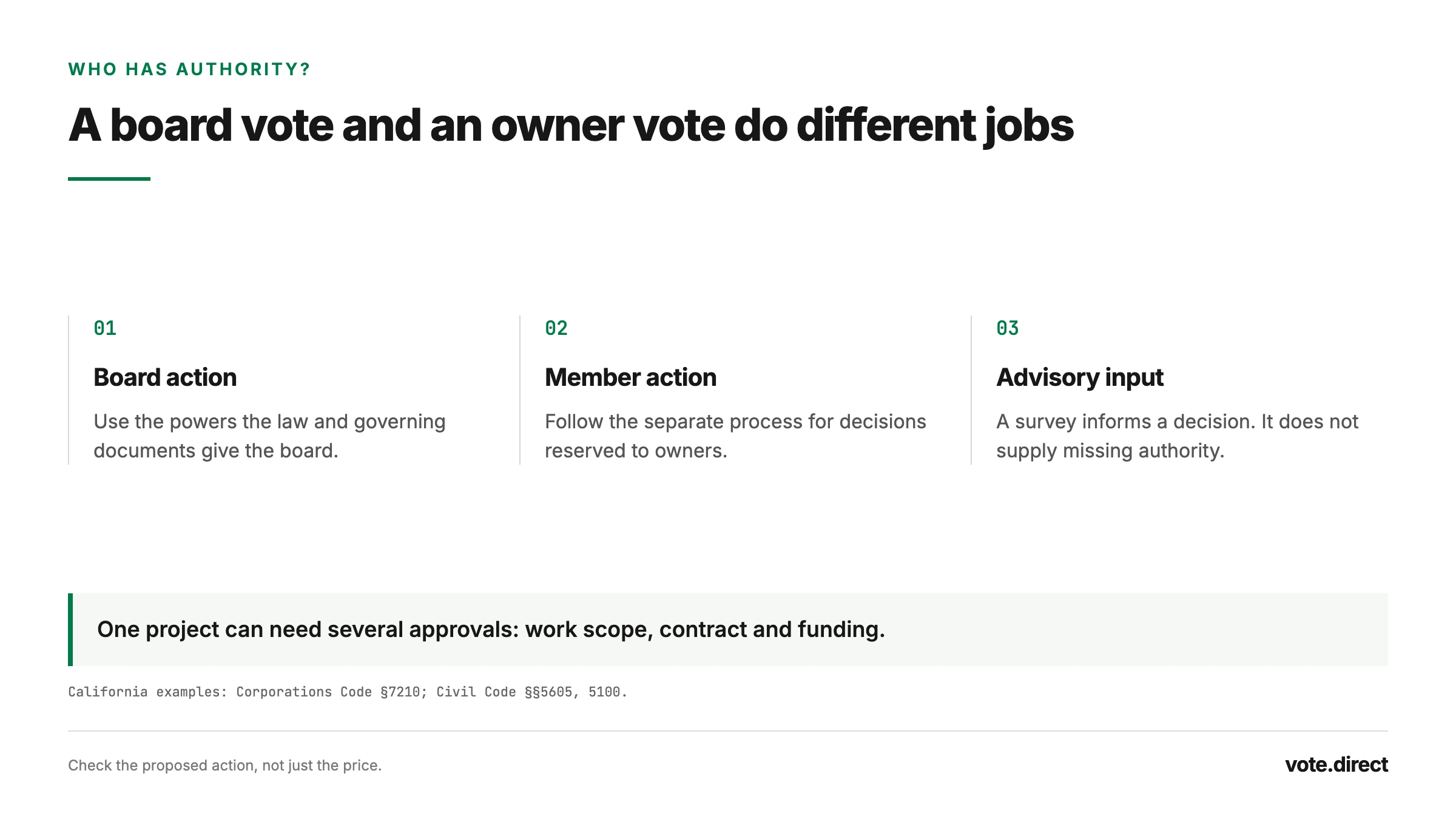
An HOA board can decide matters within its lawful authority. A homeowner vote is required when applicable law or the governing documents reserve the decision to members. The answer depends on the action, not simply its cost or popularity. A survey of owners does not replace a required member vote, and a board cannot acquire a reserved power by voting unanimously.
This U.S. guide uses California examples to show the method. It does not apply California thresholds to other states or treat condominium and HOA statutes as interchangeable.
Build an authority record before building a ballot
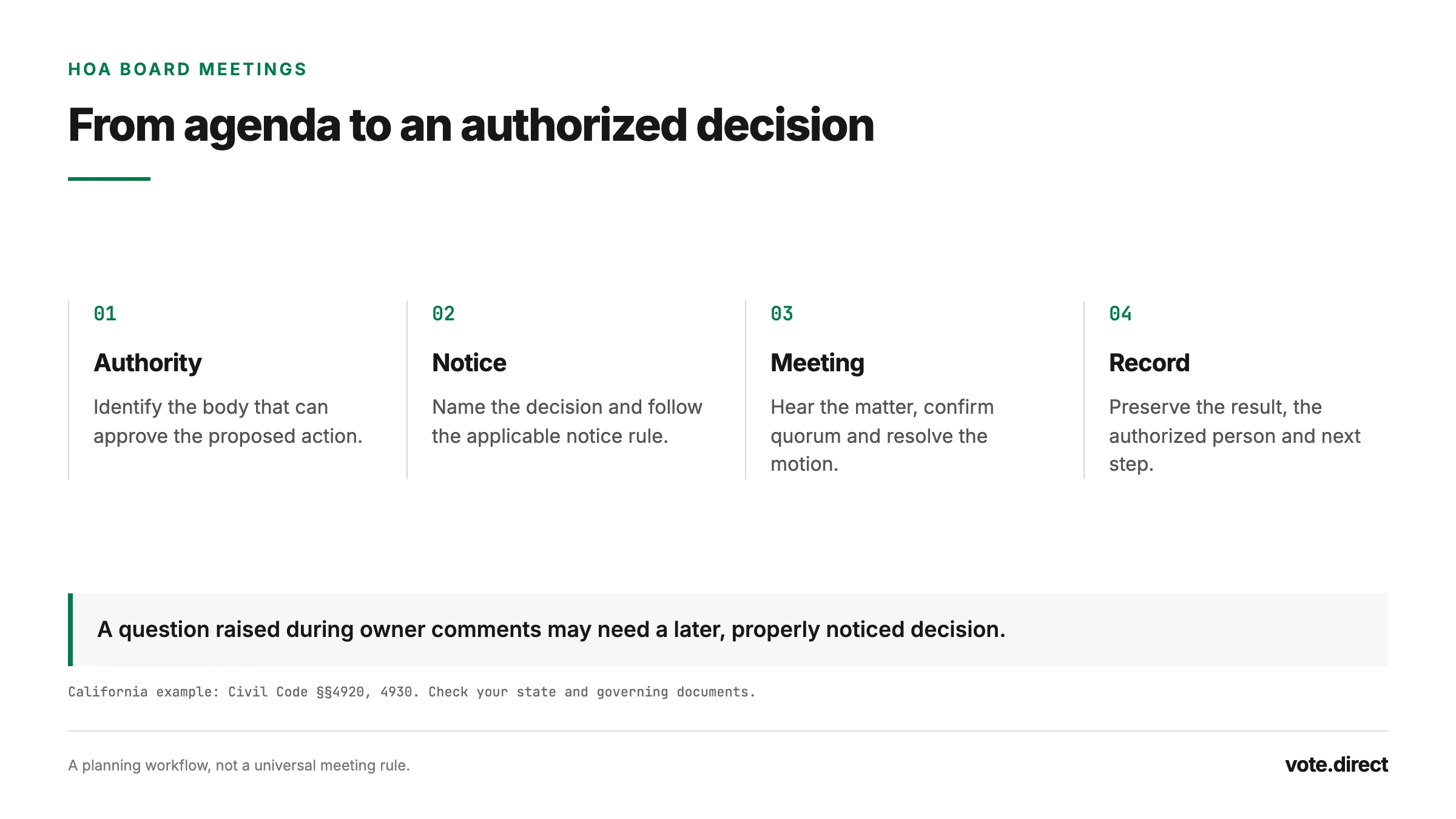
Start with the actual proposed action: signing a maintenance contract, imposing an assessment, amending a declaration, electing directors or changing an operating rule. These may belong to different approval processes even when they concern the same project.
Create a short record with these fields:
| Question | What to write down |
|---|---|
| What action is proposed? | A specific decision and its limits |
| What type of association is this? | State, legal form and applicable HOA or condominium act |
| Which provision supplies authority? | Statute and governing-document section, including amendments |
| Who approves it? | Board, members, a class of members or more than one body |
| What process is required? | Notice, meeting or ballot method, quorum and approval threshold |
| What follows approval? | Contract signature, recording, notice of results or another condition |
Do not write only “the bylaws allow it.” Include the section and the current document version. Declaration restrictions, articles and statutes can matter alongside the bylaws.
Board authority and member reservations can coexist
California Corporations Code §7210 places a nonprofit mutual benefit corporation's affairs under board direction, subject to the statute and limitations in its articles or bylaws requiring member approval. That illustrates why general management power is the beginning of the inquiry, rather than an answer to every particular decision. Read §7210.
A board may be able to select a vendor yet still need an owner vote for the funding mechanism. Conversely, an owner vote approving a project does not necessarily select the vendor or authorize an unlimited contract. Identify each approval separately and keep the records connected.
A repair project can contain three different decisions
Consider a fictional association proposing a major roof repair. First, it must determine the work needed. Second, it must select a contractor and approve contractual terms. Third, it must fund the cost. Calling all three “the roof vote” hides which body controls each step.
| Decision | Practical question before approval |
|---|---|
| Scope of work | Who can commission the assessment and approve the scope? |
| Contract | Who can approve and sign the contract, and within what limit? |
| Funding | Are reserves available, or does a proposed assessment require member approval? |
An advisory owner survey can inform these choices. Label it as advisory and explain what will happen next. Do not announce a binding approval when the survey omitted required notice, eligibility checks or an authorized voting procedure.
California example: assessment limits are action-specific
Civil Code §5605(b) places member-approval conditions on regular-assessment increases above 20 percent and aggregate special assessments exceeding 5 percent of budgeted gross expenses for the fiscal year. Other subsections and related provisions also matter, including financial-disclosure prerequisites, affordable-unit provisions and emergency rules. These are California rules, not national benchmarks. Read the current §5605.
For a simplified illustration, 5 percent of $400,000 in budgeted gross expenses is $20,000. A proposed $15,000 special assessment plus an earlier $10,000 special assessment totals $25,000. Looking only at the newest proposal misses the aggregate. This arithmetic does not resolve the full legal approval process or any exception; it identifies the question the board must investigate.
California Civil Code §5100 separately identifies elections subject to its secret-ballot procedures, including specified member decisions as well as director elections. Deciding that members must vote is therefore only one step; the method also needs review. Read §5100.
Check the denominator before announcing a result
Quorum asks whether enough eligible voting interests participated under the applicable rule. The approval threshold asks how much affirmative support the action needs. They can use different denominators.
Suppose a fictional declaration requires approval from 67 percent of all 120 equal voting interests. That requires 81 affirmative votes because 80.4 must be rounded up to reach at least 67 percent. Eighty yes votes out of 90 participating interests still falls short of that particular requirement. This example does not describe the statutory threshold for any named state.
Write the denominator in the election instructions and final report. See supermajority thresholds and the bylaw and declaration amendment guide for related distinctions.
Frequently Asked Questions
Can a unanimous board vote replace a required owner vote?
No. Agreement among all directors does not supply authority reserved to members. Identify the member-approval procedure and any other required approvals before implementing the decision.
Must owners vote on every large contract?
There is no single U.S. dollar threshold that answers that question for every HOA. Check the applicable statute, governing documents, approved budget and any financing conditions. Separate authority to sign the contract from authority to raise the money.
Does a member vote automatically amend the governing documents?
Not necessarily. The required approval, document form, certification, recording or other effectiveness conditions depend on the document and applicable law. Track the effective date separately from the date the votes were counted.
Source notes and next steps
Primary sources checked September 5, 2026: California Corporations Code §7210 and Civil Code §§5605 and 5100. The worksheets and numerical illustrations are original examples. They support document review rather than provide an opinion on a particular association.
Browse housing governance guides, prepare a board meeting agenda, or discuss managed election services once the voting procedure is established.
This article is general information, not legal advice. We recommend you do your own research and confirm anything you plan to act on. Where this article states law, the section is cited so you can read the primary source yourself rather than take our word for it. That is what the citations are for. Election requirements also turn on your own governing documents, which we have not seen, and statutes are amended. For advice about your community, consult a qualified attorney licensed in your state.
We work hard to verify every citation against the primary source, but laws change and errors happen. If you spot an inaccuracy, email support@vote.direct and we will correct it. See our editorial standards for how these pages are researched and checked.