Quick Answer
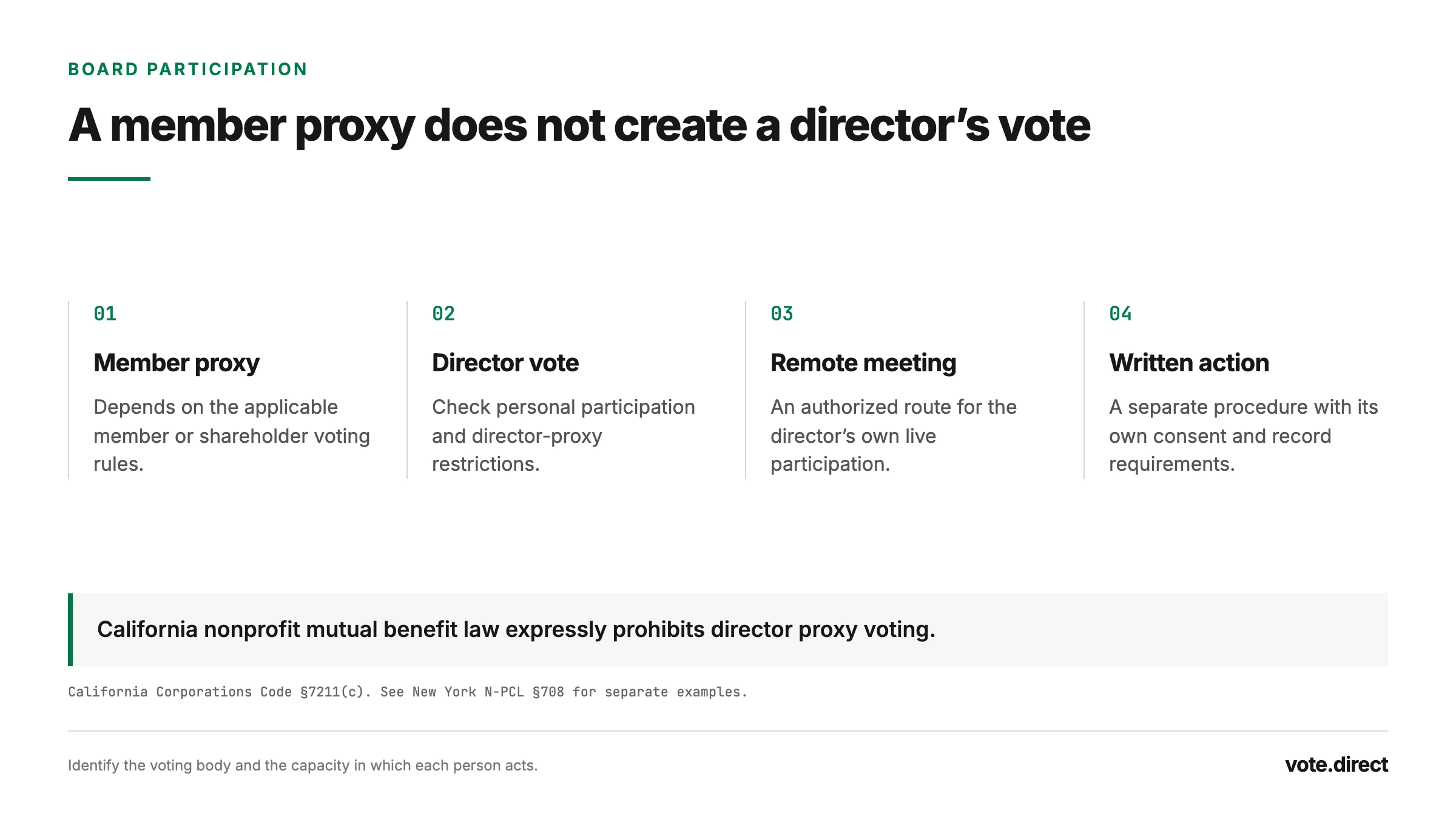
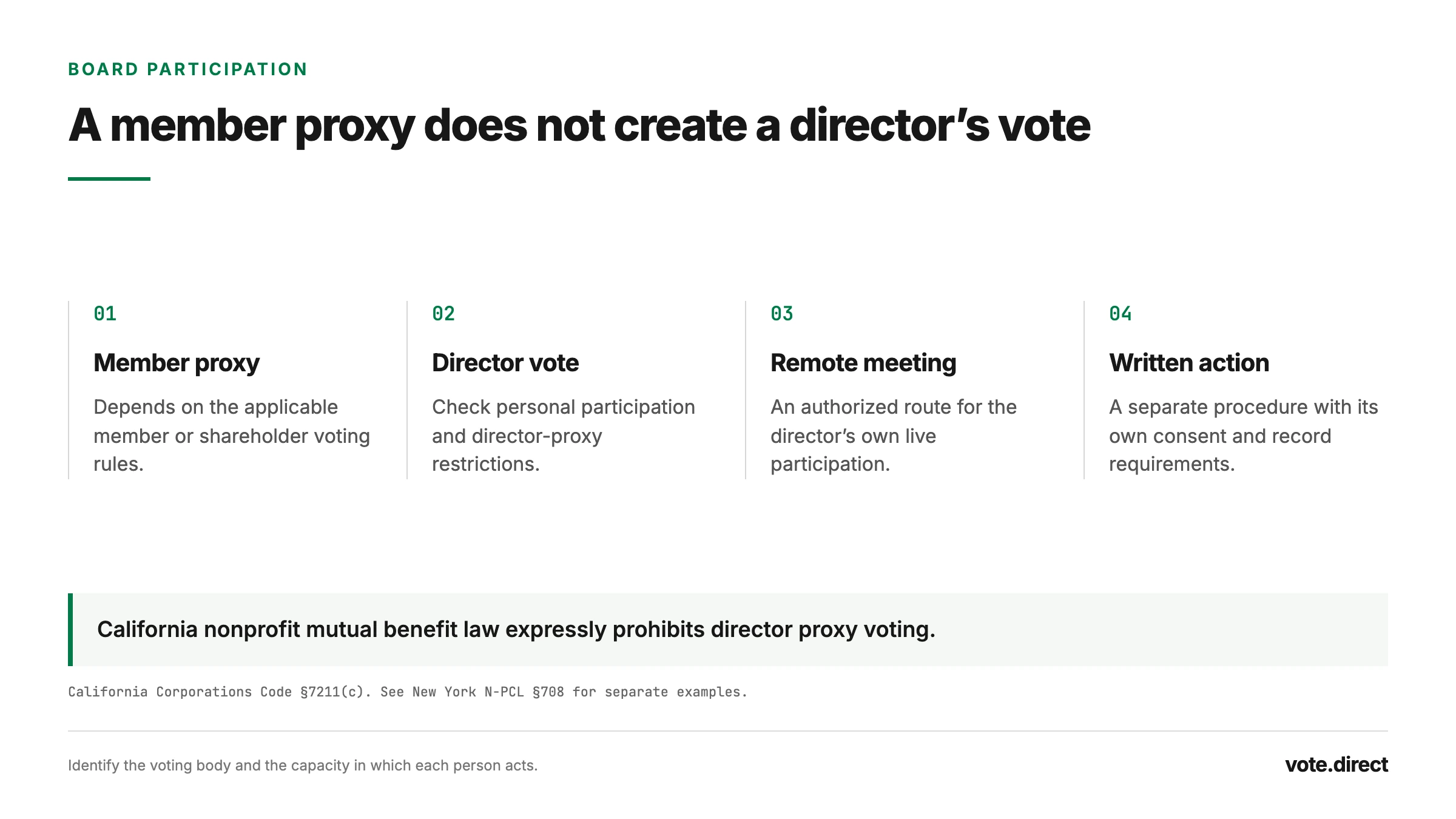
Do not assume a director may transfer a board vote to someone else. Director voting and member or shareholder proxy voting are governed separately. California nonprofit mutual benefit corporation law expressly prohibits a director from voting by proxy. Other organizations must check their own governing law and documents. Authorized remote attendance or a valid action-without-meeting procedure may offer a different route.
This guide concerns private organizational boards in the United States, not public election voting. Its statutory examples are labeled by state and entity type.
First identify the capacity in which the person votes
One person can be a homeowner, an association member and a director. At an annual membership meeting, they may exercise a membership vote. At a board meeting, they exercise the office of director. Permission attached to the first role does not automatically attach to the second.
| Capacity | Question to resolve |
|---|---|
| Individual member or shareholder | Does the applicable membership voting rule permit a proxy? |
| Director | Must the director personally participate in the board's decision? |
| Organizational member's representative | Who is authorized to act for the member organization? |
| Convention delegate | What credentials and substitution rules govern the seat? |
A spouse carrying a homeowner's proxy does not become a director. A colleague holding an absent director's written preference does not automatically gain the director's seat or increase board attendance.
California has an explicit director-proxy prohibition
California Corporations Code §7211(c), within the nonprofit mutual benefit corporation provisions, gives each director one vote on a board matter and prohibits director proxy voting. Other parts of the section address meeting participation and action without a meeting. Read §7211.
For an association governed by that provision, adding a proxy field to a board ballot does not make the practice valid. Nor should the chair read an absent director's email as an extra live vote. The system must reflect the authorized procedure rather than allow convenient settings to determine it.
Robert's Rules also distinguishes the authorization of proxy voting from its ordinary parliamentary defaults. Where proxies are authorized, their scope comes from the applicable law or bylaws. That general statement does not displace a statutory director-proxy prohibition. Official FAQ, question 10.
Three alternatives worth checking
1. Personal participation by telephone or video
Determine whether the governing law and documents allow the director to attend remotely. Confirm the required ability to hear, participate in deliberation and vote. Merely receiving a recording afterward is not live participation.
For New York nonprofits, §708(c) allows specified remote board participation unless the certificate or bylaws restrict it. The provision includes simultaneous hearing and the ability to participate in matters before the board. Section 708(b) separately addresses action without a meeting and the required consents and record. Read N-PCL §708.
A practical connection check asks the remote director to confirm that they can hear the room, read the exact proposed motion, request recognition and cast their own vote. Record a disconnection when it affects participation in a decision.
2. A permitted action without a meeting
This is a separate approval procedure, not a board meeting conducted slowly through email. Identify who must consent, the required form, any exclusions or restrictions, and how the completed action is preserved. A majority saying “looks good” is not evidence that the applicable consent requirements were satisfied.
Use a stable resolution version. Sending different versions to different directors leaves uncertainty about what was approved. Read can a board vote by email? before using an asynchronous workflow.
3. Reschedule or use the lawful vacancy procedure
When live participation and written consent are unavailable, find a meeting time that works or consider a properly authorized adjournment. Repeated absence may raise an attendance or vacancy question. It does not let the remaining directors appoint an informal voting substitute. A designated alternate can act only if the applicable legal structure actually provides for that position.
Worked attendance example
Assume a five-director board's applicable quorum rule requires three directors. Two directors arrive in person. A third sends a proxy but does not attend. Under a rule prohibiting director proxies, the paper does not turn two attendees into three.
If that third director instead joins through an authorized live process and meets its participation requirements, the attendance analysis may change. Record how the director participated and reassess if the connection fails. This example illustrates why attendance must be established independently of the number of ballot forms received.
Keep board and member elections separate in the records
Name the voting body on every ballot and result report. Use different eligibility lists for the board and membership. In a hybrid annual meeting, a director's authorized member proxy should not be imported into a later board meeting as a director credential.
For a membership proxy, preserve the authorization and applicable validation record without unnecessarily linking a voter's identity to secret ballot choices. For a director's live vote, preserve the meeting record required for that board. These are related administrative tasks with different evidence needs.
Frequently Asked Questions
Can the board president cast a missing director's vote?
Do not assume so. The president's office does not create permission to exercise another director's vote. Check the director-voting statute and governing documents, not only the membership proxy form.
Is an emailed vote the same as a proxy?
No. An email could be an informal opinion, an attempted absentee vote or part of a permitted written-consent process. Its legal effect depends on the actual procedure. Identify that procedure before counting it.
Can voting software fix an unauthorized proxy process?
No. Software can implement an authorized eligibility and counting process and preserve records. It cannot give a person authority the organization has not lawfully granted.
Source notes and next steps
Primary sources checked September 5, 2026: California Corporations Code §7211, New York N-PCL §708 and the Robert's Rules Association FAQ. The attendance scenario is original and assumes its stated quorum rule.
Continue with member proxy voting, association delegate credentials, or the meeting and voting guides.
This article is general information, not legal advice. We recommend you do your own research and confirm anything you plan to act on. Where this article states law, the section is cited so you can read the primary source yourself rather than take our word for it. That is what the citations are for. Election requirements also turn on your own governing documents, which we have not seen, and statutes are amended. For advice about your community, consult a qualified attorney licensed in your state.
We work hard to verify every citation against the primary source, but laws change and errors happen. If you spot an inaccuracy, email support@vote.direct and we will correct it. See our editorial standards for how these pages are researched and checked.