Quick Answer
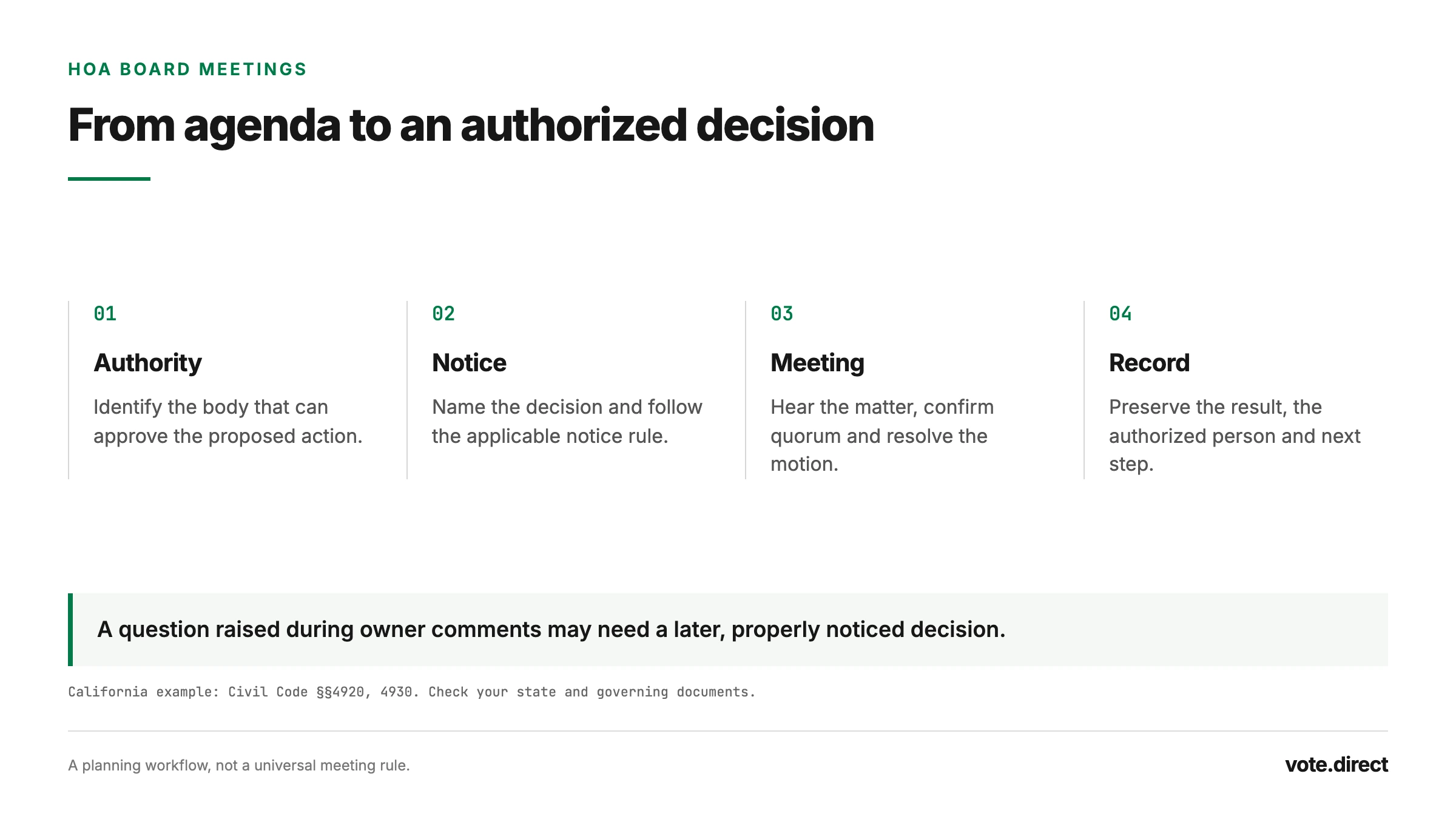
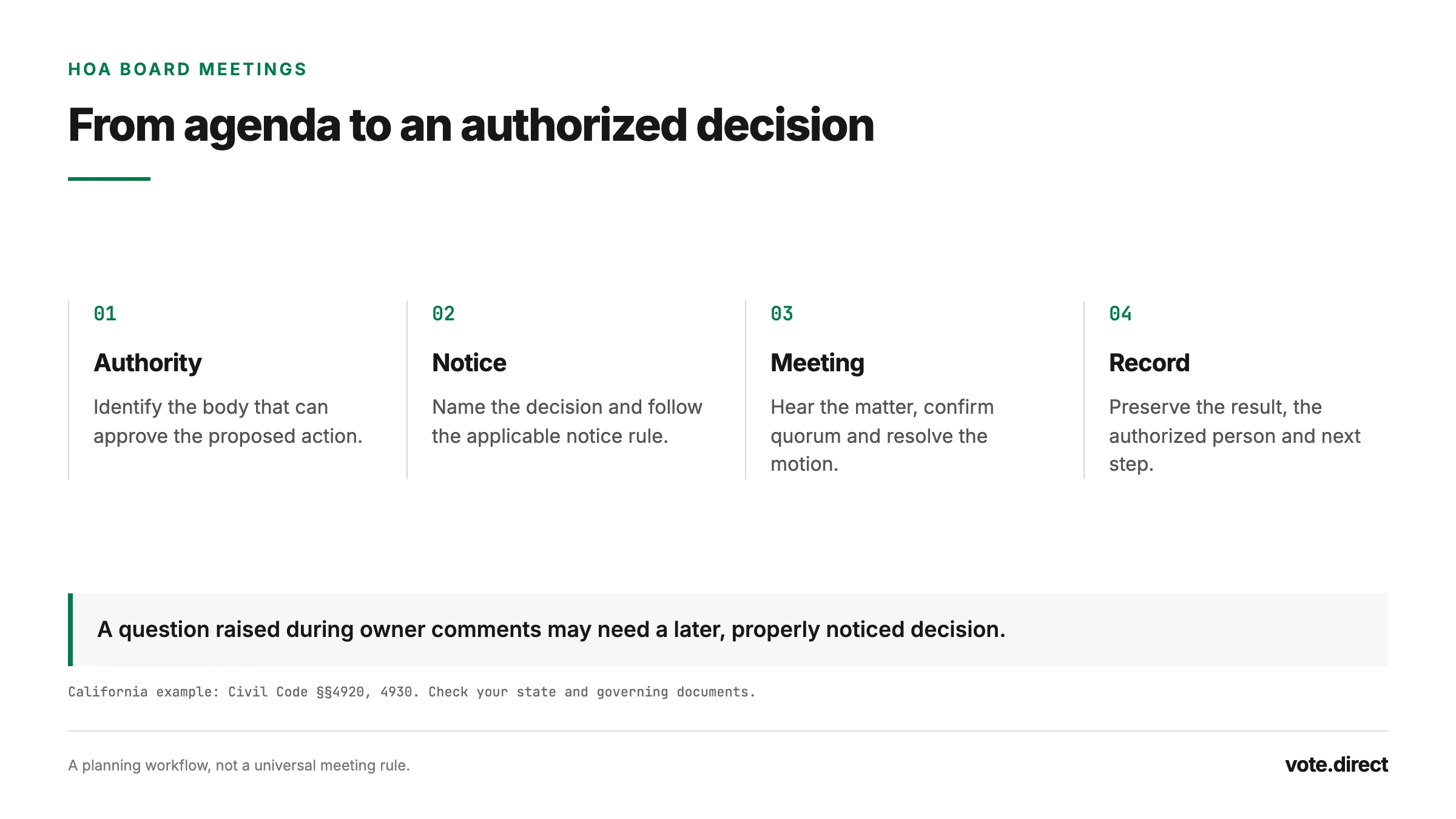
An HOA board agenda should identify the meeting, explain how owners can attend, name the business the board may consider, and separate reports from proposed decisions. Check the applicable notice and open-meeting rules before adding a last-minute vote. A request raised during owner comments does not automatically become an item the board can decide that evening.
This is a U.S. planning guide with a California statutory example. Condominium and HOA rules differ by state. The sample timings below organize a meeting; they are not legal notice periods.
Start with the decision, then write the agenda item
“Landscaping” leaves owners guessing. “Consider the landscape maintenance renewal, including the proposed scope and annual cost” tells them why attending might matter. Give the board a separate packet containing the proposal, comparison information, budget impact and draft motion. The public agenda and the board packet serve different purposes.
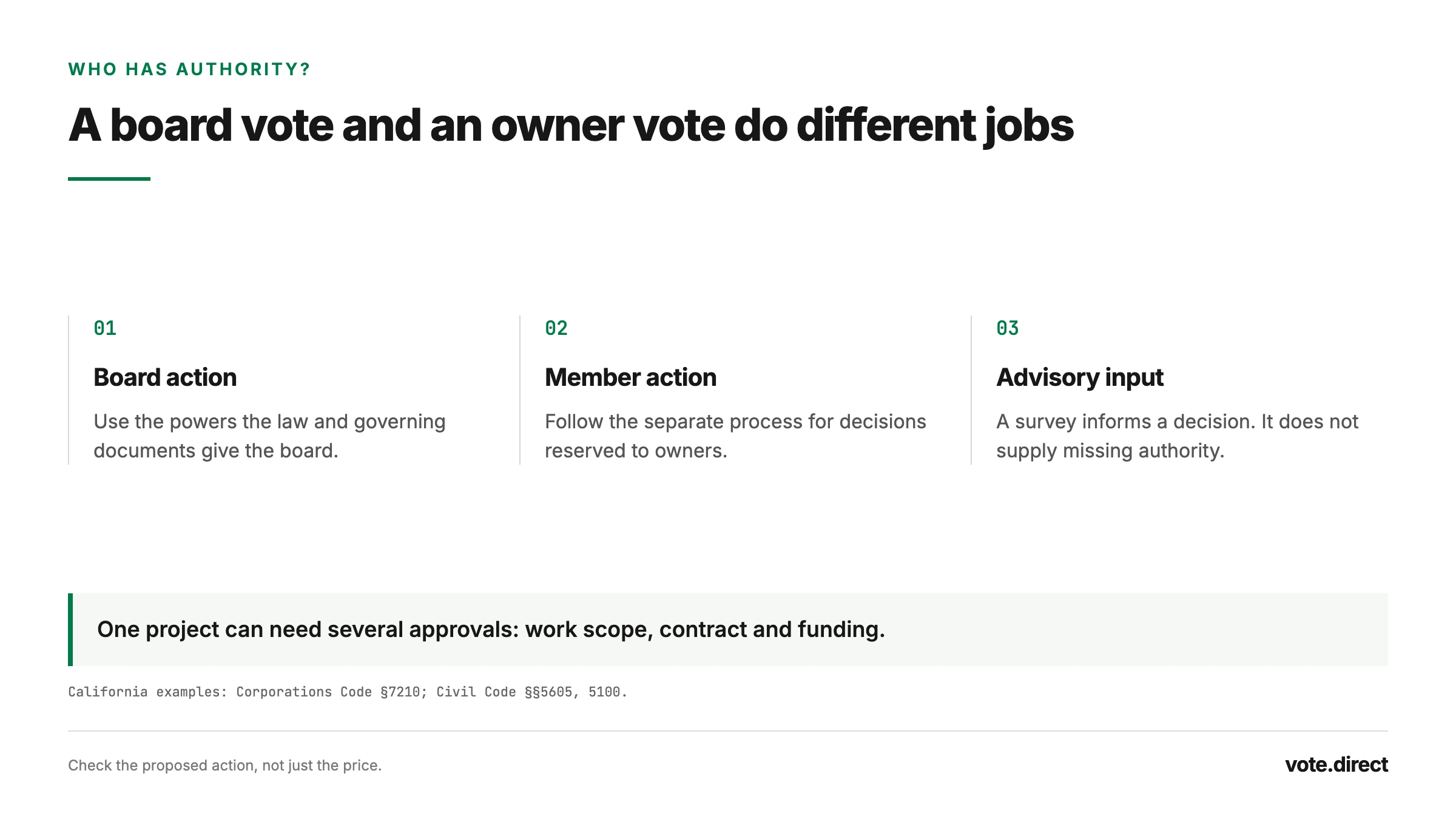
Before scheduling a vote, answer three questions: Does the board have authority? Has the association supplied the required notice? Does the board have enough information to decide? If the project also requires a member vote, label the board's action as a recommendation or authorization to begin that process. See board versus homeowner decision authority.
A practical 60-minute agenda
| Time allowance | Item | Intended output |
|---|---|---|
| 5 minutes | Call to order, attendance and quorum | Identify the directors present and whether business can proceed |
| 5 minutes | Prior minutes | Approve or correct the record through the applicable procedure |
| 10 minutes | Financial and manager reports | Receive information; identify separately noticed decisions |
| 10 minutes | Owner comment period | Hear concerns using the association's lawful participation rules |
| 20 minutes | Specifically listed decision items | Resolve each motion, record its outcome and identify the next action |
| 5 minutes | Follow-up on prior decisions | Confirm responsible people and due dates |
| 5 minutes | Next meeting and adjournment | State the next date and close the meeting |
These allowances total 60 minutes. Move or lengthen the owner comment period when applicable rules require it. A spending decision needs its own clear item even if it emerges from a financial report. A consent agenda also needs enough description for readers to identify the actions included.
California example: the notice constrains the meeting
For associations subject to California's Davis-Stirling Act, Civil Code §4920 generally requires board-meeting notice at least four days beforehand, subject to its exceptions and longer governing-document requirements. The notice includes an agenda. A nonemergency meeting held solely in executive session has a different minimum. Read §4920.
Section 4930 generally limits nonemergency board discussion and action to noticed agenda items, while allowing specified responses and exceptions. An owner may raise another issue; that does not itself authorize board action on it. The section provides particular routes for urgent matters and continued business. Read §4930.
Do not turn those exceptions into a standing “anything else” voting item. If a roof proposal arrives after notice, identify what changed, ask whether an actual exception applies, and record the basis for the chosen procedure. Where it does not apply, arrange a properly noticed decision instead of describing ordinary delay as an emergency.
What the secretary should prepare
Keep a meeting file containing the final agenda, notice and delivery record, supporting documents, attendance, motions and resulting minutes. Mark drafts clearly so a preliminary packet does not become the apparent final version.
For each decision item, prepare an action line with five fields: the exact decision, the person authorized to carry it out, any spending limit, the due date, and the reporting point. A motion to approve a repair is easier to implement when it identifies the actual proposal and the person authorized to sign it.
If the proposal changes during discussion, capture the final text before voting. Count against that version. Do not attach a superseded quote to the minutes without labeling it. The board meeting minutes guide provides a starting format for the resulting record.
When the meeting cannot finish the work
If participation drops, reassess the applicable quorum requirement before another substantive action. If the packet is incomplete, record what additional information is needed and who will obtain it. If an item needs a member vote, establish its separate notice and ballot process. Finishing every agenda item is less useful than producing decisions the association can actually implement.
For remote participation, plan recognition of speakers, access to the exact motion, and a reliable attendance record. A chat message, an advance email and a live vote are different events. The virtual board meeting guide explains why the distinction matters.
Frequently Asked Questions
Can homeowners ask for an agenda item?
They can submit a request through the association's established process. The right to demand consideration or a special meeting depends on applicable law and governing documents. Record the request and explain how it will be handled; do not promise an immediate vote merely because the request was received.
Does approving the agenda authorize every listed expense?
No. An agenda identifies business to consider. Record the separate substantive action, including any required motion, vote and spending authority. A line saying “roof discussion” is not evidence that a particular contract was approved.
Should the public agenda include confidential details?
Use the applicable open-meeting and executive-session rules to determine what belongs in each record. A privacy concern does not create unlimited permission to move ordinary business behind closed doors. Keep restricted supporting materials separate from the public agenda.
Source notes and next steps
Primary sources checked September 5, 2026: California Civil Code §§4920 and 4930, linked beside the rules above. The agenda and workflow are original planning examples, not a statutory form. Read our editorial standards and browse the housing association guides.
For an upcoming member election, vote.direct offers managed administration and mailed paper ballots. Those services support the election procedure your association is authorized to use.
This article is general information, not legal advice. We recommend you do your own research and confirm anything you plan to act on. Where this article states law, the section is cited so you can read the primary source yourself rather than take our word for it. That is what the citations are for. Election requirements also turn on your own governing documents, which we have not seen, and statutes are amended. For advice about your community, consult a qualified attorney licensed in your state.
We work hard to verify every citation against the primary source, but laws change and errors happen. If you spot an inaccuracy, email support@vote.direct and we will correct it. See our editorial standards for how these pages are researched and checked.