
Quick Answer
A meeting that misses quorum can do exactly four things: set a time to meet again, adjourn, recess, or take measures to obtain a quorum. Everything else on the agenda does not happen. Nothing that already existed is undone: the sitting board holds over, assessments keep running, and in most states the fix is to reconvene the same election at a lower threshold rather than start it over.
| The question boards ask that night | The short answer |
|---|---|
| Did we just break the law? | No. Failing to reach quorum is not a violation. Deciding things anyway is. |
| Does the board dissolve at midnight? | No. Directors hold over until successors are elected and qualified. |
| Do we have to mail everything again? | Usually not. Most states and most bylaws let you adjourn and reconvene the same meeting. |
| Can we raffle a gift card next time? | Sometimes, and two Florida statutes make buying a vote a crime. Read that section first. |
Find your own number before anything else with the quorum calculator, because half the boards that believe they missed quorum were counting the wrong base. Then plan the reconvened vote around a ballot that opens before the meeting instead of a room that fills on one evening. On vote.direct the count updates while voting is open, so you learn you are eleven short on day three instead of at 7:05 p.m. on the night.
This is general information, not legal advice. Quorum rules come from your governing documents first and your state's statutes second, and software cannot make an election legally binding or guarantee that your process complies with either. Confirm your own rules with your association's attorney.
What Legally Does Not Happen
The panic after a failed quorum is almost always about consequences that do not exist.
| The fear | What actually happens | Where it is settled |
|---|---|---|
| The board dissolves | Directors keep serving. Under California's nonprofit law each director "shall hold office until the expiration of the term for which elected and until a successor has been elected and qualified". Most states' nonprofit acts read the same way. | Cal. Corp. Code §7220(b) |
| Assessments stop | The budget is usually the board's job. In a Florida condominium the board adopts the annual budget, and if it fails to adopt one twice, the prior year's budget stays in effect. | Fla. Stat. §718.112(2)(f)1 |
| The state takes over | No agency appears. No receivership, no dissolution, no fine for an empty room. | Nothing, which is the point |
| Everything the board did is void | The opposite. Actions taken without quorum are the vulnerable ones. Adjourning protects you. | Your bylaws and parliamentary authority |
| The election is lost | It was never held. There is no result to challenge and no winner to unseat. | Your election rules |
The one real exposure runs the other way. If a board looks at twelve people, decides that is close enough, and elects directors anyway, any member can have those decisions set aside, and the association pays to redo the process months later. What that looks like once a member actually files is covered in what happens when an HOA election is challenged.
Two things get missed on the night. Board quorum is not member quorum: the board's own quorum is normally a majority of directors then in office, unaffected by how many owners showed up (fifty percent in Colorado under C.R.S. §38-33.3-309(2), a majority of board votes in Washington under RCW 64.90.450(2)). And write down what happened: the time called, the count, the motion to adjourn, the new date. That page answers the question a year later about whether the reconvened meeting was properly reached.
Adjournment and Reduced Quorum, by State
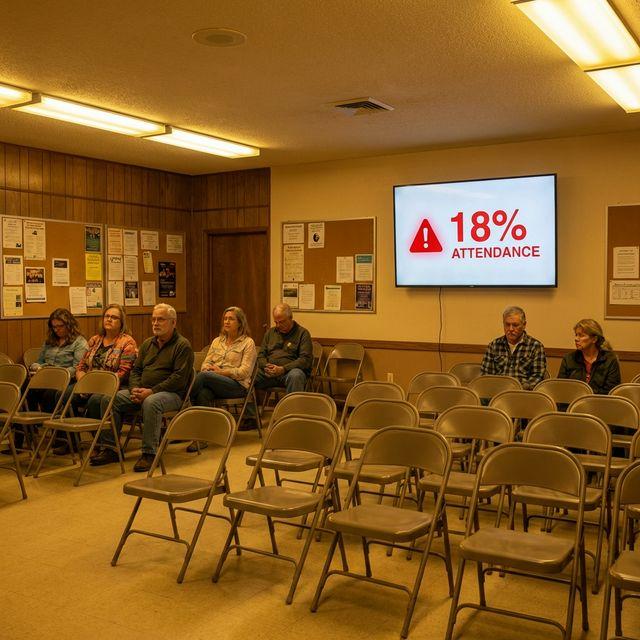
This decides whether you lose two weeks or four months. Some states hand you a statutory second attempt at a lower threshold. Others say nothing, which makes your bylaws the only thing between you and a re-run of the whole notice cycle.
| State | Default quorum when the documents are silent | Lower quorum at a reconvened meeting? | Citation |
|---|---|---|---|
| California | A quorum applies only if the governing documents impose one; the nonprofit default is one-third of the voting power | Yes: 20 percent, at a meeting reconvened at least 20 days later | Civ. Code §5115(d); Corp. Code §7512(a), (e) |
| Nevada | 20 percent, in person, by proxy, or by absentee ballot | Yes: adjourn 48 hours to 30 days out, then 20 percent | NRS 116.3109(1)–(2) |
| Colorado | 20 percent of the votes castable for election of the executive board; 10 percent for associations over 1,000 unit owners | Statute is silent, so the bylaws control | C.R.S. §38-33.3-309(1) |
| Florida (HOA) | 30 percent of total voting interests unless the bylaws set a lower number | No statutory reduction; §720.306(7) only governs announcing the new date | Fla. Stat. §720.306(1)(a), (7) |
| Florida (condo board election) | No quorum requirement at all, but at least 20 percent of eligible voters must cast a ballot | Not applicable: there is no quorum to reduce | Fla. Stat. §718.112(2)(d)5 |
| Arizona (condominium) | 25 percent of the votes in the association, in person or by proxy, unless the bylaws provide otherwise | Statute is silent, but absentee and electronic votes count toward quorum | ARS §33-1249(A); §33-1250(D) |
| Arizona (planned community) | No statutory default: the community documents control, or one-tenth if the association is a nonprofit and its documents are silent | Statute is silent, but absentee and electronic votes count toward quorum | ARS §10-3722; §33-1812(B) |
| Texas (nonprofit corporation) | One-tenth of the votes entitled to be cast | Statute is silent, so the bylaws control | Tex. Bus. Orgs. Code §22.159(a) |
| Washington | 20 percent, counting proxies, remote attendance, and absentee ballots | Statute is silent, so the organizational documents control | RCW 64.90.450(1) |
| Everywhere else | Varies. Read the bylaws, then your state's community association act, then its nonprofit corporation act | Varies: assume no unless a statute or bylaw says yes | Your documents |
California: the reduced quorum exists only if you said so in the notice
Civil Code §5115(d)(2) lets an association adjourn a director election and reconvene at least 20 days later with a quorum of 20 percent, voting in person, by proxy, or by secret ballot. Corporations Code §7512(e) says the same for the corporation side.
The trap is §5115(b)(6)(A). The general notice sent at least 30 days before ballots go out must already state that the association may call a reconvened meeting if quorum is not reached, and that the quorum there will be 20 percent. If that sentence is missing from the notice you mailed weeks ago, you are arguing about a fallback you never announced.
Two more California facts beat any turnout tactic. Under §5115(d)(1) a quorum is required only if the governing documents require one. Plenty of associations chase a threshold their own documents never imposed. And where one applies, "each ballot received by the inspector or inspectors of elections shall be treated as a member present at a meeting for purposes of establishing a quorum."
Nevada: 48 hours to 30 days, original agenda only
NRS 116.3109(2) is the cleanest reconvening rule anywhere. If the documents set a quorum above the statutory 20 percent and the meeting cannot be held, the members present in person may adjourn to a date not less than 48 hours and not more than 30 days out, and quorum there is deemed present at 20 percent. Read the limitation twice: the reconvened meeting may act only on matters from the original agenda.
Florida: two chapters, two different answers
Florida HOAs under Chapter 720 get no statutory reduction. Section 720.306(1)(a) sets the default at 30 percent, and §720.306(7) only governs announcing a new date, time, or place. A declining-quorum clause in your bylaws is the entire answer; without one, you run the notice cycle again.
Condominiums are the opposite. For a board election, §718.112(2)(d)5 says plainly: "There is no quorum requirement; however, at least 20 percent of the eligible voters must cast a ballot in order to have a valid election." That is a ballots-returned test, not an attendance test. The separate default in §718.112(2)(b)1 (a majority of voting interests for a general members' meeting) is why the same association can clear its election and still be unable to transact other business that night. Our Florida election law guide covers the rest of Chapter 718.
The states where the ballot is the quorum
Four states above solve this the same way, and it is the most useful pattern here: a vote cast before the meeting counts toward quorum.
- Arizona: "Votes cast by absentee ballot or other form of delivery, including the use of e-mail and fax delivery, are valid for the purpose of establishing a quorum" (ARS §33-1812(B)).
- California: each ballot received by the inspector counts as a member present (Civ. Code §5115(d)(1)).
- Nevada: the 20 percent may be present in person, by proxy, or by absentee ballot (NRS 116.3109(1)).
- Washington: the 20 percent may attend in person, by proxy, by remote communication, or have voted by absentee ballot (RCW 64.90.450(1)).
If you are in one of those states and still counting bodies in a room, you have chosen the hardest available way to reach a number you could have reached two weeks earlier.

Can You Lower Quorum in the Bylaws?
This is the tidiest circular problem in community association governance: lowering the quorum requires a vote, and you cannot get a vote, because the quorum is too high. Three things make it less circular than it looks.
Find out which document sets the number. Quorum usually lives in the bylaws, which are almost always easier to amend than a declaration or CC&Rs. Boards regularly assume they face a 67 percent declaration amendment when the clause sits in the bylaws at a far lower threshold. Read both. Our guide to amending bylaws and CC&Rs walks the difference.
Check who may amend them. In California, Corporations Code §7150(a) lets the board adopt, amend, or repeal bylaws unless the change would "materially and adversely affect the rights of members as to voting," and it expressly carves out §7512. Section 7512(a) supplies the asymmetry: a bylaw may set a quorum different from the statutory one-third, but "any bylaw amendment to increase the quorum may be adopted only by approval of the members." The statute polices raising the bar, not lowering it. Whether your reduction is a board action or a member action is a one-email question for your attorney, before you spend a mailing on it.
In California there is a court exit. Civil Code §4275 lets an association or any member petition the superior court to reduce the percentage needed to amend a declaration. The court may grant it only after finding that balloting followed the governing documents, that a reasonably diligent effort was made to let every eligible member vote, that members holding more than 50 percent of the votes voted in favor, and that the amendment is reasonable. Subdivision (d) then lets the order "dispense with any requirement relating to quorums."
That fourth finding is the lesson. The court does not rescue an association that never got the votes; it rescues one that got a majority and was blocked by a supermajority clause. So the order of operations never changes: raise participation with the tools you already have, confirm which document holds the clause and who may amend it, run the amendment while participation is high, and only then consider a permanently lower quorum. A 10 percent standing quorum in a community that never participates is a legitimacy problem, not a fix.
Quick question for community leaders
What would actually get more members to vote?
Can You Pay People to Vote?
Usually asked as "can we raffle a $100 gift card among everyone who returns a ballot." Three layers, and most boards think only about the first.
Criminal law. The federal ban on paying for votes, 52 U.S.C. §10307(c), reaches anyone who "pays or offers to pay or accepts payment either for registration to vote or for voting", but only in elections "held solely or in part for the purpose of selecting or electing" a federal candidate. An HOA election is not that.
State law can be your constraint. Florida makes it a first-degree misdemeanor to give or promise, directly or indirectly, "anything of value to another member with the intent to buy the vote of that member or another member or to corruptly influence that member or another member in casting his or her vote", for HOAs at Fla. Stat. §720.3065(1)(e), for condominiums at §718.112(2)(r)1.e. Both carve out food served at an election rally or meeting and items of nominal value used as election advertising. The intent element is the practical line: those statutes target buying how somebody votes, and a prize for that somebody voted is a different act. The distinction gets thin when the prize is funded by the association and awarded by a board that is itself on the ballot.
Gambling law. In most states a lottery is prize plus chance plus consideration, and if entry requires returning a ballot, a regulator can call the ballot the consideration. California is the strictest published example: Penal Code §320.5 permits raffles only for private nonprofit organizations qualified in the state for at least a year and holding specific tax-exempt status, requires at least 90 percent of gross receipts to go to charitable purposes, and requires annual registration with the Department of Justice. The standard fix is the one sweepstakes lawyers use: remove the consideration. Open the drawing to every member whether they voted or not, and the incentive survives while the lottery analysis does not.
Whose money is it. Even a lawful prize is an association expenditure and must be an authorized common expense. California adds a limit: Civil Code §5135(a) says association funds "shall not be used for campaign purposes in connection with any association board election," and §5135(b) includes both express advocacy for a candidate and featuring a candidate's name or photograph in association communications within 30 days of an election.
| Incentive | Usual verdict | The question that decides it |
|---|---|---|
| Drawing open only to members who voted | Risky | Does your state treat the ballot as consideration for a lottery? |
| Drawing open to every member, voted or not | Generally safer | Is the expenditure an authorized common expense? |
| Cash or an assessment credit for voting | Avoid | It looks exactly like the conduct Florida criminalized |
| Refreshments at the meeting | Fine | Florida names food at a meeting as an express carve-out |
| Prize tied to how a member voted | Never | This is the conduct the statutes describe |
Five Things That Actually Move Turnout
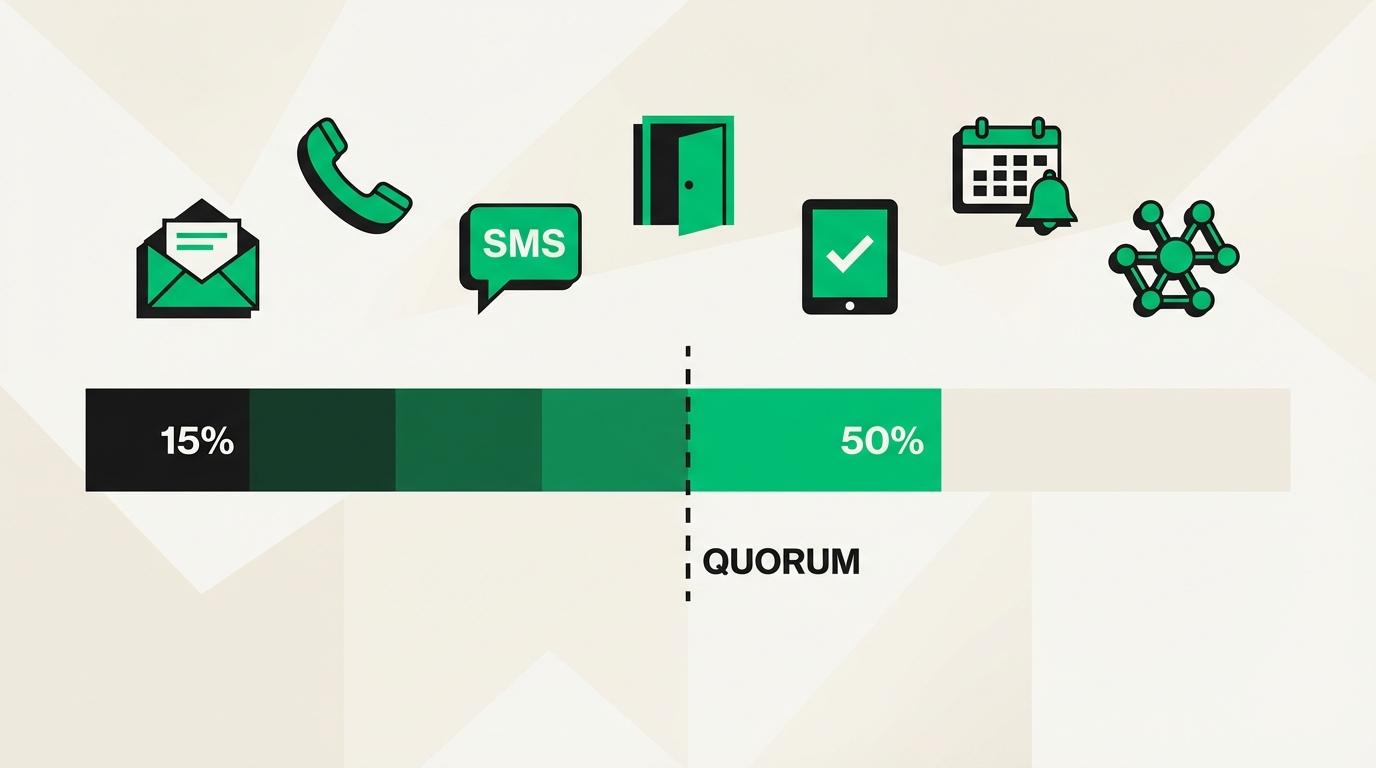
1. Let the ballot be the quorum
The largest single lever in the four states that permit it. A ballot returned in week one is quorum in the bank; a meeting is a coin flip on one evening. In a Florida condominium board election there is no attendance test at all, just 20 percent of eligible voters returning a ballot.
2. Widen the window from one evening to two weeks
The Foundation for Community Association Research's 2026 homeowner survey, run by Zogby Analytics among 3,000 residents, found 65 percent of residents with remote meeting access attend more often because of it, and 64 percent would attend more often if remote participation were available. Meetings are not elections, but the mechanism is identical.
3. Send reminders from the association, more than once
Three field experiments run with the San Mateo County registrar of voters found that neutral election emails from the official registrar produced small but statistically significant turnout increases, while the same messages from an invented outside group did not ([Malhotra, Michelson and Valenzuela, “Emails from Official Sources Can Increase Turnout”](https://isps.yale.edu/research/publications/isps12-011), Quarterly Journal of Political Science 7(3), 2012). Sender identity did work the message could not.
4. Fix the roster before you blame the members
Bounced email, returned mail, stale phone numbers, duplicate ownership records, and unresolved voting weights all look like apathy in the final number. A board that has never reconciled its owner list does not yet know its participation rate.
5. Watch the number while voting is open
Being eleven votes short with four days left is a phone list. Discovering it at 7:05 p.m. is a post-mortem.
Two honesty checks. Peer-reviewed work on Ontario municipal elections ([“Reducing the Cost of Voting”](https://www.cambridge.org/core/journals/british-journal-of-political-science/article/reducing-the-cost-of-voting-an-evaluation-of-internet-votings-effect-on-turnout/6FF8DA77C59806F0175656D66DE66907), British Journal of Political Science) estimated internet voting raised turnout by about 3.5 percentage points, not by 40. Convenience mobilizes some people and does not manufacture interest. And access is broad but not universal: Pew Research Center's mobile technology fact sheet put 2025 smartphone ownership at 78 percent among adults 65 and older, which still leaves a minority who need paper. Keep a paper route. The labeled evidence review is in what the turnout data actually shows, and seven more tactics are in how to reach quorum.
What the Second Attempt Costs
The expensive part of a failed quorum is never the platform. It is the second mailing, the second room booking, the volunteer hours, and the decisions that sit still while you wait.
| Line item | First attempt | Second attempt |
|---|---|---|
| Notice mailing to every owner | Already spent | Spent again |
| Room, setup, and a volunteer evening | Already spent | Spent again |
| Reserve projects waiting on the vote | Moving | Paused for the interval |
| Online ballot, up to 50 voters | $4.99 | Reuse the same roster |
| Online ballot, 200-owner association | $19.99 | Reuse the same roster |
If nobody on the board wants to own the reconvened election, vote.direct builds the ballot, loads the roster, sends the notices and reminders, watches the quorum count, closes, tallies, and hands back a result certificate with the audit package, from $199 for a digital election of up to 100 voters, on about 10 days of lead time. What no vendor supplies is compliance itself: notice periods, the inspector where your state requires one, and amendment thresholds stay with you and your attorney.
FAQ
Q: Is it illegal for an HOA to fail to reach quorum?
No. Missing quorum is not a violation of anything. The violation would be conducting business anyway. A meeting without quorum may only set a time to meet again, adjourn, recess, or take measures to obtain a quorum.
Q: What happens to the board when the annual meeting fails?
The sitting directors hold over. Under California's nonprofit law each director holds office until the term expires and until a successor has been elected and qualified (Corp. Code §7220(b)), and most states' nonprofit corporation acts use the same formula. Seats do not go vacant because an election could not be held.
Q: Can we hold the election again with a lower quorum?
In some states. California allows a reconvened director election at least 20 days later with a 20 percent quorum (Civ. Code §5115(d)(2)), and Nevada allows adjournment of 48 hours to 30 days followed by a 20 percent quorum (NRS 116.3109(2)). Florida HOAs get no statutory reduction, so a declining-quorum clause in the bylaws is the only route there.
Q: Do mail-in and online ballots count toward quorum?
In several states they do. California treats each ballot received by the inspector of elections as a member present (Civ. Code §5115(d)(1)), Arizona says absentee and electronic votes are valid for establishing a quorum (ARS §33-1812(B)), and Nevada and Washington both count absentee ballots toward the 20 percent. Elsewhere it depends on your documents, and it is the most valuable sentence to locate before an annual meeting.
Q: Can the HOA still collect assessments if the annual meeting failed?
Generally yes, because the budget is usually a board function rather than a membership vote. Florida condominium law puts the duty on the board and provides that if it fails to adopt a budget a second time, the prior year's budget continues in effect (Fla. Stat. §718.112(2)(f)1). Check whether your own documents require member ratification, because some do.
Q: Can we give homeowners a gift card or raffle entry for voting?
Be careful. Florida makes giving anything of value with intent to buy or corruptly influence a member's vote a first-degree misdemeanor for both HOAs (§720.3065(1)(e)) and condominiums (§718.112(2)(r)1.e). Separately, a drawing that requires a ballot to enter can look like a lottery under state gambling law; California's raffle statute (Penal Code §320.5) is restrictive. Opening the drawing to every member regardless of whether they voted removes the consideration and most of the risk.
Q: How do we know how many votes we actually need?
Multiply the base your documents name (total voting interests, members in good standing, or directors then in office) by the required percentage, and round up, because a quorum is a minimum. Twenty percent of 63 lots is 12.6, which means 13. The quorum calculator does the arithmetic, and what is a quorum explains which base to use.
The Bottom Line
A failed quorum is not a legal emergency. It is an access failure with a paperwork tail, and the tail is short if your bylaws or your state gave you a reconvening rule you actually invoked in the notice.
The permanent fix is not a lower threshold and it is not a gift card. It is removing the requirement that a predictable share of your owners be in one room on one evening. In California, Arizona, Nevada, and Washington the statute already tells you how: a ballot returned before the meeting counts. Everywhere else, your bylaws probably permit more than you have been doing.
Open the ballot early, remind the people who have not voted, watch the number climb, and let the meeting confirm a result you already hold. State thresholds are in HOA quorum requirements by state, and if some owners still need paper, combining mailed and online ballots covers how the channels are reconciled.
Sources: California Civil Code §5115(b)(6), (d); §4275; §5135. California Corporations Code §7150(a), §7220(b), §7512(a), (e). California Penal Code §320.5. Nevada NRS 116.3109(1)–(2). Colorado C.R.S. §38-33.3-309(1)–(2). Florida Statutes §720.306(1)(a), (7); §720.3065(1)(e); §718.112(2)(b)1, (2)(d)5, (2)(f)1, (2)(r)1. Arizona ARS §33-1812(B). Texas Business Organizations Code §22.159(a). Washington RCW 64.90.450(1)–(2). 52 U.S.C. §10307(c). Foundation for Community Association Research 2026 Homeowner Satisfaction Survey (Zogby Analytics, 3,000 residents). British Journal of Political Science, "Reducing the Cost of Voting." Malhotra, Michelson and Valenzuela, "Emails from Official Sources Can Increase Turnout," Quarterly Journal of Political Science 7(3), 2012 (Yale ISPS12-011). Pew Research Center Mobile Technology Fact Sheet, 2025.
This article is general information, not legal advice. We recommend you do your own research and confirm anything you plan to act on. Where this article states law, the section is cited so you can read the primary source yourself rather than take our word for it. That is what the citations are for. Election requirements also turn on your own governing documents, which we have not seen, and statutes are amended. For advice about your community, consult a qualified attorney licensed in your state.
We work hard to verify every citation against the primary source, but laws change and errors happen. If you spot an inaccuracy, email support@vote.direct and we will correct it. See our editorial standards for how these pages are researched and checked.