Quick Answer
Yes. A board president who is a member of the board has the same single vote as every other member. The belief that the president "only votes to break a tie" comes from a custom for large meetings. It is not a rule that takes the vote away, and on a small board it does not apply at all.
Under Robert's Rules of Order, in a small board, meaning one with not more than about a dozen members present, the presiding officer may make motions, speak in debate and vote on all questions like any other member. In a larger assembly the chair keeps the right to vote but refrains from using it, except when the vote is by ballot or when the chair's vote will affect the result (RONR (12th ed.) 44:12-13).
| Situation | Does the president vote? |
|---|---|
| Board of about a dozen or fewer, any question | Yes, on everything |
| Large membership meeting, voice vote or show of hands | By custom no, unless the vote would change the result |
| Any vote by ballot | Yes, along with everyone else |
| A tie, and the president has not voted | May vote yes to pass the motion. If the president does not vote, it fails |
| One more yes than no | May vote no to create a tie, which defeats the motion |
| A two-thirds vote | May vote to reach, or to block, the two-thirds |
| The person presiding is not a member of the body | No vote, unless the bylaws give one |
A tie defeats a motion that needs a majority. The chair never gets a second vote to break it unless your bylaws expressly say so.
This article is general information, not legal advice. Your bylaws can change these defaults and your state's corporation statute sets the vote a board action requires. Confirm your own documents before you rely on a rule here.
Where "Only to Break a Tie" Comes From
In a large assembly the person in the chair is supposed to be impartial. They recognize speakers, rule on points of order and announce results. If they also argued for one side and voted with it on every question, the members on the other side would have reason to doubt the rulings.
So Robert's Rules asks the chair of a large meeting to hold back. The official answer from the authors puts it in one line: it is not true that the president can vote only to break a tie. A president who is a member of the voting body has exactly the same rights and privileges as all other members, including the right to make motions, to speak in debate and to vote on all questions. Impartiality requires the presiding officer of a large assembly to refrain from voting, except by ballot or when the vote will affect the result.
Two things follow that people often get backwards:
- The restraint is the chair's to exercise. Nobody can rule the president's vote out of order because "the chair does not vote."
- "Affect the result" cuts both ways. The chair can vote to break a tie and pass a motion. The chair can equally vote no when the count is one apart, creating a tie and defeating it.
Small Boards Are Different
Most HOA boards, church councils, club boards and nonprofit boards have five, seven or nine members. They are small boards, and Robert's Rules relaxes its formality for them. The chair of a small board takes part as a member: making motions, discussing and voting.
A five-member board whose president declines to vote has turned itself into a four-member board that deadlocks at two to two. Nothing in the rules asks for that. If your president has been sitting out votes for years because "that is how it is done," the practice can simply stop.
The other small-board conventions, such as motions without a second and informal discussion, are in Robert's Rules of Order voting procedures.
What State Law Adds: Abstaining Is Not Neutral
Robert's Rules is your parliamentary authority only because your bylaws adopt it. The vote a board action needs comes from the bylaws and from state corporation law, and the statutes count directors, not officers. The president is a director and is counted like one.
The usual statutory wording is that the act of the board is the vote of a majority of the directors present at a meeting where a quorum is present:
- California. An act or decision made by a majority of the directors present at a meeting duly held at which a quorum is present is the act of the board (Corp. Code §7211(a)(8)).
- Connecticut common interest communities. If a quorum is present when a vote is taken, the affirmative vote of a majority of the board members present is the act of the executive board (C.G.S. §47-251(b)).
- Alabama nonprofit corporations. If a quorum is present when a vote is taken, the affirmative vote of a majority of directors present is the act of the board (Ala. Code §10A-3A-8.24(c)).
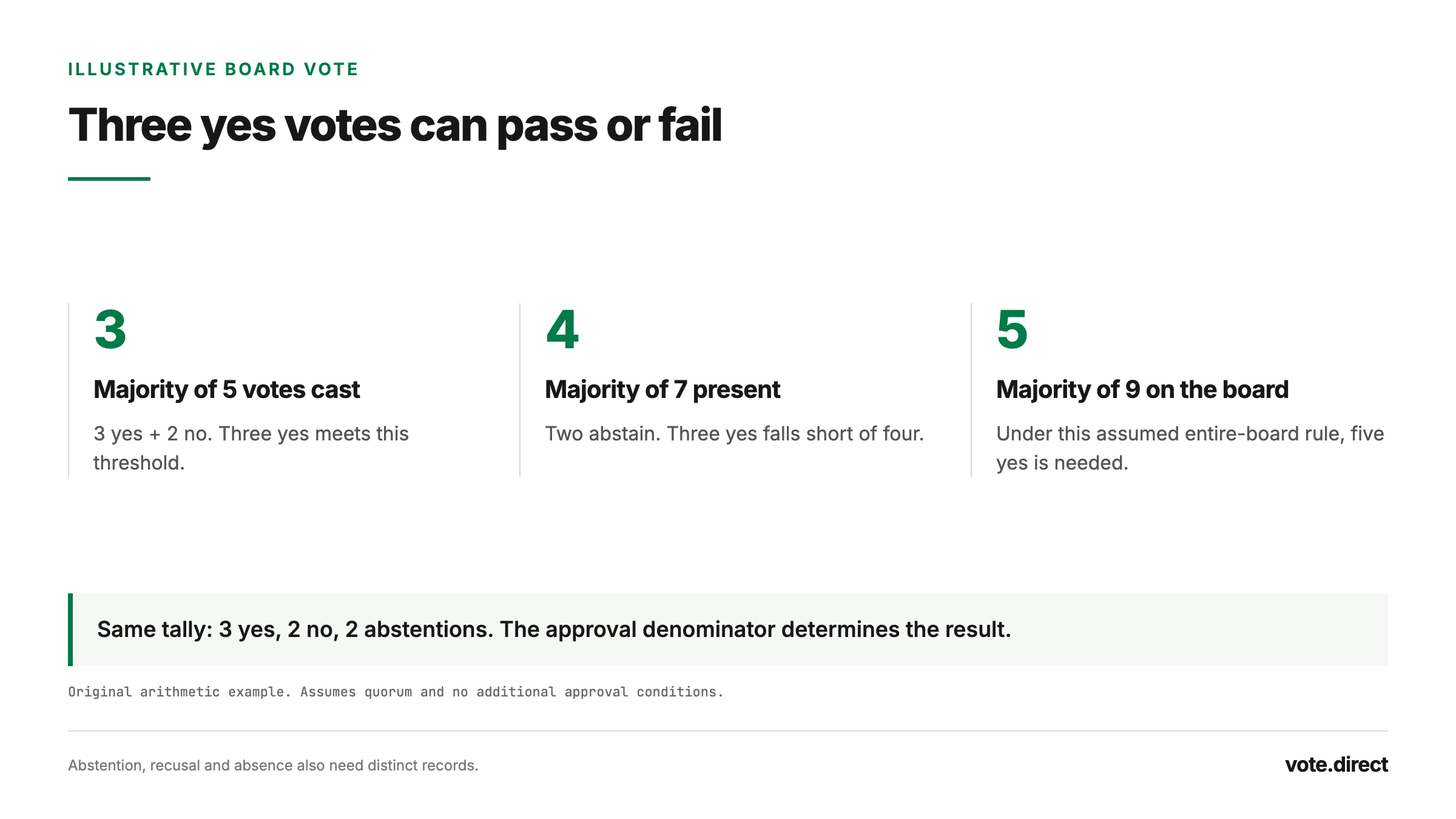
Read that standard carefully, because it changes what an abstention does. The test is not more yes than no. It is yes votes from a majority of the people in the room.
Take a hypothetical five-member board with all five present. A motion gets two votes in favor and one against. The president and one other director abstain. Two is not a majority of five, so the motion fails, even though it won two to one among those who voted.
The authors of Robert's Rules make the same point: where the rules require a majority of the members present, an abstention has the same effect as a no vote (RONR (12th ed.) 44:1, 44:3, 44:9(a)). A president who abstains to stay neutral on a board governed by a statute like these has voted no without meaning to. More on the difference in abstain versus recuse.
What Happens on a Tie
A tie is not a result that needs a tiebreaker. It is a failed motion. A proposal needs a majority, half is not a majority, and so the motion is lost and things stay as they were.
After a tie the board has ordinary options:
- Leave it. The motion failed. That is a decision.
- Bring it back. A defeated motion can be made again at a later meeting, when an absent director is present or the proposal has been changed.
- Change the proposal. Ties usually mean the motion needs amending.
- Fill the empty seat. Boards that tie repeatedly are often one member short. See how to fill a board vacancy.
An election is different. A tie between candidates for a seat elects nobody, and the usual answer under Robert's Rules is to vote again. Do not flip a coin or draw lots unless your bylaws provide for it. The mechanics are in how to count votes.
Honest question
Would you trust an online vote to decide your community's annual budget?
Casting Votes and Bylaws That Say Otherwise
Some organizations give the chair a casting vote, meaning a second vote used only to break a tie. Robert's Rules has no such thing. A presiding officer who is a member has one vote, and "breaking a tie" is only that one vote being cast at the moment it decides the question.
Your bylaws can change either rule, and they control over Robert's Rules:
- If the bylaws say the president "shall vote only in the case of a tie," that is your rule, and the president votes only then.
- If the bylaws give the chair a casting vote, the chair has it.
- If the bylaws say nothing, the president has one vote like every other director.
Check the bylaws before the meeting where it will matter. A dispute over whether the president could vote is hard to settle in the middle of a close vote.
Ex Officio Presidents and Chairs Who Are Not Members
Ex officio members. A person who sits on a board by virtue of an office has exactly the same rights as every other member, including the right to vote (RONR (12th ed.) 49:8-9, 50:16). "Ex officio" does not mean non-voting. If your bylaws intend a non-voting seat, they have to say non-voting.
A presiding officer who is not a member. Some organizations have a paid executive who carries the title of president, or invite an outside moderator to chair the annual meeting. Someone who is not a member of the body has no vote in it, whatever their title, unless the bylaws give one.
The president at a membership meeting. At an HOA annual meeting the president usually chairs and is also an owner. On a ballot vote, such as a board election, the president votes that ballot like any other owner. On a voice vote the large-assembly custom applies.
Putting It on the Record
Close votes are the ones that get challenged, and a result is easier to defend when the minutes show the count.
- Record the number voting for, against and abstaining on any divided vote.
- Record that the president voted. It removes the argument later.
- For anything likely to be contested, take the vote by roll call or in writing, not by voice.
Some states require it. In Connecticut the minutes of an executive board meeting must record how each board member voted on any final action, unless it passed by unanimous consent or without objection (C.G.S. §47-250(b)(8)).
For a decision that cannot wait for the next meeting, a recorded vote taken online gives every director a timestamped ballot and gives the board one tally to attach to the minutes. Whether your board may decide that way is in can a board vote by email. On vote.direct a vote of up to 25 voters is free, which covers any board.
FAQ
Q: Can the president of a nonprofit board vote?
Yes. A president who is a director has one vote like every other director. State nonprofit laws define a board action by the votes of the directors present and make no exception for officers, and Robert's Rules gives a presiding officer who is a member the same voting right as any other member (RONR (12th ed.) 44:12-13).
Q: Does the HOA president vote, or only break ties?
At a board meeting the president votes on everything, because an HOA board is a small board. The custom of holding back applies to a large membership meeting, and even there the president votes on any ballot and whenever the vote would change the result.
Q: Can the chair vote to create a tie?
Yes. If a motion is ahead by one, the chair may vote no. The tie defeats the motion. The chair's vote may be used whenever it will affect the result, in either direction.
Q: What happens when a board vote is tied?
The motion fails. A majority is more than half, and a tie is exactly half. The board can take the question up again at a later meeting.
Q: Can the president vote twice to break a tie?
No. Under Robert's Rules the chair has one vote. A second or casting vote exists only if your bylaws grant it.
Q: Does the president count toward quorum?
Yes. A president who is a member of the board is counted like any other director in deciding whether a quorum is present.
Q: Can the president make a motion?
On a small board, yes. Robert's Rules lets the chair of a small board make motions and speak in debate. In a large assembly the chair does not, to preserve impartiality.
Q: Should the president abstain to stay neutral?
Usually not on a board. Where the law or the bylaws require a majority of the directors present, an abstention has the same effect as a no vote. A president who truly has a conflict should recuse, which is a different act from abstaining.
The Bottom Line
The president of a board is a member of it and votes like one. The habit of sitting out every vote and stepping in only on a tie is borrowed from large assemblies, where it protects the chair's impartiality. On a board of five or nine it costs the board a vote, and under the common statutory standard it counts against the motion.
Look at two documents before your next close vote: the bylaw that says how your board acts, and the bylaw, if there is one, that says when the president votes. If neither restricts the president, the president votes.
Sources: Robert's Rules of Order Newly Revised (12th ed.) 44:1, 44:3, 44:9(a), 44:12-13, 49:8-9, 50:16, as cited in the official Frequently Asked Questions at robertsrules.com. California Corporations Code §7211(a)(8). Connecticut General Statutes §47-250(b)(8); §47-251(b). Code of Alabama §10A-3A-8.24(c). Read on October 12, 2026.
This article is general information, not legal advice. We recommend you do your own research and confirm anything you plan to act on. Where this article states law, the section is cited so you can read the primary source yourself rather than take our word for it. That is what the citations are for. Election requirements also turn on your own governing documents, which we have not seen, and statutes are amended. For advice about your community, consult a qualified attorney licensed in your state.
We work hard to verify every citation against the primary source, but laws change and errors happen. If you spot an inaccuracy, email support@vote.direct and we will correct it. See our editorial standards for how these pages are researched and checked.