Quick Answer
Illinois governs association elections with two separate statutes, and the one that applies to you decides whether proxies count. Condominiums run under the Condominium Property Act, 765 ILCS 605. Townhome, single-family and other common interest communities run under the Common Interest Community Association Act, 765 ILCS 160, known as CICAA.
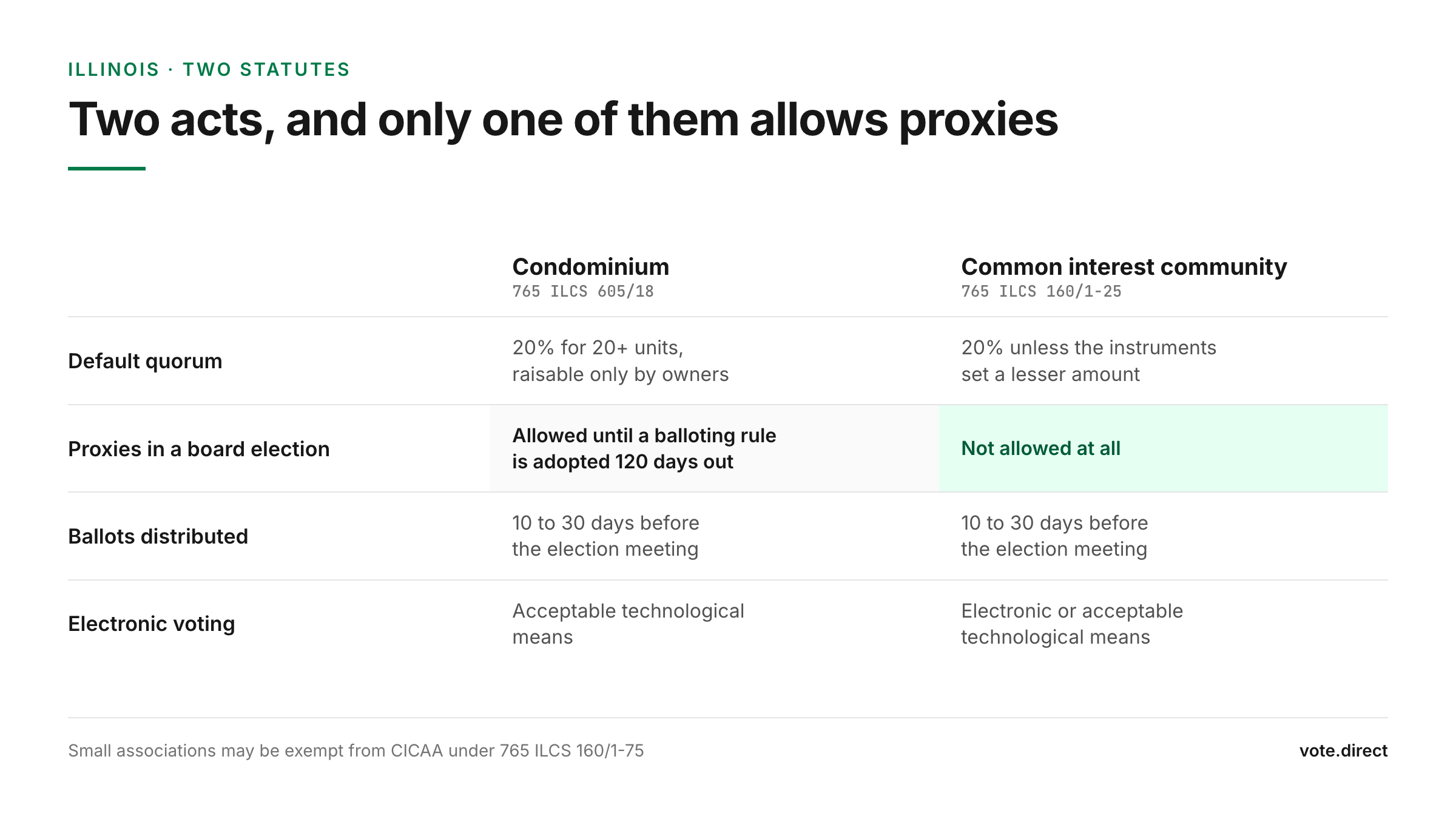
| Question | Condominium (765 ILCS 605) | Common interest community (765 ILCS 160) |
|---|---|---|
| Default quorum | 20 percent for condos of 20 or more units, unless owners holding a majority of the percentage interest set it higher (§18(b)(1)) | 20 percent, unless the community instruments set a lesser amount (§1-40(b)(1)) |
| Proxies in a board election | Allowed until the association adopts a balloting or technology rule at least 120 days out (§18(b)(9)(B), (B-5)) | Not allowed at all (§1-25(i)) |
| Meeting notice | 10 to 30 days (§18(b)(6)) | 10 to 30 days (§1-40) |
| Electronic voting | Yes, by "acceptable technological means" (§18(b)(9)(B-5)) | Yes, by electronic or acceptable technological means (§1-25(i)) |
| Election frequency | At least one-third of board terms expire annually (§18(a)(1)) | At least once every 24 months (§1-25(a)) |
If you are not sure which act you are under, the test is the form of ownership, not the shape of the buildings. A condominium declaration recorded under the Condominium Property Act puts you in 765 ILCS 605 even if every unit is a detached house. Everything else common-interest is CICAA, subject to the small-association exemption below.
This is our reading of Illinois law, offered to support your own review, and it is not legal advice. Your declaration and bylaws sit on top of the statute, Chicago condominiums also answer to the city's condominium ordinance, and software cannot make an election legally binding. Confirm anything you plan to rely on with your association's attorney.
Which Act Governs You
| Your association | Act | Notes |
|---|---|---|
| Condominium, any size | Condominium Property Act, 765 ILCS 605 | Chicago condominiums are also subject to Municipal Code ch. 13-72 |
| Common interest community, more than 10 units and more than $100,000 in annual budgeted assessments | CICAA, 765 ILCS 160 | Full coverage |
| Common interest community, 10 units or fewer, or $100,000 or less in annual budgeted assessments, organized under the General Not For Profit Corporation Act of 1986 | Exempt from CICAA | §1-75(a), unless a majority of directors or members elects coverage |
| Common interest community, 10 units or fewer, or $50,000 or less in annual budgeted assessments | Partly exempt | §1-75(b) exempts it from certain sections but it must still notice meetings so members can participate |
The exemption at 765 ILCS 160/1-75 is the one small boards miss in both directions. Some assume they are exempt when their assessments cleared $100,000 two budgets ago. Others follow rules they were never subject to, which costs nothing legally but wastes a lot of volunteer hours. Check the number in your adopted budget before you decide.
The Condominium Election Calendar
The Condominium Property Act builds the board into the bylaws. Under 765 ILCS 605/18(a)(1) the bylaws must provide for election from among the unit owners of a board of managers, for at least one-third of the board's terms to expire annually, and for all members of the board to be elected at large. Only one owner per unit may serve at a time.
Here is the sequence when the association has adopted a balloting rule.
| Step | Timing | Citation |
|---|---|---|
| Written notice of the deadline for a candidate's name to appear on the ballot | At least 21 days before that deadline | §18(b)(9)(B) |
| Nomination deadline itself | No more than 7 days before the ballots are mailed | §18(b)(9)(B) |
| Meeting notice to every unit owner | 10 to 30 days before the meeting | §18(b)(6) |
| Ballots mailed or otherwise distributed | Not less than 10 and not more than 30 days before the election meeting | §18(b)(9)(B) |
| Voting instructions, if voting by acceptable technological means | Not less than 10 and not more than 30 days before the election meeting | §18(b)(9)(B-5) |
| Election meeting and count | Candidates may attend the count | §18(a)(17) |
The 21-day notice is the step boards skip. It is not notice of the election, it is notice of the deadline to get on the ballot, and it has to precede that deadline by three weeks. Miss it and a candidate who was excluded has a straightforward complaint. The generic version of this sequence is in the HOA election timeline checklist.
The Proxy Switch, and Why It Matters
This is the most consequential decision an Illinois condominium board makes about its election, and many boards make it by accident.
Under 765 ILCS 605/18(b)(9)(B), if a rule is adopted at least 120 days before an election, or the declaration or bylaws already provide for it, unit owners may vote only by submitting an association-issued ballot, either in person at the election meeting or by mail or other delivery. Subparagraph (B-5) offers the same trade with technology: the association may instead permit voting by any acceptable technological means as defined in Section 2 of the Act.
Adopt either rule and proxies disappear from board elections. Do not adopt one, and the proxy stays, along with the proxy form requirements at 765 ILCS 605/18(a)(18): the form must let the owner designate any person as the proxy holder and give the owner the chance to express a preference among the known candidates or to write in a name.
The 120-day lead time is the trap. A board that decides in October to run a January election by ballot is too late for that election. Decide a full cycle ahead.
CICAA does not offer the choice. Under 765 ILCS 160/1-25(i), members may not vote by proxy in board elections, full stop, even though §1-25(h-5) permits proxies for other member votes and caps them at 11 months from execution unless the community instruments or the proxy itself say otherwise. If your community is CICAA and someone hands the secretary a stack of proxies for the board vote, they do not count. Where proxies do and do not count elsewhere is in HOA proxy voting rules by state.
Quorum, and the 60-Day Arrears Rule
For condominiums of 20 or more units, 765 ILCS 605/18(b)(1) sets the quorum at 20 percent, and unusually it can only move upward: unit owners holding a majority of the percentage interest may provide for a higher percentage. CICAA runs the opposite way. Under 765 ILCS 160/1-40(b)(1), 20 percent of the membership is a quorum unless the community instruments indicate a lesser amount, so the instruments can lower it but not raise it.
Illinois then does something almost no other state does, and it is worth understanding precisely. A unit owner who is in arrears on regular or separate assessments for 60 days or more is not counted for purposes of determining whether a quorum is present, but that owner retains the right to vote on amendments to the bylaws.
Read that twice, because it is the reverse of the Florida approach. Florida subtracts suspended voting interests from the denominator and takes the vote away. Illinois keeps the vote and removes the owner from the quorum count, which lowers the number of participants you need to open the meeting without silencing anyone. What every other state does with delinquency is in can an HOA take away your vote for unpaid dues.
Both mailed ballots and votes cast by acceptable technological means count toward quorum: 765 ILCS 605/18(b)(9)(D) makes votes cast under subparagraph (B) or (B-5) valid for establishing a quorum. That single sentence is what turns remote balloting from a convenience into a quorum tool, and it is the reason a condominium that struggles to fill a room can still hold a valid election. More tactics are in how to reach quorum, and the calculator is at quorum calculator.
Secret Ballots in Illinois
765 ILCS 605/18(b)(10) lets an association conduct its election by secret ballot, where the ballot is marked only with the percentage interest for the unit and the vote itself. The association has to adopt rules that verify the voter is a unit owner, because the ballot no longer carries a name.
That is the entire mechanism, and it explains a problem Illinois boards run into. If the ballot carries only a percentage interest, and two units happen to hold the same percentage interest, the verification has to happen at the envelope, not on the ballot. The double envelope approach, where identity is checked on the outer envelope and the inner envelope is separated before opening, is what makes the statute workable on paper. Digitally the equivalent is a system that records that a unit voted without storing how. Requirements in other states are in HOA secret ballot rules by state.
Counting is open to the people with the most at stake: under 765 ILCS 605/18(a)(17) a candidate or the candidate's representative has the right to be present at the counting of the ballots.
This one gets heated
Should community boards be required to use independent election administrators?
Electronic Voting and "Acceptable Technological Means"
Illinois wrote a definition rather than a permission. "Acceptable technological means" is defined at 765 ILCS 605/2 for condominiums and at 765 ILCS 160/1-5 for common interest communities, and once your rules point at that definition, electronic delivery and electronic voting both become available.
The practical requirements are modest and specific.
- The board adopts rules. For condominiums the rule needs to be in place at least 120 days before the election if it is displacing proxies (§18(b)(9)(B-5)).
- Voting instructions go to every unit owner not less than 10 and not more than 30 days before the election meeting (§18(b)(9)(B-5); §1-25(i)).
- The instructions have to name every candidate who gave timely written notice of candidacy.
- Votes cast that way count toward quorum (§18(b)(9)(D)).
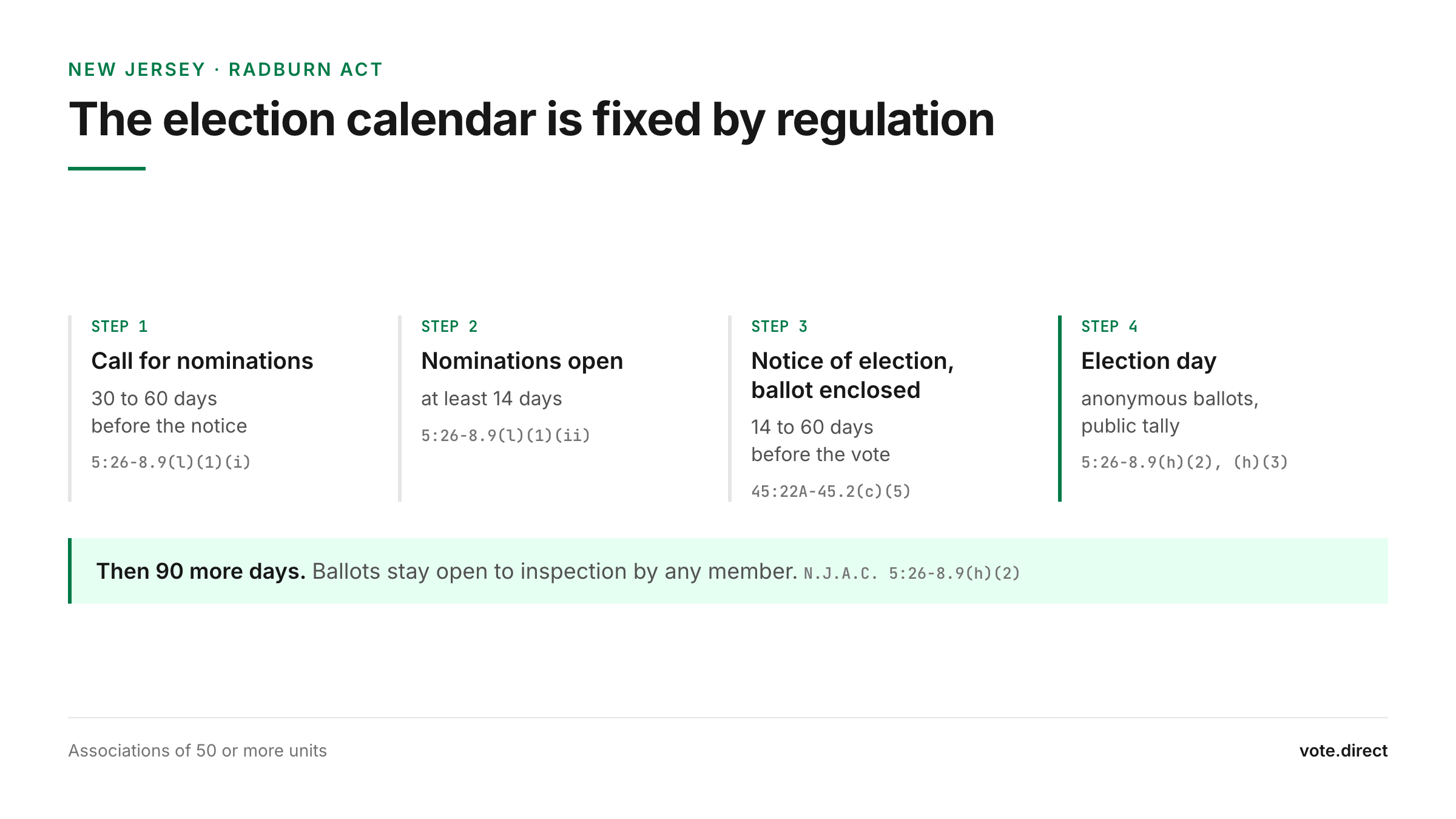
Illinois does not require individual member consent the way New Jersey and Florida do, which makes it one of the easier states to move online. The comparison across states is in electronic voting for HOAs by state, and the New Jersey consent gate is in the Radburn rules.
After the Vote: Ballots Are Records
Illinois gives unit owners an unusually clean right to look at what was counted. Under 765 ILCS 605/19(b), a unit owner may inspect, examine and copy the ballots and the proxies relating to ballots for all matters voted on by the members during the immediately preceding 12 months, including the election of board members. A written request is required, and is worth making in writing even where it is not.
Twelve months is the practical retention floor, so an association that shreds ballots the week after the meeting has destroyed records an owner is entitled to see. What that right looks like in other states, and how it coexists with a secret ballot, is in who can see the ballots after an election.
What an Illinois Election Costs
The cost driver in Illinois is the double mailing. A condominium running a ballot election sends a notice of the candidacy deadline, then a meeting notice, then ballots, each to every unit.
| Line item | Paper | Online |
|---|---|---|
| Notice of candidacy deadline | Print and postage to every unit | Included |
| Meeting notice, 10 to 30 days out | Print and postage to every unit | Included |
| Ballots, 10 to 30 days out | Print and postage to every unit | Included |
| Counting with candidates present | A volunteer evening | Live count, observable |
| 12 months of ballot retention | Storage, and someone to produce it | Exportable record |
| Platform, 100-unit building | Not applicable | $9.99 |
| Platform, 300-unit building | Not applicable | $24.99 |
Elections up to 25 voters are free. Above that the flat rate starts at $4.99 per election and the whole ladder is published at pricing. Owners who want paper can be mailed a ballot from the same roster at $3.00 each, which keeps one roster and one count across both channels. The paper baseline is in paper versus digital election cost.
FAQ
Q: Is my association a condominium or a common interest community under Illinois law?
It depends on how the property was declared, not on what the homes look like. If a condominium declaration was recorded under the Condominium Property Act, you are under 765 ILCS 605. Most other Illinois common interest communities fall under CICAA, 765 ILCS 160, unless they qualify for the small-association exemption at §1-75.
Q: Can Illinois condo owners vote by proxy in a board election?
Yes, unless the association has adopted a rule at least 120 days before the election requiring association-issued ballots (§18(b)(9)(B)) or permitting acceptable technological means (§18(b)(9)(B-5)), or the declaration or bylaws already provide for balloting. Once such a rule is in place, proxies no longer apply to board elections.
Q: Can CICAA association members vote by proxy in a board election?
No. 765 ILCS 160/1-25(i) says members may not vote by proxy in board elections. Proxies remain available for other member votes under §1-25(h-5), where they are valid for no more than 11 months from execution unless the community instruments or the proxy itself provide otherwise.
Q: Do electronic votes count toward quorum in Illinois?
Yes for condominiums. 765 ILCS 605/18(b)(9)(D) provides that votes cast by ballot under subparagraph (B) or by electronic or acceptable technological means under subparagraph (B-5) are valid for the purpose of establishing a quorum.
Q: Can an Illinois association stop a delinquent owner from voting?
The Condominium Property Act does not take the vote away for arrears. Under §18(b)(1) a unit owner 60 days or more in arrears on regular or separate assessments is not counted for quorum purposes, but retains the right to vote on amendments to the bylaws. Any broader suspension would have to come from your declaration or bylaws, and that is a question for your attorney.
Q: How long do we have to keep the ballots?
Long enough to satisfy 765 ILCS 605/19(b), which gives unit owners the right to inspect ballots and related proxies for all matters voted on during the immediately preceding 12 months. Treat one year as the floor and keep them longer if a challenge is live.
The Bottom Line
Illinois is not a hard state to run an election in. It is a state where the answer changes depending on which of two acts you are under, and where one board decision, the balloting rule, quietly removes proxies from the process 120 days later.
Settle three things before your next cycle. Which act governs you. Whether you want proxies in board elections or association-issued ballots and electronic voting instead. And whether your quorum math is counting owners who are 60 days in arrears, because under §18(b)(1) it should not be.
Then work backwards from the meeting: 21 days of notice before the candidacy deadline, no more than 7 days from that deadline to the mailing, and 10 to 30 days from the mailing to the vote. The state summary is at Illinois HOA voting rules.
Sources: Illinois Condominium Property Act, 765 ILCS 605/2 (acceptable technological means), 605/18(a)(1), (a)(17), (a)(18), 605/18(b)(1), (b)(6), (b)(9)(B), (b)(9)(B-5), (b)(9)(D), (b)(10), and 605/19(b). Illinois Common Interest Community Association Act, 765 ILCS 160/1-5, 160/1-25(a), (d), (h-5), (i), 160/1-40(b)(1), and 160/1-75(a)-(b). Municipal Code of Chicago ch. 13-72 (condominium ordinance).
Every rule on one page: Illinois HOA voting rules, with quorum, notice, proxy and electronic voting at a glance.
This article is general information, not legal advice. We recommend you do your own research and confirm anything you plan to act on. Where this article states law, the section is cited so you can read the primary source yourself rather than take our word for it. That is what the citations are for. Election requirements also turn on your own governing documents, which we have not seen, and statutes are amended. For advice about your community, consult a qualified attorney licensed in your state.
We work hard to verify every citation against the primary source, but laws change and errors happen. If you spot an inaccuracy, email support@vote.direct and we will correct it. See our editorial standards for how these pages are researched and checked.