Quick Answer
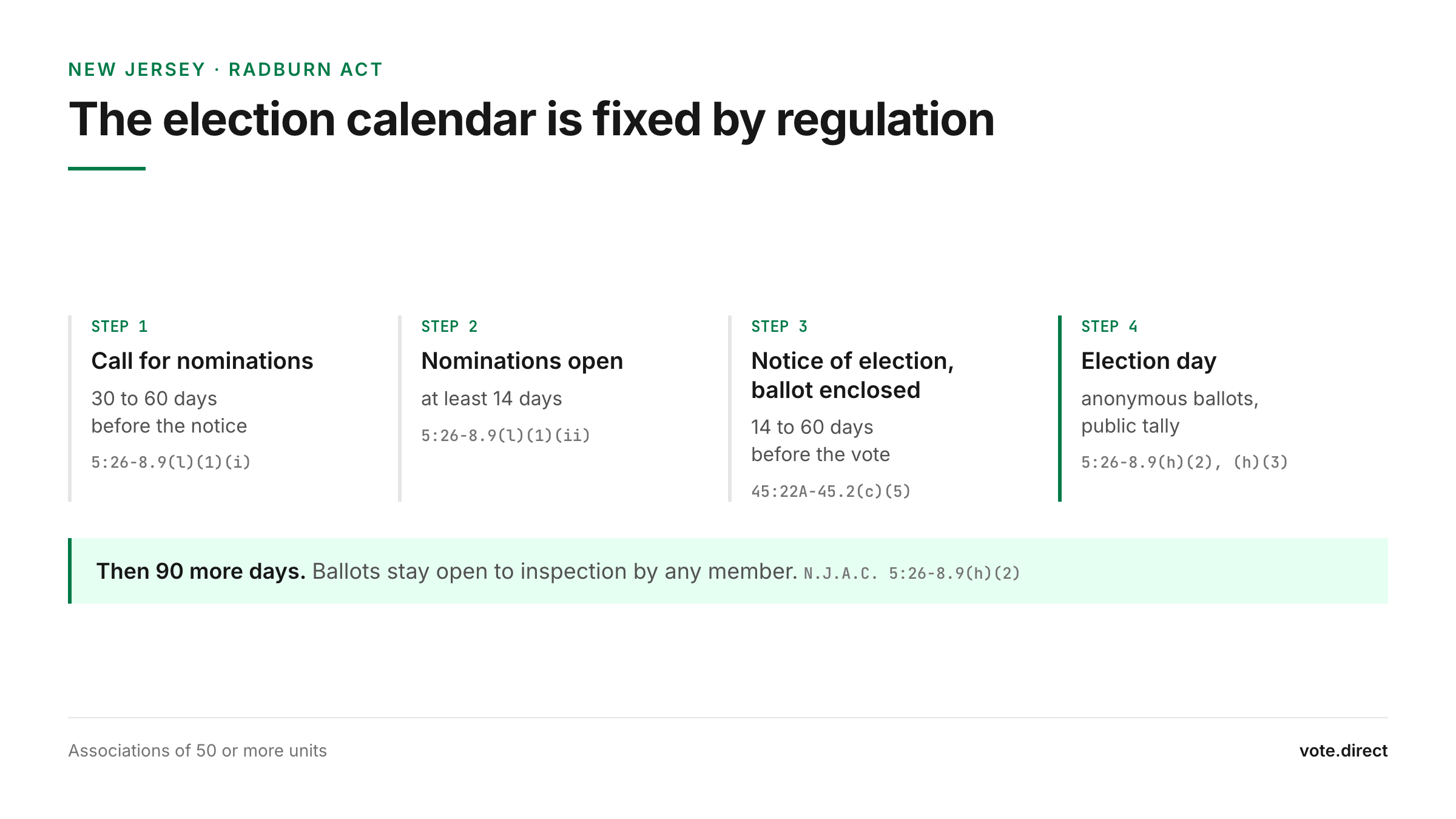
New Jersey is the only state that regulates association elections by administrative rule as well as by statute. The Radburn Act (P.L. 2017, c. 106) rewrote the election provisions of the Planned Real Estate Development Full Disclosure Act, and the Department of Community Affairs then wrote the calendar into N.J.A.C. 5:26-8. In a community of 50 or more units the sequence is fixed and it is long.
| Step | Window | Where it comes from |
|---|---|---|
| Written call for nominations | 30 to 60 days before the election notice goes out | N.J.A.C. 5:26-8.9(l)(1)(i) |
| Members may nominate | At least 14 days | N.J.A.C. 5:26-8.9(l)(1)(ii) |
| Notice of election, with the ballot | 14 to 60 days before the election | N.J.S.A. 45:22A-45.2(c)(5); N.J.A.C. 5:26-8.9(l)(1)(iii) |
| Ballots cast | Anonymously | N.J.A.C. 5:26-8.9(h)(3) |
| Tally | In public | N.J.A.C. 5:26-8.9(h)(2) |
| Any member may inspect the ballots | 90 days after the election | N.J.A.C. 5:26-8.9(h)(2) |
Work backwards from the meeting date and the first mailing lands roughly two and a half months earlier. Boards that discover Radburn six weeks out have already missed the nomination call, and there is no way to compress it. The election timeline checklist has the generic version; this article is the New Jersey one.
This is our reading of New Jersey law, offered to support your own review, and it is not legal advice. The Radburn regulations have already been partly reversed in court, your governing documents sit on top of the statute, and software cannot make an election legally binding. Have your association's attorney confirm the current text of any provision before the board acts on it.
What the Radburn Act Actually Changed
Before 2017, a New Jersey association could run its board election more or less however its bylaws allowed, and the practical result in a lot of communities was a nominating committee appointed by the board that produced exactly as many candidates as there were seats. The Radburn Act, signed July 13, 2017, amended PREDFDA (N.J.S.A. 45:22A-21 et seq.) and did three things that still drive every compliance question boards ask.
It took the nomination process away from the board. Under N.J.S.A. 45:22A-45.2(c)(4), any member in good standing may nominate themselves or another member, and the nomination period must run for at least 14 days before ballots are mailed. A board cannot screen candidates for anything except good standing.
It defined good standing, narrowly, and for three purposes only. The definition at N.J.S.A. 45:22A-43 applies "solely with respect to eligibility to" vote in executive board elections, vote to amend the bylaws, and nominate or run for the board. A member in good standing is one current on common expenses, late fees, interest on unpaid assessments, legal fees, and other charges lawfully assessed, and who has not failed to satisfy a judgment for those amounts. That phrase, "solely with respect to," is doing real work: good standing is not a general-purpose lever an association can pull for other things.
It moved the detail into regulation. The DCA adopted N.J.A.C. 5:26-8 to implement the statute, which is why a New Jersey election has calendar rules that no other state's HOA has, down to the font on the ballot.
The Radburn Calendar for 50 or More Units
Most of the prescriptive rules apply to communities of 50 or more units. Here is the full sequence with the citation for each step.
| # | What happens | Timing | Citation |
|---|---|---|---|
| 1 | Association sends written notice calling for nominations | Not fewer than 30 and not more than 60 calendar days before the election meeting notice is mailed | N.J.A.C. 5:26-8.9(l)(1)(i) |
| 2 | Members submit nominations | At least 14 days from the mailing of the request | N.J.A.C. 5:26-8.9(l)(1)(ii) |
| 3 | Association notifies any member not in good standing, with the reason | At least 30 days before the election | N.J.A.C. 5:26-8.9(l)(1)(v) |
| 4 | That member may cure and regain standing | Up to five business days before the election | N.J.A.C. 5:26-8.9(l)(1)(v) |
| 5 | Notice of election goes out, with the ballot enclosed | Not fewer than 14 and not more than 60 days before the election | N.J.S.A. 45:22A-45.2(c)(5) |
| 6 | Members vote | Anonymously | N.J.A.C. 5:26-8.9(h)(3) |
| 7 | Ballots are tallied in public | Election day | N.J.A.C. 5:26-8.9(h)(2) |
| 8 | Ballots stay open to member inspection | 90 days | N.J.A.C. 5:26-8.9(h)(2) |
Two structural rules sit outside the calendar. Elections must be held at least every two years unless the bylaws set a different interval, which may not exceed four years (N.J.A.C. 5:26-8.9(b)(1)), and no board member may be elected to a term longer than four years (N.J.S.A. 45:22A-45.2(c)(1)). Separately, if an association has not held an election in compliance with its governing documents for two or more years, 25 percent of the members in good standing may petition, and the association then has 90 days to hold one (N.J.S.A. 45:22A-45.2(a)).
Under 50 Units, the List Is Shorter
Smaller communities are not exempt, they are held to principles rather than a calendar. N.J.S.A. 45:22A-45.2(b) requires an election system that provides notice, gives every member in good standing access to nomination, reviews candidate qualifications, tells members how to vote, and counts ballots in a verified way and without fraud. Those associations still have to comply with paragraphs (9) and (10) of subsection (c), which cover vote allocation and the rule that election procedures may never be built to keep residents of low- or moderate-income units from participating.
In practice, a small New Jersey association that runs the 50-plus calendar anyway has an easier time defending its election than one that improvises, and the calendar costs nothing extra to follow.
The Ballot Itself Has Rules
This is where New Jersey is unusually specific, and where a homemade ballot fails.
- Every nominated candidate must appear, listed in alphabetical order by last name (N.J.A.C. 5:26-8.9(l)(1)(iv)(2)).
- Every name must be printed in the same font, in the same size, and in the same font color (N.J.A.C. 5:26-8.9(l)(1)(iv)(4)). No bolding the incumbents.
- There must be space for write-in candidates for as many seats as are up for election (N.J.A.C. 5:26-8.9(l)(1)(iv)(6)).
The font rule reads like fussiness until you have seen a ballot where the two board-endorsed candidates were set in bold and the challenger was not. That is the behaviour the regulation exists to stop, and it is the kind of detail an election challenge is built on.
Anonymous Ballots and a Public Count, at the Same Time
New Jersey asks for two things that sound contradictory. All ballots must be cast in an anonymous manner (N.J.A.C. 5:26-8.9(h)(3)), and all tallying must occur publicly with the ballots open to inspection by any member for 90 days after the election (N.J.A.C. 5:26-8.9(h)(2)). When the Appellate Division reviewed those provisions in 2024 it saw no conflict, noting that privacy could be addressed with a double envelope system.
That is the mechanism: the voter seals the ballot in an unmarked inner envelope, signs the outer envelope, and the two are separated before the inner envelope is opened. Identity is verified on the outside, the vote is anonymous on the inside, and what a member later inspects is a stack of unattributable ballots. A physical ballot depository has to be secured (N.J.A.C. 5:26-8.9(h)) for the same reason.
Digitally the equivalent is a system that records that a person voted without storing which way, which is what a secret ballot requirement means once the paper is gone. What a member can inspect afterwards, in New Jersey and elsewhere, is covered in who can see the ballots after an election.
Electronic Voting in New Jersey
New Jersey permits it, and it names a condition no other state uses.
The statute is N.J.S.A. 45:22A-45.2(c)(8): an association shall not prevent voting for an executive board member by electronic means where the executive board determines to employ electronic voting and the member consents to it. Two gates, both required. The board adopts it, and the individual member opts in.
The regulation adds the operational condition. Under N.J.A.C. 5:26-8.9(h)(4), a ballot may be cast electronically if it is administered by a neutral third party and anonymity is maintained. "Neutral third party" is the phrase to read twice. It is not satisfied by the management company that works for the board, and it is not satisfied by a board member with a spreadsheet. It points at a vendor with no stake in the outcome, which is the same logic that puts an inspector of elections in front of a California ballot box.
Consent also has to be real and recorded. If your association is moving online this cycle, collect the opt-ins during the nomination window, not the week of the election, and keep the record. Our note on electronic voting by state covers the equivalent gates elsewhere.
This one gets heated
Should community boards be required to use independent election administrators?
Proxies and Absentee Ballots Travel Together
N.J.S.A. 45:22A-45.2(a) sets a rule that catches boards out. If an association offers proxy voting, it must tell members that using a proxy is voluntary and that a proxy is revocable, and it must also make absentee ballots available. You cannot run a proxy-only election.
The Radburn notice provision reinforces it: the election notice "shall include a proxy ballot and an absentee ballot" listing every nominated candidate in alphabetical order (N.J.S.A. 45:22A-45.2(c)(5)). Where proxies count and where they do not in other states is in HOA proxy voting rules by state.
What a Court Threw Out in 2024
Do not read N.J.A.C. 5:26-8 as published without checking this. On February 23, 2024, the Appellate Division decided a challenge brought by the New Jersey chapter of the Community Associations Institute and reversed several of the Radburn regulations as exceeding the authority PREDFDA gave the DCA. The opinion is unpublished, which limits its precedential weight, but it is the current state of play.
| Regulation | Subject | Outcome |
|---|---|---|
| N.J.A.C. 5:26-8.9(h) | Public tallying and ballot anonymity | Upheld |
| N.J.A.C. 5:26-8.9(l)(1)(v) | 30-day notice to members not in good standing | Upheld |
| N.J.A.C. 5:26-8.12(f)(6) | 30-day retention of electronic meeting recordings | Upheld |
| N.J.A.C. 5:26-8.10(a)(2) | Reserved board seat for affordable-housing units | Reversed |
| N.J.A.C. 5:26-8.12(e)(1)-(2) | Voting in closed session | Reversed |
| N.J.A.C. 5:26-8.13(f)(4) | Requiring both proxy and absentee ballots for bylaw amendments | Reversed |
The election machinery this article describes, the nomination window, the notice window, the ballot rules, the anonymity and inspection rules, and the electronic voting provision, survived. The reversals cluster around board composition, closed-session voting, and bylaw amendment mechanics. Confirm the live text of anything you plan to rely on, because a regulation that has been reversed still appears in the published code.
What a Compliant New Jersey Election Costs
The expensive part of Radburn is the mailing count. A 50-plus community sends a nomination call, then a good-standing notice to some members, then an election notice with a ballot, a proxy ballot, and an absentee ballot enclosed. That is two full mailings to every unit before anyone votes.
| Line item | Paper | Online |
|---|---|---|
| Call for nominations to every unit | Print, stuff, postage | Email or text, included |
| Election notice with ballot, proxy ballot, absentee ballot | Print, stuff, postage | Included |
| Anonymous ballot handling | Double envelopes, a secured depository | Built in |
| Public tally | A volunteer evening | Live count, published |
| 90-day inspection | A box someone has to store and produce | Exportable record |
| Platform, 200-unit association | Not applicable | $19.99 |
| Platform, 400-unit association | Not applicable | $24.99 |
Elections up to 25 voters are free. Above that the flat rate starts at $4.99 per election and the whole ladder is published at pricing. Owners who need paper can be mailed a ballot from the same roster at $3.00 each, which is how a Radburn-compliant absentee route coexists with an electronic one. Compare against the paper cost baseline before assuming online is the expensive option.
If nobody on your board wants to own the calendar, vote.direct can run it for you from $199 for a digital election of up to 100 voters, on about 10 days of lead time. What no vendor supplies is compliance itself. The notice periods, the good-standing determinations, and the reading of your own bylaws stay with you and your attorney.
FAQ
Q: Does the Radburn Act apply to condominiums as well as HOAs?
It applies to associations governed by PREDFDA, which covers planned real estate developments including condominiums, cooperatives, and homeowners associations. New Jersey also has a separate Condominium Act (N.J.S.A. 46:8B-1 et seq.), and initial condominium elections follow the notice timeline in that Act rather than N.J.S.A. 45:22A-45.2 (see subsection (d)). Ask your attorney which statute your community was formed under before you build the calendar.
Q: How far in advance do we have to start a New Jersey board election?
Roughly two and a half months for a community of 50 or more units. The call for nominations goes out 30 to 60 days before the election notice, members get at least 14 days to nominate, and the election notice itself must be sent 14 to 60 days before the election. Add the 30-day good-standing notice, which runs in parallel, and there is no compliant way to do this in a month.
Q: Can our board reject a candidate it does not like?
No. Good standing is the sole criterion for eligibility of a nominee. Any member in good standing may nominate themselves or another member under N.J.S.A. 45:22A-45.2(c)(4), and there is no discretionary screen on top of it.
Q: Can a New Jersey association take away a member's vote for unpaid dues?
Effectively yes, because good standing is defined at N.J.S.A. 45:22A-43 by reference to being current on common expenses and lawfully assessed charges, and it gates voting in board elections and bylaw amendments. But the association must notify the member at least 30 days before the election, state the reason, and let them cure up to five business days before election day (N.J.A.C. 5:26-8.9(l)(1)(v)). How other states handle this is in can an HOA take away your vote for unpaid dues.
Q: Can we run the whole election online?
You can run the voting online where the board has determined to employ electronic voting and the member consents (N.J.S.A. 45:22A-45.2(c)(8)), and where it is administered by a neutral third party with anonymity maintained (N.J.A.C. 5:26-8.9(h)(4)). Keep an absentee route open for members who do not consent, because the statute conditions electronic voting on individual consent rather than a board vote alone.
Q: Are the ballots really open to anyone for 90 days?
To any member of the association, yes, under N.J.A.C. 5:26-8.9(h)(2), and that provision was upheld in the 2024 Appellate Division decision. Because the ballots are also required to be anonymous, what a member inspects is a set of votes that cannot be traced back to individual owners.
The Bottom Line
New Jersey did something no other state did. It wrote the election calendar down, put it in the administrative code, and made the nomination process something a board administers rather than controls.
The cost of that is a long runway. The benefit is that a New Jersey board that follows the sequence has very little left to argue about, because almost every decision that used to be discretionary is now a date with a citation next to it.
Start with the election date, count backwards, and put the call for nominations in the calendar first. Then decide whether you are printing three enclosures per unit or sending them. The state rules summary for your community is at New Jersey HOA voting rules, and the sequence for a community that has never run one online is in how to switch an HOA to online voting.
Sources: New Jersey P.L. 2017, c. 106 (the Radburn Act). N.J.S.A. 45:22A-21 et seq. (Planned Real Estate Development Full Disclosure Act); N.J.S.A. 45:22A-43 (definition of good standing); N.J.S.A. 45:22A-45.2(a), (b), (c)(1), (c)(4), (c)(5), (c)(8), (c)(9), (c)(10), (d), (f). N.J.A.C. 5:26-8.9(b)(1), (h), (h)(2), (h)(3), (h)(4), (l)(1)(i)-(v). N.J.S.A. 46:8B-1 et seq. (New Jersey Condominium Act). In the Matter of the Challenge of the Community Associations Institute New Jersey Chapter, Inc., N.J. Super. Ct. App. Div., decided February 23, 2024 (unpublished).
Every rule on one page: New Jersey HOA voting rules, with quorum, notice, proxy and electronic voting at a glance.
This article is general information, not legal advice. We recommend you do your own research and confirm anything you plan to act on. Where this article states law, the section is cited so you can read the primary source yourself rather than take our word for it. That is what the citations are for. Election requirements also turn on your own governing documents, which we have not seen, and statutes are amended. For advice about your community, consult a qualified attorney licensed in your state.
We work hard to verify every citation against the primary source, but laws change and errors happen. If you spot an inaccuracy, email support@vote.direct and we will correct it. See our editorial standards for how these pages are researched and checked.