Quick Answer
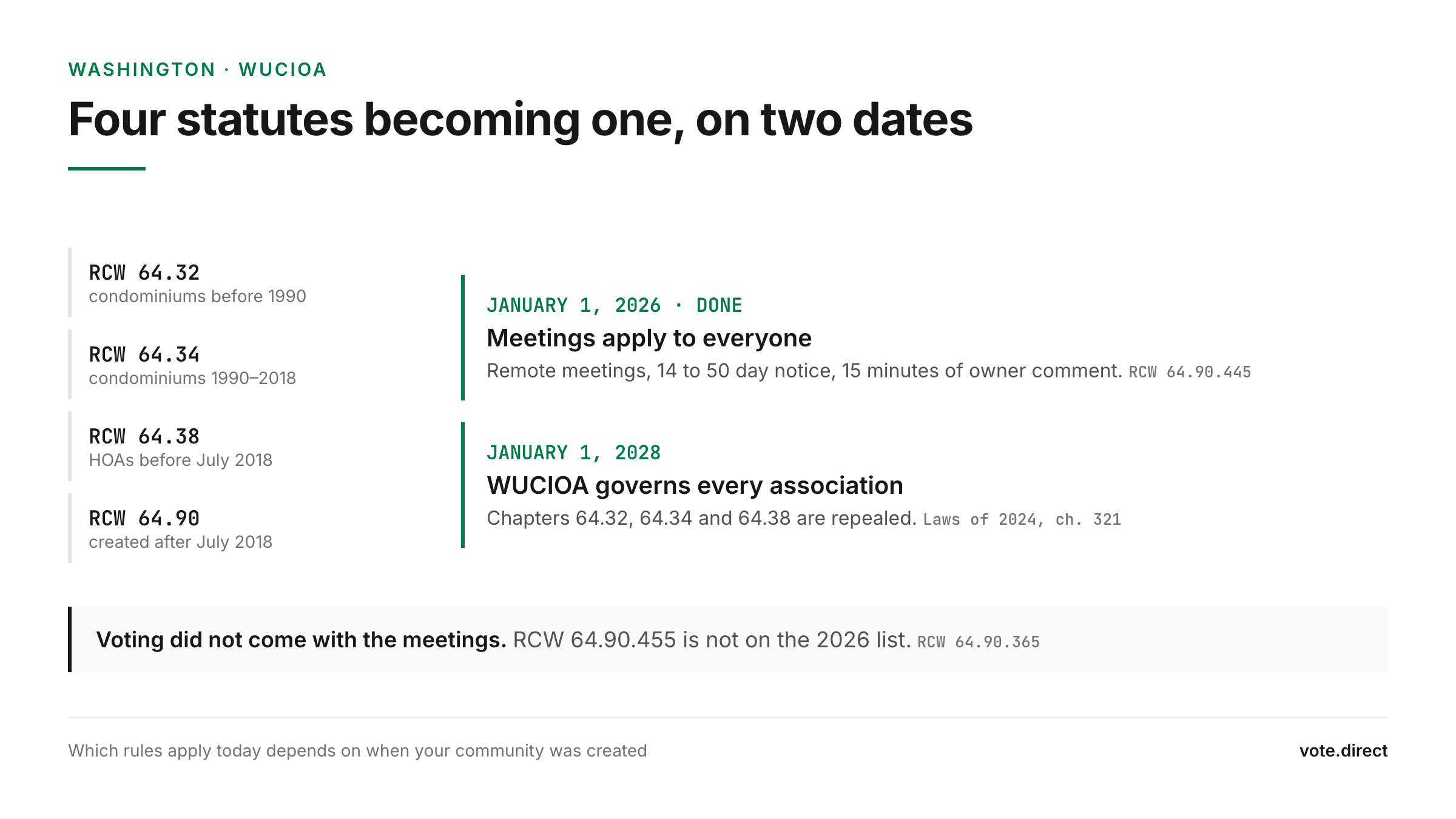
Washington is halfway through consolidating four community association statutes into one, and which election rules apply to you today depends on when your community was created. On January 1, 2028 that stops mattering. Until then it matters a great deal.
| Your community was created | Governing act today | Voting rules today |
|---|---|---|
| Condominium before July 1, 1990 | RCW 64.32, Horizontal Property Regimes Act | Chapter 64.32 and your declaration |
| Condominium between July 1, 1990 and July 1, 2018 | RCW 64.34, Washington Condominium Act | RCW 64.34.340 |
| Homeowners association before July 1, 2018 | RCW 64.38, Homeowners' Associations Act | RCW 64.38.120, quorum 34 percent under RCW 64.38.040 |
| On or after July 1, 2018, or opted in | RCW 64.90, WUCIOA | RCW 64.90.455, quorum 20 percent under RCW 64.90.450(1) |
One thing already changed for everyone. Since January 1, 2026, the WUCIOA meetings section, RCW 64.90.445, applies to preexisting communities too. The WUCIOA voting section, RCW 64.90.455, does not. It is not on the list at RCW 64.90.365.
That gap is the most misread fact about a Washington election this year, and it is the difference between "we have to run a secret ballot" and "we do not, yet."
This is our reading of Washington law, offered to support your own review, and it is not legal advice. Washington is mid-transition, sections have been recodified, and your governing documents sit on top of the statute. Confirm the current text and the applicability of anything you plan to rely on with your association's attorney before the board acts.
The Four Acts and the Two Dates
Washington ran multiple community association statutes side by side for decades. The oldest condominiums answer to RCW 64.32. Condominiums created between 1990 and mid-2018 answer to RCW 64.34. Homeowners associations formed before July 1, 2018 answer to RCW 64.38. WUCIOA, RCW 64.90, arrived in 2018 for everything created after that.
Two bills are collapsing that into one.
ESSB 5796, Laws of 2024, ch. 321. The "WUCIOA for all" bill. It repeals chapters 64.32, 64.34 and 64.38 RCW effective January 1, 2028, at which point WUCIOA governs every Washington common interest community regardless of when it was formed, subject to narrow exceptions. It also renumbered the applicability sections: RCW 64.90.080 became RCW 64.90.365, and RCW 64.90.095 became RCW 64.90.370.
SSB 5129, Laws of 2025, ch. 119. The acceleration bill. It pulled a defined set of WUCIOA provisions forward to January 1, 2026 for all communities, including the meetings section, and it raised the small-community exemption thresholds from 12 units to 50 and from $300 in annual assessments to $1,000.
So Washington associations are living through a two-step. Some WUCIOA rules arrived in January 2026. The rest arrive in January 2028.
What Actually Changed on January 1, 2026
RCW 64.90.445 now reaches preexisting communities, and it is more prescriptive than what most Washington HOAs were doing.
- Notice. Annual and special meetings of unit owners need notice not less than 14 and not more than 50 days before the meeting date (RCW 64.90.445(1)(c)). Board meetings need at least 14 days, or seven for an emergency meeting (RCW 64.90.445(2)(f)).
- Remote meetings, regardless of your documents. A meeting of unit owners is not required to be held at a physical location if it is conducted under RCW 64.90.445(3), and the board may notify owners that they may participate remotely (RCW 64.90.445(1)(e), (1)(f)). An association whose bylaws say meetings happen at the clubhouse no longer has to amend them first.
- Fifteen minutes of owner comment before the board votes. RCW 64.90.445(2)(e) requires at least 15 minutes at the beginning of each board meeting for unit owners to comment on agenda items before the board votes, with at least 90 seconds per owner per unit.
- Verbal board votes. Under RCW 64.90.445(3)(c), votes of the board are conducted by roll call or other verbal vote. No silent hand-raising on a video call where nobody can tell who voted.
- A general right to be heard. RCW 64.90.445(1)(d) gives unit owners a reasonable opportunity at any meeting to comment on any matter affecting the community.
If your association is still on chapter 64.38 and has not read RCW 64.90.445, that is the homework. Running a remote or hybrid annual meeting is now the statutory default option rather than a bylaw project.
The Gap Nobody Mentions: Voting Did Not Come With It
RCW 64.90.365 lists the WUCIOA sections that reach communities created before July 1, 2018. Our reading of that list is that it includes RCW 64.90.010, 64.90.370, 64.90.405(1)(b) and (c), 64.90.445, 64.90.480(10), 64.90.502, 64.90.513, 64.90.525, 64.90.545 and 64.90.580.
RCW 64.90.455, unit owner voting, is not among them.
The practical consequence for a 1998 Washington HOA holding an election this year:
| Rule | Applies today? | Because |
|---|---|---|
| 14 to 50 day meeting notice | Yes | RCW 64.90.445(1)(c), applied by RCW 64.90.365 |
| 15 minutes of owner comment at board meetings | Yes | RCW 64.90.445(2)(e) |
| Remote meetings without amending the bylaws | Yes | RCW 64.90.445(1)(e), (1)(f) |
| Secret ballot required for the board election | No | RCW 64.90.455(9) is not applied to preexisting communities |
| Write-in space required on the ballot | No | RCW 64.90.455(2)(c) is not applied |
| Incumbents barred from counting the ballots | No | RCW 64.90.455(9)(c) is not applied |
| 34 percent quorum | Yes | RCW 64.38.040, until chapter 64.38 is repealed |
None of that stops an association from adopting the WUCIOA practices voluntarily, and there is a good argument for doing so, because on January 1, 2028 they become mandatory anyway. But it does mean a vendor or manager telling a 1998 HOA that state law now requires a secret ballot is ahead of the statute. Confirm applicability with counsel rather than assuming the whole chapter arrived at once.
Voting Under WUCIOA, If You Are Under It
For a community created on or after July 1, 2018, or one that has elected WUCIOA coverage, RCW 64.90.455 is the operative section and it is one of the more modern voting statutes in the country.
Secret ballots are mandatory for three things. RCW 64.90.455(9)(a) requires a secret ballot for the election of board members, the removal of board members or officers, and amendments to the governing documents. Under RCW 64.90.455(9)(c), incumbent board members and every person whose name is on the ballot as a candidate may not possess, be given access to, or participate in the opening or counting of the secret ballots. That single sentence eliminates the most common Washington election complaint, which is the sitting president counting the votes for their own seat.
Write-in space is required. Any ballot the association provides for the election of board members must designate a blank space for owners to cast a vote for one or more candidates (RCW 64.90.455(2)(c)).
Absentee ballots work when the notice carries the substance. Owners may vote by absentee ballot where the name of each candidate and the text of each proposal appear in or with the meeting notice and the association provides the ballot.
You can vote without holding a meeting at all. RCW 64.90.455(4) permits a vote conducted entirely by ballot. The notice must state the date by which a ballot must be delivered to be counted, which may not be fewer than 14 days after the date of the notice (RCW 64.90.455(4)(b)(i)). And the quorum still has to be met, in ballots: approval by ballot is valid only if the number of votes cast equals or exceeds the quorum required to be present at a meeting (RCW 64.90.455(4)(f)).
Electronic ballots are permitted, with a record requirement. An association that allows electronic ballots must create a record of electronic votes capable of retention, retrieval and review (RCW 64.90.455(4)(m)). That is a specific and testable standard, and it is the reason a spreadsheet of emailed replies is a weak answer in Washington. What a defensible record looks like is in voting software audit trails.
Proxies survive, with an expiry. Votes may be cast by directed or undirected proxy executed in the manner provided in RCW 24.06.110, and a proxy terminates 11 months after issuance unless it says otherwise. The association must take reasonable measures to verify the identity of both the owner and the proxy holder.
This one gets heated
Should community boards be required to use independent election administrators?
Quorum: 20 Percent, and Ballots Count
Under RCW 64.90.450(1), unless the organizational documents provide otherwise, a quorum is present throughout a meeting of unit owners if, at the beginning of the meeting, persons entitled to cast 20 percent of the votes in the association attend in person, by proxy, by the remote means allowed under RCW 64.90.445(1)(e) or (f), or have voted by absentee ballot. A board quorum is a majority of the votes on that board (RCW 64.90.450(2)).
The clause that matters is the last one in the list. A ballot already returned counts as attendance. An association that opens voting two weeks early and watches the number climb reaches quorum before anybody drives to the clubhouse, which is the whole argument for running the ballot ahead of the meeting rather than at it.
Preexisting HOAs are still on RCW 64.38.040, where the default is 34 percent present in person or by proxy. That is a materially harder number, and it is one more reason a pre-2018 Washington HOA might choose to opt into WUCIOA early rather than wait for 2028. What happens when you miss it is in your HOA missed quorum, and the arithmetic is at the quorum calculator.
If You Are Still Under Chapter 64.38 or 64.34
Neither older act leaves you without options.
Homeowners associations, RCW 64.38.120. Owners present may vote by voice, show of hands, standing, written ballot or another designated method. Absentee ballots are available where the candidate names and proposal text accompany the meeting notice and the association provides a ballot, and the association must verify the ballot was cast by the owner entitled to cast it. Proxies are governed by subsection (5), terminate 11 months after issuance unless stated otherwise, and are void if undated. Subsection (6) allows a vote by ballot without a meeting, with a return window of not fewer than 14 days.
Condominiums, RCW 64.34.340. The structure is nearly identical: in-person methods at subsection (3), absentee ballots at (3)(d) where the notice carries the candidates and proposals, ballot authenticity verification at (4), proxies at (5), and voting by ballot without a meeting at (6).
Neither chapter spells out electronic ballots the way WUCIOA does. That does not make them impossible, because Washington's Uniform Electronic Transactions Act supports electronic records generally, but it does mean the authority comes from your governing documents and general law rather than from a sentence in your community association act. Get that reviewed before you run your first online cycle rather than after. The state-by-state comparison is in electronic voting for HOAs.
Records: One Year, With Redaction
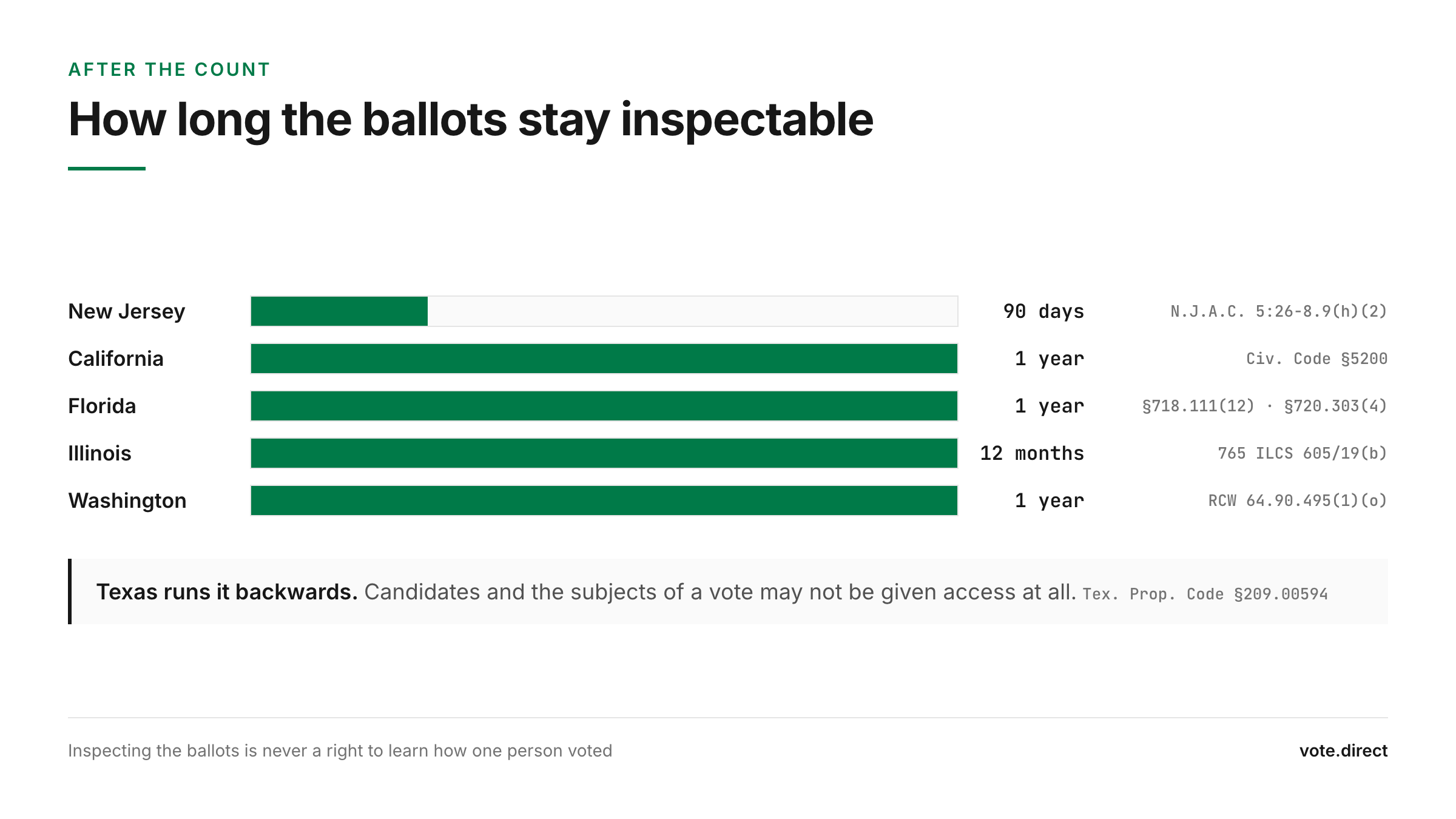
RCW 64.90.495(1)(o) requires an association to keep ballots, proxies, absentee ballots and other records related to voting by unit owners for one year after the election. Records are made available to unit owners and their authorized agents on 10 days' notice, longer for large requests.
Then Washington does something clean that most states leave to argument. RCW 64.90.495(3)(l) requires the association to redact, before disclosure, any information that would compromise the secrecy of a ballot cast under RCW 64.90.455(9). The right to inspect and the secrecy of the ballot are reconciled in the statute itself rather than in a courtroom. How other states handle the same tension is in who can see the ballots after an election.
What to Do Before January 1, 2028
Three things, in order.
- 1Determine which act governs you and write it down. Find the recording date of the declaration. Every other answer in this article follows from it, and half the boards we talk to are guessing.
- 2Run your next election to the WUCIOA standard even if you do not have to yet. Secret ballot, write-in space, nobody on the ballot touching the count, a retained electronic record. It costs nothing extra and it is the rule you will be under in 2028.
- 3Look at your governing documents against RCW 64.90. WUCIOA will supply defaults, but where your declaration or bylaws conflict on something the statute leaves to you, the documents still govern. Amendment thresholds are in how to amend bylaws and CC&Rs.
What It Costs
| Line item | Paper | Online |
|---|---|---|
| Meeting notice, 14 to 50 days out | Print and postage per unit | Included |
| Ballot with write-in space | Print and postage per unit | Included |
| Secret ballot handling | Double envelopes, a neutral counter | Built in |
| One year of ballot retention with redaction | A box, and someone to redact it | Exportable, secrecy preserved |
| Platform, 150-lot association | Not applicable | $19.99 |
| Platform, 400-lot association | Not applicable | $24.99 |
Elections up to 25 voters are free. Above that the flat rate starts at $4.99 per election and the whole ladder is published at pricing. Owners who need paper can be mailed a ballot from the same roster at $3.00 each. If nobody on the board wants to own the transition cycle, vote.direct can run it from $199 for a digital election of up to 100 voters, on about 10 days of lead time. Compliance itself, notice periods and document review included, stays with you and your attorney.
FAQ
Q: Does WUCIOA apply to my Washington HOA right now?
In full, only if your community was created on or after July 1, 2018 or has elected WUCIOA coverage. Since January 1, 2026 a defined subset of WUCIOA applies to preexisting communities as well, including the meetings section RCW 64.90.445. On January 1, 2028, chapters 64.32, 64.34 and 64.38 RCW are repealed and WUCIOA governs everyone, with narrow exceptions.
Q: Do we have to run a secret ballot in Washington?
Under WUCIOA, yes, for board elections, removal of board members or officers, and amendments to the governing documents (RCW 64.90.455(9)(a)). Preexisting communities are not yet covered by that section, because RCW 64.90.455 is not on the applicability list at RCW 64.90.365. Adopting it early is still the sensible call, since it becomes mandatory in 2028.
Q: Can incumbent board members count the ballots?
Not under WUCIOA. RCW 64.90.455(9)(c) bars incumbent board members and anyone on the ballot from possessing, accessing or participating in the opening or counting of the secret ballots. Use a neutral counter, whether that is a volunteer with no stake, a manager, or a platform.
Q: What is the quorum for a Washington HOA meeting?
Twenty percent under WUCIOA (RCW 64.90.450(1)), counting owners present in person, by proxy, remotely, or who have already voted by absentee ballot. Thirty-four percent for a preexisting homeowners association under RCW 64.38.040, unless the governing documents say otherwise. That is a large gap and it is worth knowing which one you are working against.
Q: Can a Washington association vote entirely by ballot, with no meeting?
Under WUCIOA, yes. RCW 64.90.455(4) allows a vote conducted by ballot, with a return window of at least 14 days from the notice (RCW 64.90.455(4)(b)(i)), and approval is valid only if the ballots cast meet the quorum that would have been required at a meeting (RCW 64.90.455(4)(f)). Chapter 64.38 has a comparable mechanism at RCW 64.38.120(6) for preexisting HOAs.
Q: What did SB 5129 change for elections specifically?
Its main election-adjacent effect is that RCW 64.90.445 now applies to all communities from January 1, 2026, which changes meeting notice, remote participation, the 15-minute owner comment period and verbal board votes. It did not pull RCW 64.90.455, the voting section, forward.
The Bottom Line
Washington gave every association a firm date to work toward and an awkward two years to get there. The meeting rules already changed. The voting rules have not, unless you were formed after mid-2018.
The useful response is not to wait. Find your recording date, then run your next election the way WUCIOA will require it in 2028: a secret ballot, a write-in space, a count nobody on the ballot touches, and a record you can still produce a year later.
That is a better election under any statute, and it means the 2028 transition is a filing change rather than a scramble. The state summary is at Washington HOA voting rules.
Sources: RCW 64.90.365 (applicability to preexisting common interest communities, recodified from RCW 64.90.080 by 2024 c 321 s 510); RCW 64.90.370; RCW 64.90.445(1)(c)-(f), (2)(e)-(f), (3)(c); RCW 64.90.450(1)-(2); RCW 64.90.455(2)(c), (3), (4)(b)(i), (4)(f), (4)(m), (9)(a), (9)(c); RCW 64.90.495(1)(o), (2)(a), (3)(l). RCW 64.38.040; RCW 64.38.120(3)-(6). RCW 64.34.340. RCW 24.06.110. Laws of 2024, ch. 321 (ESSB 5796). Laws of 2025, ch. 119 (SSB 5129).
Every rule on one page: Washington HOA voting rules, with quorum, notice, proxy and electronic voting at a glance.
This article is general information, not legal advice. We recommend you do your own research and confirm anything you plan to act on. Where this article states law, the section is cited so you can read the primary source yourself rather than take our word for it. That is what the citations are for. Election requirements also turn on your own governing documents, which we have not seen, and statutes are amended. For advice about your community, consult a qualified attorney licensed in your state.
We work hard to verify every citation against the primary source, but laws change and errors happen. If you spot an inaccuracy, email support@vote.direct and we will correct it. See our editorial standards for how these pages are researched and checked.