Quick Answer
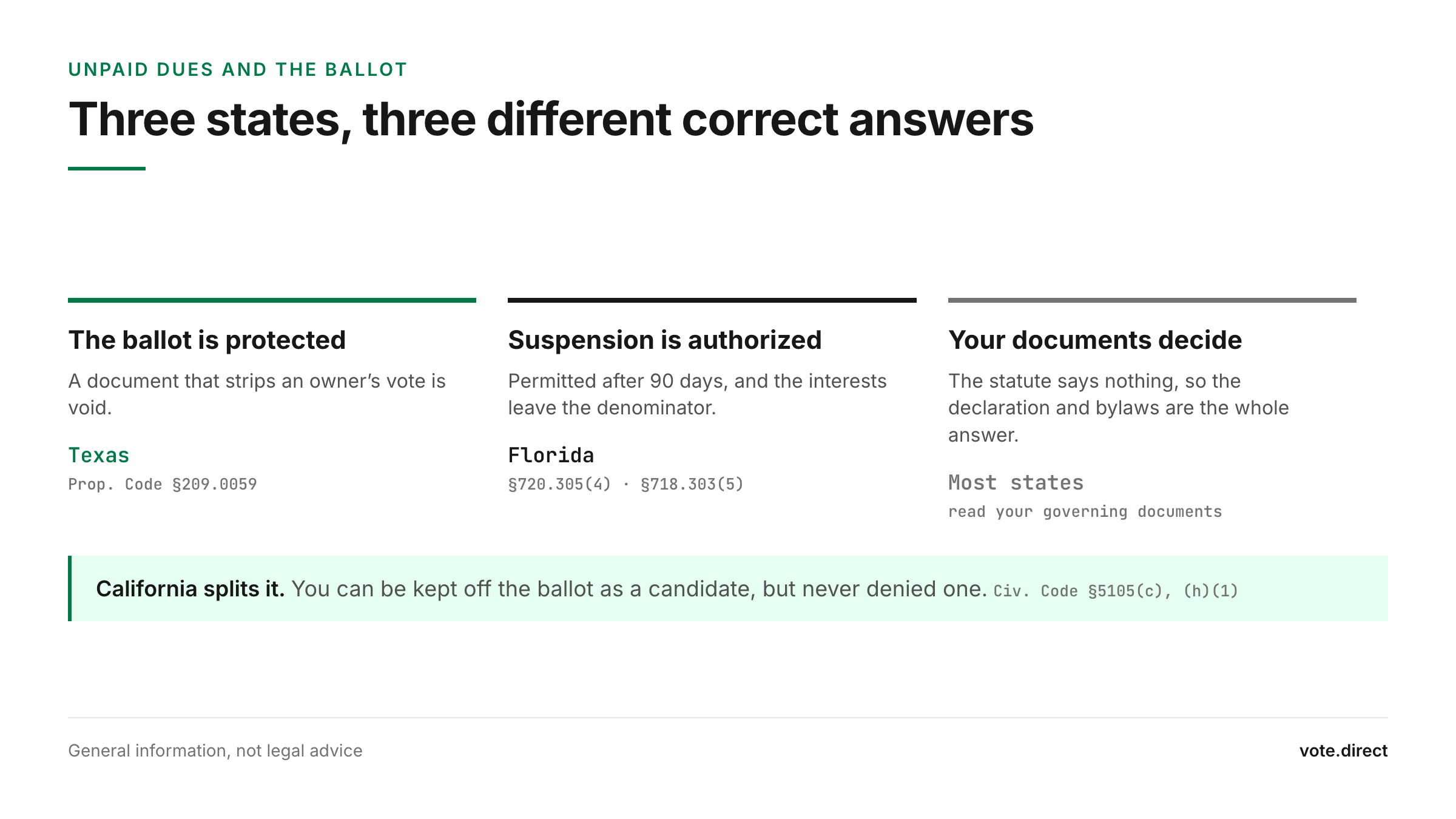
Whether unpaid dues can cost you your vote depends entirely on your state, and there are three different correct answers. A board that says "we can do this, it is standard" is usually right in Florida, wrong in Texas, and half right in California.
| Regime | What it means | Example |
|---|---|---|
| The ballot is protected | A governing-document provision that strips an owner's vote is void | Texas, Prop. Code §209.0059 |
| Suspension is authorized | Statute expressly permits it after a delinquency period | Florida, §720.305(4) for HOAs and §718.303(5) for condominiums |
| Running and voting are split | The association may bar you from the ballot as a candidate, but not from casting one | California, Civ. Code §5105(c) and §5105(h)(1) |
| Good standing is defined | Statute defines the status and ties it to voting, with a cure period | New Jersey, N.J.S.A. 45:22A-43 |
| The statute is silent | Your declaration and bylaws are the whole answer | Most states |
Before anything else, find out which bucket you are in, because the arguments that work in one are useless in another.
This is our reading of these statutes, offered to support your own review, and it is not legal advice. Your governing documents sit on top of state law and can be more protective than it is. Have your association's attorney, or your own, confirm before the board suspends anyone or before you challenge a suspension.
The States That Protect the Ballot
Texas is the clearest. Property Code §209.0059 provides that a provision in a dedicatory instrument that would disqualify a property owner from voting in a property owners' association election of board members, or on any matter concerning the rights or responsibilities of the owner, is void.
Not unenforceable in this instance. Void. It does not matter that it is in the CC&Rs, it does not matter that owners voted for it, and it does not matter how far behind the owner is. The association has liens, late fees, and eventually foreclosure available to it, and those are the collection tools Texas intends it to use. Two narrow carve-outs exist: the section does not apply to a property owners' association subject to Chapter 552 of the Government Code through Gov. Code §552.0036, and in a residential development of 10 or fewer lots whose declaration was recorded before January 1, 2015, a person may not vote unless subject to a dedicatory instrument through which the association exercises its authority. The full Texas picture is in Texas HOA election rules.
California protects the ballot too, in a specific way. Civil Code §5105(h)(1) requires an association's election rules to prohibit the denial of a ballot to a member for any reason other than not being a member at the time when ballots are distributed. Owning on the distribution date is the only qualification the rules may impose. The rules must also prohibit denying a ballot to a person with general power of attorney for a member, and must count that ballot if it is returned on time.
Illinois condominiums keep the vote and adjust the quorum instead. Under 765 ILCS 605/18(b)(1), a unit owner 60 days or more in arrears on regular or separate assessments is not counted for the purpose of determining whether a quorum is present, but that owner retains the right to vote on amendments to the bylaws. The delinquency changes the denominator, not the voice. Details are in Illinois condo and HOA election rules.
The States That Authorize Suspension
Florida is the model, and it is the reason so many boards elsewhere believe suspension is normal. Read the two chapters side by side, because they do not say the same thing.
| Florida HOA, Ch. 720 | Florida condominium, Ch. 718 | |
|---|---|---|
| Statute | §720.305(4) | §718.303(5) |
| Trigger | Any fee, fine, or other monetary obligation more than 90 days delinquent | A monetary obligation more than $1,000 and more than 90 days delinquent |
| Dollar floor | None | More than $1,000 |
| Notice | Board action | Proof of the obligation provided to the owner 30 days before suspension |
| Effect on the denominator | Suspended voting interests are subtracted from the total | Suspended voting interests are subtracted from the total |
| Ends | On payment in full | On payment in full |
The dollar floor is the part boards get wrong. A Florida condominium owner who is 120 days behind on $600 has not met the §718.303(5) threshold and their vote cannot be suspended. The same arrears in a Chapter 720 HOA down the road can be. Same state, same delinquency, different answer.
Florida keeps use rights on a separate track. Under §720.305(3) and §718.303(4), an association may suspend the right to use common areas or common elements once an owner is more than 90 days delinquent, and those suspensions do not require the notice and hearing that a fine requires under §720.305(2). Suspending amenities and suspending the vote are two different decisions with two different tests. The rest of Florida's election law is in Florida HOA election law.
The Good Standing States
New Jersey took a third path: it defined the status in statute and then limited what the status can be used for.
Under N.J.S.A. 45:22A-43, "good standing" applies "solely with respect to eligibility to" do three things: vote in executive board elections, vote to amend the bylaws, and nominate or run for the board. A member in good standing is current on common expenses, late fees, interest on unpaid assessments, legal fees and other charges lawfully assessed, and has not failed to satisfy a judgment for those amounts.
So in New Jersey, arrears can cost you the ballot. But the regulations attach a cure right that most states do not have. Under N.J.A.C. 5:26-8.9(l)(1)(v), an association of 50 or more units must notify a member who is not in good standing at least 30 days before the election, state the reason, and allow that member to fix it up to five business days before election day. A New Jersey owner who is told on the night of the meeting that they cannot vote was entitled to a month's warning and a chance to pay. The full sequence is in the Radburn rules.
The phrase "solely with respect to" is worth borrowing even if you are not in New Jersey. Good standing is not a general-purpose lever. If your documents define it, check whether they define what it may be used for.
Running Versus Voting: California's Split
This is the distinction that surprises people, and it is the practical answer for a large share of the country because so many associations copied California-style election rules.
You can be barred from running. Civil Code §5105(c)(1) lets an association, through its bylaws or election operating rules, disqualify a nominee for not being current in the payment of regular and special assessments. If it imposes that on nominees, §5105(f) requires it to impose the same on sitting directors.
But only for the right money. Section 5105(d) is explicit: an association may disqualify a person for nonpayment of regular and special assessments, but not for nonpayment of fines, fines renamed as assessments, collection charges, late charges, or costs levied by a third party. Padding an assessment ledger with collection costs to push a challenger over the line does not work.
And not if the money is in dispute or on a plan. Under §5105(d)(1) and (d)(2), the disqualification does not apply where the person paid the assessment under protest under §5658, or is complying with a payment plan approved under §5665.
And not without an offer of dispute resolution first. Section 5105(e) prohibits disqualifying a person who has not been given the opportunity to engage in internal dispute resolution under §5900 et seq. In practice this means the association must tell the person they are disqualified, say why, and invite them to IDR. Doing it silently is itself a violation.
And never the ballot. Section 5105(h)(1) still stands over all of it. Whatever the association decides about candidacy, it may not deny a member a ballot for anything other than not being a member when ballots were distributed.
So the California answer to "can they take my vote for unpaid dues" is no, and the answer to "can they keep me off the ballot as a candidate" is yes, within tight limits. The full walk-through of those sections is in Civil Code 5100 to 5145.
The Quorum Arithmetic Nobody Expects
Here is a piece of Florida practice that runs against intuition. Suspending a delinquent owner's vote can make quorum easier to reach, not harder, because the statute removes those interests from the denominator.
Take a 200-unit Florida HOA with a 30 percent quorum requirement.
| No suspensions | 20 owners suspended | |
|---|---|---|
| Total voting interests | 200 | 180 |
| Quorum at 30 percent | 60 | 54 |
| Owners who must participate | 60 | 54 |
Both §720.305(4) and §718.303(5) provide that suspended voting interests are subtracted from the total number of voting interests, which is then reduced by that number when calculating the total percentage or number of all voting interests available to take or approve any action.
Two cautions before anyone treats this as a turnout strategy. First, it only works if the suspensions were lawful, properly noticed, and properly recorded, and a wrongly suspended owner is a clean election challenge. Second, suspending twenty neighbours to lower a threshold is the kind of decision that produces the recall petition you were trying to avoid. Better ways to move the number are in how to reach quorum, and the calculator is at quorum calculator.
Illinois shows the same idea without the suspension: under 765 ILCS 605/18(b)(1) the delinquent owner comes out of the quorum count and keeps the vote.
Honest question
Would you trust an online vote to decide your community's annual budget?
Before a Board Suspends Anyone
Six questions, in order. If you cannot answer all six, do not suspend.
- 1Does our state authorize it at all? In Texas the answer is no, whatever the CC&Rs say.
- 2Does the delinquency meet the statutory test? Ninety days in Florida, plus more than $1,000 for a condominium.
- 3What kind of money is it? Assessments, fines, late charges and collection costs are not interchangeable, and California treats them very differently for candidacy.
- 4Did the owner get the notice the statute requires? Thirty days of proof in a Florida condominium. Thirty days plus a cure window in a 50-plus New Jersey community.
- 5Did the board actually vote, at a meeting, with the decision recorded? A suspension nobody minuted is a suspension nobody can prove.
- 6Have we recalculated quorum and every approval threshold? If your statute subtracts suspended interests, your old denominator is now wrong on every count for the rest of the election.
Getting this wrong is one of the cleanest ways to end up personally in a complaint, which is covered in can board members be sued over an election.
If Your Vote Was Refused
Do this in writing, and keep it short and factual.
- Ask for the specific provision relied on: the statute, and the section of the declaration, bylaws or election rules.
- Ask for the amount and the category. Assessment, fine, late charge or collection cost, and the date each became due.
- Ask when the board voted to suspend and ask for the minutes of that meeting.
- Ask what you must pay, and by when, to have the right restored before this election closes.
- If you are in California, say that Civil Code §5105(h)(1) prohibits denying a ballot to a member for any reason other than not being a member on the distribution date, and ask which subsection they rely on instead.
- If you are in Texas, cite §209.0059 and ask them to identify the exception they believe applies.
- If you are in a 50-plus New Jersey community, ask for the good-standing notice that N.J.A.C. 5:26-8.9(l)(1)(v) required 30 days before the election.
Most of these end there, because in a lot of cases the board is applying a rule it copied from another state's template. If it does not end there, what to do when an election is disputed covers the escalation path, and California adds a specific statutory remedy under Civil Code §5145.
How the Roster Should Handle This
Whatever your state permits, the operational problem is the same: the list of who may vote has to be correct on the day ballots go out, and it has to be defensible afterwards.
That means the eligibility decision belongs on the roster, made once, with a reason attached, rather than being argued at the ballot box. On vote.direct the roster is the record of who was entitled to vote and why, the quorum and approval thresholds recalculate against the eligible set rather than a stale total, and the audit package shows the state of the roster when voting opened. If a suspension is later reversed, you can see exactly what it changed. The wider record question is in voting software audit trails.
A 200-owner association is $19.99 for the election. Elections up to 25 voters are free. Above that the flat rate starts at $4.99 per election and the whole ladder is published at pricing.
FAQ
Q: Can my HOA stop me voting because I owe dues?
It depends on the state. In Texas a dedicatory-instrument provision that disqualifies an owner from voting is void (Prop. Code §209.0059). In California an association's rules must prohibit denying a ballot to a member for any reason other than not being a member when ballots were distributed (Civ. Code §5105(h)(1)). In Florida the association may suspend voting rights once you are more than 90 days delinquent, and for a condominium the obligation must also exceed $1,000 (§720.305(4); §718.303(5)). Everywhere else, read your governing documents first.
Q: Can they stop me from running for the board?
More often than they can stop you voting. California expressly allows disqualification of a nominee who is not current on regular and special assessments (Civ. Code §5105(c)(1)), but not for fines, fines renamed as assessments, collection charges, late charges or third-party costs (§5105(d)), not if you paid under protest or are on an approved payment plan, and not without an offer of internal dispute resolution first (§5105(e)).
Q: Does a suspended owner still count toward quorum?
In Florida, no. Both §720.305(4) and §718.303(5) subtract suspended voting interests from the total number of voting interests, which lowers the number needed for quorum and for any approval threshold. In Illinois a condominium owner 60 days or more in arrears is not counted toward quorum but keeps the right to vote on bylaw amendments (765 ILCS 605/18(b)(1)).
Q: How much notice does the association have to give before suspending a vote?
It varies. A Florida condominium must provide proof of the obligation to the owner 30 days before the suspension takes effect (§718.303(5)). A New Jersey community of 50 or more units must notify a member who is not in good standing at least 30 days before the election, with the reason, and allow a cure up to five business days before election day (N.J.A.C. 5:26-8.9(l)(1)(v)). Many states require nothing specific, which is where your bylaws matter.
Q: Can an association suspend my right to use the pool for unpaid dues?
In Florida, yes, once you are more than 90 days delinquent, under §720.305(3) for HOAs and §718.303(4) for condominiums, and that kind of suspension does not carry the notice and hearing requirement that a fine does. Suspending amenities and suspending the vote are separate decisions under separate tests.
Q: What if I am disputing the charge?
Say so in writing, immediately, and keep paying anything you do not dispute. California builds this in: a person who paid under protest under Civ. Code §5658, or who is complying with a payment plan under §5665, may not be disqualified from candidacy on that basis. Elsewhere, a documented dispute in the file before the election is far more useful than an argument raised after it.
The Bottom Line
The instinct behind suspending a delinquent owner's vote is understandable. The people who pay feel like the people who do not should not get to decide how the money is spent.
State legislatures have mostly not agreed, and the ones that did attach conditions: a waiting period, a dollar floor, a notice, a cure window. Texas went further and voided the idea outright, on the theory that an association already has liens and foreclosure and does not need the ballot as a collection tool.
So the practical rule for a board is narrow. Find your statute. Meet its test exactly, including the dollar amount and the notice. Record the decision. Recalculate quorum. And if your state is silent, understand that you are relying on your own documents alone, which is the weakest position of the three when an owner challenges the result.
For an owner: ask in writing which provision they are relying on. That question resolves most of these.
Sources: Texas Property Code §209.0059; Texas Government Code §552.0036. California Civil Code §5105(c), (d), (e), (f), (h); §5145; §5658; §5665; §5900 et seq. Florida Statutes §720.305(2), (3), (4); §718.303(4), (5). Illinois Condominium Property Act, 765 ILCS 605/18(b)(1). New Jersey N.J.S.A. 45:22A-43; N.J.A.C. 5:26-8.9(l)(1)(v).
This article is general information, not legal advice. We recommend you do your own research and confirm anything you plan to act on. Where this article states law, the section is cited so you can read the primary source yourself rather than take our word for it. That is what the citations are for. Election requirements also turn on your own governing documents, which we have not seen, and statutes are amended. For advice about your community, consult a qualified attorney licensed in your state.
We work hard to verify every citation against the primary source, but laws change and errors happen. If you spot an inaccuracy, email support@vote.direct and we will correct it. See our editorial standards for how these pages are researched and checked.