Quick Answer
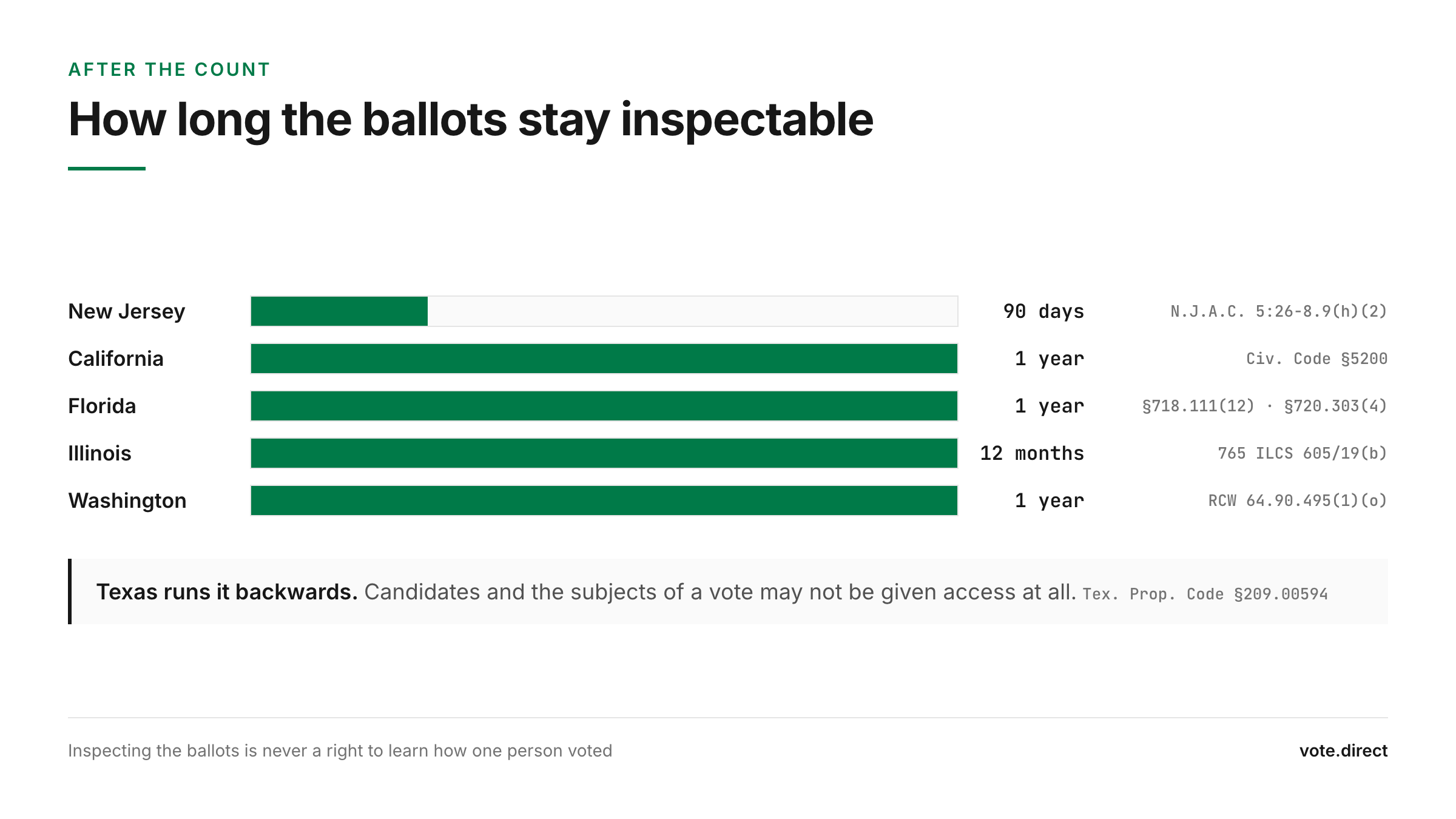
In most states the ballots become association records the moment the count ends, with a retention clock and an inspection right attached, and one year is the usual floor. What almost nobody explains is that the right to inspect the ballots is not a right to learn how any individual voted. Those are separate questions, and every state that answers the first one carefully also answers the second one no.
| State | How long ballots are kept | Who may inspect | Citation |
|---|---|---|---|
| California | One year after the date of the election | Members, as "association election materials"; signed voter envelopes may be inspected but not copied | Civ. Code §5200; §5125 |
| Florida condominium | One year from the date of the election, vote or meeting | Unit owners, as official records | Fla. Stat. §718.111(12)(a)12. |
| Florida HOA | At least one year after the date of the election, vote or meeting | Parcel owners, as official records | Fla. Stat. §720.303(4)(l) |
| Illinois condominium | Effectively 12 months | Unit owners may inspect, examine and copy ballots and related proxies for matters voted on in the preceding 12 months | 765 ILCS 605/19(b) |
| Washington | One year after the election | Unit owners, on 10 days' notice, with secrecy-compromising information redacted | RCW 64.90.495(1)(o), (2)(a), (3)(l) |
| New Jersey | Open to inspection for 90 days | Any member of the association | N.J.A.C. 5:26-8.9(h)(2) |
| Texas | Records policy governs retention | Access is restricted: candidates and the subjects of a vote may not be given access at all | Tex. Prop. Code §209.00594 |
Texas is the outlier and it is worth knowing why: it treats ballot access as a risk to be contained rather than a right to be granted.
This is our reading of these statutes, offered to support your own review, and it is not legal advice. Retention and inspection rules also come from your governing documents and your corporate records policy. Confirm with your association's attorney before you refuse a request or destroy a record.
The Custody Chain, and Why It Exists
California wrote the clearest version of something every association should have, whether or not the statute requires it.
Under Civil Code §5125, the sealed ballots, signed voter envelopes, voter list, proxies, candidate registration list and the tally sheet of votes cast by electronic secret ballot stay in the custody of the inspector or inspectors of elections, or at a location the inspector designates, until after the tabulation and until the time allowed by §5145 for challenging the election has expired. Only then does custody transfer to the association.
Read that sequence again, because it is the whole point. The people who might be accused of tampering do not hold the evidence during the window in which they could be accused. The board gets the box back after the argument window closes, not before.
Section 5125 then adds the exception that makes the arrangement useful: if there is a recount or another challenge to the election process, the inspector must, on written request, make the ballots and the tally sheet available for inspection and review by a member or the member's authorized representative. So during the period when it matters most, a neutral party holds the ballots and shows them to anyone with standing to ask.
The challenge window itself is a year. Civil Code §5145 lets a member bring a civil action within one year of the date the inspector notifies the board and membership of the results, or the date the cause of action accrues, whichever is later. A court shall void the results where election procedures were not followed, unless the association shows the noncompliance did not affect the outcome, and a prevailing member is entitled to reasonable attorney's fees with a civil penalty of up to $500 per violation available. That is why California ties retention to one year and not to a shorter, more convenient number. The section-by-section walk-through is in Civil Code 5100 to 5145.
Even where your state names no inspector, the pattern transfers: somebody who is not on the ballot should hold the ballots until the challenge window closes. Who that can be is in the inspector of elections guide.
What "Secret" Actually Protects
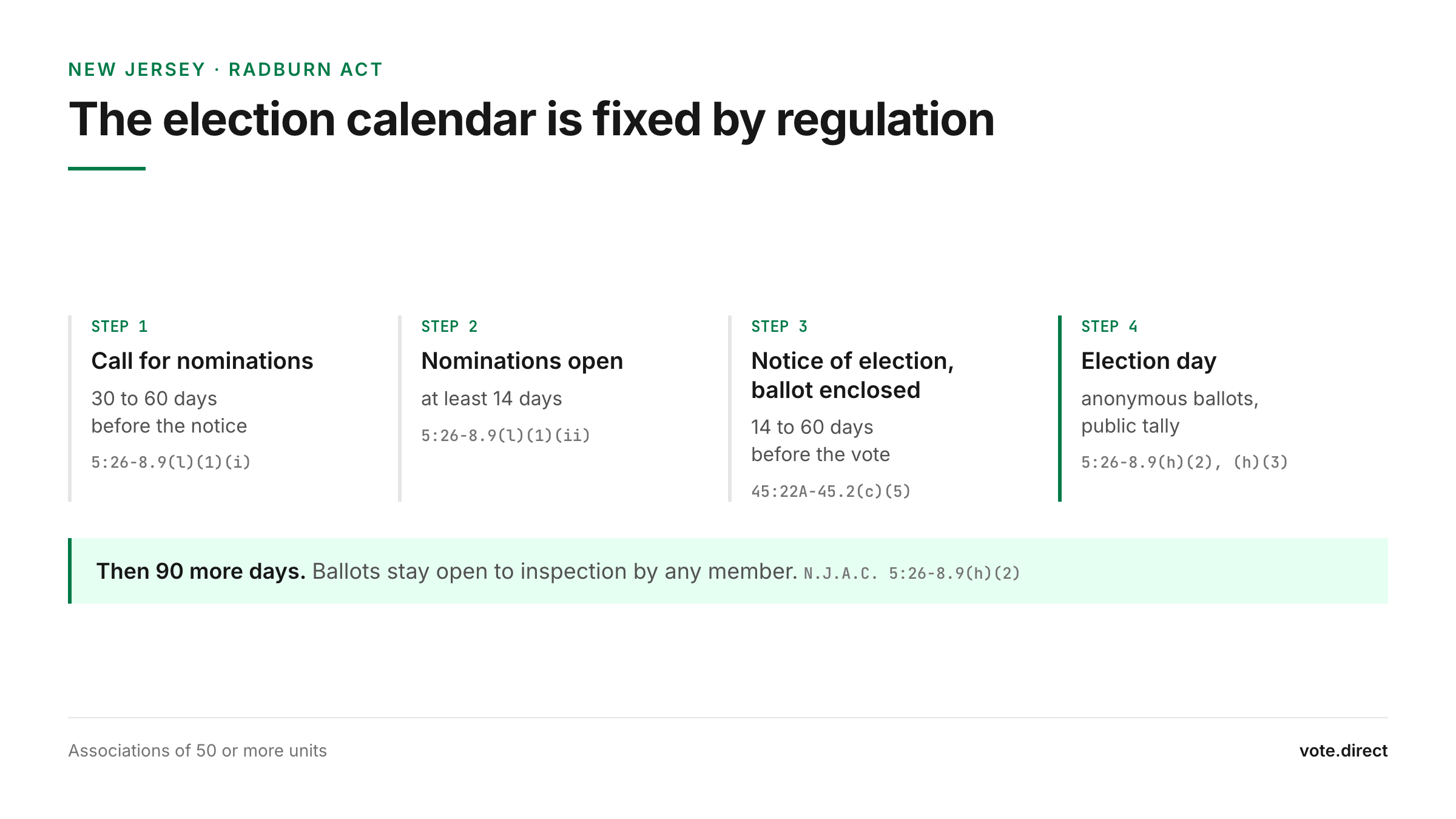
Here is the tension that confuses people. New Jersey requires that all ballots be cast in an anonymous manner, and in the same regulation requires that tallying occur publicly with the ballots open to inspection by any member for 90 days after the election (N.J.A.C. 5:26-8.9(h)(2), (h)(3)). When the Appellate Division reviewed those provisions on February 23, 2024 it upheld them, observing that privacy could be addressed with a double envelope system.
That is the mechanism, and it resolves the apparent contradiction:
- 1The voter marks the ballot and seals it in a blank inner envelope.
- 2The inner envelope goes inside an outer envelope the voter signs.
- 3Eligibility is checked on the outside, and the signature is recorded against the roster.
- 4The outer envelope is separated and set aside before any inner envelope is opened.
- 5What gets counted, and what a member later inspects, is a pile of ballots that cannot be attributed to anyone.
So the inspection right is real and the secrecy is real, because they apply to different objects. You may look at the votes. You may look at the list of who returned a ballot. You may not connect the two.
Washington states this outright rather than leaving it to practice. RCW 64.90.495(1)(o) requires ballots, proxies, absentee ballots and other voting records to be kept for one year after the election, subsection (2)(a) makes records available to unit owners on 10 days' notice, and subsection (3)(l) requires the association to redact, before disclosure, any information that would compromise the secrecy of a ballot cast under RCW 64.90.455(9). The statute reconciles the two rights itself. The full Washington picture is in Washington HOA and condo elections.
California does the same in a smaller way: signed voter envelopes are inspectable but may not be copied.
Texas Runs It Backwards
Most states start from "these are records, members may see them" and carve out secrecy. Texas starts from "these are dangerous, restrict access" and carves out the people who need it.
Property Code §209.00594 provides that a candidate in a property owners' association election, a person who is the subject of an association vote, and their relatives within the third degree of consanguinity or affinity may not tabulate or otherwise be given access to the ballots cast, except as provided in the section. Persons other than those may tabulate. Only an authorized tabulator, or a person conducting a recount under §209.0057(c), may be given access to the ballots. A tabulator or recount conductor may not disclose to any other person how an individual voted. Compliance with a court order requiring release is preserved.
The effect is that a Texas homeowner who wants to "see the ballots" generally cannot, and neither can the board president whose seat was on them. The route is a recount: under §209.0057 a demand must be made within 15 days of the election or of the announcement of results, and the association must provide an invoice estimating the recount costs within 20 days of receiving the request.
Texas adds one more wrinkle that sits awkwardly beside all of this. Under §209.0058, a vote cast in a property owners' association election must be in writing and signed by the member, though written and signed ballots are not required for uncontested races, and an association may adopt rules allowing voting by secret ballot with measures ensuring a member cannot cast more votes than they are eligible to cast and that every eligible vote is counted. A signed ballot is not a secret ballot, which is exactly why the access restriction in §209.00594 has to be as strict as it is. More in Texas HOA election rules.
What Counts as an Election Record
California's definition is the most complete and is a good checklist for any association. "Association election materials" under Civil Code §5200 means the returned ballots, the signed voter envelopes, the voter list of names and parcel numbers and the voters to whom ballots were to be sent, the proxies, the candidate registration list, and the tally sheet of votes cast by electronic secret ballot.
Notice what is on that list besides the ballots. The voter list is a record. The candidate registration list is a record. The tally sheet is a record. A member who suspects the roster was wrong does not need the ballots at all, they need the list, and in California they are entitled to it. Florida's official-records provisions are similarly broad, covering ballots, sign-in sheets, voting proxies and all other papers and electronic records relating to voting.
If you are running the election on a platform, the equivalent question is whether it can produce those artifacts a year later as records, rather than as a screen that has since changed. That is what voting software audit trails are for.
This one gets heated
Should community boards be required to use independent election administrators?
How to Make the Request
Keep it short, in writing, and specific. Vague requests get vague refusals.
- Name the election: the date, and what was voted on.
- Ask for the records by category, using your state's words. In California, "association election materials" as defined in Civil Code §5200. In Florida, the official records under §718.111(12) or §720.303(4). In Illinois, ballots and related proxies under 765 ILCS 605/19(b). In Washington, records under RCW 64.90.495.
- Say you are not asking for anything that would identify how any individual voted, and that you expect the association to redact accordingly. This removes the most common reason a request is refused outright and, in Washington, matches what the statute already requires.
- Ask for the inspector's tally sheet and the voter list, not only the ballots. Most disputes are about eligibility, not marking.
- Give a date. Illinois requires a written request; Washington gives the association 10 days' notice, more for large requests.
- If you intend to demand a recount, check the clock first. Texas gives you 15 days.
If it goes nowhere, what to do when an election is disputed covers the escalation. Refusing is not costless: Florida makes willfully and knowingly refusing to release association records, with the intent to avoid detection or punishment for a crime, a third-degree felony, and knowingly defacing or destroying required accounting records with intent to harm the association or its members a first-degree misdemeanor.
What a Digital Record Should Be Able to Show
Moving online does not remove any of this. It changes what "produce the ballots" means, and it is worth being precise about what a platform can and cannot honestly offer.
It should show, a year later: who was on the roster when voting opened, who was sent a ballot, who returned one, when each ballot arrived, the tally, and any change to the roster after voting opened. That set answers eligibility disputes, which is most of them.
It should be able to prove it was not altered afterwards. On vote.direct every election writes to an append-only audit log, and the result certificate and the audit package are produced from it rather than typed up later. There is a public verification page for checking a published result against that record.
Whether it can show how a person voted depends on a choice you make before the election, not after. An identified election records the link between voter and ballot, and a per-voter report is available to the organizer. An anonymous election does not record it. A sealed election separates the ballot from the voter permanently at close, which means nobody, including us, can reconstruct it later. That is a feature when your state requires a secret ballot and a liability when your documents require a roll-call vote, so choose deliberately. The trade-offs are in secret ballot requirements by state and voter privacy in online elections.
The honest summary: a good digital record makes eligibility and integrity easy to inspect, and makes vote attribution impossible unless you deliberately chose an identified election.
What This Costs
| Line item | Paper | Online |
|---|---|---|
| Storing a year of ballots and envelopes | A box, and somewhere secure to keep it | Retained record |
| Producing them for an inspection request | Someone's afternoon, plus copying | Export |
| Redacting anything that breaks secrecy | Manual, and easy to get wrong | Structural |
| Proving the record was not altered | Custody log, if anyone kept one | Append-only audit log |
| Platform, 200-owner association | Not applicable | $19.99 |
Elections up to 25 voters are free. Above that the flat rate starts at $4.99 per election and the whole ladder is published at pricing. The comparison against a fully paper cycle is in paper versus digital election cost.
FAQ
Q: Can I find out how my neighbour voted in the HOA election?
No, in any state that requires a secret ballot, and that is the intent of every statute above. You may generally inspect the ballots and the record of who returned one, but the two are deliberately separated. Washington goes further and requires the association to redact any information that would compromise ballot secrecy before disclosing records (RCW 64.90.495(3)(l)).
Q: How long does an HOA have to keep the ballots?
One year is the common answer. California requires association election materials to be maintained for one year after the date of the election (Civ. Code §5200). Florida requires one year from the date of the election, vote or meeting for both condominiums (§718.111(12)(a)12.) and HOAs (§720.303(4)(l)). Washington requires one year after the election (RCW 64.90.495(1)(o)). Illinois gives owners inspection rights covering the preceding 12 months (765 ILCS 605/19(b)). New Jersey's inspection window is shorter, at 90 days (N.J.A.C. 5:26-8.9(h)(2)).
Q: Who holds the ballots between the count and the challenge deadline?
In California, the inspector of elections, or a location the inspector designates, until tabulation is complete and the §5145 challenge period has expired, at which point custody transfers to the association (Civ. Code §5125). Elsewhere the statute is often silent, and the safe practice is the same: someone who is not on the ballot.
Q: Can I demand a recount?
It depends on the state and the clock. Texas allows a demand within 15 days of the election or the announcement of results, and the association must provide an estimated cost invoice within 20 days of the request (Tex. Prop. Code §209.0057). California does not set a separate recount statute but gives members a civil action within one year under Civ. Code §5145, and §5125 requires the inspector to make the ballots and tally sheet available on written request where there is a recount or challenge.
Q: Can a board member count the ballots in their own election?
In several states, no. Washington bars incumbent board members and every candidate from possessing, accessing or participating in the opening or counting of secret ballots (RCW 64.90.455(9)(c)). Texas bars candidates, subjects of a vote and close relatives from tabulating or being given access (§209.00594). Illinois takes the opposite approach for observation, giving a candidate or the candidate's representative the right to be present at the counting (765 ILCS 605/18(a)(17)).
Q: What if the association refuses to produce the records?
Put the request in writing with the statutory citation, give a deadline, and keep the correspondence. Florida attaches real consequences: willfully and knowingly refusing to release association records with the intent to avoid detection or punishment for a crime is a third-degree felony, and knowingly destroying required accounting records with intent to harm the association or its members is a first-degree misdemeanor. In California a member may bring an action under Civ. Code §5145 with attorney's fees available to a prevailing member. Talk to your own attorney before assuming which route fits.
The Bottom Line
The ballots are not the board's private property and they are not a secret in the way people assume. In most states they are records with a clock on them, and the clock is usually one year.
What the law protects is the link between a person and a vote, not the ballots themselves. Once you see that, the apparently contradictory rules line up: New Jersey can require anonymous ballots and a public count, Washington can grant inspection and mandate redaction, and California can let a member look at a signed voter envelope but not copy it.
For a board, the practical steps are small. Keep everything for a year. Let someone who is not on the ballot hold it until the challenge window closes. Produce it when asked, with the identifying half redacted. And decide before the election whether it is identified, anonymous or sealed, because that is the one decision you cannot revisit afterwards.
Sources: California Civil Code §5125; §5145; §5200. Florida Statutes §718.111(12)(a)12.; §720.303(4)(l). Illinois Condominium Property Act, 765 ILCS 605/18(a)(17); 605/19(b). Washington RCW 64.90.455(9)(c); RCW 64.90.495(1)(o), (2)(a), (3)(l). Texas Property Code §209.0057; §209.0058; §209.00594. N.J.A.C. 5:26-8.9(h)(2), (h)(3). In the Matter of the Challenge of the Community Associations Institute New Jersey Chapter, Inc., N.J. Super. Ct. App. Div., decided February 23, 2024 (unpublished).
This article is general information, not legal advice. We recommend you do your own research and confirm anything you plan to act on. Where this article states law, the section is cited so you can read the primary source yourself rather than take our word for it. That is what the citations are for. Election requirements also turn on your own governing documents, which we have not seen, and statutes are amended. For advice about your community, consult a qualified attorney licensed in your state.
We work hard to verify every citation against the primary source, but laws change and errors happen. If you spot an inaccuracy, email support@vote.direct and we will correct it. See our editorial standards for how these pages are researched and checked.